
Twilio charges $0.0085 a minute to receive a US call on a local number, $0.0220 on toll-free and $0.0140 to call US and Canada numbers. An AI agent adds Media Streams at $0.0044 a minute. Dograh, the open-source AI voice agent platform we build, runs on your Twilio account. You can self-host it or run it on Dograh Cloud.
Key Takeaways
- A 5-minute AI call on Twilio costs $0.0645 inbound and $0.0920 outbound.
- Twilio rounds every call leg up to the next full minute.
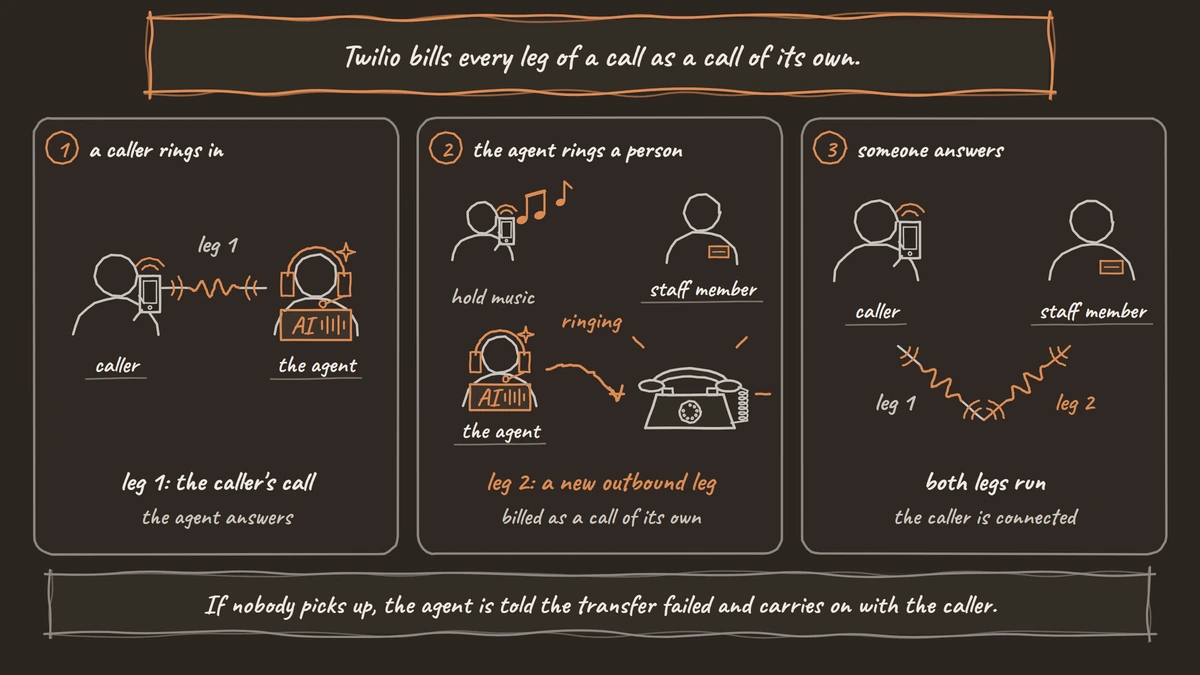
- A transfer to a person adds a second, outbound leg.
This post is part of our guide to Twilio pricing, which prices the number, minutes, media stream and add-ons of one AI call. Here we go deeper on minutes: one inbound and one outbound call, the rounding and leg rules, then the same minutes with Dograh as the agent.
Twilio's US per-minute rates
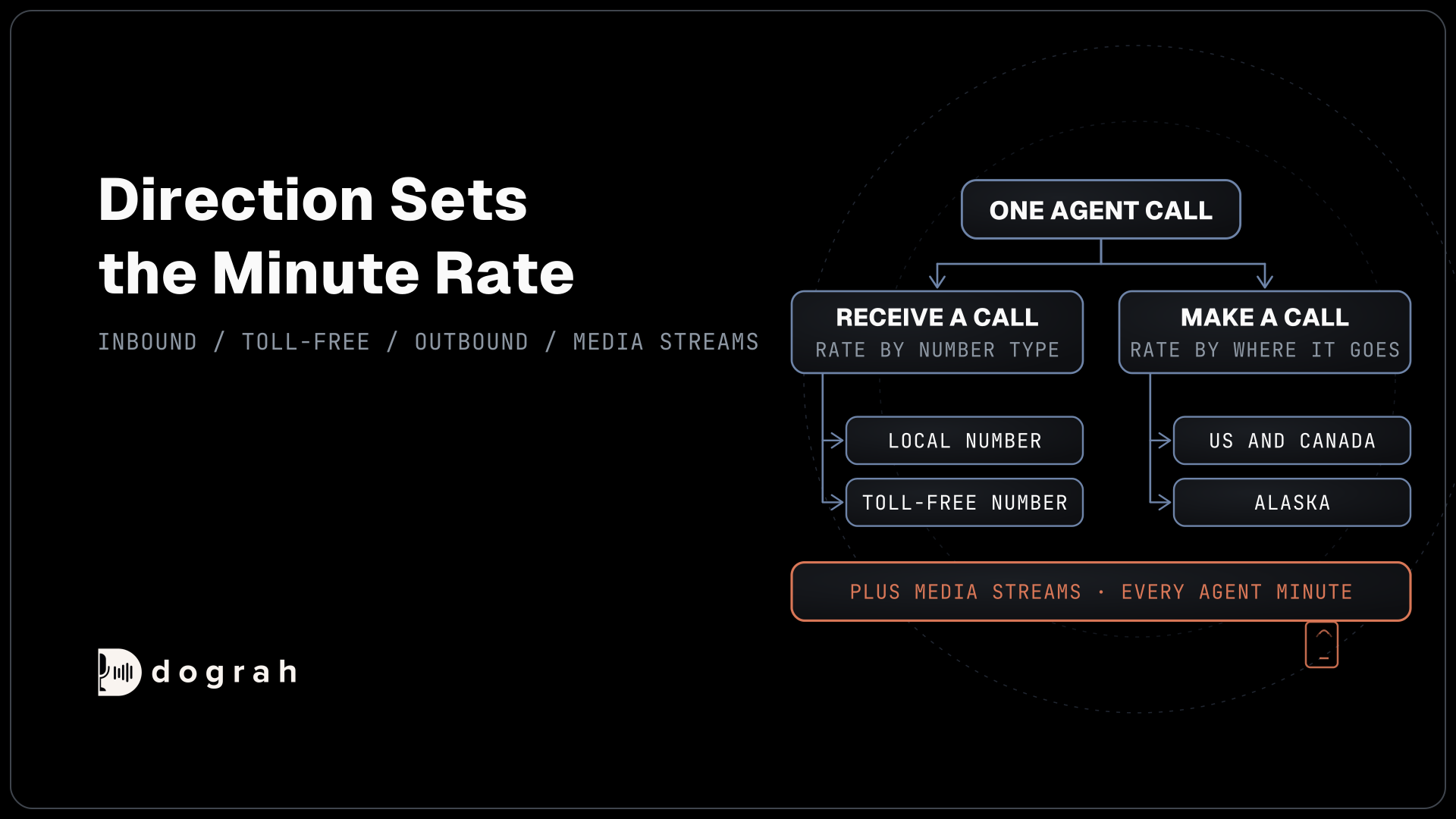
Twilio sets one rate for receiving a call and another for making one, and the number type changes the inbound rate. Every figure below is a Twilio US voice rate.
| What happens | Rate per minute |
|---|---|
| Receive a call on a local number | $0.0085 |
| Receive a call on a toll-free number | $0.0220 |
| Make a call to US and Canada numbers, toll-free and Hawaii included | $0.0140 |
| Make a call to Alaska | $0.0945 |
| Media Streams, sending the call audio to your agent | $0.0044 |
| Calls over the SIP interface or your own trunk (BYOC) | $0.0040 |
Most per-minute summaries stop at the first three rows. An AI agent also needs the call's audio on its own server, and Twilio's Media Streams charges $0.0044 a minute for that, in both directions. So the real per-minute figure for an agent call is the direction rate plus the stream rate.
A 5-minute inbound call, worked through
Here is one worked example. A customer calls a business's local Twilio number and talks to its AI agent for exactly 5 minutes.
| Line | Working | Cost |
|---|---|---|
| Inbound minutes, local number | 5 x $0.0085 | $0.0425 |
| Media Streams | 5 x $0.0044 | $0.0220 |
| Twilio total | $0.0645 |
The stream is about a third of the Twilio total on this call, which is why leaving it out makes a budget look too low. Move the same call to a toll-free number and the inbound line becomes 5 x $0.0220, or $0.1100. With the stream, the toll-free call costs $0.1320, about twice the local one. Callers pay nothing to reach a toll-free number, so the business carries that difference.
A 5-minute outbound call, worked through
The second example is the agent calling out. It rings a customer's US mobile number, and the conversation runs for 5 minutes.
| Line | Working | Cost |
|---|---|---|
| Outbound minutes, US and Canada | 5 x $0.0140 | $0.0700 |
| Media Streams | 5 x $0.0044 | $0.0220 |
| Twilio total | $0.0920 |
Outbound costs the same whether the call leaves from a local or a toll-free number, because Twilio prices it by where the call goes. Alaska is the exception that can surprise a campaign. The same 5 minutes to an Alaska number cost 5 x $0.0945, or $0.4725, plus the $0.0220 stream, so $0.4945 for one call.

Open Source Alternative to Vapi / Retell
Self-hosted voice agent platform — no per-minute fees
dograh-hq/dograh
Star on GitHub
Rounding, call legs and calls that never connect
Three billing rules change the count more than the rates do, and rounding comes first. Twilio rounds each call up to the next full minute, so a call that lasts 4 minutes 10 seconds bills as 5 minutes. Twilio's guide to billed minutes asks you to round your call-log durations up the same way when you check a bill.
Twilio bills every leg of a call as a call of its own. When an agent hands a caller to a person with Transfer Call, that person's phone is rung as a new outbound leg at $0.0140 a minute. Dograh dials the destination while the caller hears hold music and connects the two once someone answers. If nobody picks up, the agent is told the transfer failed and carries on with the caller. The join itself runs through a Twilio conference, which starts at $0.0018 per participant per minute.
Twilio doesn't bill attempts that fail or get a busy signal. That matters for outbound campaigns, where many attempts never connect. Count connected calls when you budget a campaign, not dial attempts.
Short calls feel rounding most. A 30-second reminder bills a full minute, so the real cost per spoken second doubles. If your calls are short and many, model them at billed minutes, as our Twilio pricing calculator does.
Join the Dograh Community
Dograh is an OSS alternative to Vapi. Join our Slack community for queries, releases, best practices & community interactions.
The same minutes with Dograh as the agent
Dograh connects to your own Twilio account, so the minutes and the stream above are the whole Twilio line. Every Dograh call on Twilio uses Media Streams to carry the audio, and you connect a Twilio account with its Account SID and Auth Token.
The platform line comes next. Self-hosted Dograh has no per-minute platform fee, but servers, model keys and phone minutes still cost money. Dograh Cloud charges a 1¢-a-minute platform fee. That adds $0.05 to either 5-minute call above.
The models make up the last line, and you choose them. With your own keys for speech-to-text, the language model and the voice, each provider bills you at its own rate, or you run open models on your own servers. Our breakdown of what an AI voice agent costs per minute adds those rates to a phone line like this one.
Glossary
- Billed minute
- A minute as Twilio counts it on the bill. Each call leg is rounded up to the next full minute, so a 4 minute 10 second call is 5 billed minutes.
- Call leg
- One connection between Twilio and a phone. An agent call is one leg, and a transfer to a person adds a second, outbound leg that Twilio bills at its own rate.
- Media Streams
- Twilio's feature that sends the live audio of a call to your server and plays back the audio your server returns. It costs $0.0044 a minute and is how an AI agent hears the caller.
- Platform fee
- What a voice agent platform charges to run calls, separate from the phone line and the models. Dograh Cloud charges it per minute, and self-hosted Dograh has none.