
Most voice agents are not high-risk under the EU AI Act. One becomes high-risk when its output decides or shapes a listed outcome, such as a credit score, insurance price, hiring choice or public benefit. Dograh, the open-source AI voice agent platform, can keep those decisions with a person, and you can self-host it or run it on Dograh Cloud.
Key Takeaways
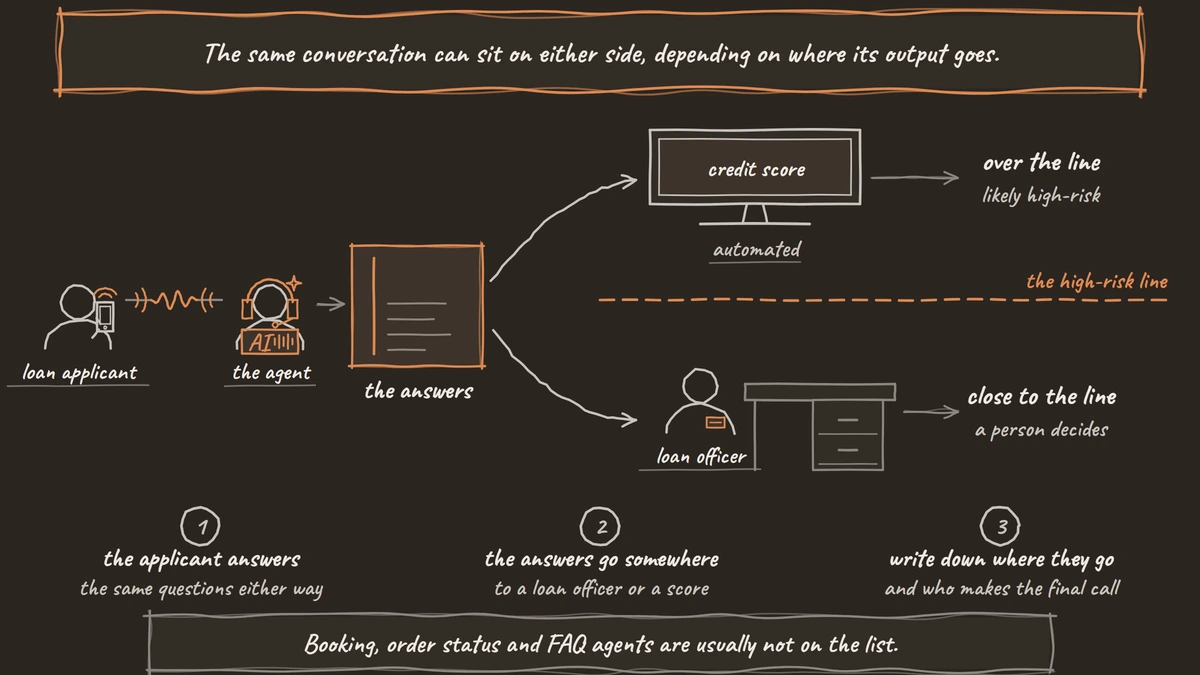
- Booking, order status and FAQ agents are usually not on the list.
- An agent whose answers feed a credit or hiring score likely is.
- Listed duties for deployers apply from 2 December 2027.
This post is part of our guide to the EU AI Act for voice agents, where high-risk uses such as lending and hiring turn on whether the agent's output decides them. Here we go through each listed use a phone agent touches, the narrow way out and deployer duties.
The test is what the agent's answers decide
The AI Act treats AI as high-risk in two ways. It can be a safety part of a regulated product, or it can be used for one of the purposes the Act lists in its high-risk annex. Phone agents almost always fall under the second route, so the question is whether yours is used for a listed purpose.
That question turns on what the agent's output does. An agent that books a viewing, reads out an order status or answers questions decides nothing listed. An agent that collects a loan applicant's details for a loan officer is close to the line. One whose answers flow straight into an automated credit score is over it. The same conversation can sit on either side, depending on where its output goes.
The Commission's AI Act page groups the listed uses into areas such as employment, access to essential private and public services, and biometrics. Those are the areas a voice agent can reach.
Voice uses on the high-risk list
The rows below follow the areas the Commission groups, narrowed to the uses a phone agent can reach. A call may fall under a row when its output feeds the listed decision, while the calls in the last column usually stay outside it.
| Listed use | A voice agent that may fall under it | Usually outside it |
|---|---|---|
| Judging a person's creditworthiness or setting a credit score, except fraud detection | A pre-qualification call whose answers feed a credit score | A call that books an appointment with a loan officer |
| Risk assessment and pricing for people in life and health insurance | A call gathering health answers used to price cover | A claims status line, or car and home cover |
| Deciding eligibility for essential public benefits and services, including healthcare, by or for a public body | A benefits helpline that decides who qualifies | A helpline that answers questions about the rules |
| Classifying emergency calls, dispatching or prioritising responders, triaging emergency patients | An emergency line that ranks calls by urgency | An after-hours line that takes a message |
| Recruiting or selecting people, deciding on work terms, promotion or termination, monitoring and evaluating workers | A screening call that scores or filters candidates | A call that only books the interview |
| Emotion recognition, and sorting people into sensitive categories from biometric data | Detecting callers' emotions from their voices | Sentiment read from a written transcript |
Each row is a listed use in plain words, with a voice agent that may fall under it and one that usually does not. Hiring is the use already on the market. Fireflies launched voice agents in September 2026 that run screening calls and produce a candidate scorecard, and The Next Web's report read that against the high-risk list. Emotion recognition also has a ban at work and in schools, which our post on the EU AI Act risk categories covers.
The narrow way out, and writing it down
A listed system can still fall outside high-risk. It has to pose no significant risk of harm, including by not materially influencing the decision, and do only one of four limited jobs, which are a narrow procedural task, improving the result of a human activity already done, spotting patterns or deviations without replacing a person's review, or a preparatory task for an assessment. A system that profiles people never qualifies.
For voice agents, this may cover an intake call that only collects answers and hands them to a person who decides. It does not cover one that ranks, scores or filters people, because that is profiling. Treat the route as a question to answer for each agent, not a label to claim.
The answer has to be on paper. A provider that decides its listed system is not high-risk must document that assessment before the system goes on the market or into service, register it, and show the assessment to authorities when asked. The Commission's draft guidelines on classifying high-risk systems, published on 19 May 2026, give examples, and final guidelines are still to come.

Open Source Alternative to Vapi / Retell
Self-hosted voice agent platform — no per-minute fees
dograh-hq/dograh
Star on GitHub
What deployers must do from December 2027
After the AI Omnibus, which entered into force on 27 July 2026, the listed high-risk duties apply from 2 December 2027, and high-risk AI in regulated products from 2 August 2028. Our EU AI Act timeline sets out every date. The duty to tell callers they are talking to an AI already applies to every voice agent, high-risk or not.
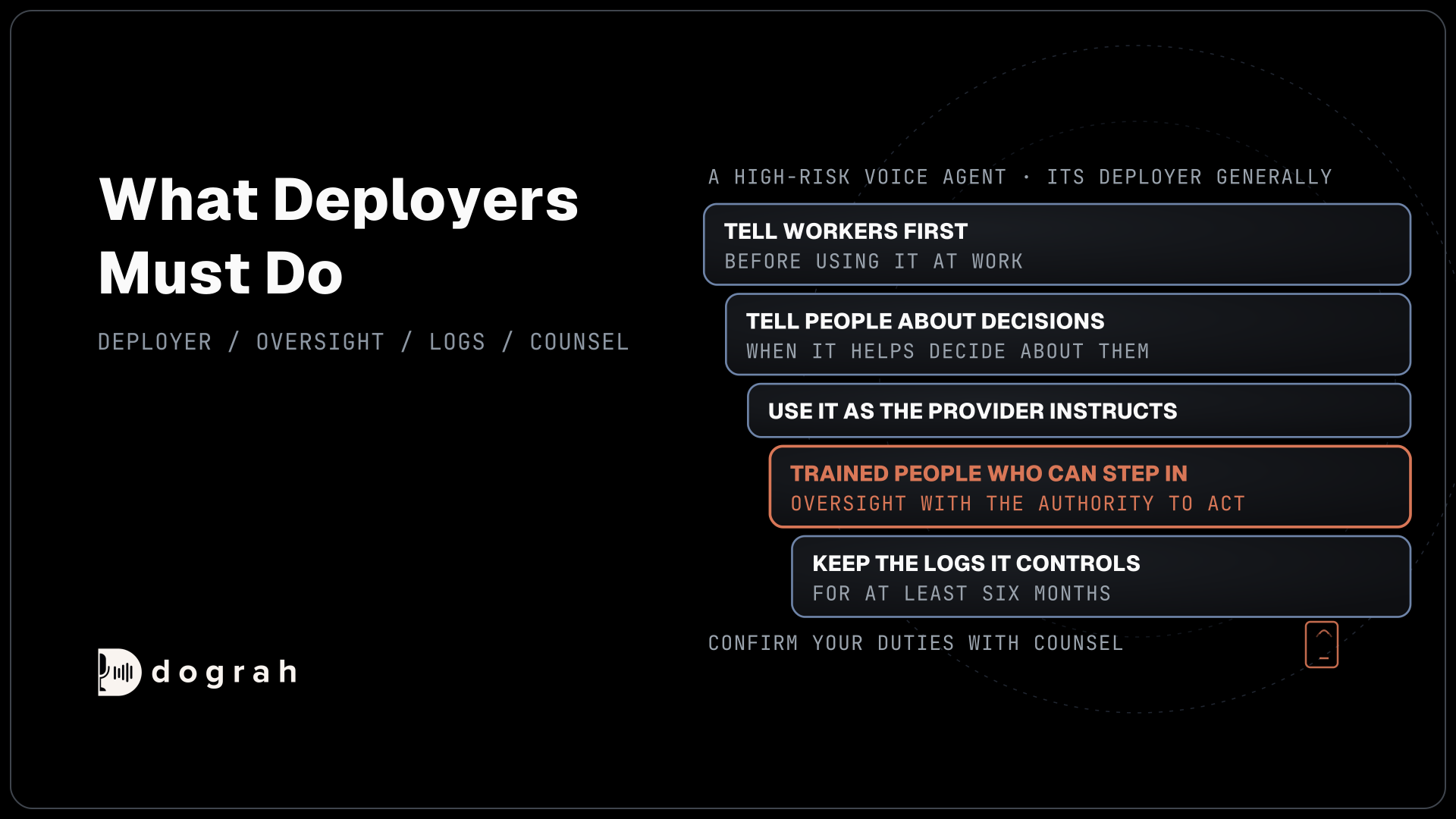
A business that runs a high-risk voice agent is its deployer. It must use the system as the provider instructs and give oversight to trained people with the authority to step in. It must check that the input data it controls is relevant, watch for risks and report them, and keep the logs it controls for at least six months. It must tell workers before using such a system at work, and tell people when a listed system makes or helps make decisions about them.
Some deployers must also assess the effect on people's fundamental rights before first use. That covers public bodies, private companies providing public services, and anyone deploying a credit scoring or life and health insurance pricing system.
The GDPR applies alongside. Decisions based solely on automated processing that have legal or similarly significant effects on a person carry their own rules, whatever the AI Act class. Confirm your classification and duties with counsel before any listed use goes live.
Keeping the decision with a person in Dograh
The simplest design keeps the agent as the intake step and a person as the decision-maker. In Dograh, the agent gathers the answers and a Transfer Call tool hands the caller to a person over Twilio, Telnyx, Plivo, Cloudonix or Asterisk ARI. Dograh dials the person while the caller hears hold music, and connects them once the person answers. Any scoring stays in your own system, under your own oversight.
Every run keeps its transcript, recording and the answers the agent gathered, which gives oversight staff a record of each call. Built-in QA reads the transcript text, and its sentiment label comes from those words, not from the caller's voice. Self-hosted, those records stay on servers you choose, in an EU region, with the models running there too. Self-hosted Dograh has no per-minute platform fee, but servers, model keys and phone minutes still cost money. Dograh Cloud charges a 1¢-a-minute platform fee.
Write down, for each agent you run, what its output decides and who makes the final call, so the answer is ready before 2 December 2027.
Join the Dograh Community
Dograh is an OSS alternative to Vapi. Join our Slack community for queries, releases, best practices & community interactions.
Glossary
- High-risk AI system
- Under the EU AI Act, AI used for a listed purpose such as credit scoring, hiring or emergency triage, or as a safety part of a regulated product. It carries extra duties for providers and deployers.
- Deployer
- The business or body that uses an AI system under its own authority, such as a company running a voice agent on its phone lines. The provider is the one that builds or sells the system.
- Profiling
- Automated processing of personal data to evaluate aspects of a person, such as their reliability or performance. A listed AI system that profiles people is always high-risk.
- Fundamental rights impact assessment
- A check some deployers of high-risk AI must make before first use, covering who the system affects and how. It applies to public bodies, public-service providers, and credit scoring and life and health insurance pricing.