
The EU AI Act sorts AI into four levels, from banned practices down to high-risk, transparency and minimal risk. Most voice agents sit in the transparency level and must tell callers they are talking to an AI. Dograh, the open-source AI voice agent platform, plays that notice word for word, self-hosted or on Dograh Cloud.
Key Takeaways
- Most phone agents need the AI notice and little more.
- Tracking your own staff's emotions from their voices is banned.
- A high-risk agent that talks to people also needs the notice.
This post is part of our guide to the EU AI Act for voice agents, where 2 August 2026 switched on the duty to tell callers they are talking to an AI, after the bans of February 2025. Here we give each of the four levels a phone-agent example.
The four levels at a glance
The AI Act does not regulate every AI system the same way. It sorts uses by how much harm they could do, and the duties grow with the level. The Commission names four.
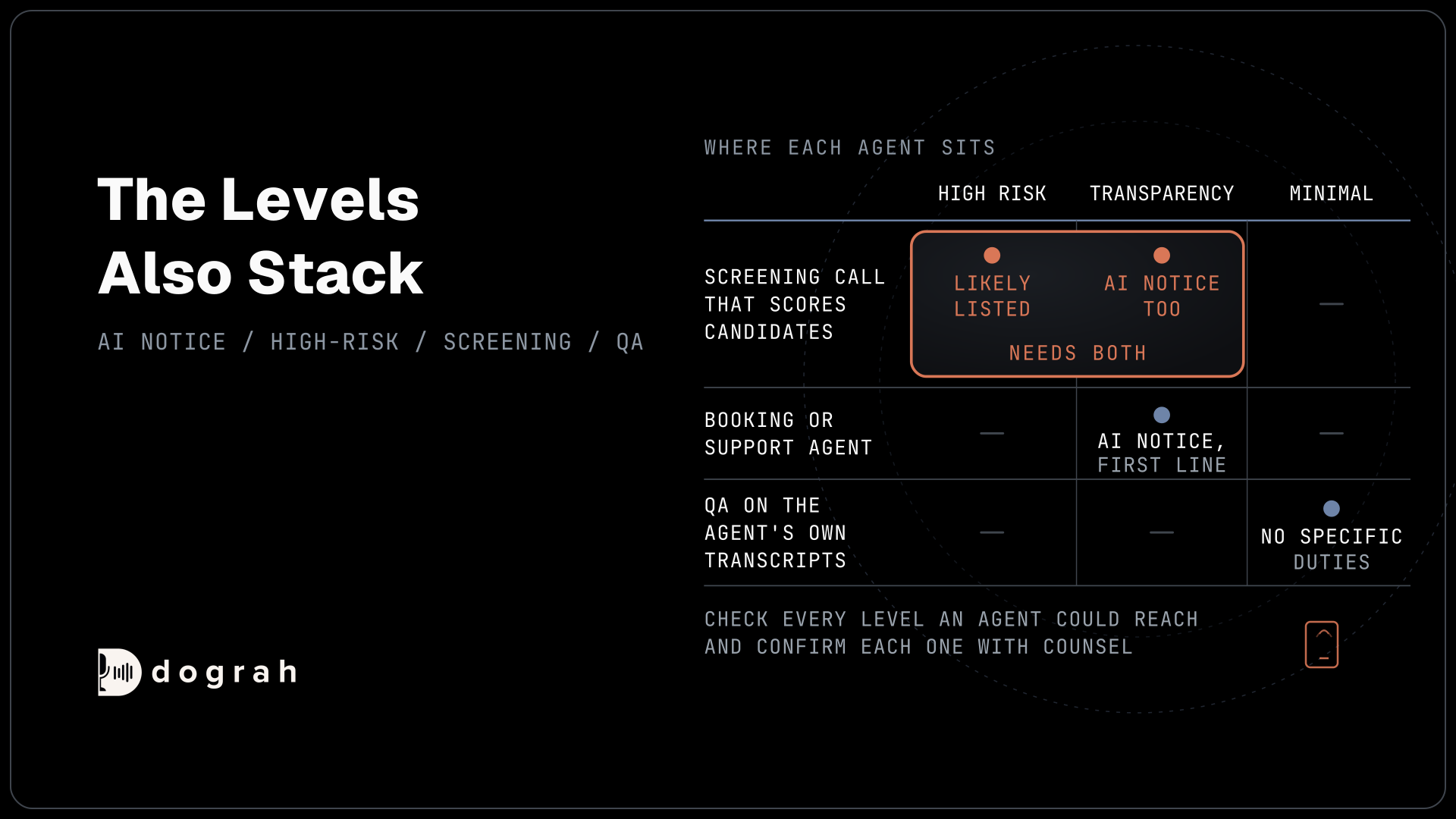
| Level | What it means | A voice-agent example | Applies from |
|---|---|---|---|
| Unacceptable risk | Banned outright | A call centre tracking its own staff's emotions from their voices | 2 February 2025 |
| High risk | Allowed, with strict duties | A screening call that scores job candidates | 2 December 2027 |
| Transparency risk | People must be told | A booking or support agent on a phone line | 2 August 2026 |
| Minimal or no risk | No specific duties | QA that reviews the agent's own transcripts | n/a |
The transparency level used to be called "limited risk". The Commission now calls it transparency risk, which says more about the duty. The levels are uses, not products, so the same voice platform can run agents in different levels.
Banned practices a voice agent can touch
The Commission lists nine banned practices. Eight have applied since 2 February 2025. The ninth, AI that generates non-consensual sexual or intimate content or child sexual abuse material, was added by the AI Omnibus and applies from December 2026. Three of the nine can reach a phone call.
Manipulation is the first. AI that uses manipulative or deceptive techniques to push a person into a decision they would not otherwise make, causing or likely to cause significant harm, is banned. An agent scripted to pressure or mislead callers into a purchase that harms them would cross that line. Exploiting vulnerability is the second. AI that exploits a person's age, disability or social or economic situation in the same way is banned, such as an outbound agent aimed at older callers that uses their confusion to close a sale.
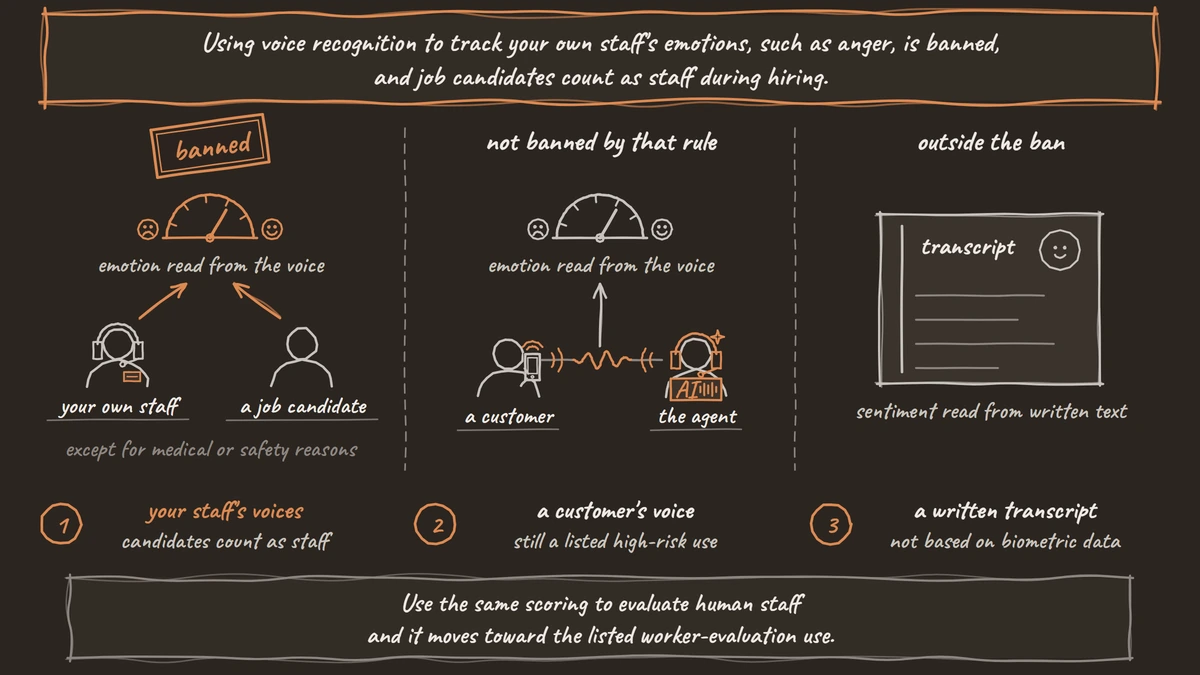
Emotion recognition at work and in education is the third, except for medical or safety reasons. The Commission's guidelines on prohibited practices give a call-centre example. Using voice recognition to track your own staff's emotions, such as anger, is banned, and job candidates count as staff during hiring. Tracking customers' emotions is not banned by that rule, though emotion recognition stays a listed high-risk use. Emotions read from written text, such as sentiment analysis of a transcript, are not based on biometric data and fall outside the ban.
High-risk: when the agent's output decides
High-risk systems are allowed but carry strict duties. For a voice agent, the question is whether its output decides or materially shapes a listed outcome, such as a credit score, life or health insurance pricing, a hiring decision, eligibility for public benefits or the triage of emergency calls. These duties apply from 2 December 2027.
A screening call that scores candidates is likely listed. A call that only books the interview usually is not. Our post on whether your voice agent is high-risk goes through each listed use, the narrow way out and what deployers must do.

Open Source Alternative to Vapi / Retell
Self-hosted voice agent platform — no per-minute fees
dograh-hq/dograh
Star on GitHub
Transparency: telling callers it is an AI
This is the level most voice agents sit in. An AI system that talks with people must tell them they are talking to an AI, unless that is obvious to a reasonably well-informed person, at the latest at the first interaction. That has applied since 2 August 2026. The Commission's questions and answers on transparency put the fines for breaking these rules at up to EUR 15 million or 3% of worldwide turnover, whichever is higher.
A separate duty asks providers of systems that generate synthetic audio to mark it in a machine-readable way. It falls on the provider of the generating system, such as a text-to-speech vendor, and starts on 2 December 2026 for systems already on the market.
On a phone call, the notice belongs in the first line. In Dograh, the Start Call node's Greeting Text plays fixed words exactly as written, or a pre-recorded clip. Allow Greeting Interruption is on by default, so switch it off when the notice sits in the greeting and the caller hears it in full. Our guide to what a voice agent must tell callers covers the wording.
Minimal risk, and agents in two levels
Everything else is minimal risk, with no specific duties under the Act, though voluntary codes of conduct are encouraged. Post-call QA that reviews the AI agent's own transcripts for your team is a fair example, since no one talks to it and it judges the agent, not people. Use the same scoring to evaluate human staff and it moves toward the listed worker-evaluation use.
The levels also stack. A high-risk voice agent that talks to people carries the transparency duty too, so a screening agent needs both the high-risk duties and the AI notice. The rules for general-purpose AI models, in force since August 2025, fall on the model vendors, not on the business running the phone agent. Our EU AI Act timeline lists every date. Confirm with counsel which level each of your agents sits in before you rely on the answer.
Where Dograh fits on each level
Dograh's built-in QA reads the call transcript after the call, and its sentiment label comes from the words, not the caller's voice. That keeps post-call review on text, which the Commission's guidelines place outside the emotion ban.
For the transparency level, the fixed greeting with interruption switched off gives each call the same notice, and the run's recording and transcript show that it played. Self-hosted, those records and the models can stay on servers you choose in the EU. Self-hosted Dograh has no per-minute platform fee, but servers, model keys and phone minutes still cost money. Dograh Cloud charges a 1¢-a-minute platform fee.
Write down the level of each agent you run, with the reason, and review it when the agent's job changes.
Join the Dograh Community
Dograh is an OSS alternative to Vapi. Join our Slack community for queries, releases, best practices & community interactions.
Glossary
- Prohibited practice
- A use of AI the EU AI Act bans outright, such as harmful manipulation, exploiting vulnerable people, social scoring and emotion recognition at work. The Commission lists nine.
- Transparency risk
- The AI Act level for systems that interact with people or generate content. People must be told they are dealing with an AI. Its older name is limited risk.
- Emotion recognition system
- AI that infers a person's emotions or intentions from biometric data, such as their voice or face. Inferring emotion from written text is not biometric under the Commission's guidelines.
- Minimal risk
- The AI Act level for everything not banned, high-risk or covered by transparency duties. It carries no specific duties, though voluntary codes of conduct are encouraged.