
Since 2 August 2026, the EU AI Act has required AI systems that talk with people to tell them they are dealing with an AI, unless that is obvious. For a phone agent, that means a spoken notice at the start of the call. The AI Omnibus left this date alone, and recording consent remains a separate rule.
Key Takeaways
- Put the AI notice in the fixed greeting and switch off greeting interruption.
- Agents that decide credit or hiring face high-risk duties from 2 December 2027.
- For EU data location, self-host on EU servers with the models running there.
Below, we cover what Article 50 asks of a phone agent, who carries the duty, what the AI Omnibus changed and where recording fits, and show how each part works in Dograh, the open-source AI voice agent platform we build. You can self-host it or run it on Dograh Cloud.
What changed on 2 August 2026 for phone agents
The EU AI Act became applicable on 2 August 2026, with a few exceptions, and that date switched on the duty that matters most for phone agents, telling people they are talking to an AI. The earlier dates covered banned practices, from February 2025, and the rules for general-purpose AI models, from August 2025. As the Commission's AI Act page sets out, the model rules mostly land on model vendors, not on the business that runs the calls.
The number of businesses this touches is growing fast. Eurostat found that 20.0% of EU enterprises with 10 or more employees used AI in 2025, up from 13.5% a year earlier, and 8.8% used it to generate written or spoken language. Some of those systems now answer the customer line or call customers back, and each of those calls now needs the notice.
The rule itself is short. The hard parts are who carries it, how the notice should sound on a phone line, when it can be skipped and how it sits beside recording law, and the rest of this guide takes them one at a time.
What Article 50 asks of a voice agent
Article 50 of the AI Act says an AI system built to interact directly with people must be designed so that they are "informed that they are interacting with an AI system". The notice has to be clear and given at the latest at the first interaction. It also has to meet the accessibility rules that apply, so people with disabilities can take it in.
Two other parts of the same article often get mixed into this one. A separate rule asks providers of systems that generate synthetic audio, images, video or text to mark that output in a machine-readable way, and another covers deep fakes. Neither of them tells your agent what to say when the caller picks up. The marking rule falls on the provider of the generating system, such as a text-to-speech vendor, and for systems already on the market it starts on 2 December 2026.
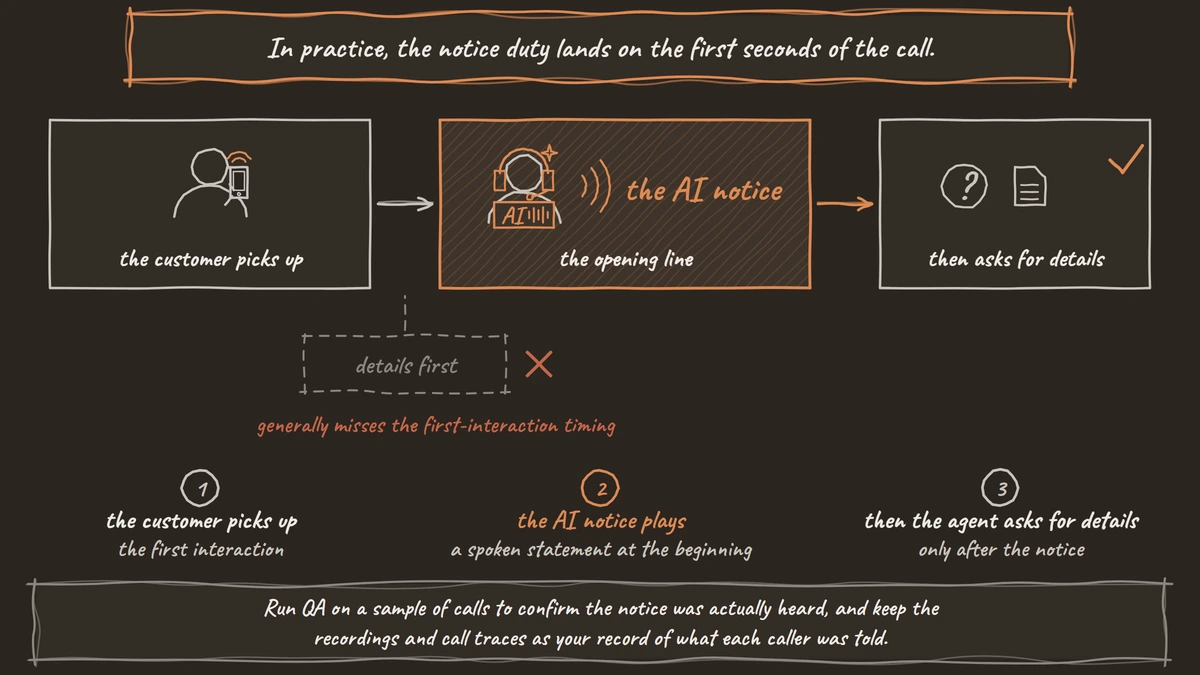
In practice, the notice duty lands on the first seconds of the call. The opening line is the one place where the wording can be fixed in advance and proven afterwards, which is why this guide keeps coming back to it. Our post on what a voice agent must tell callers under Article 50 walks through the text and the Commission's guidance in detail, with sample opening lines.
Provider or deployer: where your business sits
Article 50 puts the interaction notice on the provider. That is the company that develops an AI system, or has one developed, and puts it into service under its own name. Deployers, the businesses that use an AI system under their authority, carry other duties in the same article, such as labelling deep fakes. The Commission's Article 50 guidelines count in-house builds as provided systems and say that open-source licences give no exemption from these duties.
Our reading is that a business which builds its own phone agent on an open-source platform and runs it under its own brand most likely sits in the provider role for the notice. A business that buys a finished agent is closer to a deployer, but it still decides what its callers hear first, so the safe move is the same in both cases. Whether a recorded call fits the guidelines' exemption from machine marking for live content that is not stored is also unsettled. Treat both points as informed commentary, and confirm your role with counsel before you rely on either.
The cost of getting it wrong is set out in the Commission's questions and answers. Fines for breaching Article 50 can reach 15 million euros or 3% of total worldwide turnover for the preceding financial year, whichever is higher. National market surveillance authorities do most of the enforcement, and smaller firms may see proportionate fines.

Open Source Alternative to Vapi / Retell
Self-hosted voice agent platform — no per-minute fees
dograh-hq/dograh
Star on GitHub
Tell the caller at the start of the call
On the phone, the Commission's guidelines point to a spoken statement at the beginning of the call, with "This is an AI-powered assistant" as their example. They add reminders in longer calls, especially after an interruption or when the AI's role changes, and say tones or beeps can help but are not enough by themselves. A notice that only comes after the agent has asked for details generally misses the first-interaction timing.
In Dograh, the opening line is the Greeting Text on the Start Call node, which plays word for word through text-to-speech, or Greeting Type can play a pre-recorded clip in a real voice. Allow Greeting Interruption is on by default, so a caller who starts talking can cut the notice off. Switch it off on the Start Call node and the caller's speech is held until the greeting finishes, so the whole notice plays on every call.
Reminders later in the call are softer. A node prompt can tell the agent to repeat that it is an AI before a transfer or when the topic changes, but the model writes those words, so they vary from call to call. Transition Speech, the fixed line that plays when the agent moves to another step, is a more dependable place for a reminder, although text lines do not play on speech-to-speech models.
Then check that it worked. Run QA on a sample of calls to confirm the notice was actually heard, and keep the recordings and call traces as your record of what each caller was told.
When the "obvious" exception does not help
Article 50 skips the notice only when it is obvious to a reasonably well-informed, observant and circumspect person that they are dealing with an AI. The Commission's questions and answers say the obvious exception should be read restrictively, because it takes transparency away from people. A robotic-sounding voice is one factor the guidelines mention, and today's synthetic voices rarely sound robotic.
The guidelines go further for lines the public can call. Where older callers, people with lower AI literacy or people with disabilities may be on the line, the exception cannot be relied on, and the notice must be accessible to them. For a customer service number, that makes the exception unavailable for practical purposes, so say it on every call, in the language the caller is likely to speak.
Language takes some planning. Greeting Text plays before Dograh can hear which language the caller speaks, so a bilingual inbound line needs the notice in both languages, for example "Bonjour, hello". On outbound campaigns, a greeting override column in the contact list lets each person hear the notice in their own language.
Consumer law adds a second layer. The guidelines note that the Unfair Commercial Practices Directive and the Consumer Rights Directive apply whether or not the AI is obvious. A sales agent that lets a caller believe they are talking to a person can break consumer law even where the AI Act alone would not catch it.
Join the Dograh Community
Dograh is an OSS alternative to Vapi. Join our Slack community for queries, releases, best practices & community interactions.
Recording consent is a separate step
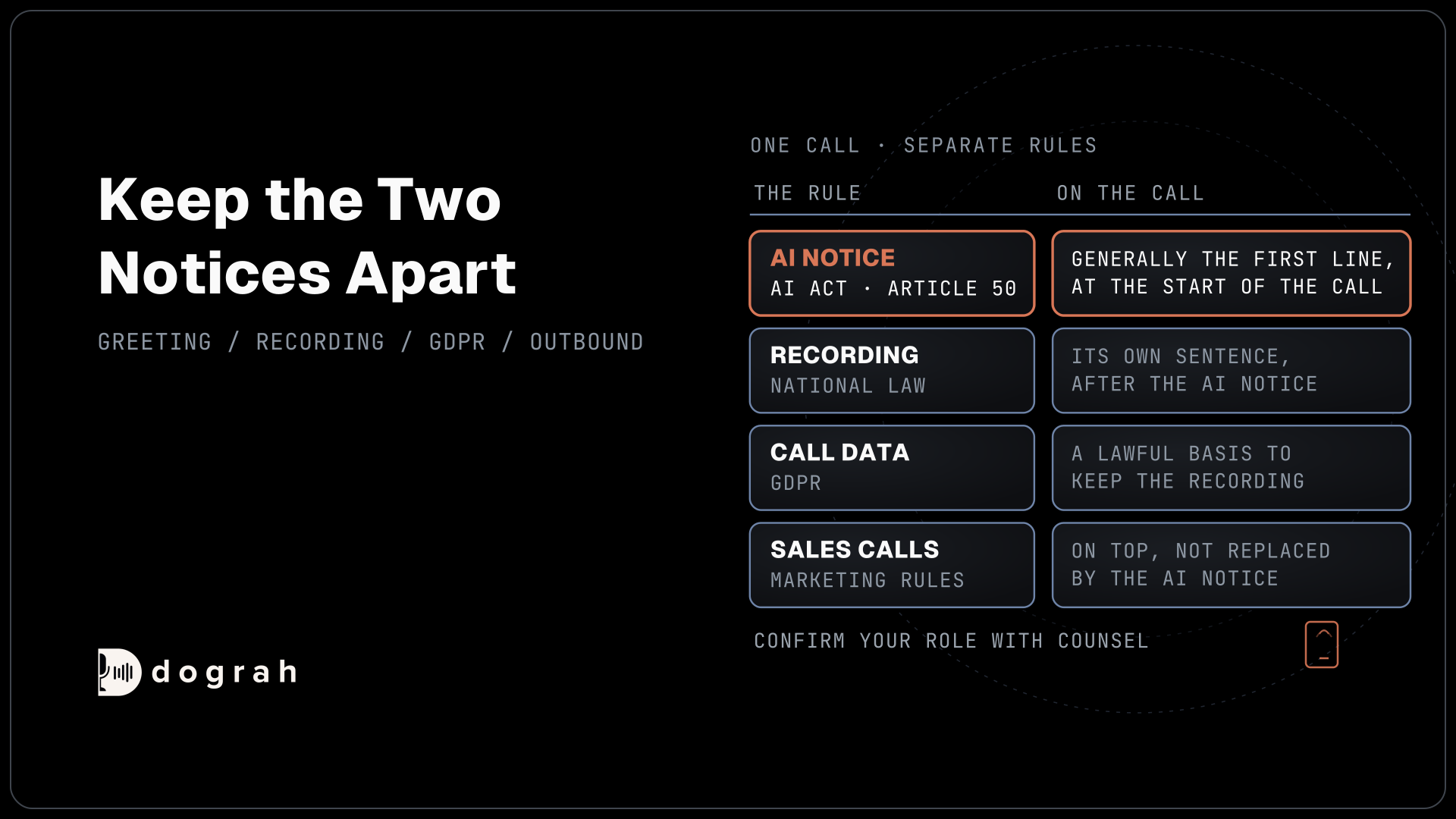
Article 50 says nothing about recording calls. Whether you may record, and what you must tell the caller first, comes from the ePrivacy Directive, which protects the confidentiality of communications through each country's own law, and from the General Data Protection Regulation (GDPR), which needs a lawful basis for keeping the recording. Our post on GDPR and voice AI covers the data side, from controllers to erasure requests.
Keep the two notices apart in the greeting. Put the AI notice first and the recording notice in its own sentence after it, so a caller can tell which is which and you can change one without touching the other. Where a country asks for consent instead of a notice, the agent has to ask and record the answer, and you need a plan for callers who refuse. Our post on call-recording consent laws covers the notice wording and how to configure the agent.
Outbound calls bring national marketing rules on top. Consent rules for sales calls differ sharply between EU countries, as our post on outbound calling in Germany and Spain shows, and none of them is replaced by the AI notice.
What the AI Omnibus changed, and what it did not
The AI Omnibus (Regulation (EU) 2026/1744), the AI Act part of the Commission's digital simplification package that many people call the Digital Omnibus, entered into force on 27 July 2026. It was proposed on 19 November 2025 and agreed politically on 7 May 2026. Its biggest effect is on the high-risk calendar.
It pushed the high-risk deadlines back and gave providers of generators already on the market until 2 December 2026 to add machine-readable marking. It softened the AI literacy duty into a duty to take measures that support AI literacy. It also gave the AI Office a role in the codes of practice for transparency, which the Commission can approve.
It did not touch the notice. The duty to tell people they are talking to an AI, and the rule that the notice comes at the latest at the first interaction, still apply from 2 August 2026. The Omnibus also left the GDPR, the ePrivacy Directive and national recording law as they were. Our EU AI Act timeline puts every date, old and new, in one table.
High-risk uses: lending, hiring and essential services
Most phone agents are not high-risk systems. The Act's list of high-risk uses covers AI used for decisions such as credit scoring, hiring and access to essential public and private services, and those duties now apply from 2 December 2027. High-risk AI built into regulated products follows from 2 August 2028. The Act sorts every use into four risk levels, and EU AI Act risk categories for voice AI gives each level a phone-agent example.
What matters is whether the agent's output decides the outcome. An agent that collects details for a loan application and passes them to a person who decides is in a very different place from one whose answers feed an automated score. Where you can, keep the decision with a person and the agent as the intake step, and write down which is which before the high-risk date arrives. Our post on EU AI Act high-risk rules for voice agents goes through each listed use a phone agent touches, from credit calls to hiring screens.
Running the agent on EU servers with Dograh
Where the call audio goes is a GDPR question more than an AI Act one, but buyers ask both at once. Dograh is open-source, so you can self-host it on servers in an EU data centre you choose, for example with Docker on your own machines. For the audio and transcripts to stay in the EU, the speech-to-text, language and voice models must run there too, either as open-weight models on the same servers or with providers whose EU processing you have checked. For the whole setup in one place, see self-hosted voice agents for the EU AI Act.
Dograh is the orchestration layer that runs the call flow, tools and telephony, and the speech and language models are a separate layer you choose. That split is what makes EU hosting practical, because you can bring your own keys for any provider or switch to local models without rebuilding the agent.
Self-hosted Dograh has no per-minute platform fee, but servers, model keys and phone minutes still cost money. Dograh Cloud charges a 1¢-a-minute platform fee. Either way, the recordings and full call traces of every greeting are yours to inspect, and that is what a regulator or an unhappy customer will ask about first.
Start with the greeting. Write the AI notice, switch off greeting interruption, add the recording sentence after it, and listen to a batch of real calls before you widen the rollout.
Each part of the AI Act above has its own deep dive:
- EU AI Act Article 50: What a Voice Agent Must Tell Callers
- EU AI Act Timeline: What Applies From August 2026
- EU AI Act High-Risk Rules for Voice Agents in 2026
- EU AI Act Risk Categories Explained for Voice AI in 2026
Glossary
- Provider (AI Act)
- The company that develops an AI system, or has it developed, and puts it into service under its own name. Article 50 puts the duty to tell people they are talking to an AI on the provider, and in-house builds count.
- Deployer (AI Act)
- A business that uses an AI system under its authority. Under Article 50 deployers carry duties such as labelling deep fakes, and a business that buys a finished phone agent is usually closer to this role.
- Obvious exception
- The case where the AI notice can be skipped because a reasonably well-informed, observant and circumspect person would already know they are dealing with an AI. The Commission reads it restrictively, and it cannot be relied on for lines the general public calls.
- AI Omnibus
- The amending regulation that entered into force on 27 July 2026. It moved the high-risk deadlines and gave existing generators until 2 December 2026 for machine marking, but left the 2 August 2026 AI notice unchanged.