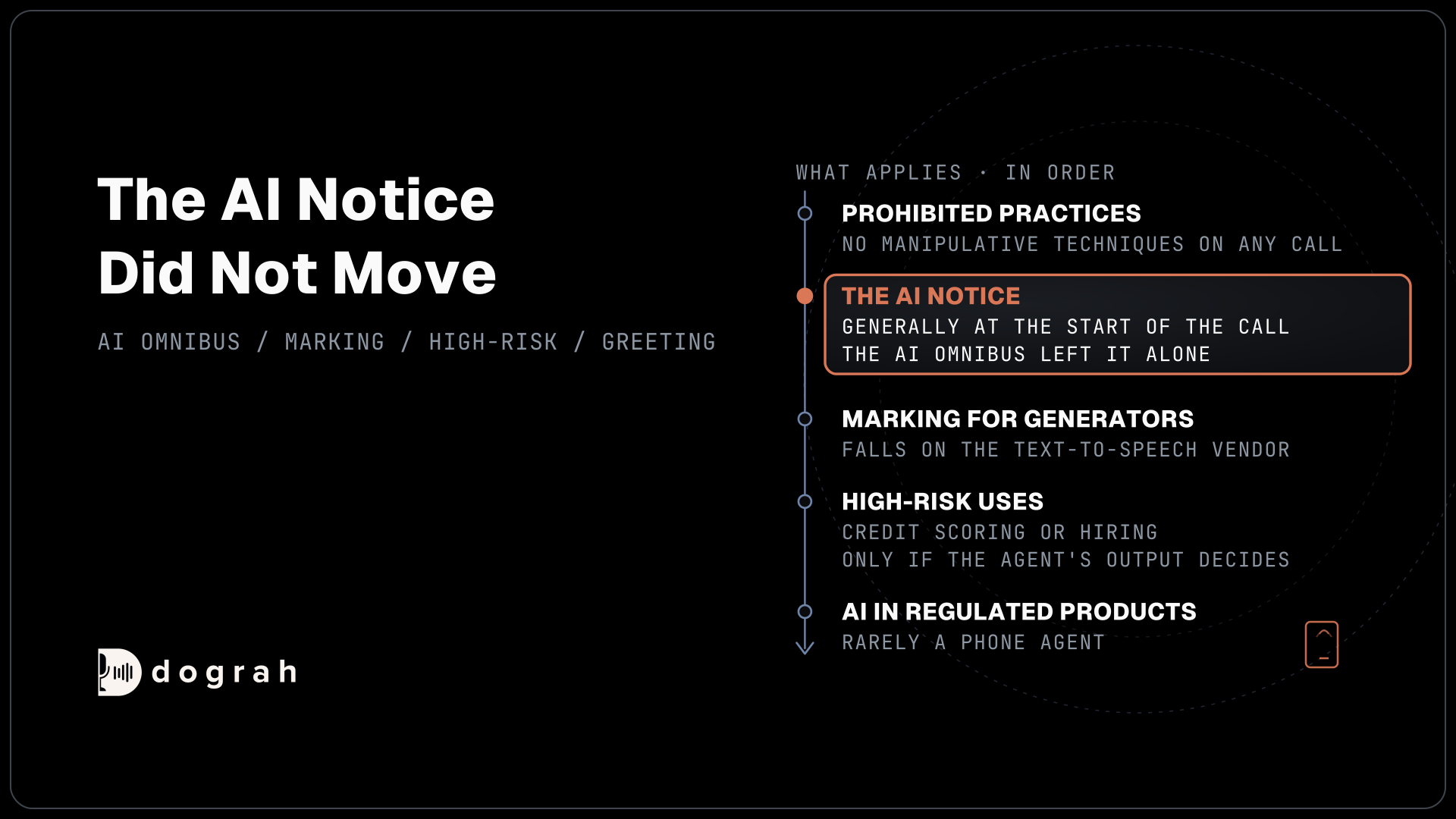

The EU AI Act became applicable on 2 August 2026, including the duty to tell people they are talking to an AI. Bans on prohibited practices started in February 2025 and the model rules in August 2025. The AI Omnibus moved high-risk duties to 2 December 2027 and 2 August 2028, but not the AI notice.
Key Takeaways
- A phone agent's AI notice has applied since 2 August 2026.
- Machine-readable marking for generators already on the market starts 2 December 2026.
- Credit scoring and hiring uses wait for high-risk duties until 2 December 2027.
This post is part of our guide to the EU AI Act for voice agents. Below, we put every application date in one table and explain what the AI Omnibus moved, then set up the 2 August notice in Dograh, the open-source AI voice agent platform we build.
Every AI Act date in one table
The AI Act did not switch on in one go. The Commission's AI Act page says the Act entered into force on 1 August 2024 and became applicable on 2 August 2026, with some exceptions, and the table below lists each of them. The dates come from the transitional provisions of the AI Act as amended by the AI Omnibus, and the last column says what each one means for a business that runs a phone agent.
| Date | What applies | What it means for a phone agent |
|---|---|---|
| 1 August 2024 | The Act enters into force | Nothing to do yet |
| 2 February 2025 | Bans on prohibited practices, and the AI literacy duty (since softened to supporting measures) | No manipulative techniques on any call. Staff who run the agent get AI literacy support |
| 2 August 2025 | Rules for general-purpose AI models, governance and the penalties chapter | Mostly the model vendors' job |
| 27 July 2026 | The AI Omnibus enters into force | No new duty for the agent |
| 2 August 2026 | General date of application, including the duty to tell people they are talking to an AI | The spoken AI notice at the start of every call |
| 2 December 2026 | Machine-readable marking for generators already on the market, and new bans on intimate-image manipulation | Falls on the provider of the voice generator |
| 2 December 2027 | High-risk duties for listed uses such as credit scoring, hiring and access to essential services | Agents whose output decides those outcomes |
| 2 August 2028 | High-risk duties for AI built into regulated products | Rarely a phone agent |
| 2 August 2030 | High-risk systems that public authorities already had in service must comply | Government helplines with a high-risk use |
Read the table from the right-hand column. For a typical customer service or sales agent, only one row asks the business to change anything on the call itself, and that row has already passed.
What 2 August 2026 means for a phone agent
From 2 August 2026, an AI system built to talk with people must be designed so they are told they are dealing with an AI, unless that is obvious, and the notice has to reach the caller at the latest at the first interaction. The AI Omnibus did not move this date. Eurostat counted 7.2% of EU enterprises using speech recognition in 2025, so the rule already touches many customer lines.
In Dograh, which you can self-host or run on Dograh Cloud, the notice belongs in the Greeting Text on the Start Call node, which plays word for word. Allow Greeting Interruption is on by default, so switch it off on that node and the caller's speech is held until the greeting has finished. Our post on what a voice agent must tell callers under Article 50 has the Commission's guidance and sample opening lines.

Open Source Alternative to Vapi / Retell
Self-hosted voice agent platform — no per-minute fees
dograh-hq/dograh
Star on GitHub
What the AI Omnibus moved
The AI Omnibus (Regulation (EU) 2026/1744), published on EUR-Lex, entered into force on 27 July 2026, and its main job was to give high-risk systems more time. Under the original text, most high-risk duties would have applied from 2 August 2026, and those for AI in regulated products from 2 August 2027. Listed high-risk uses now apply from 2 December 2027, and AI in regulated products from 2 August 2028.
It also turned the AI literacy duty into a duty to take measures that support AI literacy, and it gave providers of generators already on the market a grace period for marking. The AI notice for phone agents and the timing of that notice stayed as they were. A plan that assumed the whole Act slipped to 2027 needs correcting.
2 December 2026: marking for generators
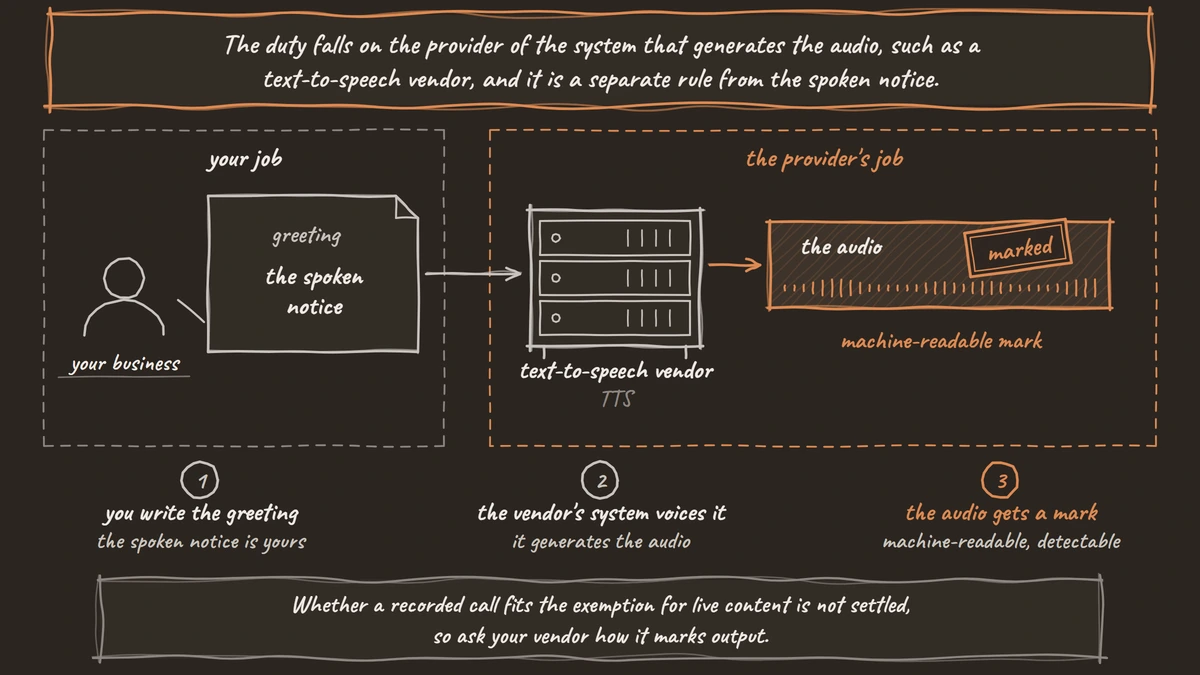
Article 50 also asks providers of systems that generate synthetic audio, images, video or text to mark that output in a machine-readable, detectable way. Under the Commission's questions and answers, providers of systems already on the market before 2 August 2026 have until 2 December 2026 for this one rule, and content made before 2 August 2026 does not need labelling after the fact.
The duty falls on the provider of the system that generates the audio, such as a text-to-speech vendor, and it is a separate rule from the spoken notice. The Commission's guidelines allow an exemption for live content that is not recorded, stored or passed on, where marking is not technically feasible and people are told. Whether a recorded phone call fits that exemption is not settled, so ask your text-to-speech vendor how it handles marking and confirm your own position with counsel.
Join the Dograh Community
Dograh is an OSS alternative to Vapi. Join our Slack community for queries, releases, best practices & community interactions.
2027 and later: the high-risk dates
The high-risk duties are heavier, with risk management, logging, human oversight and registration among them, and they bite only where the AI is used for one of the listed purposes. For a phone agent the most likely ones are credit scoring, hiring decisions and access to essential services. Those apply from 2 December 2027.
AI built into products already covered by EU product law follows from 2 August 2028, which rarely includes a phone agent. Public authorities that already had a high-risk AI system in service before the rules applied have until 2 August 2030. Hosting is a separate question again, and our post on GDPR and voice AI covers where call data may sit.
If your agent only collects details and a person makes the decision, the high-risk dates may never reach it. Write that split down now, while there is still a year to change the design.
Glossary
- Date of application
- The day a rule in the AI Act starts to bind. The Act entered into force on 1 August 2024, but most of it became applicable only on 2 August 2026, with the exceptions in the table.
- AI Omnibus
- The amending regulation in force since 27 July 2026. It moved the high-risk dates to 2 December 2027 and 2 August 2028 and left the 2 August 2026 AI notice in place.
- Machine-readable marking
- A detectable mark on synthetic audio, images, video or text, added by the provider of the system that generates it. For generators already on the market it applies from 2 December 2026.
- High-risk AI system
- AI used for a listed purpose, such as credit scoring or hiring, or built into a regulated product. Its duties now start on 2 December 2027 or 2 August 2028.