
Under the EU AI Act, a voice agent must never use manipulative or deceptive techniques, or exploit a caller's age, disability or financial situation, in ways that cause significant harm. It must also never infer the emotions of staff or job candidates from their voices. Dograh, which we build, is an open-source voice agent platform.
Key Takeaways
- An AI notice helps, but it does not clear a harmful manipulative script.
- Reading staff or candidates' emotions from their voices is banned at work.
- Sentiment read from a transcript's text sits outside the emotion ban.
This post is part of our guide to the EU AI Act for voice agents, which covers the start-of-call notice and the high-risk uses. Below, we go deeper on the manipulation and emotion bans, turn them into script rules for outbound and hiring agents, and show what Dograh's QA reads.
What the bans cover, and who carries them
The bans in Article 5 of the AI Act have applied since 2 February 2025. They cover placing a banned system on the market, putting it into service and using it, so the company that builds a voice agent and the business that runs its calls are both in scope.
Our overview of EU AI Act risk categories explains which bans can reach a phone call. Two more, on AI-generated intimate images and child abuse material, apply from 2 December 2026 and sit far from phone agents. Breaching a ban carries the Act's highest fine, set out in our post on EU AI Act penalties for phone agents.
The Commission's guidelines on prohibited practices are the main reading of these bans. They are not binding, and only the Court of Justice gives the final word, but national authorities lean on them, so the examples below come from them.
The harm test behind the manipulation ban
The manipulation ban needs three things to line up. The system uses subliminal, purposefully manipulative or deceptive techniques. Those techniques materially distort a person's behavior by impairing their ability to make an informed decision. And the result causes, or is reasonably likely to cause, significant harm to that person or someone else.
The Commission's guidelines on prohibited AI practices give examples that fit phone agents closely. A chatbot that presents false or misleading information can be caught, in particular when it has not been disclosed as an AI. Their clearest example is an AI chatbot that impersonates a friend or relative with a synthetic voice to run a scam, the reverse of the threat in our post on voice cloning fraud against AI agents.
Intent is not required. The guidelines note that an AI system can learn deceptive techniques because they improve its results. A language model tuned on conversion rates, or a prompt that rewards closing at any cost, can drift into invented deadlines or false scarcity without anyone writing them. The test looks at what the agent did to the caller.
Where persuasion ends and deception starts
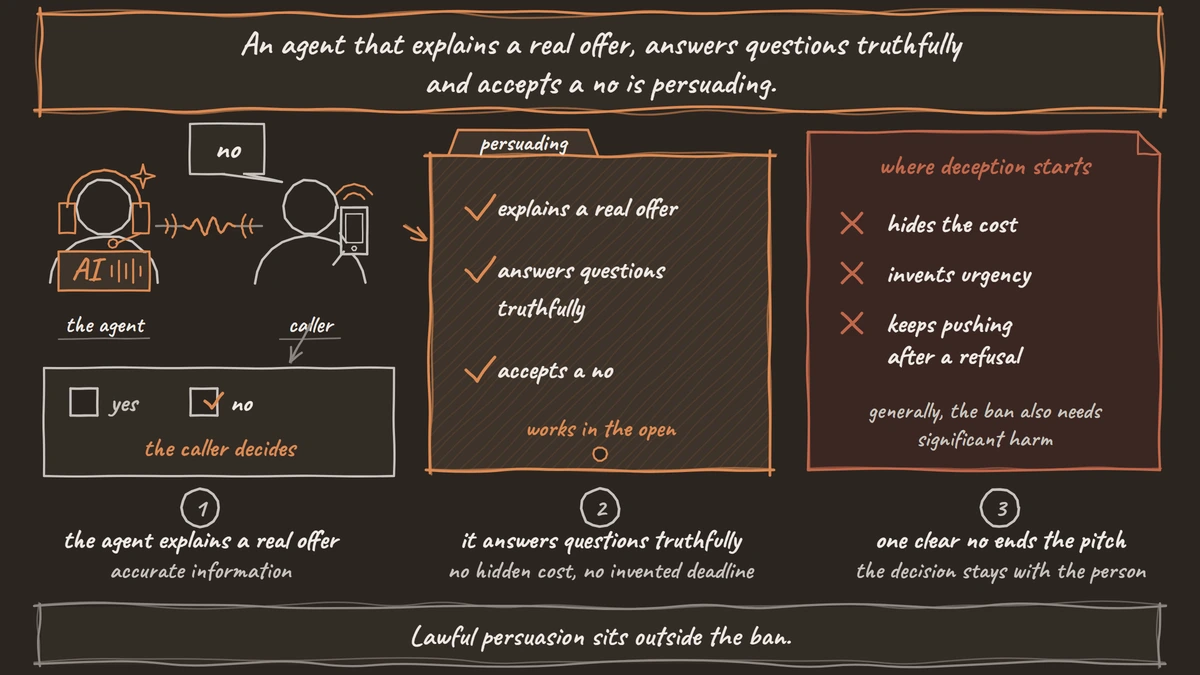
Lawful persuasion sits outside the ban. In the guidelines' reading, persuasion works in the open, gives accurate information and leaves the decision with the person. An agent that explains a real offer, answers questions truthfully and accepts a no is persuading. One that hides the cost, invents urgency or keeps pushing after a refusal is moving toward the line.
Telling the caller it is an AI helps. The guidelines treat the notice as a measure that lowers the risk of deception, but they also say a deceptive technique can still be banned despite the notice when all the conditions, including significant harm, are met. The notice that opens the call does not license what comes after it.
Older callers get specific attention. The guidelines name AI systems that target older people with deceptive personalized offers or scams, exploiting reduced cognitive capacity, as likely to cause significant financial harm. A general assistant for older people is not caught unless all the conditions are met, so the risk sits in outbound sales lists aimed at age groups, paired with pressure.

Open Source Alternative to Vapi / Retell
Self-hosted voice agent platform — no per-minute fees
dograh-hq/dograh
Star on GitHub
Script rules for sales, collections and hiring
The safest agent says the parts that matter in fixed words and lets the model handle only the conversation around them. Put the offer, the price and the terms in fixed wording: the Greeting Text, a Transition Speech line or pre-recorded clips in a real voice. Inside an agent step the model writes its own sentences, so wording you need to prove belongs outside the prompt.
Write the prompt rules for everything else. No deadline the business has not set, no claim that stock or a rate is running out unless it is true, and one clear no ends the pitch. A caller who asks for a person gets the Transfer Call tool, and a caller who says stop is not called again.
Collections agents need the same care with money. Verify the person first, read the balance from the creditor's system and never threaten an action the business will not take. Hiring screens record the candidate's answers and nothing about how they sounded. Germany's market surveillance authority, the Bundesnetzagentur, keeps a plain list of the bans that is worth reading against your scripts.
Where the emotion ban starts and stops
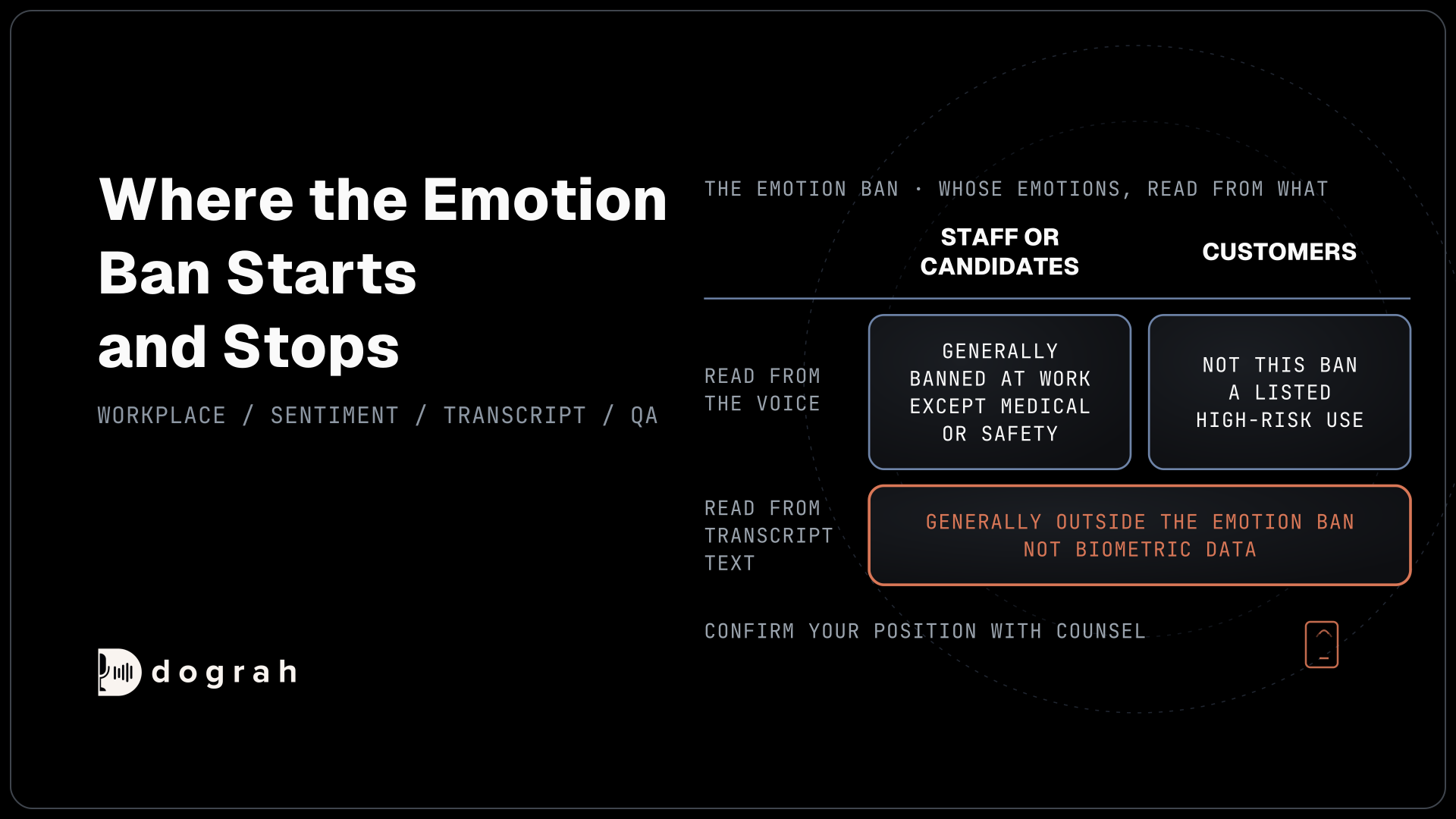
The emotion ban covers inferring people's emotions at work and in education from biometric data, which includes the voice, except for medical or safety reasons. The guidelines read "workplace" broadly: job candidates during selection, staff on probation, contractors, trainees and volunteers all count. An AI interview that scores a candidate's nervousness from their voice is banned, and so is a team tool that tracks the emotional tone of hybrid meetings.
Call centers get a direct example. Using voice recognition to track employees' emotions, such as anger, is banned. Tracking customers' emotions by voice, such as anger or impatience, is not banned by this rule, though emotion recognition stays a listed high-risk use with duties from 2 December 2027, as our post on high-risk rules for voice agents explains. Emotion read from written text, such as sentiment analysis of a transcript, is not based on biometric data and falls outside the ban.
One narrow carve-out exists. Emotion recognition used only for an employee's own training may be allowed if the results never reach HR and cannot affect assessment or promotion, and the ban is not being sidestepped. That reading is narrow and fact-specific, so confirm your position with counsel before you build on it.
Join the Dograh Community
Dograh is an OSS alternative to Vapi. Join our Slack community for queries, releases, best practices & community interactions.
What Dograh's QA reads
Dograh's built-in QA works from the call transcript after the call ends. Each step gets its own tags, score, sentiment and summary, and that sentiment comes from the words on the page, the text-based analysis the guidelines place outside the emotion ban.
Add a QA check that flags pressure lines, invented deadlines or a pitch that continued after a no, and read the flagged calls with their recordings and full call traces. Self-hosted Dograh has no per-minute platform fee, but servers, model keys and phone minutes still cost money. Dograh Cloud charges a 1¢-a-minute platform fee.
A lawful call comes from the wording you choose and the rules you write into the prompt, and the call records let you prove what each caller heard.
Glossary
- Material distortion
- Changing a person's behavior by impairing their ability to make an informed decision, so they decide something they would not otherwise have decided. It is one of the conditions of the AI Act's manipulation ban.
- Significant harm
- Serious physical, psychological, financial or economic harm to a person or group. The manipulation and vulnerability bans apply only when it is caused or reasonably likely.
- Emotion recognition system
- AI that identifies or infers emotions or intentions from biometric data, such as the voice. Inferring emotions from written text, such as a transcript, does not count.
- Lawful persuasion
- Influence that works in the open, gives accurate information and leaves the decision with the person. The Commission's guidelines place it outside the manipulation ban.