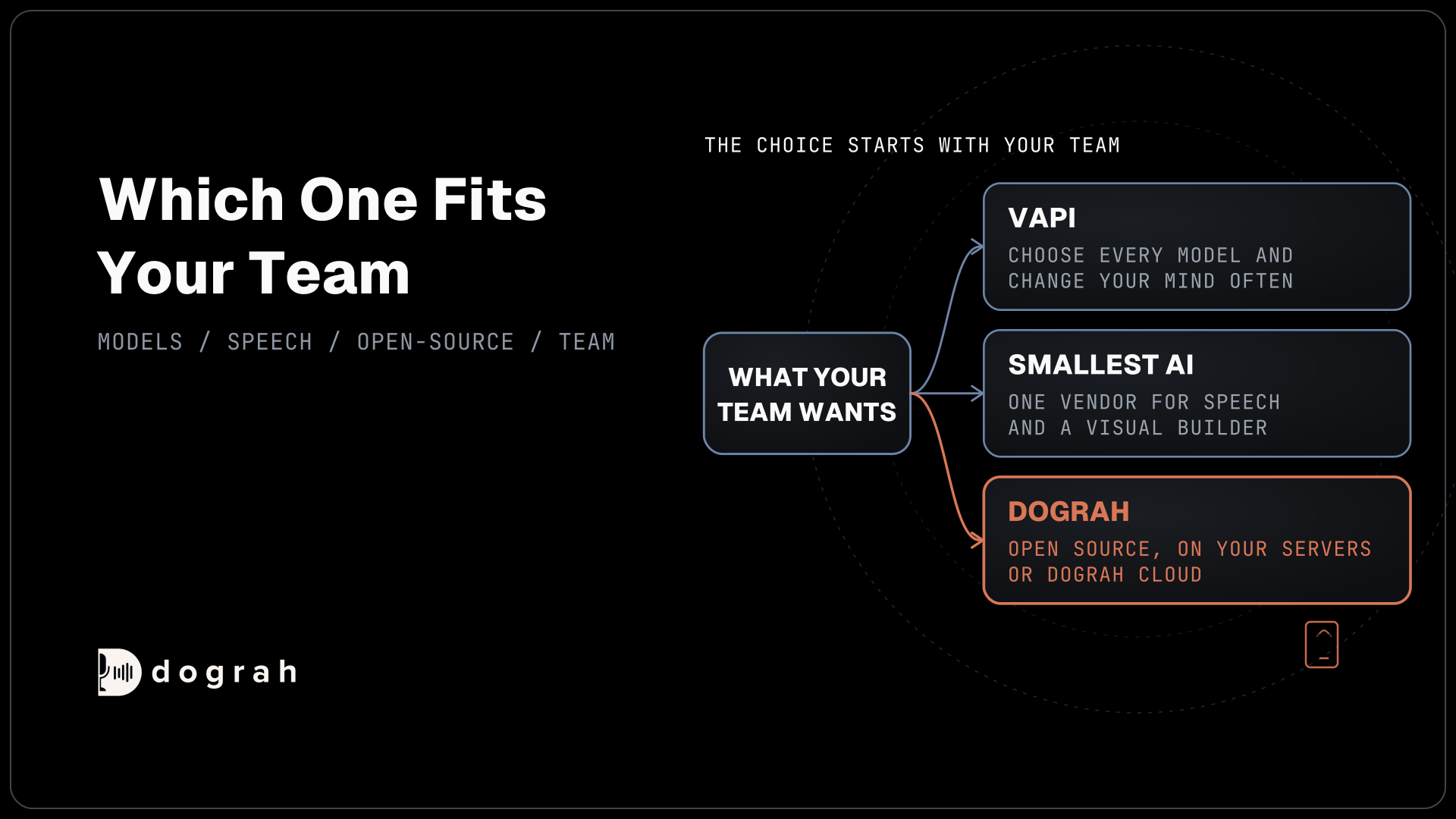

Vapi suits developers who want to pick every model, paying $0.05 a minute for hosting plus each provider at cost. Smallest AI suits teams that want one vendor's speech models, with a minute from $0.05 depending on the models and 20 calls at once. Dograh is the open-source option, for teams that want to run the platform themselves.
Key Takeaways
- Vapi charges $0.05 a minute to host the call, with every model billed at cost.
- Smallest charges $0.01 a minute hosting and fills the call with its own speech models.
- Smallest's Lightning voice also runs inside Vapi, so the two can work together.
Vapi and Smallest AI both run phone agents, but Vapi rents you other companies' models while Smallest sells its own. We table both, show how they combine, price one month, then compare limits and compliance and say who each fits. If you want open source, the last section covers Dograh.
Vapi and Smallest AI in one table
Vapi is an orchestration platform that bills $0.05 a minute for running the call, while Smallest's Atoms platform runs agents on Smallest's own speech models. Read the table as two different ideas of what a voice platform should sell.
| Row | Vapi | Smallest AI |
|---|---|---|
| How you pay | $0.05 a minute hosting, models and phone at cost | Pay as you go from $0.05 a minute, varying by model, with $0.01 a minute hosting |
| Plans | No package, Core $29 a month, Pro from $999 a month, Premier custom | Pay as you go, Enterprise custom |
| Speech and language models | Any supported provider, your own keys, or a custom language model at your URL | Smallest's Lightning voices and Pulse speech-to-text, plus language models at cost |
| Builder | Assistants and Squads, in code or the dashboard | Atoms visual builder with APIs, version history and rollback |
| Calls at once | 4 with no package, 10 on Core, 30 on Pro, extra lines $10 a month | 20 on pay as you go, more only on Enterprise |
| Phone | Vapi numbers, your own carrier or a SIP trunk | Smallest numbers at $10 a month, or your own carrier over SIP at cost |
| HIPAA | $2,000-a-month add-on with a BAA | Zero data retention add-on at $1,000 a month |
| Where it runs | Vapi's cloud | Smallest's cloud, on-premise on Enterprise |
| Free start | $5 credit | $10 in free credits |
Who supplies the models on each call
The real dividing line is who owns the speech models. On Vapi you pick the speech-to-text, the language model and the voice from Vapi's provider list, or you bring your own keys and even a custom language model at a URL you host. Each provider bills at its own rate, and Vapi adds its $0.05 for running the call.
That freedom has a cost in engineering time. Every new mix of providers changes latency and accuracy, so your team tests each combination over real calls before it ships. Vapi builds agents as Assistants and Squads, groups of assistants that pass a call between them, since its visual Workflows were retired in August 2026.
Smallest works the other way round and ships its own models. They include Lightning voices, Pulse speech-to-text in 38 languages, Electron, a language model under 3 billion parameters, and Hydra, a speech-to-speech model. Larger language models such as ChatGPT 4.1 are billed at cost on top. The Atoms builder is visual, with APIs when you need them, and keeps version history with rollback.
So Vapi is a switchboard for other vendors' models, and Smallest is one vendor's stack with a builder on top. If your team likes to swap models as new ones appear, Vapi fits that habit. If you would rather own one relationship for speech, Smallest does.
Smallest's voice can run inside Vapi
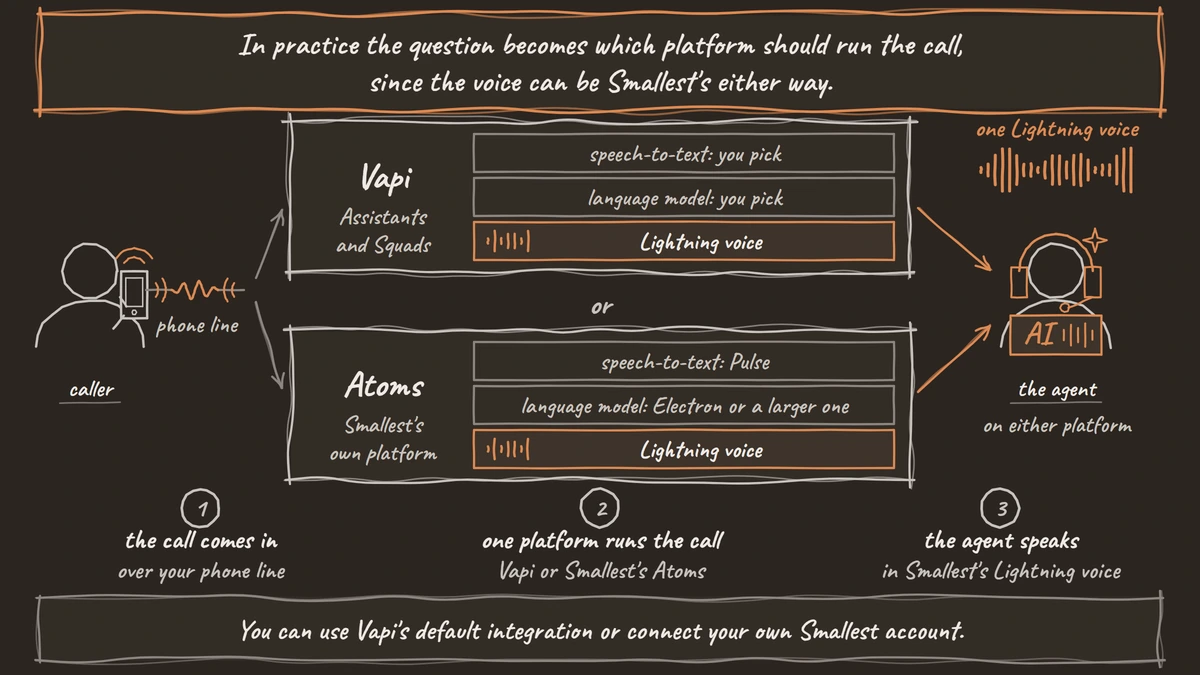
The two are not strict rivals, because one can borrow the other's voice. Vapi supports Smallest as a voice provider. You set the assistant's voice provider to smallest-ai and the model to lightning, then pick a voice ID from the library. You can use Vapi's default integration or connect your own Smallest account.
That gives you a third choice. A team that likes Vapi's Squads and API can keep them and still give callers Smallest's Lightning voice. What stays on Atoms is the rest of Smallest's stack: Pulse speech-to-text, the Electron language model and the Hydra speech-to-speech model, plus Smallest's own builder.
In practice the question becomes which platform should run the call, since the voice can be Smallest's either way. That shifts the decision to the builder, the limits and the bill, which the next sections cover.
What 10,000 minutes a month costs
A worked example puts the two price models on one footing. Take 10,000 call minutes in one month and count only the platform line, because both let you bring your own carrier and the models depend on what you pick. At three minutes a call, that is about 3,300 calls.
| Plan | Platform line for 10,000 minutes | Still to add |
|---|---|---|
| Vapi, no package | 10,000 x $0.05 = $500 | All models at cost, phone, 4 calls at once |
| Vapi Core | $29 + $500 = $529 | All models at cost, phone, 10 calls at once |
| Smallest pay as you go | 10,000 x $0.01 = $100 hosting | Smallest's speech models and the language model, phone, 20 calls at once |
| Dograh Cloud | 10,000 x $0.01 = $100 | Your model keys and carrier |
The rows are not like for like. On Vapi, $500 is only the fee for running calls, and every model sits on top. On Smallest, the $100 hosting line is small, but the models fill most of the minute. A full pay-as-you-go minute on Smallest starts from $0.05, varying with the models selected, so the same month starts from $500 there with the models included.
Our breakdown of Smallest AI pricing adds up a full minute layer by layer, speech-to-text, language model, voice and hosting. On Vapi, price the exact models you plan to run before you compare, because a large language model can cost more than the hosting fee.

Open Source Alternative to Vapi / Retell
Self-hosted voice agent platform — no per-minute fees
dograh-hq/dograh
Star on GitHub
Calls at once, HIPAA and where each runs
Limits split the two more sharply than price does. Vapi allows 4 calls at once with no package, 10 on Core and 30 on Pro, and sells extra lines at $10 a month each. A line that needs 25 calls at once can take Core plus 15 extra lines, $179 a month before any minutes.
Smallest includes 20 calls at once on pay as you go and sells no extra lines on that plan. The 21st caller at the same moment needs an Enterprise contract, which is also where custom concurrency, dedicated infrastructure and forward-deployed engineers sit.
For patient calls, both sell HIPAA as an add-on. Vapi's costs $2,000 a month and comes with a business associate agreement (BAA) under the Health Insurance Portability and Accountability Act (HIPAA). Smallest's zero data retention add-on costs $1,000 a month on pay as you go. Smallest lists SOC 2 and single sign-on (SSO) under Enterprise, so a security review that asks for a SOC 2 report starts a sales conversation there.
Hosting follows the same pattern. Vapi runs only in its own cloud. Smallest offers on-premise deployment on Enterprise. In both cases the platform code stays closed, so you run or rent software you cannot read or change.
Join the Dograh Community
Dograh is an OSS alternative to Vapi. Join our Slack community for queries, releases, best practices & community interactions.
Which one fits your team
Vapi fits developer teams that want to choose every model and change their minds often. If you already know which language model you want, need more than 20 calls at once without a contract, or want to mix Smallest's voice with another company's speech-to-text, Vapi gives you that room. It fits less well when nobody on the team wants to own testing and tuning.
Smallest fits a team that wants one vendor for speech and a visual builder, with steady traffic under 20 calls at once. One relationship for the voice and the transcription is simpler to manage, and the $1,000 HIPAA add-on is half of Vapi's. It fits less well once peaks pass 20 calls or a buyer asks for SOC 2 before you are ready for Enterprise.
Test either one on a real phone number before you sign. Phone networks still deliver most calls to the agent as 8 kHz audio, while a browser demo runs at 16 kHz, so a voice and a transcriber that sound sharp in the dashboard can stumble once a real caller dials in.
Where Dograh fits as the open-source option
If neither closed platform suits you, Dograh is the open-source third option. It runs the call flow, tools and phone line, and you choose every model under it. Smallest's Lightning voices and Pulse speech-to-text are built-in providers on your own Smallest key, set as the agent's voice provider, next to any other LLM, speech-to-text and voice, or open models on your own servers.
Self-hosted Dograh has no per-minute platform fee, but servers, model keys and phone minutes still cost money. Dograh Cloud charges a 1¢-a-minute platform fee. That is the $100 line in the example above. Pre-recorded clips can play your agent's most common lines, with the voice model filling in the rest, which trims the voice bill further.
Call limits are yours to set. Self-hosted, Dograh runs 10 calls at once by default, raised with one environment setting, and your servers and carrier set the real ceiling. Dograh Cloud's pay as you go includes 10, with more on request. When a model provider caps you instead, several API keys from separate accounts with that provider can add capacity, where the provider counts its limit per account.
For patient calls, a self-hosted install needs no BAA with Dograh, because the calls never reach us. Model providers may need their own, and so may the phone carrier, depending on what it stores.
The QA step scores each step of test and live calls, and you choose what share of calls it samples. That is how you catch an agent drifting after a prompt change without listening to every recording.
When a score looks off, the call trace breaks every turn into speech-to-text, AI and voice time. You can see whether a slow reply came from the language model or the voice, and fix that one layer.
For the wider field, see our guides to Vapi alternatives and Smallest AI alternatives.
Glossary
- Hosting fee
- A platform's charge for running the call itself, separate from the models. Vapi charges $0.05 a minute and Smallest $0.01 a minute, with speech and language models billed on top.
- Zero data retention add-on
- Smallest's $1,000-a-month pay-as-you-go option for HIPAA work, which stops Smallest keeping call data. Vapi sells its own HIPAA add-on at $2,000 a month with a BAA.
- Calls at once
- How many calls an account can run at the same moment. Vapi allows 4, 10 or 30 by package plus $10 lines, and Smallest's pay as you go allows 20 with no extra lines.
- Bring your own key (BYOK)
- Connecting a model provider with your own account key, so that provider bills you directly. Vapi and Dograh both accept your own keys, and Vapi can also use Smallest through its default integration.