
Retell AI suits teams that want a hosted phone agent running fast, at $0.055 a minute plus models and phone, in Retell's cloud. Pipecat suits developers who want open-source code and will build the phone product themselves. Dograh, the open-source AI voice agent platform we build on a Pipecat fork, is the middle option, phone product included.
Key Takeaways
- Retell bills $0.055 a minute before models and phone, in its own cloud.
- Pipecat is free code, but transfers need Daily PSTN or SIP.
- Pipecat Cloud's smallest agent costs $0.01 an active minute to host.
Retell AI is a product you configure, and Pipecat is a toolkit you build with. We put both in one table, then cover what each handles for you, one month priced on each, data and HIPAA, and who each fits. The last section covers Dograh, Pipecat with the product built.
Retell AI, Pipecat and Dograh in one table
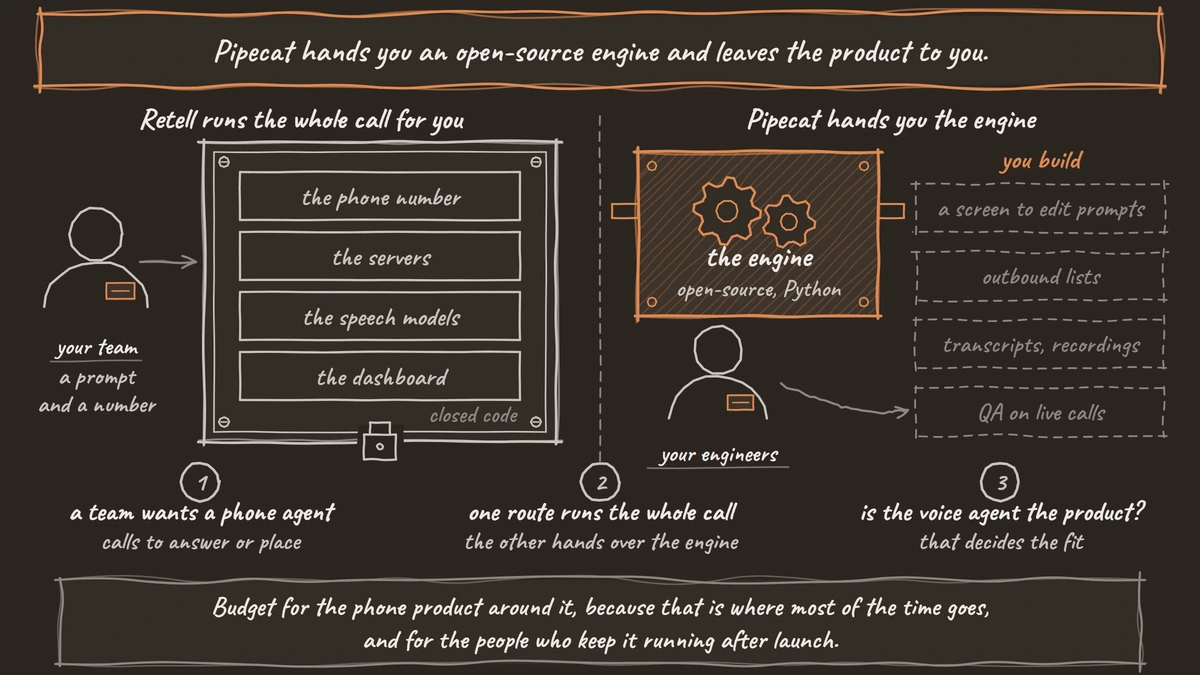
Retell runs the whole call for you, Pipecat gives you the engine, and Dograh sits between them. The rows show where each one stops and your own work begins.
| Row | Retell AI | Pipecat | Dograh |
|---|---|---|---|
| What it is | Hosted voice agent platform | Open-source Python framework | Open-source AI voice agent platform on a Pipecat fork |
| Code | Closed | BSD-2-Clause | BSD 2-Clause |
| Where it runs | Retell's cloud, VPC or on-prem on Enterprise | Your servers, or Pipecat Cloud | Your servers, or Dograh Cloud |
| Platform price | $0.055 a minute, models and phone on top | Framework free, Pipecat Cloud from $0.01 an active minute | Self-hosted no per-minute fee, Cloud a 1¢-a-minute platform fee |
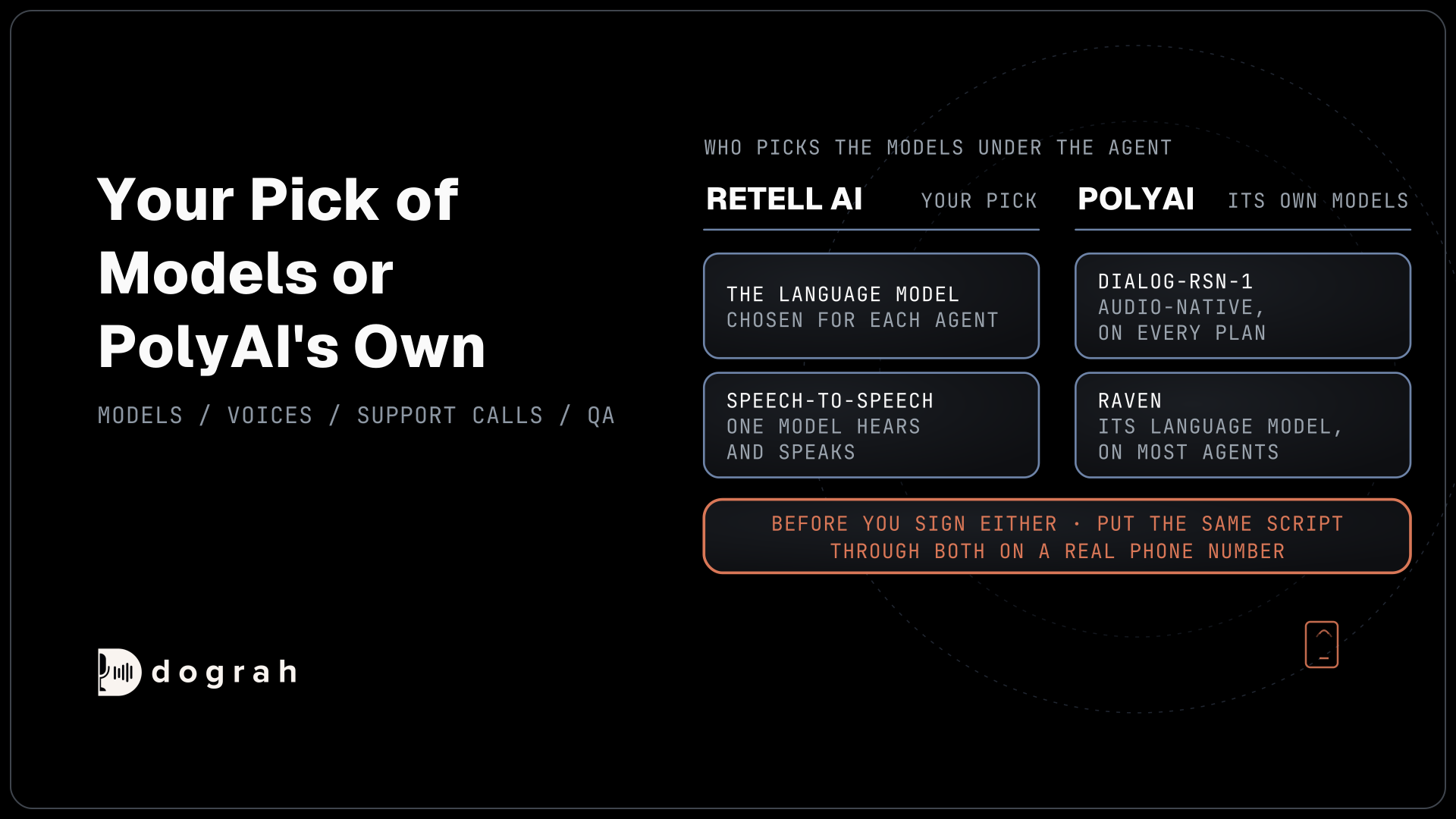
| Models | Picked from Retell's list | Any provider you wire in | Your own keys for any provider, or local models |
| Calls at once | 20 included, $8 a month each extra | Whatever your servers carry | 10 by default self-hosted, set by you |
| Transfer to a person | Built in | Daily PSTN or SIP routes, built by you | Transfer Call on Twilio, Telnyx, Plivo, Cloudonix and Asterisk ARI |
| Builder and QA | Prompt agents, Conversation Flow, paid add-ons | None, you build them | Visual workflow builder, built-in QA, call traces |
| HIPAA | Self-signed BAA at no extra fee | Your deployment, your agreements | Self-hosted needs no BAA with Dograh |
| EU | Retell does not operate services in the EU | Where you deploy it | Where you self-host it |
What Retell takes off your hands
Retell takes the whole call off your hands, from the phone number to the dashboard. You write a prompt or lay out a Conversation Flow, pick a model and a voice from its list, and point a number at the agent. Retell runs the servers, the speech models and the call lifecycle, and it also sells speech-to-speech options such as GPT-Live 1 and Grok Voice 3.0.
The price is a stack of per-minute charges. Retell charges $0.055 a minute for voice infrastructure, then bills the language model, the voice and telephony on top, each by the minute. A workspace includes 20 calls at once, and each extra line costs $8 a month. Above the limit, burst concurrency takes extra calls at $0.10 a minute for the whole call, up to the lower of three times your limit or your limit plus 300. Inbound calls past that wait in a queue for about 40 seconds and then go to the number's fallback number.
What you accept in return is Retell's cloud and Retell's code. You cannot read or change the platform, every minute carries the platform fee, and features such as QA are paid add-ons. For a team that wants a working phone agent this week, that trade is often fine. The trouble starts later, when you want a model Retell does not list, a change to how turns end, or call data in a region Retell does not serve. Then the answer depends on Retell's roadmap rather than your own.
What Pipecat hands you, and what it leaves
Pipecat hands you an open-source engine and leaves the product to you. It is a Python framework from Daily under the BSD-2-Clause license, with ready integrations for dozens of speech-to-text, language and voice services and the Smart Turn model for ending turns. You own every line of the pipeline and can change any part of it.
Phone calls show where the work starts. Pipecat connects to Twilio, Telnyx, Plivo and Exotel through WebSocket routes, which have no advanced call center features like transfers or reconnects. To hand a caller to a person, you move the agent to Daily PSTN or a SIP route, which gives "full control, including transfers".
Past the phone line, the product layer is yours to build: a screen where non-developers edit prompts, outbound lists with calling hours, stored transcripts and recordings, and QA on live calls. Our post on Dograh vs Pipecat walks through that list item by item.
Hosting can be yours or Daily's. Pipecat Cloud starts at $0.01 per active minute on the smallest agent size, with Daily phone calls at $0.018 a minute, and models billed by their own providers.

Open Source Alternative to Vapi / Retell
Self-hosted voice agent platform — no per-minute fees
dograh-hq/dograh
Star on GitHub
What 10,000 minutes a month costs
A worked example puts the three on the same footing. Take 10,000 call minutes in one month and count only the platform or hosting line, since every option still needs models and a phone line.
| Option | Platform or hosting line for 10,000 minutes | Still to add |
|---|---|---|
| Retell AI | 10,000 x $0.055 = $550 | Language model, voice and telephony per minute |
| Pipecat, self-hosted | $0 for the framework | Servers, models, phone and the engineering time to build the product |
| Pipecat Cloud, agent-1x | 10,000 x $0.01 = $100 | Models, phone (Daily PSTN 10,000 x $0.018 = $180 if used) and the product you build |
| Dograh Cloud | 10,000 x $0.01 = $100 | Your model keys and carrier |
| Dograh, self-hosted | $0 per minute | Servers, model keys and phone minutes |
The rows are not like for like. Retell's $550 buys a finished product with a dashboard, while Pipecat's $0 or $100 leaves you to build one, and engineering time is usually the largest cost in that row. Our breakdowns of Retell AI pricing and Pipecat Cloud pricing cover the model, voice and phone lines in full.
At this volume the platform line is small next to the models. It grows with volume, though. At 100,000 minutes a month, Retell's fee alone reaches $5,500, which is when teams start to ask whether they could host the platform themselves.
Data, HIPAA and where each runs
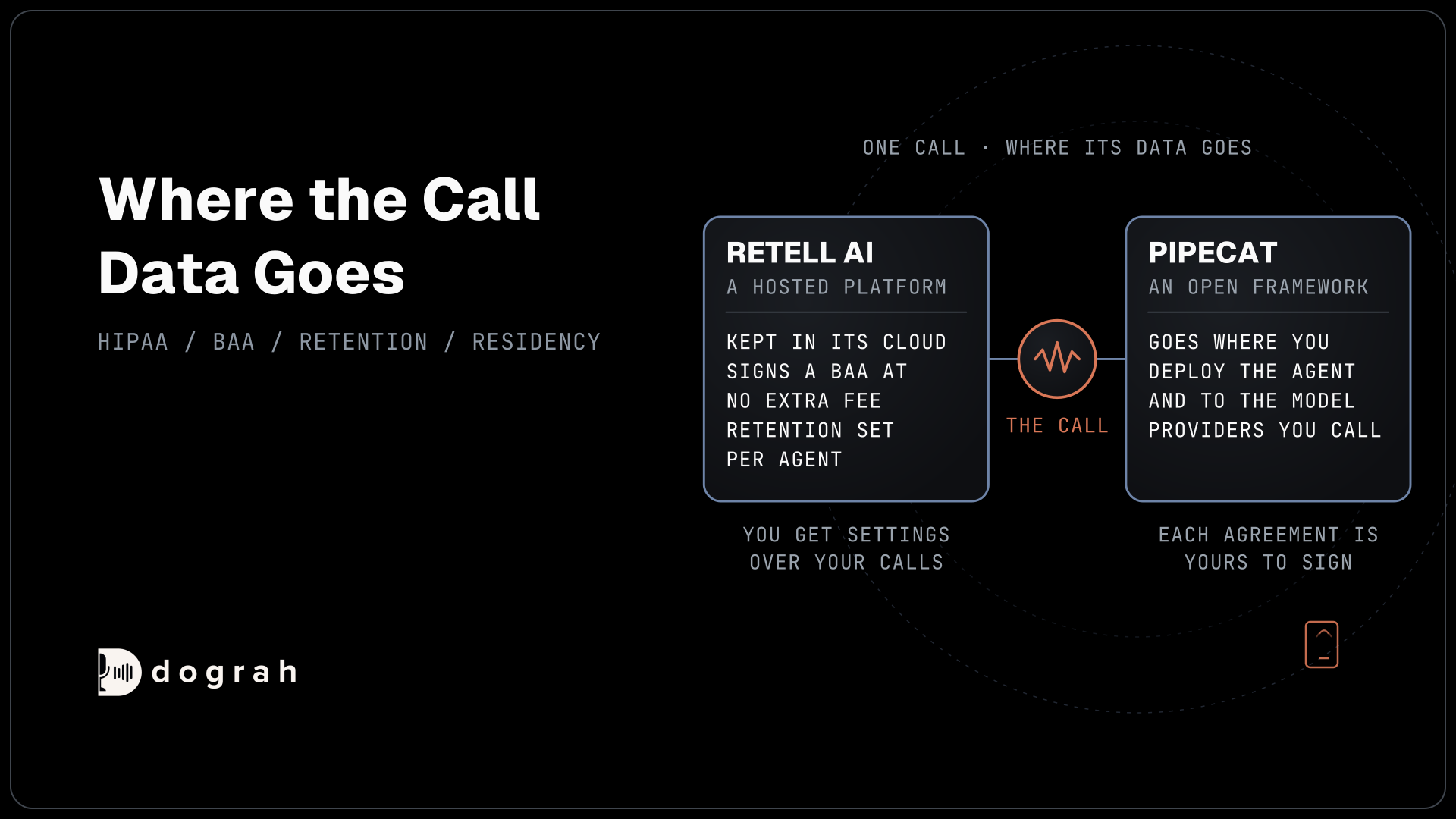
Retell keeps your calls in its cloud and gives you settings over them. Retell holds SOC 2 Type 1 and Type 2, signs a business associate agreement (BAA) under the Health Insurance Portability and Accountability Act (HIPAA) at no extra fee, and lets you set retention per agent from 1 day to 2 years. It also states that it does "not currently operate services within the European Union", which rules it out for teams that need EU processing.
Retell's own enterprise security post lists cloud, VPC or on-prem deployment for enterprises, with air-gapped operation. That comes through an Enterprise contract, with no published price, and the code stays closed.
Pipecat has no compliance story of its own because it is not a service. The audio goes wherever you deploy the agent and to whichever model providers you call. That gives you full control over residency, and it also means each agreement, from your cloud host to your speech provider, is yours to sign and check.
Join the Dograh Community
Dograh is an OSS alternative to Vapi. Join our Slack community for queries, releases, best practices & community interactions.
Which one fits your team
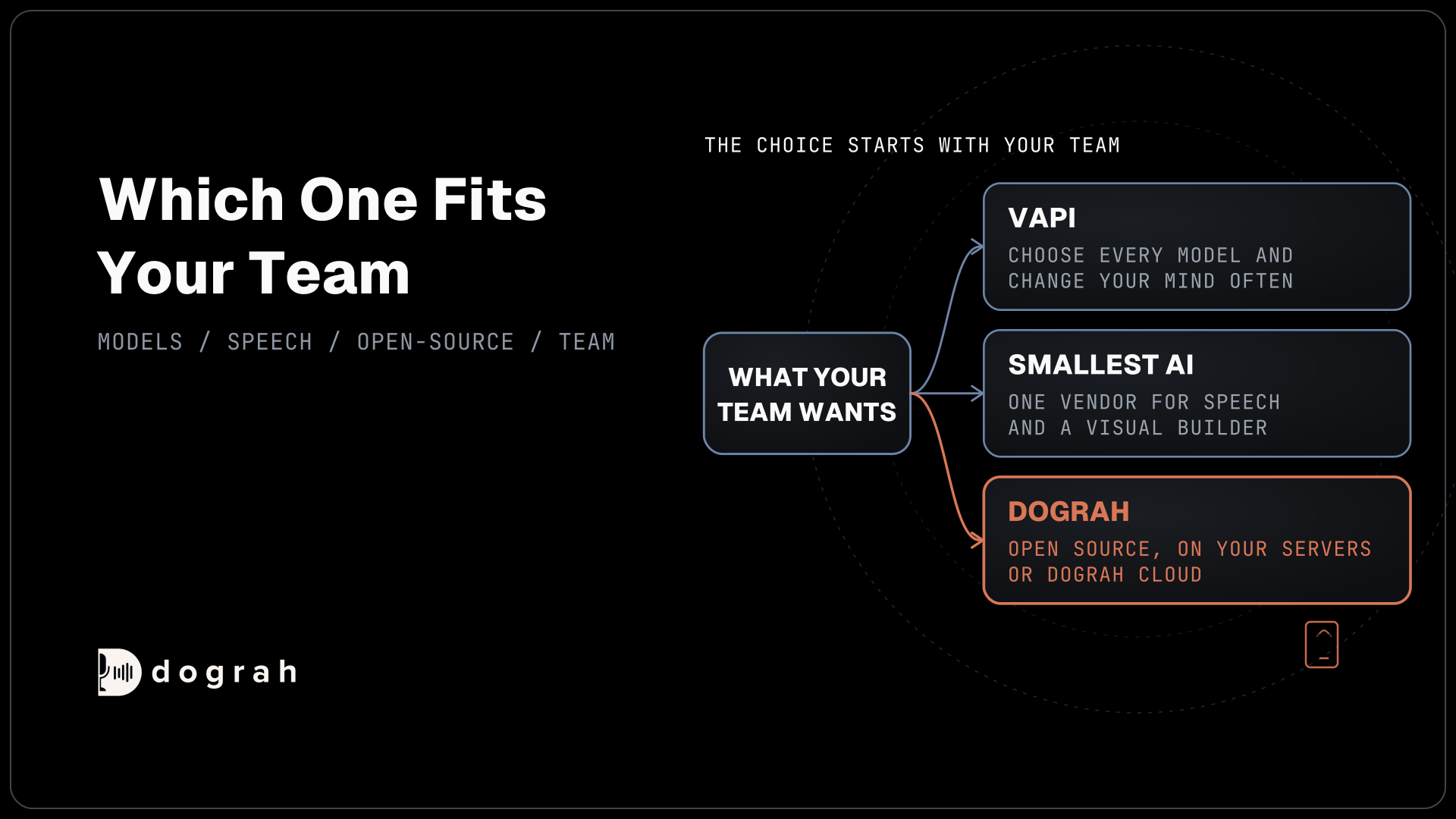
Retell fits a team that wants a phone agent live quickly without hiring voice engineers. If your calls are standard, such as booking, routing or reminders, your volume sits within 20 lines or a modest add-on, and you can live with Retell's cloud and per-minute fee, it gets you to production faster than any build. Agencies that build custom stacks still say managed platforms win on time to market, and we agree.
Pipecat fits a team with Python engineers whose voice agent is the product. If you need to change how turns end, run your own models on your own servers or embed voice into something that is not a call center, the framework gives you that control. Budget for the phone product around it, because that is where most of the time goes, and for the people who keep it running after launch.
Whichever you lean towards, pilot over a real phone number. Most phone calls still reach the agent as 8 kHz audio, while a browser demo runs at 16 kHz, so an agent that sounds right in a demo can mishear callers on the line.
Where Dograh fits: Pipecat underneath, product on top
Dograh is the middle path. It runs on a fork of Pipecat, kept close to the upstream code, and ships the product a Pipecat team would otherwise build: a visual workflow builder, campaigns, built-in QA, call traces, an MCP server and phone lines on Twilio, Telnyx, Plivo, Vonage, Exotel, Vobiz, Cloudonix, Asterisk ARI and WhatsApp. It is open-source under BSD 2-Clause, so you can read and change all of it.
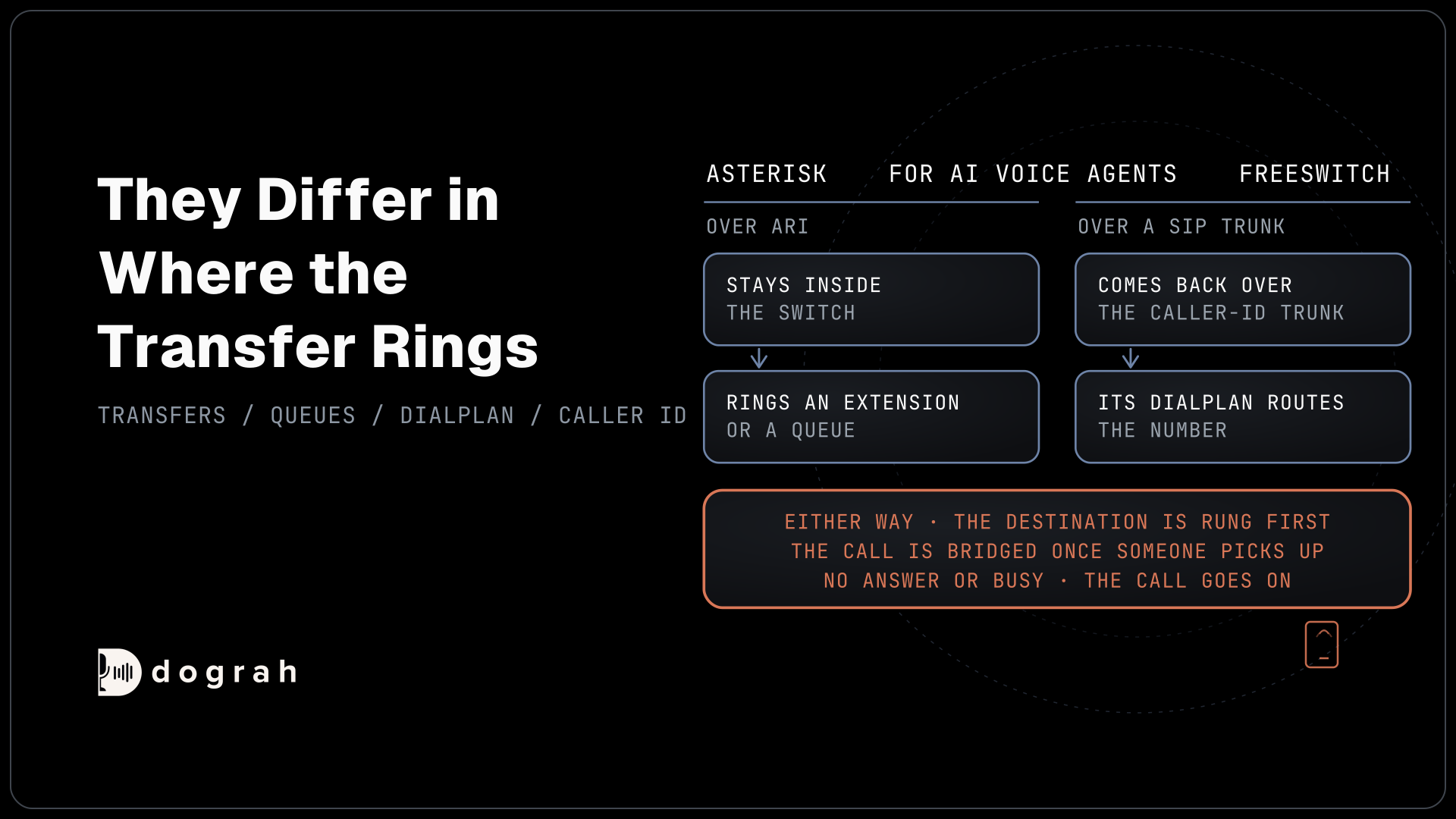
Transfer Call can pass a caller to a person on Twilio, Telnyx, Plivo, Cloudonix or Asterisk ARI. While the caller hears hold music, Dograh dials the destination and connects the two once someone answers. If nobody answers, the line is busy, the dial fails or it times out, the agent gets transfer_failed and the call goes on.
You bring your own keys for any language, speech-to-text and voice provider, or run open models on your own servers. Self-hosted Dograh has no per-minute platform fee, but servers, model keys and phone minutes still cost money. Dograh Cloud charges a 1¢-a-minute platform fee. Self-hosted, it runs 10 calls at once by default, raised with one environment setting, and your servers and carrier set the real ceiling.
For a healthcare line, a self-hosted install needs no BAA with Dograh, because the calls never reach us. Your model providers may need their own, and the phone carrier may need one depending on what it stores.
Quality checks come with the platform. The QA step scores each step of test and live calls on a sample you set, so you see which part of the flow went wrong instead of a single grade.
When a score looks off, the call trace shows the speech-to-text, AI and voice time for every turn.
For the wider field, see our guides to Retell AI alternatives and Pipecat alternatives.
Glossary
- Voice infrastructure
- Retell's per-minute charge for running the call, $0.055 a minute, billed before the language model, the voice and telephony. It applies to every minute whichever models you pick.
- WebSocket route
- A phone connection where the carrier streams call audio to the Pipecat pipeline over a WebSocket. Pipecat has them for Twilio, Telnyx, Plivo and Exotel among others, and those routes do not carry transfers.
- Burst concurrency
- Retell's option to take calls above a workspace's limit at $0.10 a minute for the whole call, up to the lower of three times the limit or the limit plus 300.
- Active minute
- The unit Pipecat Cloud bills, a minute in which an agent instance is running, from $0.01 on the smallest agent size. Phone time and models are billed separately.