
Pipecat Cloud bills each active agent minute, from $0.01 on the smallest agent-1x size, with phone, recording and models billed on top. In our example month of 1,000 five-minute calls over Daily PSTN, hosting and phone minutes come to $140 before models. Dograh, the open-source AI voice agent platform we build on Pipecat, runs self-hosted or on Dograh Cloud.
Key Takeaways
- Pipecat Cloud bills each active agent minute, $0.01 to $0.03 by size.
- On Daily's phone lines, phone minutes cost more than the hosting.
- Reserved agents bill every minute they stay on, calls or not.
Pipecat Cloud's pricing has many lines, and only a few of them matter for a phone agent on real calls. We turn those lines into one month of calls, then price the same month on self-hosted Pipecat and on Dograh, which runs on a fork of Pipecat.
How Pipecat Cloud charges
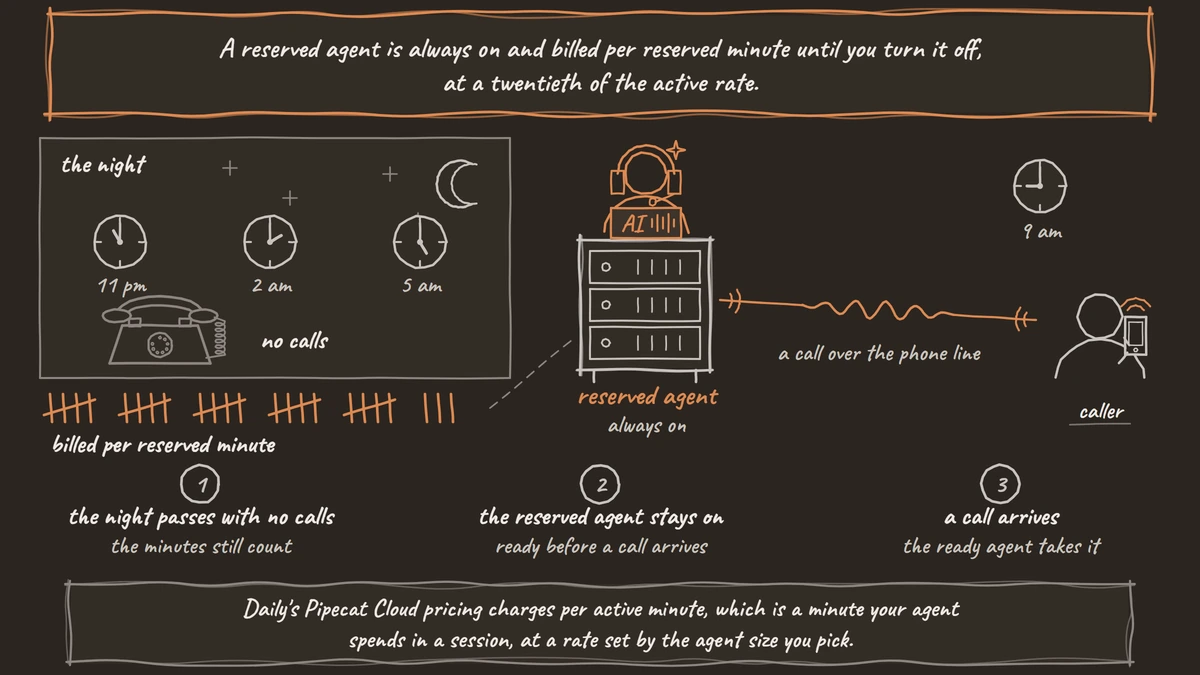
Pipecat Cloud is Daily's hosting for agents written with Pipecat, the open-source framework. You give it an agent image, and it handles deploys, session starts, scaling and logs. Daily's Pipecat Cloud pricing charges per active minute, which is a minute your agent spends in a session, at a rate set by the agent size you pick.
| Agent size | CPU and memory | Active minute | Reserved minute |
|---|---|---|---|
| agent-1x | 0.5 vCPU, 1 GB | $0.01 | $0.0005 |
| agent-2x | 1 vCPU, 2 GB | $0.02 | $0.0010 |
| agent-3x | 1.5 vCPU, 3 GB | $0.03 | $0.0015 |
A phone agent whose models run at outside providers mostly passes audio and text between them, so agent-1x is a sensible first size to test. Pipecat Cloud scales agents up from zero with demand, between the min_agents and max_agents you set, and concurrency is unlimited. Agents run in Daily-hosted regions in the US, Europe and India. If your agent needs more room, for example to run a local turn-taking model, agent-2x doubles the hosting line, so the same minutes cost twice as much.
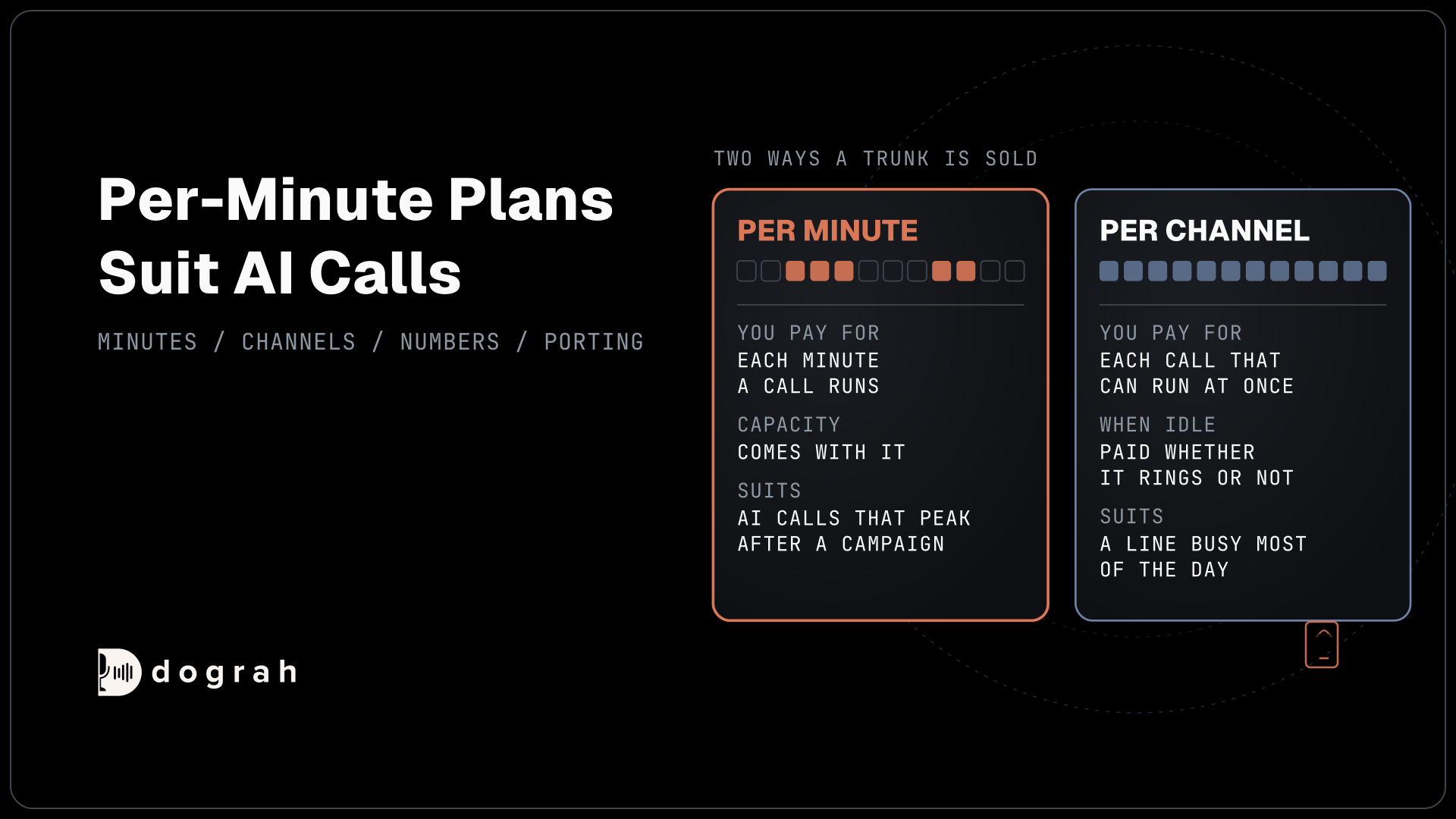
Reserved agents are the second price. A reserved agent is always on and billed per reserved minute until you turn it off, at a twentieth of the active rate. Keeping one agent-1x reserved for a 30-day month is 43,200 minutes x $0.0005, or $21.60, whether or not a call comes in.
Enterprise adds volume pricing, single sign-on, custom data residency and 24/7 support, all through sales. Pipecat Enterprise can also run agents in a Kubernetes cluster in your own VPC, with Daily running the control plane.
Phone, recording and other charges
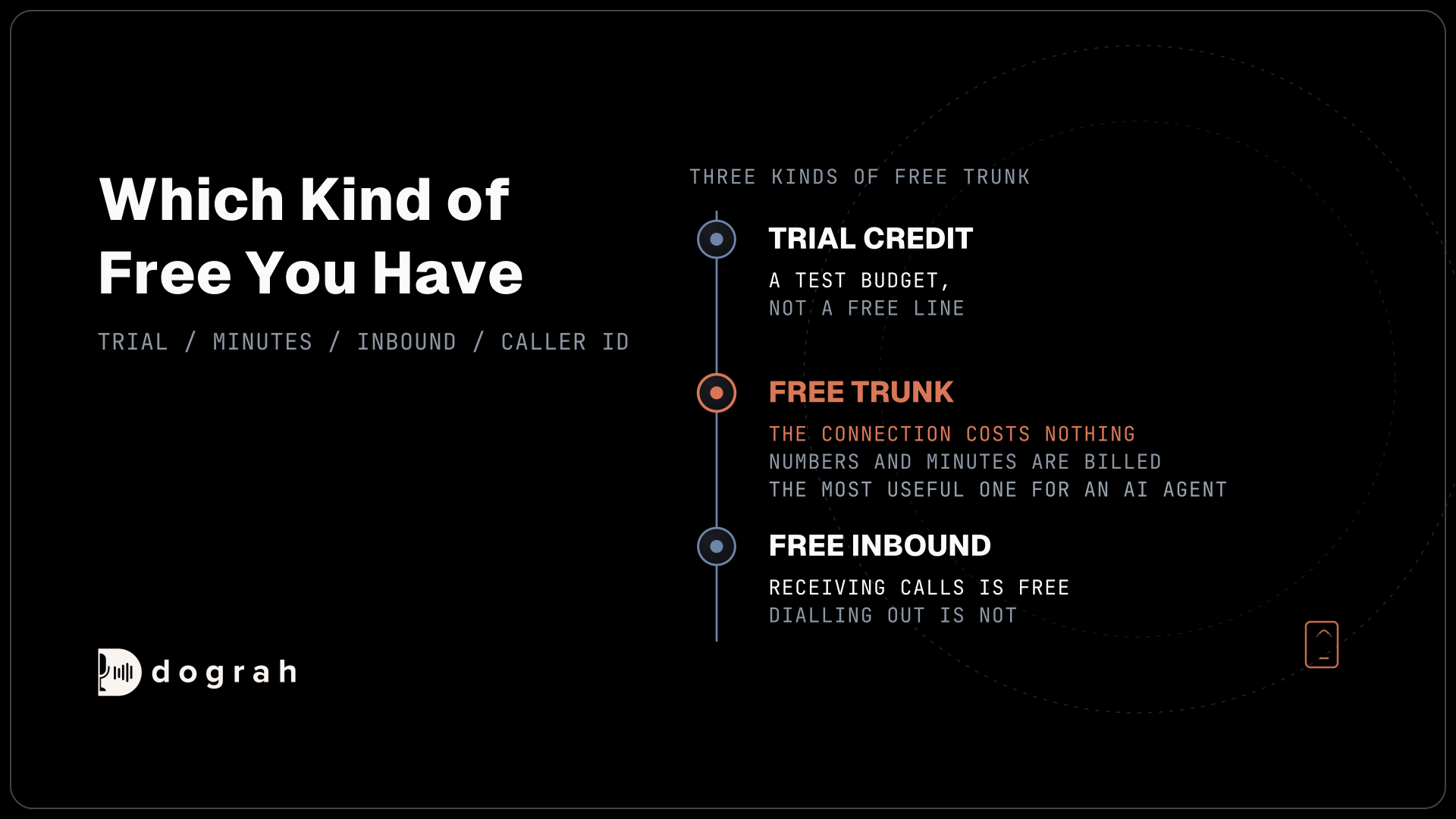
The phone line is often the biggest line, and Daily sells it two ways. Daily PSTN dial-in and dial-out, with SIP included, is $0.018 a minute, and Daily SIP dial-in and dial-out is $0.003 to $0.02 a minute. If your agent connects to Twilio over a WebSocket, Twilio bills you directly at its own rates. Browser calls over Daily WebRTC are free for one-to-one voice.
Transfers cost extra and depend on the route. A SIP REFER transfer is $0.20 per event, after which Daily leaves the call. On Pipecat's telephony routes, the WebSocket integrations with Twilio, Telnyx, Plivo and Exotel come without advanced call centre features such as transfers or reconnects, so a support line that hands callers to staff needs the SIP or PSTN route.
The smaller lines add up on busy months. Krisp VIVA noise cancellation is free up to 10,000 active session minutes a month, then $0.0015 a minute. Recording is $0.005 a minute for audio, plus $0.003 a minute for storage. Speech and language models are billed by your own providers, or bundled through Enterprise Integrated Billing.
One month of calls on Pipecat Cloud
Here is one example month, built only from published rates. A business line takes 1,000 inbound calls, each about 5 minutes, so the agent runs for 5,000 minutes. Each call uses one agent-1x, and the calls arrive over Daily PSTN.
| Line | Rate | 5,000 minutes |
|---|---|---|
| agent-1x hosting | $0.01 per active minute | $50.00 |
| Daily PSTN dial-in | $0.018 a minute | $90.00 |
| Krisp VIVA | Free up to 10,000 minutes | $0.00 |
| Subtotal | $140.00 | |
| Recording, if every call is recorded | $0.005 + $0.003 storage a minute | $40.00 |
| Subtotal with recording | $180.00 |
So the month is $140 before models, or $180 with every call recorded, plus the phone number. Phone minutes are $90 of the $140, more than the hosting itself. Keeping one reserved agent on all month adds $21.60.
Volume moves one line you might not expect. At 3,000 calls, or 15,000 minutes, hosting is $150 and Daily PSTN is $270, and Krisp VIVA now passes its free 10,000 minutes, so the extra 5,000 minutes add $7.50. That month is $427.50 before recording and models.
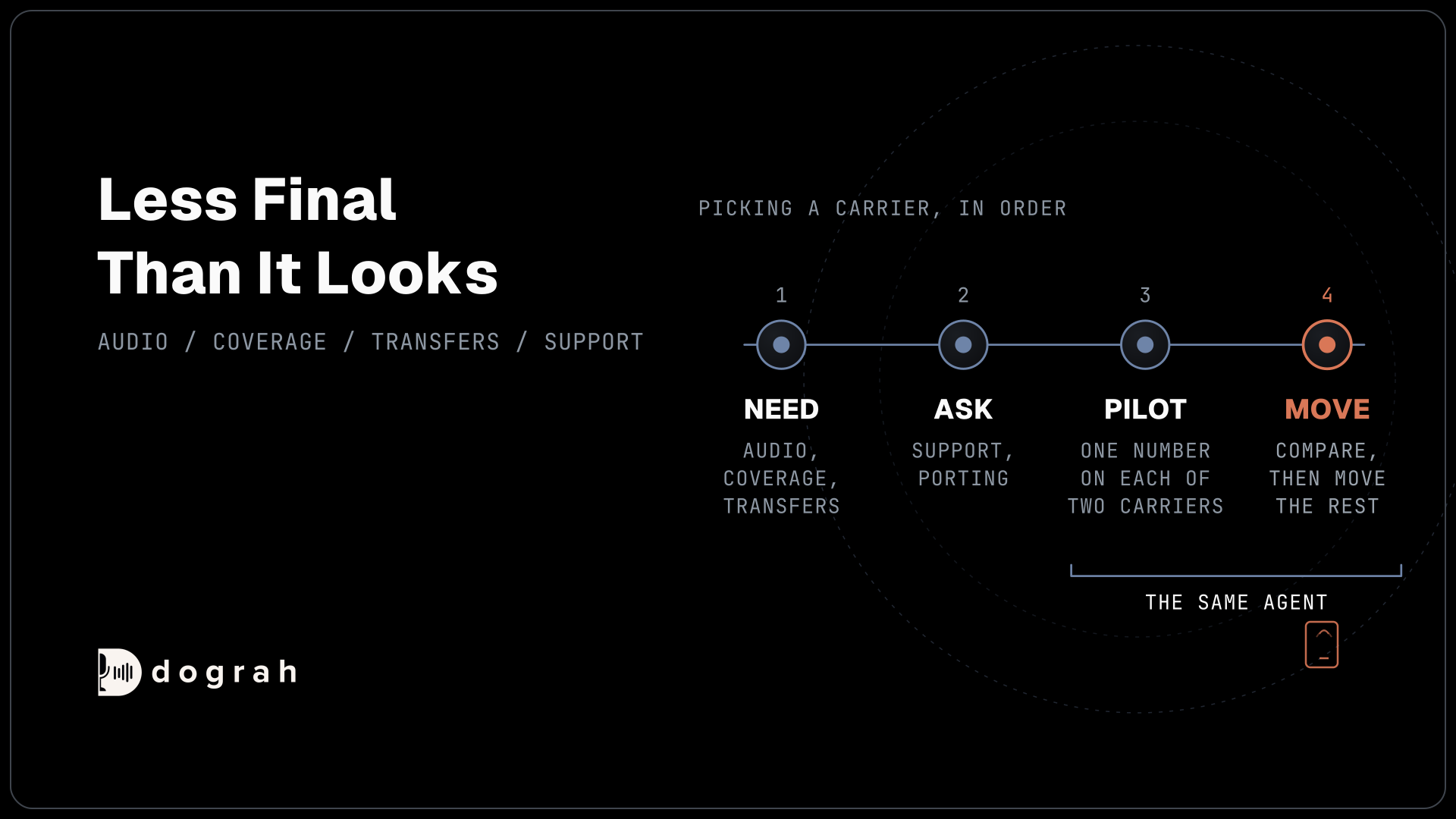
Bring your own Twilio number instead and the Daily phone line drops out. The agent connects over a Twilio Media Stream, so Twilio's own rates apply. That means $1.15 for a local number, $0.0085 a minute inbound and $0.0044 a minute for the stream, or $65.65 for the month. With $50 of hosting, that route is $115.65 before models, but it gives up transfers on the WebSocket route.
The models cost the same on every route, because your own provider keys pay for them. Our breakdown of what an AI voice agent costs per minute prices the speech-to-text, language model and voice lines, so this post holds them constant.

Open Source Alternative to Vapi / Retell
Self-hosted voice agent platform — no per-minute fees
dograh-hq/dograh
Star on GitHub
Self-hosting open-source Pipecat
The framework itself costs nothing. Pipecat is an open-source Python framework under the BSD 2-Clause licence, so you can run the same agent on your own servers and pay only for them. A DigitalOcean Basic droplet with 4 vCPUs and 8 GiB of memory is $48 a month, and one with 8 vCPUs and 16 GiB is $96.
How many calls one server carries depends on your agent, so test your own load before you size it. The carrier line does not change, so the Twilio month above becomes $48 plus $65.65, or $113.65 before models, on one small server.
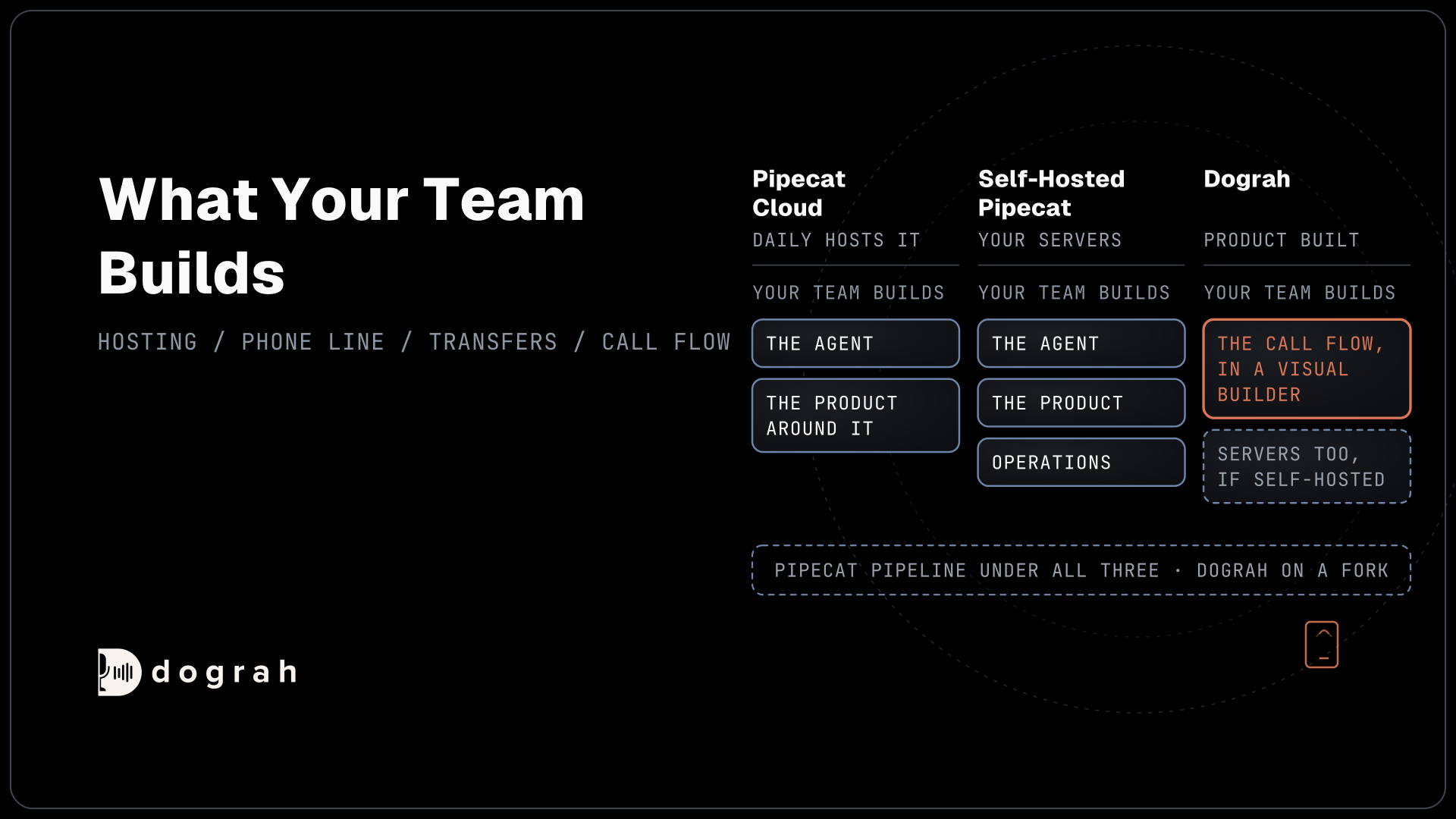
The larger cost is the work around the framework. Pipecat is an excellent base, but a production phone agent needs a lot more plumbing, such as telephony and transfers, retries for outbound lists, a dashboard for people who don't write code, call records, QA and monitoring. Your team builds all of it, then runs and upgrades it, on top of the server bill.
The same month on Dograh
The platform we build runs on a fork of Pipecat, so the same pipeline handles the audio and turn-taking, with the product around it already built. Self-hosted Dograh has no per-minute platform fee, but servers, model keys and phone minutes still cost money. Dograh Cloud charges a 1¢-a-minute platform fee. Pay as you go on the cloud includes 10 concurrent calls, with more on request.
On Dograh Cloud, the 5,000 minutes add $50 of platform fee. The Twilio line is the same $65.65, because Dograh connects to your own carrier, so the month is $115.65 before models. Self-hosted, the $50 becomes your server, such as the $48 droplet above, and the models stay on your own keys either way.
Concurrency is the other line to check. Pipecat Cloud lists it as unlimited, while Dograh Cloud's 10 included calls and self-hosted Dograh's default of 10 set a ceiling you can raise. Spread over 22 working days of 8 hours, 5,000 minutes average under one call at a time, so 10 leaves room for the busy hours.
What changes is the build. Dograh adds a visual workflow builder, Campaigns for outbound lists, full call traces, per-step QA and an MCP server. Its Transfer Call tool works on Twilio, Telnyx, Plivo, Cloudonix and Asterisk ARI, and Dograh dials the destination while the caller hears hold music, connecting once the destination answers. Pre-recorded clips can play for the lines your agent says most, with TTS as the fallback, which trims the voice bill.
A team already deep in Pipecat code should weigh what it keeps and what it hands over. Our Dograh vs Pipecat comparison goes through the builder, telephony and the pinned fork in detail.
Join the Dograh Community
Dograh is an OSS alternative to Vapi. Join our Slack community for queries, releases, best practices & community interactions.
Which option fits your team
Every route below prices the same 5,000 minutes before models, with the Twilio line at $65.65 wherever your own carrier is used. The totals land close together, so the last column, what your own team has to build, usually decides more than the price.
| Option | Hosting or platform | Phone line | Month before models | What your team builds |
|---|---|---|---|---|
| Pipecat Cloud with Daily PSTN | $50.00 | $90.00 plus the number | $140.00 | The agent and the product around it |
| Pipecat Cloud with your Twilio | $50.00 | $65.65 | $115.65 | The same, with no transfers on the WebSocket route |
| Self-hosted Pipecat | Your server, e.g. $48.00 | $65.65 | $113.65 | The agent, the product and the operations |
| Dograh Cloud | $50.00 platform fee | $65.65 | $115.65 | The call flow, in a visual builder |
| Self-hosted Dograh | Your server, e.g. $48.00 | $65.65 | $113.65 | The call flow, plus running the servers |
Pipecat Cloud suits a team that has written its agent in Pipecat and wants Daily to run it, with Daily's phone lines on the same bill. Self-hosting Pipecat suits a team that wants full control of the code and has engineers to build the product around it. Dograh suits a team that wants the same engine with that product already built, on its own servers or on Dograh Cloud. Our guide to Pipecat alternatives covers the other frameworks and hosted APIs.
Price your own month the same way. Count your minutes, pick the phone route, then add the models.
Glossary
- Active minute
- A minute an agent spends in a live session. Pipecat Cloud bills hosting by active minute, at $0.01 on agent-1x up to $0.03 on agent-3x.
- Reserved agent
- An agent kept running so it is ready before a call arrives. Pipecat Cloud bills it per reserved minute, from $0.0005 on agent-1x, until you turn it off, even when no call comes in.
- SIP REFER
- A SIP message that hands a live call to another number. Daily charges $0.20 per REFER event and leaves the call once the handoff succeeds.
- WebSocket route
- Sending call audio between the phone provider and the agent over a WebSocket stream, as Twilio Media Streams do. On Pipecat it is the simple route, without transfers or reconnects.