
Retell AI suits developers who build their own agent, at $0.055 a minute plus the models and phone they choose, with a free self-signed BAA. PolyAI suits contact centers that want its own models and, on Enterprise, an agent PolyAI or a partner builds. Dograh is the open-source voice agent platform we build, for teams that want to run the platform themselves.
Key Takeaways
- Retell charges $0.055 a minute plus the model, voice and phone you choose.
- PolyAI sells plans from $49 a month, or 9.5¢ a minute pay as you go.
- Retell's BAA is self-signed at no fee. PolyAI's BAA sits on Enterprise.
Retell gives developers a toolkit, while PolyAI's top tier gives you a team that builds the agent for you. We table both, compare who builds and which models run, price one month, then cover HIPAA, EU callers and fit. If you want open source, the last section covers Dograh.
Retell AI and PolyAI in one table
Retell bills a platform minute that your developers build on, while PolyAI sells plans with its own models inside and a managed build at the top. The table shows how that split plays out row by row.
| Row | Retell AI | PolyAI |
|---|---|---|
| How you pay | $0.055 a minute voice infrastructure, plus model, voice and phone | Plans with included minutes, or Platform pay as you go from 9.5¢ a minute |
| Plans | Pay as you go, Enterprise custom | Essentials $49, Plus $199, Scale $299 per location a month, Enterprise custom |
| Who builds | Your team: single-prompt, multi-prompt or Conversation Flow agents | Your team in Agent Studio, Wren or the ADK, or PolyAI or a partner on Enterprise |
| Models | Your pick from Retell's list, including speech-to-speech | Dialog-RSN-1 on every plan, Raven on most agents |
| Calls at once | 20 free, then $8 each a month | 5 on Essentials, 10 on Plus and Platform, 10 per location on Scale |
| Phone | Retell numbers at $2 a month, or your own SIP at no charge | A PolyAI number, or your own carrier over SIP at no charge |
| HIPAA | Self-signed BAA, no extra fee | HIPAA with a BAA on Enterprise |
| EU callers | Retell says it does not currently run services in the EU | US, UK, EU and APAC regions |
| Where it runs | Retell's cloud, with VPC or on-prem listed for Enterprise | PolyAI's cloud |
| Free start | $10 credit | $20 credit on Platform, free trials on plans |
Who builds and maintains the agent
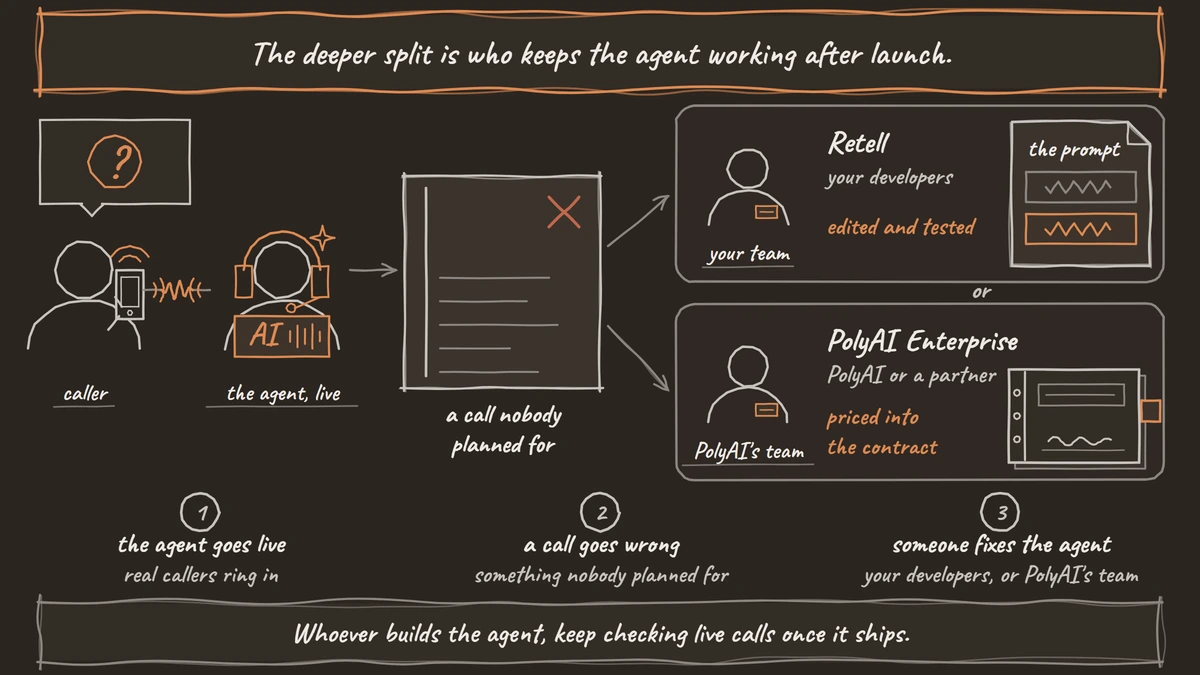
The deeper split is who keeps the agent working after launch. Retell is a developer platform. Your team writes the prompt, chooses between a single-prompt agent, a multi-prompt agent or a Conversation Flow with nodes for dialogue, tools and transfers, then tests and fixes it as calls come in. That suits teams with developers who want full control of every prompt and tool.
PolyAI now covers both ends, with several ways to build. Agent Studio is for visual building, Wren lets you describe an agent in plain words, and an Agent Development Kit (ADK) gives developers a Python package and Git workflow. Essentials and Plus put those tools in your hands for $49 or $199 a month.
The managed service starts higher up. Scale adds the Wren AI Suite, which reviews and improves your agent and adds custom AI scores. Enterprise goes further, with the agent built by PolyAI or a partner, a named account manager and 24/7 support.
So on Retell the hours after launch come from your developers. On PolyAI Enterprise they come from PolyAI's team, priced into the contract. Count that engineering time honestly before you compare the per-minute numbers.
Your pick of models or PolyAI's own
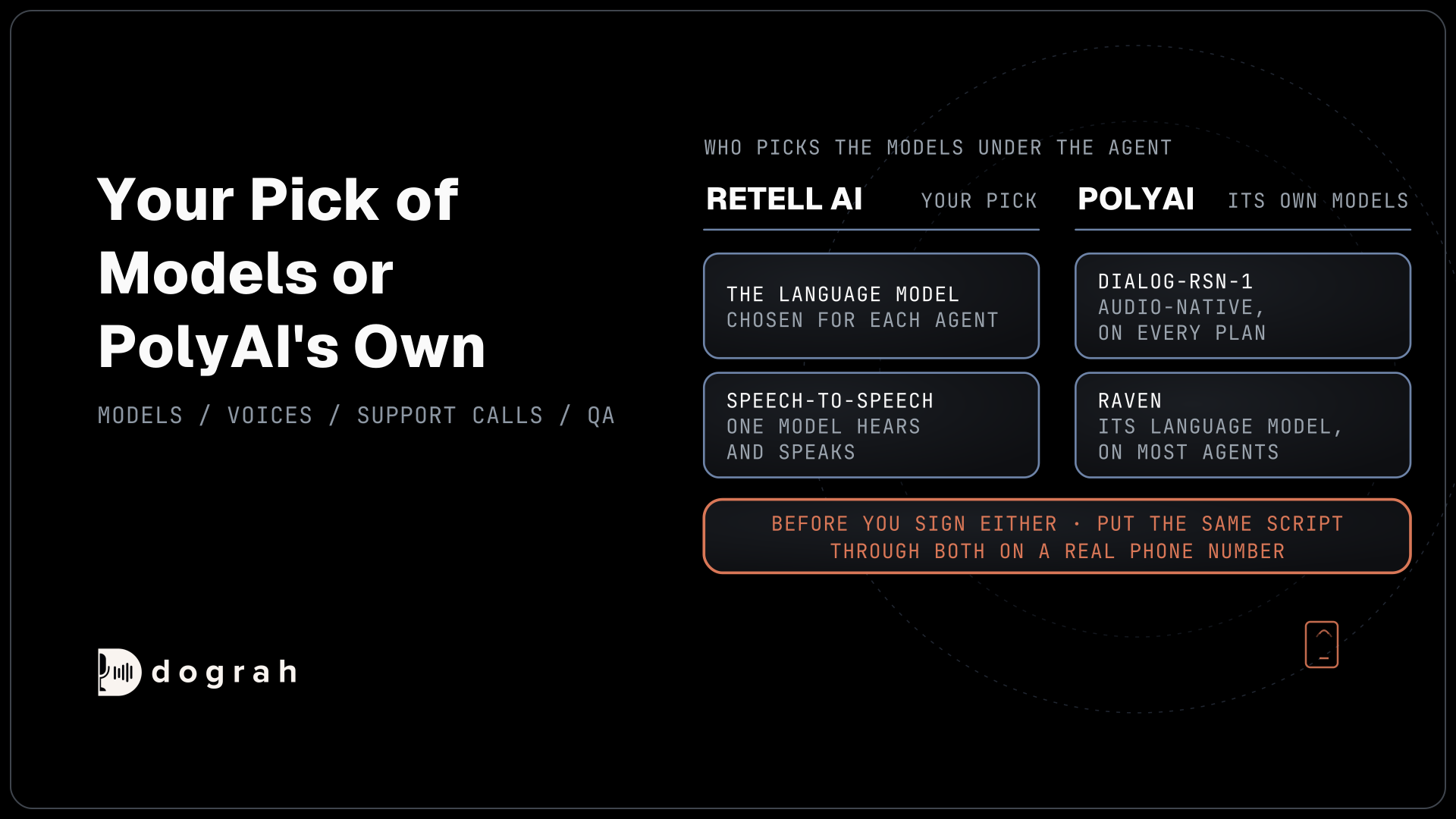
Retell lets you choose the language model for each agent and prices it per minute. Retell prices GPT 4.1 at $0.045, GPT 5.4 mini at $0.024 and Claude 4.5 Haiku at $0.025. Most voices cost $0.015 a minute, with ElevenLabs Flash at $0.040.
Retell also sells speech-to-speech models, where one model hears and speaks. GPT Realtime 2 and 2.1 cost $0.38 a minute, GPT Realtime 2.1 mini $0.07 and Grok Voice 3.0 $0.135. That range is wide, so the model you pick can move your bill more than Retell's own fee.
PolyAI leads with its own models. Every plan includes Dialog-RSN-1, PolyAI's audio-native model, and PolyAI says most agents run on Raven, its language model for customer service. You get a model tuned for support calls without choosing one, but you are tied to PolyAI's roadmap for when that model improves.
What 5,000 minutes a month costs
A worked example shows how differently the two bill. Take 1,000 support calls of five minutes each, 5,000 minutes in a month, on your own carrier, which both connect over SIP at no charge.
| Route | Line by line for 5,000 minutes | What it includes |
|---|---|---|
| Retell, GPT 4.1, standard voice | 5,000 x ($0.055 + $0.045 + $0.015) = $575 | Platform, model and voice, 20 calls at once |
| PolyAI Platform pay as you go | 5,000 x $0.095 = $475 | Platform, Dialog-RSN-1 and standard voice, 10 calls at once |
| PolyAI Plus | $199 + 4,000 x $0.25 = $1,199 | 1,000 minutes, CRM connectors, 10 calls at once |
| PolyAI Scale, one location | $299 + 3,500 x $0.20 = $999 | 1,500 minutes, Wren AI Suite, more connectors |
| Dograh Cloud | 5,000 x $0.01 = $50 | Platform only, your model keys and carrier on top |
The rows are not like for like. PolyAI sets the Platform rate at 9.5¢ and up, and the plans add connectors and Wren features that the pay-as-you-go minute does not. Both PolyAI routes bill connected time and never round a call up to the next minute.
On Retell, using its phone numbers adds $0.015 a minute, $75 here, plus $2 a month a number. A larger language model would raise the $575 too. Our breakdown of Retell AI pricing shows how each of its charges adds up.

Open Source Alternative to Vapi / Retell
Self-hosted voice agent platform — no per-minute fees
dograh-hq/dograh
Star on GitHub
HIPAA, EU callers and where each runs
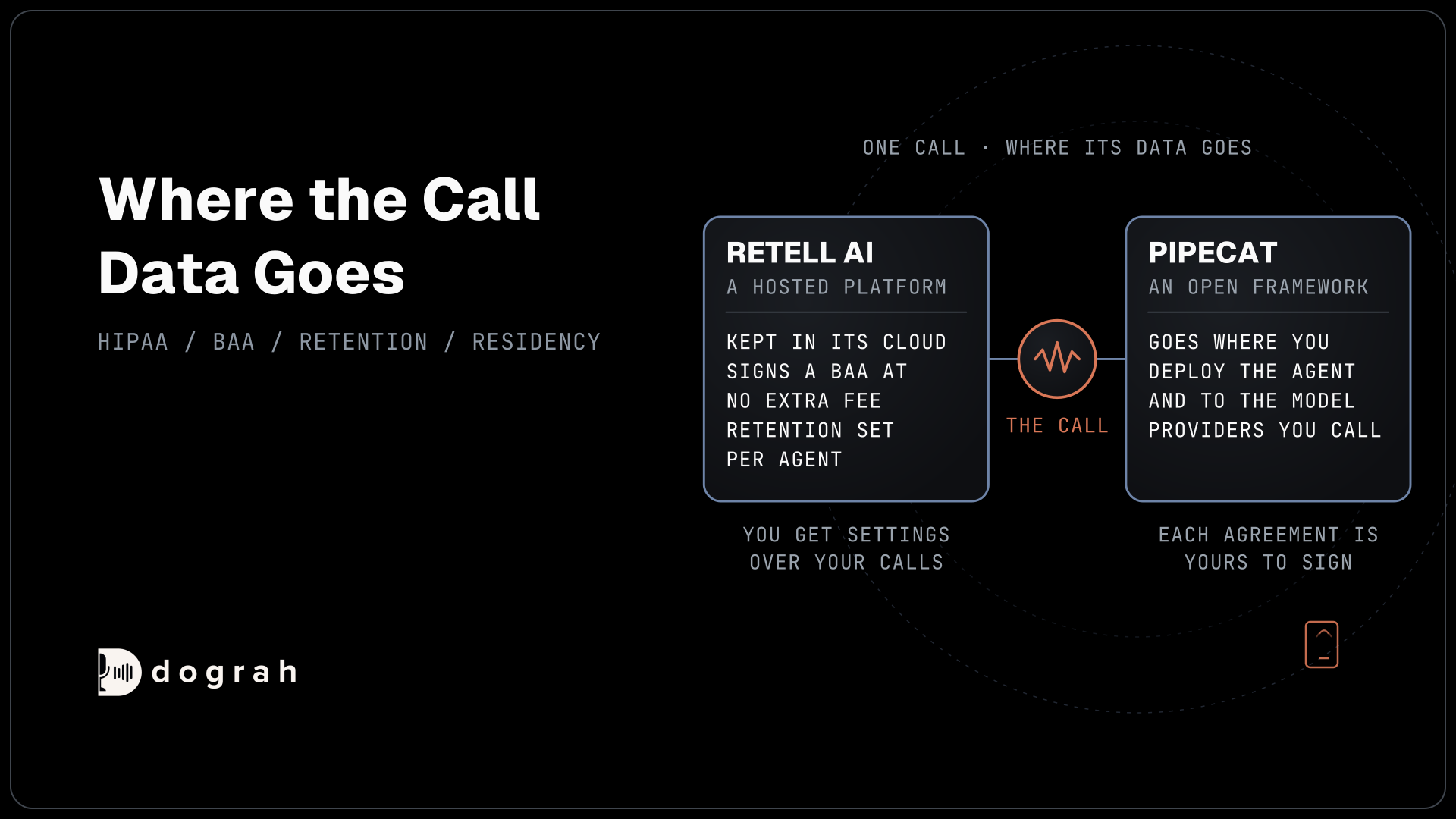
Compliance is where the two differ most for regulated teams. Retell covers HIPAA, GDPR and SOC 2 Type 1 and Type 2. Its business associate agreement (BAA) under the Health Insurance Portability and Accountability Act (HIPAA) is self-signed, and "There is no additional fee to sign these agreements". You can also set retention per agent, from 1 day to 2 years. That is useful when one account runs several lines, since a billing-dispute agent can keep its recordings for a day while a sales agent keeps them for months.
Retell also states that it does "not currently operate services within the European Union". For a European company with European callers, that means the call data is processed outside the EU. On hosting, Retell's own blog lists cloud, VPC or on-prem deployment for enterprises, with no published price.
PolyAI puts HIPAA with a BAA, single sign-on and an uptime SLA on Enterprise. It runs in US, UK, EU and APAC regions, and its plans sit on SOC 2 and ISO 27001 certified infrastructure. Data residency is an Enterprise item too.
So a small US clinic can sign Retell's BAA today without a contract. A European contact center will find PolyAI's EU region a better fit, though it means an Enterprise conversation.
Join the Dograh Community
Dograh is an OSS alternative to Vapi. Join our Slack community for queries, releases, best practices & community interactions.
Which one fits your team
Retell fits a developer team that wants to choose every model, ship fast and keep tuning the agent itself. It suits US callers, HIPAA work without an enterprise contract, and traffic of up to 20 calls at once on the free allowance. It fits less well when callers are in the EU or when nobody on the team has time to own the agent.
PolyAI fits a contact center that wants a model built for support calls and ready connectors. Plus adds HubSpot, Zoho and Dynamics 365, Scale adds Salesforce, Zendesk and Amazon Connect, and Enterprise adds NICE CXone, Five9 and Genesys Cloud. It fits less well when you want to pick your own language model or need a BAA on a $199 plan.
Whoever builds the agent, keep checking live calls once it ships. Run QA on a random 5 to 10% of production calls, because real callers ask things nobody planned for during the build. Before you sign either, put the same script through both on a real phone number. Phone networks still deliver most calls as 8 kHz audio while a browser demo runs at 16 kHz, so the agent that sounded best in a demo may not be the one that hears callers best.
Where Dograh fits as the open-source option
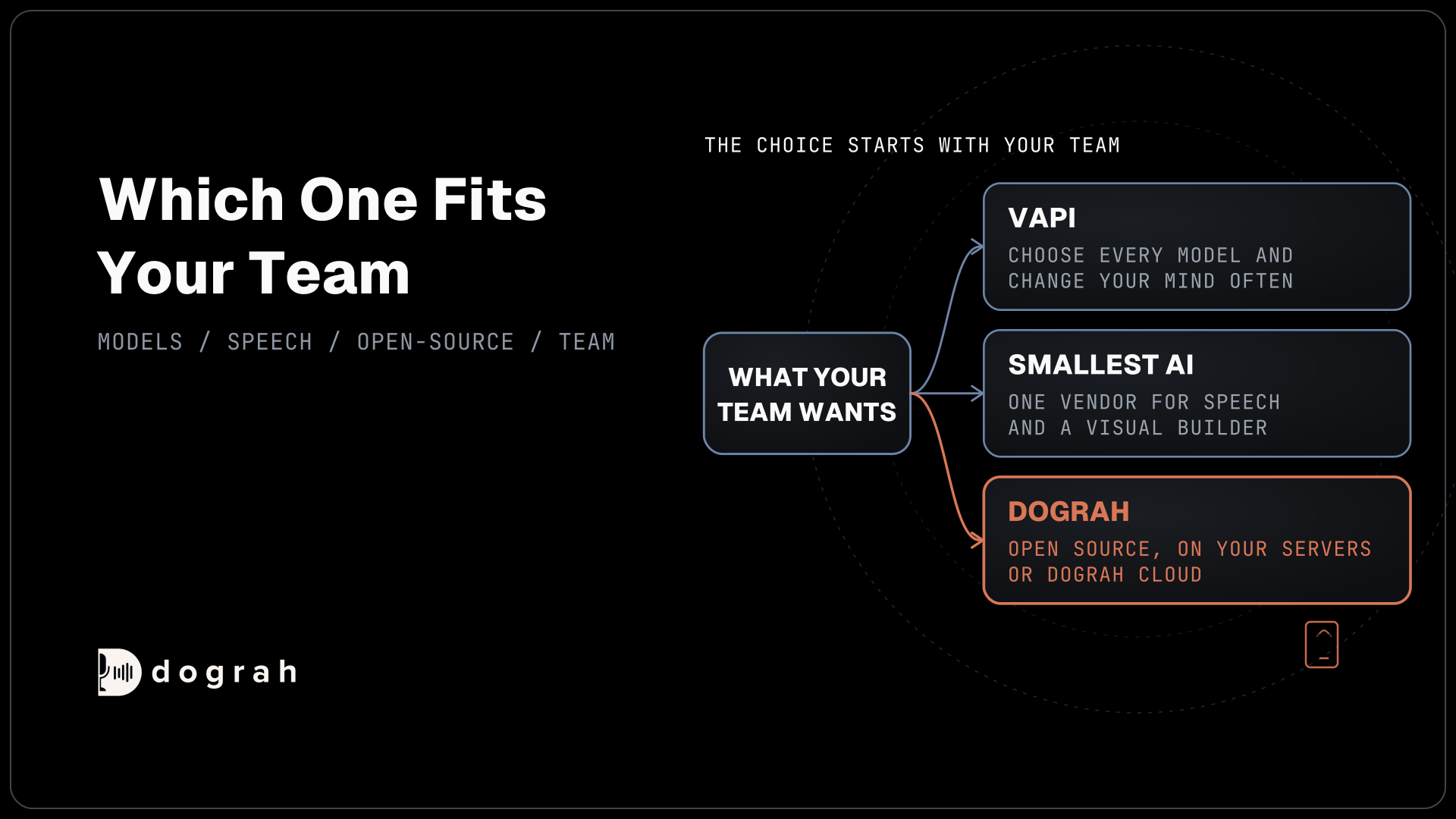
If you like building the agent yourself, as on Retell, but want to own the runtime too, Dograh is the open-source third option. Your team designs the call in a visual workflow builder, and you run it on your own servers or on Dograh Cloud.
Every model is your choice. You bring your own keys for any language model, speech-to-text and voice, or a single speech-to-speech model, or you run open models on your own hardware. Self-hosted Dograh has no per-minute platform fee, but servers, model keys and phone minutes still cost money. Dograh Cloud charges a 1¢-a-minute platform fee. That is the $50 line in the example.
Self-hosting also answers the two compliance questions above. Run it in an EU data center with the models there too, and the calls stay in the EU. For patient calls, a self-hosted install needs no BAA with Dograh, because the calls never reach us, though model providers may need their own and the phone carrier may need one depending on what it stores.
PolyAI's team improves its Enterprise agents after launch. On Dograh, that loop is built in for your own team. The QA step scores every step of test and live calls, at a sample share you choose.
When a score drops, the call trace shows the speech-to-text, AI and voice time for every turn. Dograh's own limit is 10 calls at once by default when self-hosted, lifted with one setting, while Dograh Cloud includes 10 and adds more on request. Our post on scaling to thousands of simultaneous calls covers each limit in the chain.
For the wider field, see our guides to Retell AI alternatives and PolyAI alternatives.
Glossary
- Voice infrastructure
- Retell's per-minute charge for running the call, $0.055 a minute. The language model, the voice and Retell's phone numbers are billed on top at their own per-minute prices.
- Self-signed BAA
- A business associate agreement a customer signs online without a sales contract. Retell offers one at no extra fee, while PolyAI's BAA comes with its Enterprise plan.
- Conversation Flow
- Retell's node-based agent type, with nodes for dialogue, tools and transfers. It sits beside single-prompt and multi-prompt agents for teams that want each step laid out.
- Connected time
- Charging only for the time a call is connected, not ringing. PolyAI bills this way and never rounds a call up to the next minute.