
Cognigy is an enterprise conversational AI platform for voice and chat, owned by NiCE since September 2025. It suits large contact centers that want one vendor, and it is closed source, priced by quote and SaaS-only for new customers. For teams that want to own the platform, Dograh is the open-source option, self-hosted or on Dograh Cloud.
Key Takeaways
- NiCE owns Cognigy now and sells it inside CXone or as its own product.
- New customers get Cognigy SaaS, since on-prem installs are closed to them.
- Billing counts conversations, not minutes, and every deal is priced by quote.
Cognigy has a new owner and a new product generation, so a fair review starts with what you buy today. We cover its pros and cons, how it is sold, hosted and billed, its models and phone lines, where data sits, who it fits, and where open-source Dograh fits instead.
Cognigy pros and cons at a glance
Cognigy is a broad suite built for big contact centers, and most of its weak spots follow from that. The table sums up the review before each part gets its own section.
| Strengths | Watch-outs |
|---|---|
| Voice, chat, webchat, WhatsApp and SMS from one platform | Closed source, run under a license |
| Native in NiCE CXone, built for Amazon Connect, Avaya and Genesys | New customers can buy SaaS only, with no on-prem option |
| Agent Copilot and Live Chat for human agents beside the AI | Priced by quote, so no rate to check before a sales call |
| LLMs from six providers, plus included models on CXone installs | Speech to speech is still marked experimental in the docs |
| SaaS regions in Europe, the US, the UK and Australia | Exported flows open only inside Cognigy |
What Cognigy is after the NiCE deal
Cognigy is now a NiCE product, and that shapes how it is sold. NiCE agreed to buy the company on 28 July 2025 in a deal that valued Cognigy at about $955 million, according to the deal announcement filed with the SEC. At that point, over 1,000 brands used Cognigy, Mercedes-Benz, Nestlé and Lufthansa Group among them.
The deal closed on 8 September 2025. In the closing announcement, NiCE said Cognigy would be sold inside its CXone platform and as an independent product. So a team on Genesys or Amazon Connect can still buy it, and a CXone team gets it as the built-in AI layer.
The product itself answers on voice, chat, webchat, WhatsApp and SMS, in more than 100 languages. Around that sit AI Agent Studio, Voice Connectivity, Agent Copilot, Live Chat, Knowledge AI and Insights. On 12 November 2026, NiCE launched a next generation of the product with an Agentic Experience Studio, reusable skills and step-by-step tracing, and said everything already in production keeps running unchanged.
How you buy and host Cognigy
New customers buy Cognigy as a managed cloud service. Cognigy SaaS runs in a shared cloud environment operated by Cognigy, with clusters in Europe, the US, the UK and Australia. Teams that buy through CXone run in NiCE's own regions, which add sites such as Tokyo, Mumbai, Canada and Cape Town. Teams that want to try the builder first can sign up for a NiCE Cognigy trial.
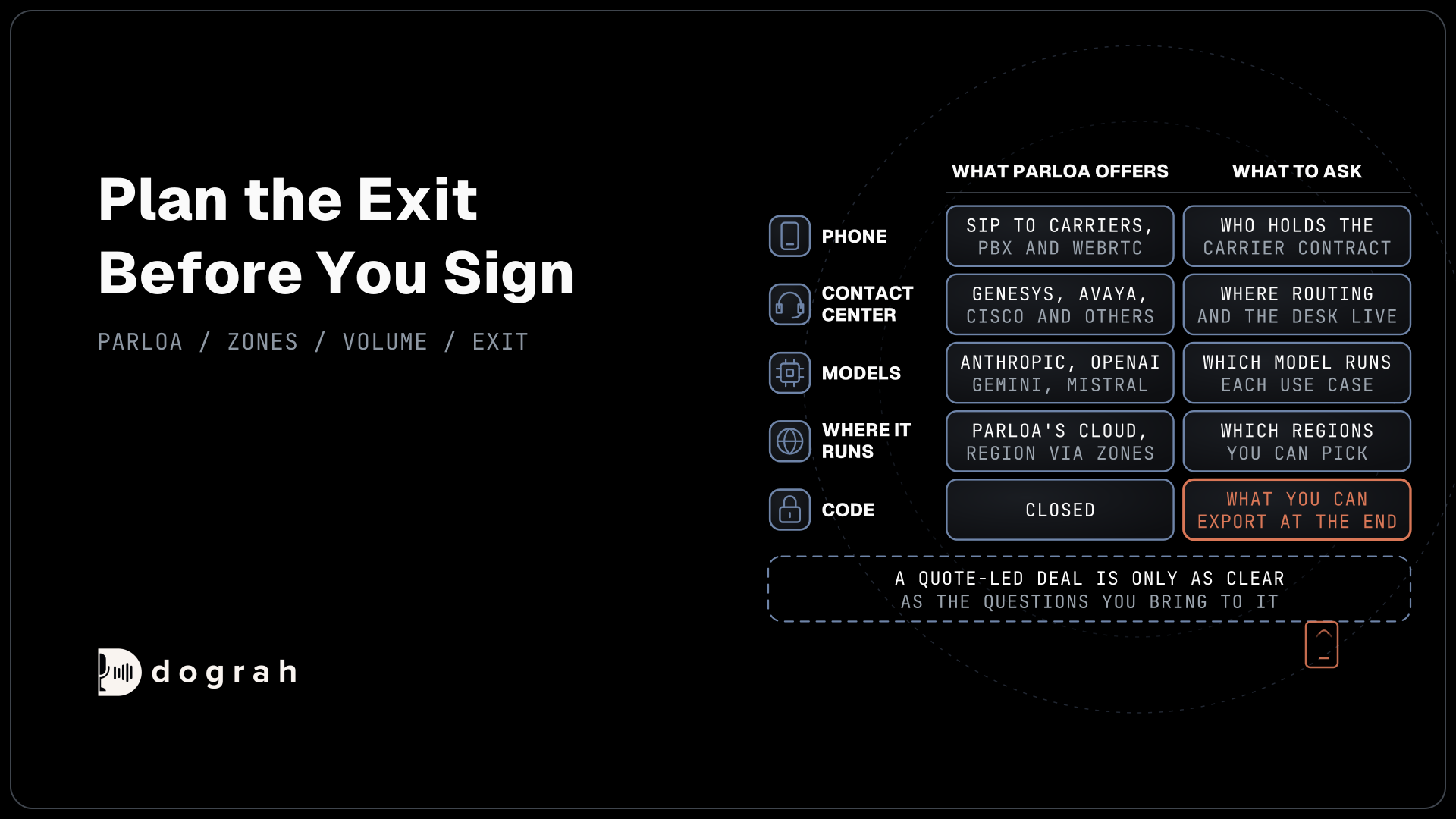
On-prem is the big change. Cognigy no longer offers on-premises installations to new customers. Teams that already run one keep it, and it keeps getting updates.
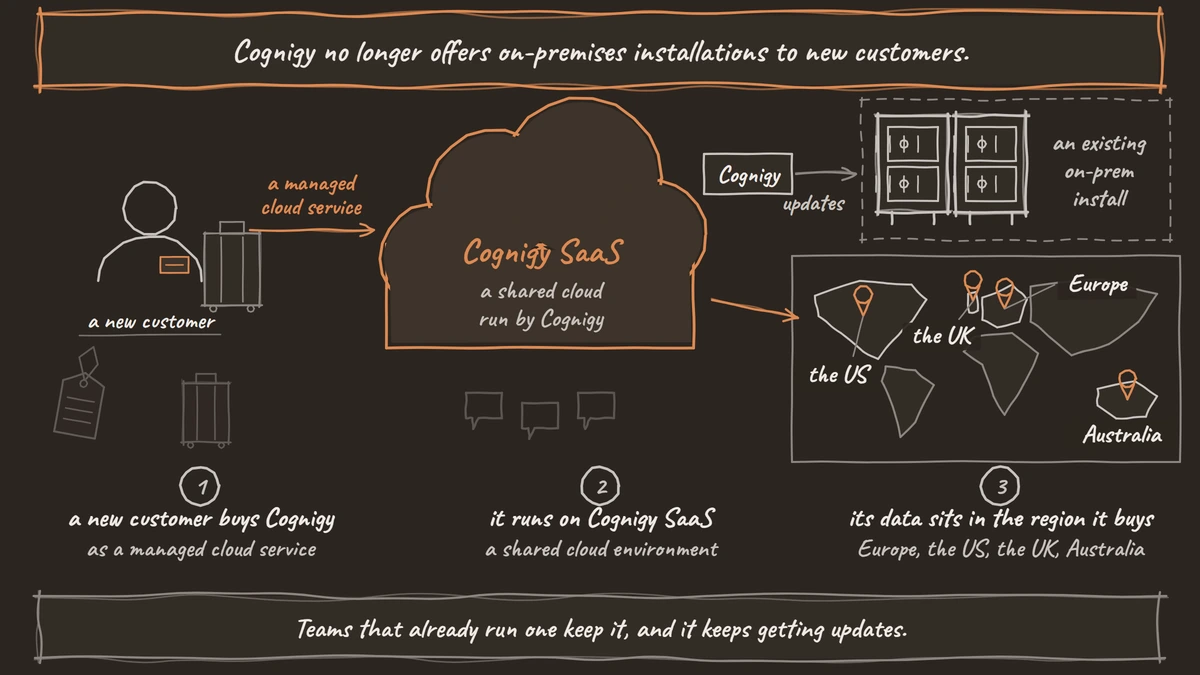
Even those existing installs stay tied to the vendor. They run on Kubernetes across at least six worker nodes, need a license key from a signed agreement, and must reach Cognigy's container registry and billing server over the internet. A team that wants the platform running entirely on its own terms will not get that from Cognigy today.

Open Source Alternative to Vapi / Retell
Self-hosted voice agent platform — no per-minute fees
dograh-hq/dograh
Star on GitHub
How Cognigy bills a conversation
Cognigy prices each deal by quote, and the bill is counted in conversations. A billable conversation covers up to 50 user inputs within 24 hours, so a long chat or a chatty caller can start a second one. Voice Gateway lines are sold separately, in packages of concurrent lines, and a day that goes above the package is billed as overage for that day.
CXone counts voice differently. On NiCE CXone Cognigy, each call counts one conversation for every 10 minutes it runs, so a 12-minute call counts as two. Knowledge AI adds its own limits on stored chunks and queries.
Models changed in the November 2026 launch. NiCE says default AI models are now included in the conversation price, with premium third-party models billed by usage or kept on your own contracts. These included models need a new SKU, and Cognigy limits them to installs connected to CXone. Our post on Cognigy pricing works through the units and the questions to ask in a quote.
Models, speech and phone lines
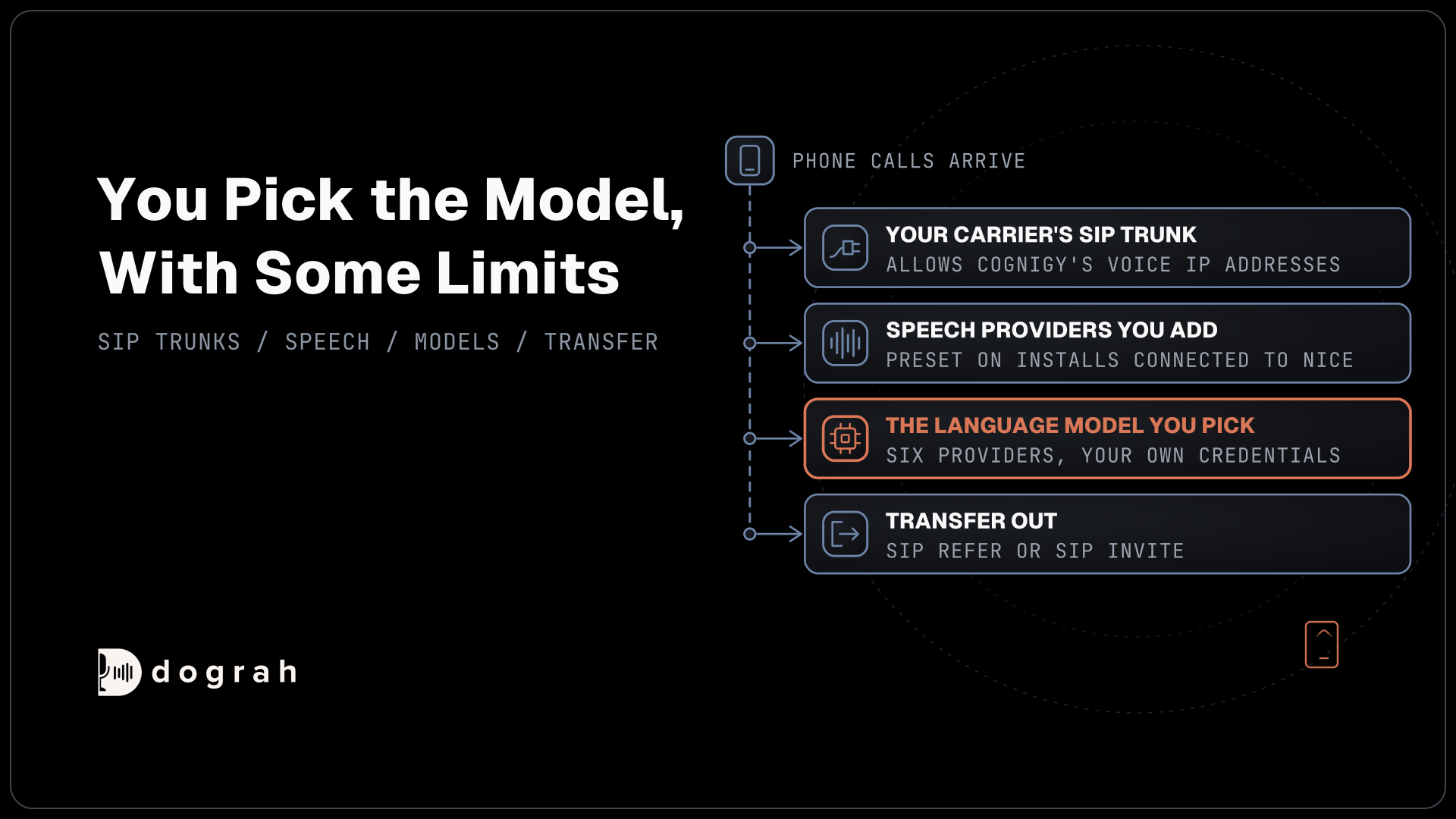
Cognigy lets you pick the language model, with some limits on how. It supports OpenAI, Azure, Anthropic, Amazon Bedrock, Google and Mistral AI, each used with your own API credentials, plus custom models the same way. Speech comes from providers you add, including Microsoft Azure, Google, Deepgram, ElevenLabs, OpenAI, Speechmatics, Amazon Polly and Nuance. Installs connected to NiCE get a preset speech provider that cannot be edited.
Phone calls arrive over SIP trunks from your own carrier, which has to allow Cognigy's voice IP addresses. G.711 is the preferred codec, with Opus and G.722 also supported, and calls transfer out through SIP REFER or SIP INVITE. Cognigy also offers a fallback speech vendor and a view of speech latency for each call.
Speech to speech is the one area where NiCE and Cognigy's docs disagree. NiCE's November launch announced native speech-to-speech models, while Cognigy's docs still list one model, OpenAI's GPT Live, and mark speech to speech as experimental and not recommended for production. Ask which version your contract covers before you plan around it.
Closed code and where call data sits
Cognigy is closed source, so your team configures the product but never runs or reads its code. That matters most for call data and for leaving. On SaaS, conversations live in the Cognigy or CXone region you buy, in a shared environment by default. The caller's audio also reaches whichever speech and language providers you configure. For a regulated contact center, that is a list of processors to review, and none of them sits on servers you control.
Leaving is where the closed model shows. Cognigy snapshots, its way of packaging an agent, are encrypted files you can use only in Cognigy, and they leave out endpoints, analytics, logs and knowledge stores. Conversation logs come out through an OData endpoint that reads data only, at up to 10 requests a second. Our post on the open-source alternative to Cognigy covers what a move takes.
Who Cognigy fits
Cognigy fits a large contact center that wants one vendor for the AI layer across voice and digital channels. If you already run CXone, it is the built-in choice, and teams on Amazon Connect, Avaya or Genesys get supported connections. A team with a real build budget and an in-house conversation design group can get a lot from its builder, its Copilot for human agents and its scale.
It fits less well a team that needs to read or host the code, or one that wants a self-managed install, which new customers can no longer buy. It also fits less well a smaller team that wants a price before the first sales call. Our roundup of Cognigy alternatives sorts the other options by why teams leave, and our post on why procurement stalls on closed voice AI covers the review questions a closed platform raises.
Join the Dograh Community
Dograh is an OSS alternative to Vapi. Join our Slack community for queries, releases, best practices & community interactions.
Where Dograh fits
Dograh is for teams that want the platform itself, with the code and the servers under their control. It is open source under BSD 2-Clause, and you can self-host it with Docker Compose on a server with 8 GB of RAM and 4 vCPUs, or run it on Dograh Cloud. On-prem and private-cloud deployment come with the Enterprise plan, along with SSO and SAML and audit logs.
The platform is voice-first. It answers phone calls, browser voice calls and inbound WhatsApp voice calls, and its website widget can run as voice or as a typed chat panel. As the orchestration layer, it runs the call flow, tools and telephony, while you pick the speech-to-text, LLM and voice for each agent. Those can be Dograh's models, your own provider keys, or open-weight models on your own servers, and seven speech-to-speech options are built in. When a caller wants a person, Dograh calls the destination first and connects the caller only when someone answers, on Twilio, Telnyx, Plivo, Cloudonix or Asterisk ARI.
Where data lives decides most of the cost picture. Self-hosted with local models, recordings, transcripts and audio stay on your servers, while your own keys move the contract to you and the audio still reaches each provider. Self-hosted Dograh has no per-minute platform fee, but servers, model keys and phone minutes still cost money. Dograh Cloud charges a 1¢-a-minute platform fee. Self-hosting also means the server, the database and the upgrades are yours, with community support on the open-source edition and custom SLAs on Enterprise.
Leaving stays open too. Completed calls download as a CSV report, and an agent saved as JSON loads into another install through Upload Agent Definition. The QA step scores each step of test and live calls, and View Trace shows the speech-to-text, AI and voice time for every turn.
Glossary
- Billable conversation
- Cognigy's billing unit, up to 50 user inputs within 24 hours. On NiCE CXone Cognigy, a voice call counts one conversation for each 10 minutes it runs.
- Concurrent lines
- Voice Gateway capacity a Cognigy customer buys in packages, one line for each call running at the same time. A day that goes above the package is billed as overage.
- Snapshot
- Cognigy's packaged copy of an agent project. Snapshots are encrypted and can be used only in Cognigy, so they cannot serve as a portable export.
- Orchestration layer
- The layer of a voice agent that handles the call flow, turn-taking, tool calls and the phone line. The speech and language models sit in a separate layer you choose.