
Cognigy alternatives are divided into open-source platforms you run, hosted platforms with published prices and voice-first managed vendors. Dograh is the open-source option for teams that want to own the platform, run self-hosted or on Dograh Cloud. Vapi, Retell AI and Bland are the hosted platforms, and PolyAI and Parloa are the voice-first vendors.
Key Takeaways
- New Cognigy buyers get SaaS only, since on-prem installs are closed to them.
- Dograh is open source under BSD 2-Clause and runs on your own servers.
- Kore.ai still suits big teams that want another suite with an on-prem option.
NiCE now owns Cognigy, and new buyers can get it only as SaaS, so some teams are weighing a move. We compare every option in one table, start with open-source Dograh, then cover hosted and voice-first vendors, price one month, and say when staying wins and what leaving takes.
Cognigy alternatives in one table
Cognigy is the baseline row, and every other option answers the same questions. Cognigy no longer offers on-premises installs to new customers, so a new contract means Cognigy SaaS or Cognigy inside NiCE CXone.
| Option | Open source | Where it runs | How it bills | Channels and scope |
|---|---|---|---|---|
| Cognigy (baseline) | No, licensed | Cognigy SaaS in Europe, the US, the UK or Australia, or inside NiCE CXone. On-prem closed to new customers | By quote, per billable conversation, Voice Gateway lines sold in packages | Voice, chat, webchat, WhatsApp and SMS |
| Dograh | Yes, BSD 2-Clause | Your own servers with Docker Compose, on-prem on Enterprise, or Dograh Cloud | Self-hosted, no per-minute platform fee. Dograh Cloud, 1¢/min platform fee. Models and phone extra | Voice-first, with phone, browser voice and a web chat widget |
| Vapi | No | Vapi's cloud | $0.05/min hosting plus models and phone. Core $29/mo for 10 calls at once | Voice agents set up in code or the dashboard |
| Retell AI | No | Retell's cloud, with on-prem through Enterprise sales | $0.055/min voice infrastructure, $0.015/min telephony, the LLM per minute. $0.07 to $0.31/min all-in | Voice agents, 20 calls at once included |
| Bland | No | Bland's cloud, with on-prem on Enterprise | Start $0.14/min. Build $0.12/min plus $299/mo | Voice agents, with Bland's models in the rate |
| PolyAI | No | PolyAI's cloud | Essentials $49/mo for 250 minutes. Enterprise by quote | Voice-first, self-serve or built for you |
| Parloa | No | Parloa's cloud, in a region you choose | By quote, per minute for voice and per interaction for chat | Voice-first, with chat on the same platform |
| Kore.ai | No | Multi-tenant SaaS, a dedicated VPC or on-prem | By quote, per session on a yearly contract | Voice and digital service, plus employee and process automation |
| LiveKit Agents and Pipecat | Yes, Apache-2.0 and BSD-2-Clause | Your own servers | Free to self-host | Frameworks. Your team builds the product |
Three rows let you run the code yourself, and only Dograh arrives as a working product with the builder, phone connections and QA in place. Every other row runs closed code, and unless you sign an on-prem deal, your recordings and transcripts sit on the vendor's servers.
Dograh: open code you can run on your own servers
Dograh's whole platform sits in its GitHub repository under the BSD 2-Clause license, so your team can read every line that touches a call. You can self-host it with Docker Compose on a server with 8 GB of RAM and 4 vCPUs, or run it on Dograh Cloud, and the Enterprise plan adds on-prem and private-cloud deployment. New agents start in the Agent Builder, where you describe the agent, approve the "Your agent requirements" card and let it build, with a canvas for hand edits.
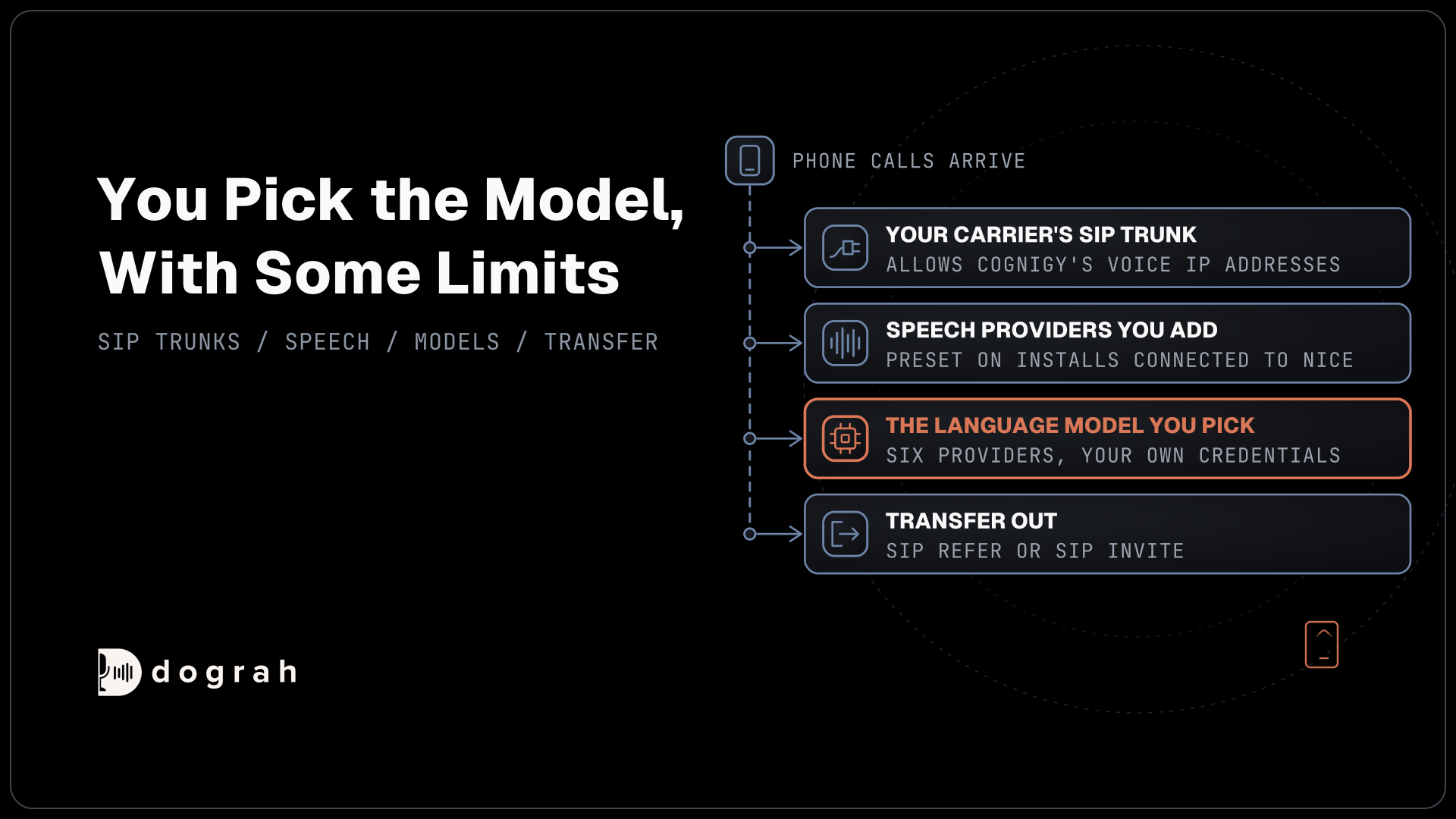
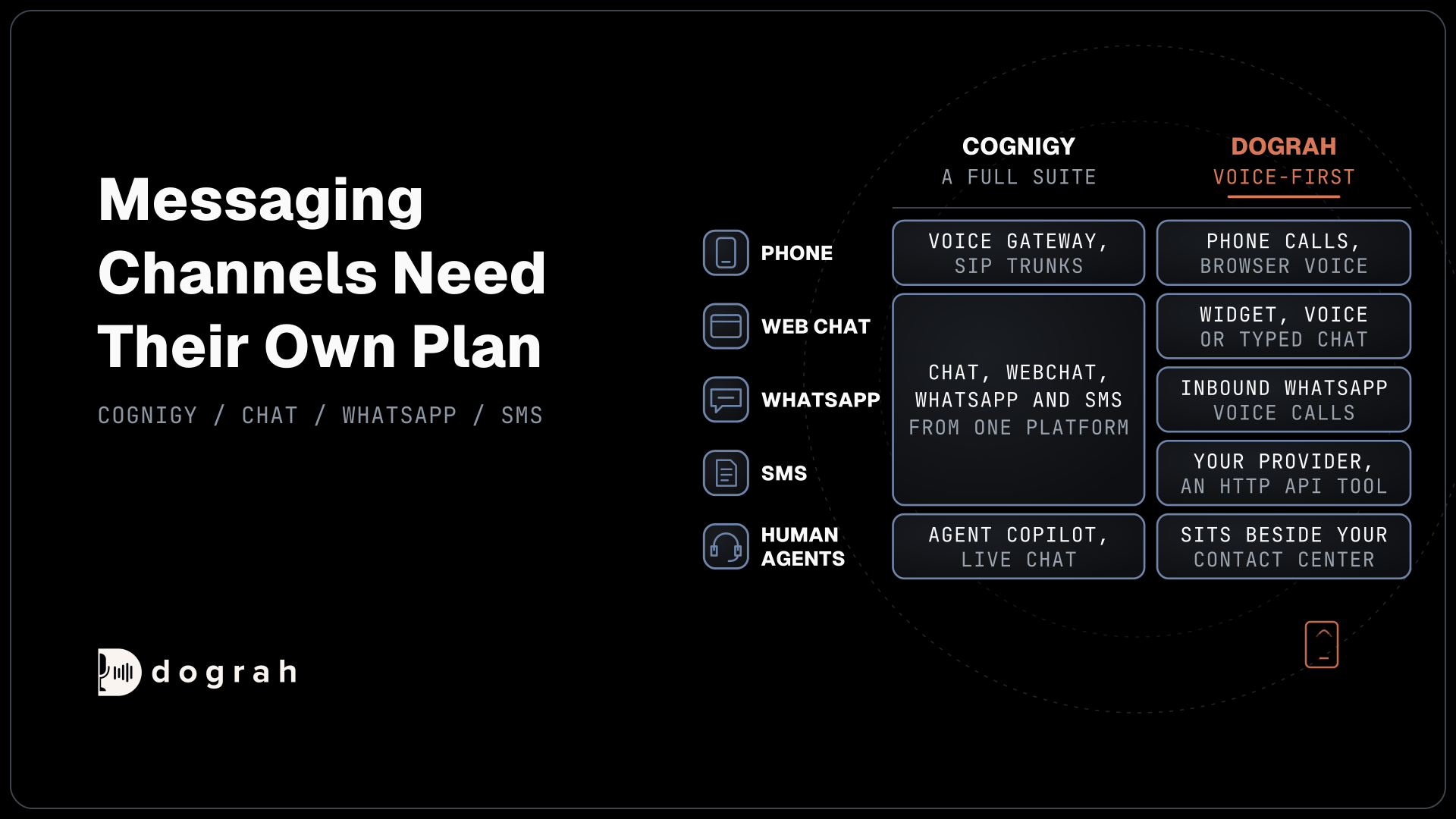
The platform is voice-first. It answers phone calls, browser voice calls and inbound WhatsApp voice calls, and the website widget can run as voice or as a typed chat panel. As the orchestration layer, it runs the call flow, tools and telephony, while you pick the speech-to-text, LLM and voice for each agent from Dograh's models, your own keys or open-weight models on your own servers. Bring your own key (BYOK) moves the contract to you, and the audio still reaches that provider, so it stays inside your network only when the models run there too.
A Cognigy team usually keeps its contact center, and Dograh sits beside it. It connects to your carrier, from Twilio, Telnyx and Plivo to Vonage and Asterisk ARI for an existing PBX. When a caller wants a person, Dograh calls the destination first and connects the caller only when someone answers, and that works on Twilio, Telnyx, Plivo, Cloudonix and Asterisk ARI. HTTP API tools reach your CRM during the call, and QA scores each step of test and live calls.
Where calls run decides the cost. On your own servers there is no per-minute platform fee, though servers, model keys and phone minutes still cost money. Dograh Cloud charges a 1¢-a-minute platform fee and includes 10 calls at once, with more on request, while a self-hosted install runs 10 by default and you can raise it. In exchange, the server, the database and the upgrades are yours, with community support on open source and custom SLAs on Enterprise. Our post on the open-source alternative to Cognigy walks through that route in full.

Open Source Alternative to Vapi / Retell
Self-hosted voice agent platform — no per-minute fees
dograh-hq/dograh
Star on GitHub
Hosted platforms that publish a per-minute rate
These run on the vendor's cloud and bill for as long as you use them, but you can price them before anyone books a demo. Vapi charges $0.05 a minute for hosting, with speech, the language model, the voice and the phone line on top. Core costs $29 a month for 10 calls at once, and HIPAA handling is a $2,000-a-month add-on.
Retell AI charges $0.055 a minute for voice infrastructure and $0.015 a minute for telephony, with the language model priced per minute on top. Its own all-in range runs from $0.07 to $0.31 a minute, and 20 calls at once come included. Bland's Start plan costs $0.14 a minute with its own models included, and Build costs $0.12 a minute plus $299 a month for 50 calls at once.
PolyAI's self-serve plans start with Essentials at $49 a month for 250 minutes, and Plus is $199 for 1,000 minutes. All four are closed source, so recordings, transcripts and the runtime stay on the vendor's servers, whatever rate you pay.
Voice-first vendors that build agents with you
Some Cognigy buyers mostly care about voice and still want a vendor to build the agent. PolyAI Enterprise is quoted by sales and adds a HIPAA BAA, single sign-on, a committed uptime SLA and data storage in your region, with PolyAI or a partner building the agent in its Wren builder.
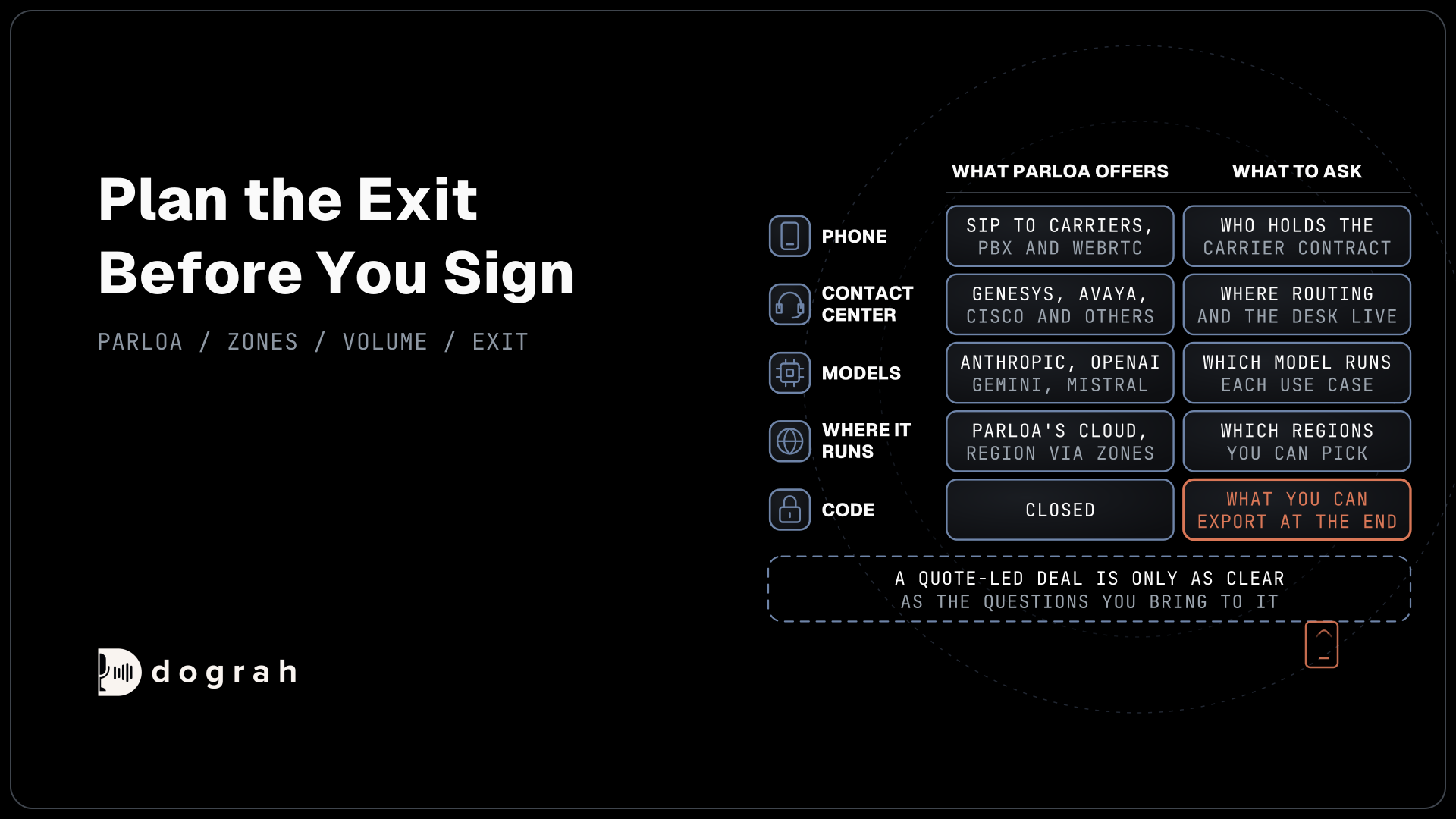
Parloa calls itself voice-first and runs voice and chat on one platform in more than 140 languages. It prices each deal through its team, per minute for voice and per interaction for chat, and its Zones keep customer data in the region you choose. Parloa connects to Genesys, Five9, Avaya, Amazon Connect and Cisco, so it fits beside the contact center you already run.
Sierra and Decagon also come up, though both started from chat agents and run on their own clouds. Our guides to Sierra alternatives and Decagon alternatives cover them. Every vendor here is closed source too, so the trade is the same as with Cognigy, with a voice-first focus in place of a broad suite.
Open-source frameworks: LiveKit Agents and Pipecat
LiveKit Agents and Pipecat give developers strong building blocks and leave the product to them. LiveKit Agents is Apache-2.0, with its turn-detection models under a separate LiveKit Model License, and Pipecat is a BSD-2-Clause Python framework that Dograh itself is built on. With either one, your team writes the phone wiring, call history, transfers and QA before the first customer call.
What 25,000 minutes a month costs
A worked example makes the published rates concrete. Take 25,000 call minutes in one month, about 6,250 calls of four minutes, and price only the line each vendor bills for them.
| Option | Platform line for 25,000 minutes | Still to add |
|---|---|---|
| Cognigy | By quote, counted in billable conversations | Voice Gateway lines, premium models |
| Vapi | 25,000 x $0.05 = $1,250 | Speech, language model, voice and phone |
| Retell AI | 25,000 x $0.055 = $1,375, plus 25,000 x $0.015 = $375 telephony, so $1,750 | The language model. Retell's own all-in range gives $1,750 to $7,750 |
| Bland Build | 25,000 x $0.12 + $299 = $3,299 | Phone time |
| Dograh Cloud | 25,000 x $0.01 = $250 | Your models and carrier |
| Dograh self-hosted | No platform fee | Servers, model keys and phone minutes |
| PolyAI Enterprise, Parloa, Kore.ai | By quote | Set in the quote |
The rows count different things. Bland's rate already pays for its models, while the Vapi, Retell AI and Dograh rows still need models added at each provider's price. For Cognigy, the useful number is the count, since about 6,250 calls make about 6,250 billable conversations unless a caller passes 50 inputs. Every row except the suites can be worked out before a sales call.
Join the Dograh Community
Dograh is an OSS alternative to Vapi. Join our Slack community for queries, releases, best practices & community interactions.
When staying on Cognigy makes sense
The NiCE deal alone is no reason to move. NiCE still sells Cognigy as a standalone product, its next-generation release in November 2026 added a new studio and tracing, and everything in production keeps running. If you run NiCE CXone, Cognigy is the built-in AI layer, and teams on Amazon Connect, Avaya or Genesys get supported connections too.
Cognigy also covers more than voice. It answers chat, webchat, WhatsApp and SMS from one platform and gives human agents Agent Copilot and Live Chat, which none of the voice platforms above try to match. Our Cognigy review sets out who it fits. If you want another enterprise suite, with an on-prem option Cognigy no longer sells to new customers, our Kore.ai review covers the closest one.
What moving off Cognigy takes
A move is a rebuild, so plan what you can carry across. Cognigy snapshots are encrypted files you can use only in Cognigy, so they will not open anywhere else. Keep the flows themselves, the prompts and the lexicons as the written spec for the new agent, and pull conversation logs out through Cognigy's OData endpoint before the contract ends.
Phone lines are the easy part. Cognigy takes calls over SIP trunks from your own carrier, so the trunk and numbers already sit in your account and can point at a new platform when you are ready. On Dograh Cloud, the agent is rebuilt in the Agent Builder. Self-hosted installs run the builder with a Dograh Service Key, or the flow can be built on the canvas.
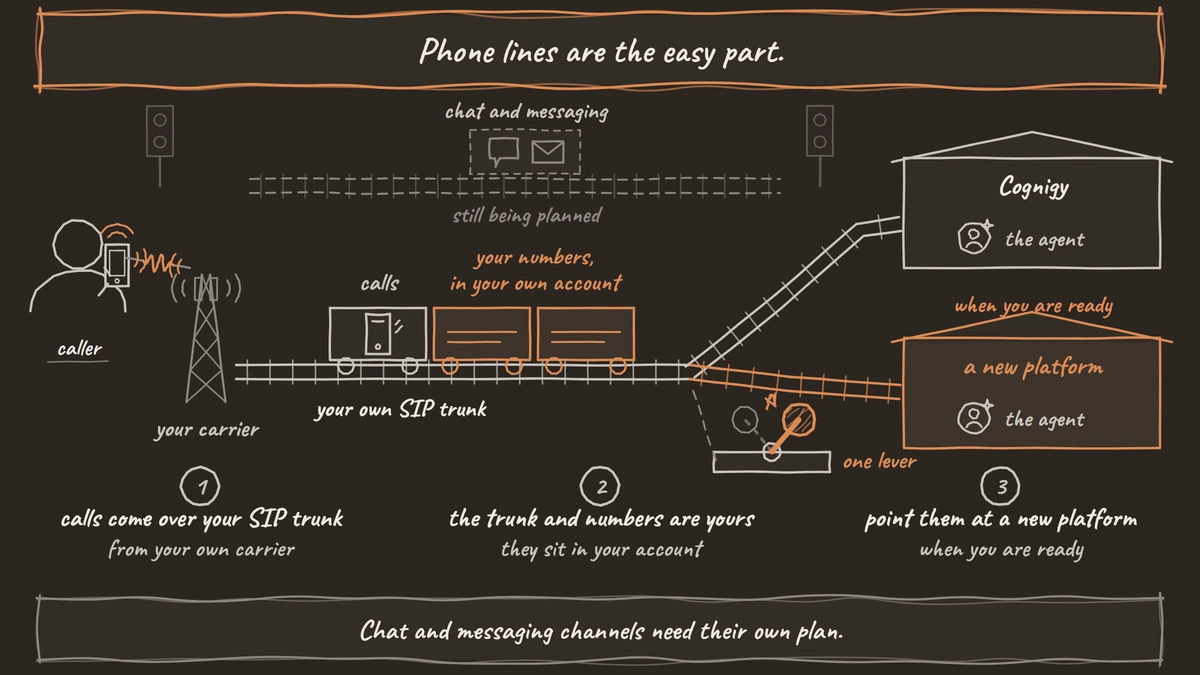
Then run both for a while. Move one queue or one after-hours line first, keep Cognigy on the rest, and test every transfer over a real phone call, since a browser test call cannot run one. Chat and messaging channels need their own plan. Dograh covers typed chat through its web widget, and texts go out through your own provider via an HTTP API tool.
Picking your Cognigy alternative
Start from why you are leaving. If the reason is control, meaning open code, your own servers or on-prem inside your network, start with Dograh, with an Enterprise contract behind it when you need on-prem. If you would rather build the product yourself, LiveKit Agents and Pipecat are good bases. If price is the reason, Vapi, Retell AI and Bland let you check the rate at your own volume before you talk to anyone.
If you want a voice-first vendor to build the agent, PolyAI Enterprise and Parloa fit. And if what you need is another full suite with messaging and agent desktop tools, Kore.ai is the closest swap, or staying put is. Whichever way you lean, run one real call flow on the new option before you move a phone line.
Glossary
- Billable conversation
- The unit Cognigy bills by, covering up to 50 user inputs in a 24-hour window. On NiCE CXone Cognigy, each 10 minutes of a voice call is one conversation.
- Platform fee
- The charge a voice agent platform makes for running the call, separate from the models and the phone line. Hosting on Vapi costs $0.05 a minute, and Dograh Cloud's fee is $0.01 a minute.
- Snapshot
- Cognigy's packaged copy of an agent project. Snapshots are encrypted and usable only in Cognigy, so the flows must be rebuilt on any other platform.
- Bring your own key (BYOK)
- Plugging your own model provider account into the platform. The contract and bill are yours, though call audio still reaches that provider.