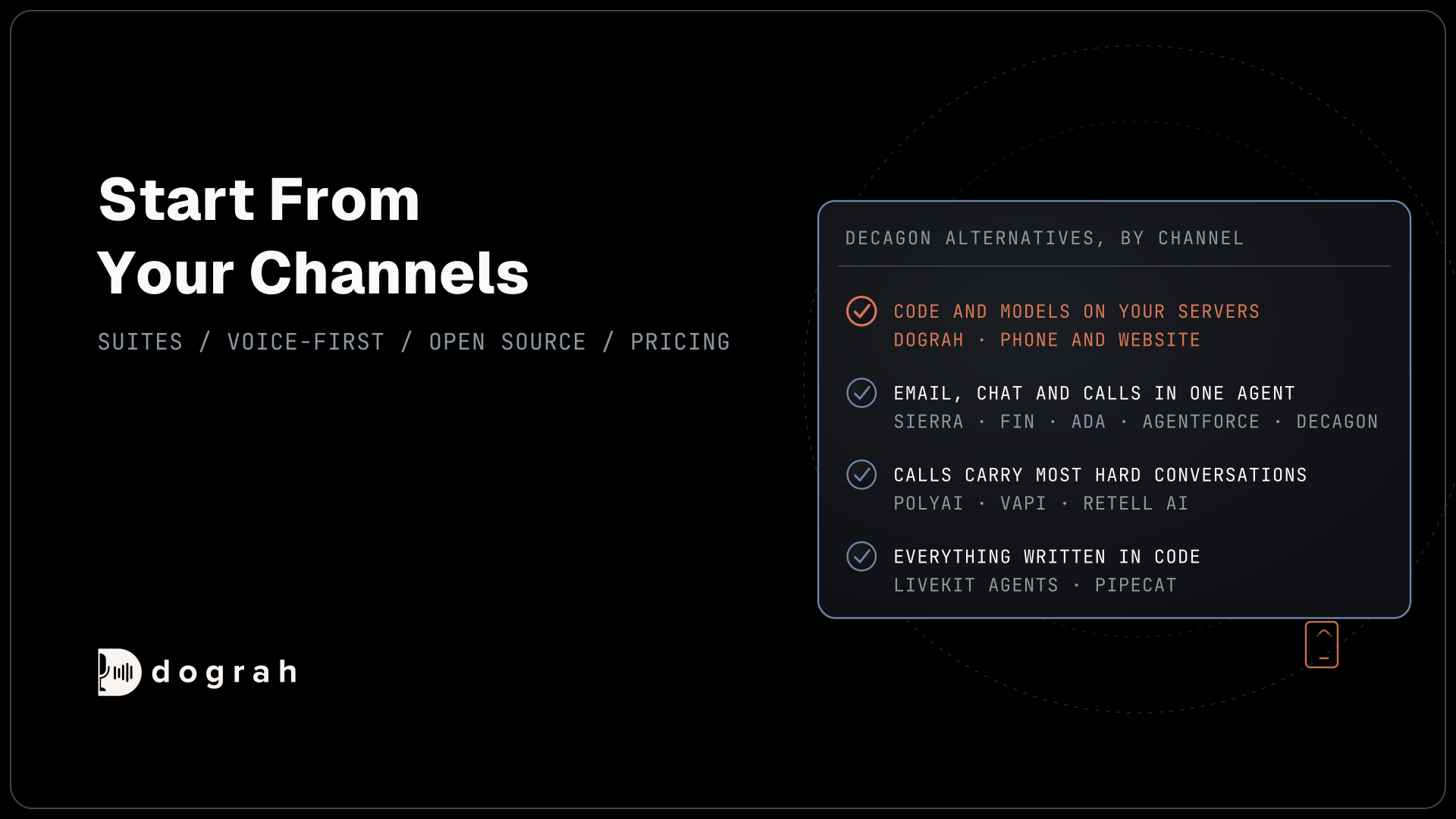

Decagon alternatives fall into three groups. Sierra, Intercom Fin, Ada and Salesforce Agentforce are hosted customer-service suites. PolyAI, Vapi and Retell AI focus on phone calls. Dograh, our open-source AI voice agent platform, takes over the phone and website side of Decagon's job with models you choose, and runs self-hosted or on Dograh Cloud.
Key Takeaways
- Decagon runs chat, voice and email from one agent on its own cloud.
- Decagon charges per conversation or per resolution, and its site leads to a demo.
- Dograh's whole platform is open source under BSD-2-Clause, for phone and website conversations.
Decagon's code is not public, and the only way to learn its price is to book a demo. This guide sorts the alternatives, from support suites and voice-first platforms to open-source Dograh, then covers what Decagon costs, when staying makes sense and how to move one channel at a time.
What Decagon sells, and why teams look elsewhere
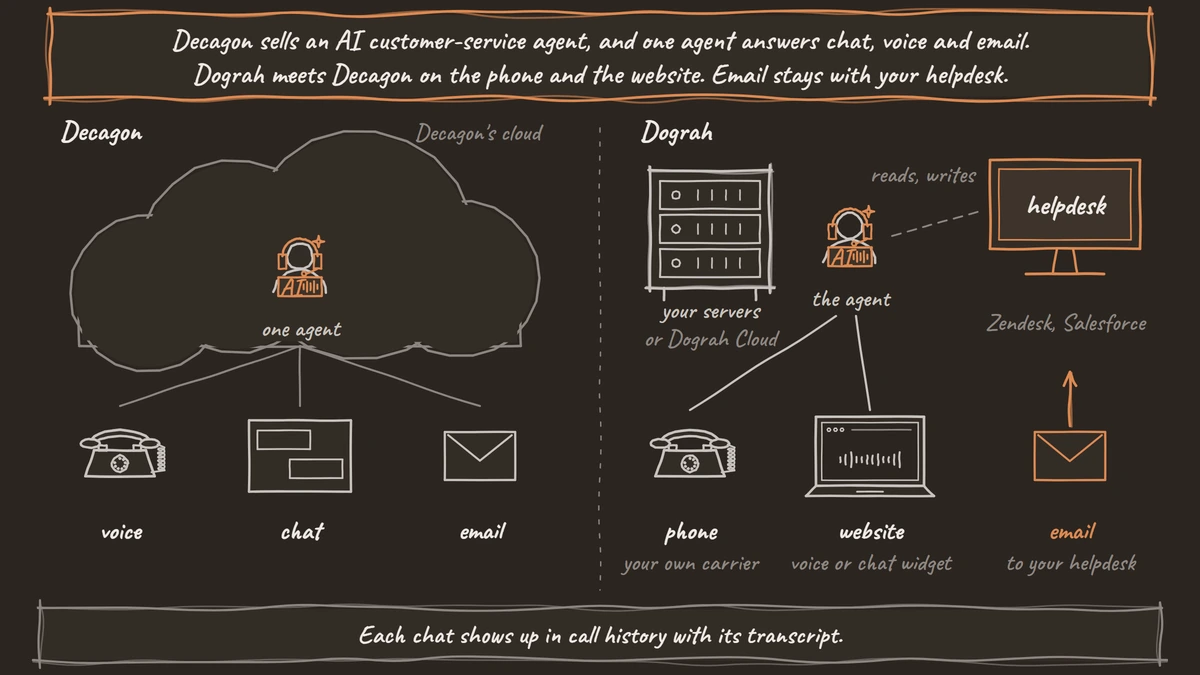
Decagon sells an AI customer-service agent, and one agent answers chat, voice and email. Its site describes "a single intelligence layer" across the three. Teams write the agent's behaviour as Agent Operating Procedures (AOPs), workflows in plain language that a support team can edit, while engineers can version them with Git. Duet, Decagon's AI partner, can draft AOPs from uploaded transcripts.
Around that sit live A/B Experiments, simulated test conversations at scale, Watchtower for always-on QA, and reporting on what customers ask about. On voice, it covers more than 70 languages with automatic switching and offers hundreds of voices, built on Chord, a speech model Decagon post-trained for customer conversations. Voice 3 added a duplex design that lets the agent listen, speak and act at once. The agent can also place outbound calls and transfer a call to a person "with a concise summary".
It is a large, serious vendor. Decagon announced a $250 million Series D at a $4.5 billion valuation and says it added more than 100 new global enterprise customers in its last fiscal year. Chime, Duolingo, Notion and Hertz are among the customers on its site.
Teams look at Decagon competitors for concrete reasons. Decagon is a managed platform. It runs on its own multi-region infrastructure, it uses AI providers such as OpenAI and Anthropic, and its code is not public. The only way in from its site is "Get a demo", so pricing starts with a sales conversation.
The channel mix is the other reason. For many support teams, chat and email carry most of the volume and voice is one channel of three. Teams whose main channel is the phone often want a platform built around calls, their own carrier and the models they pick. Some also want to run the whole thing on their own servers.
How we compared the alternatives
We compared each product on the points that change a buying decision. The license decides whether you can read the code and keep running it if the vendor changes course. Where it runs separates platforms you can put on your own servers or private cloud from those that live only in the vendor's cloud. Models covers who picks them, and whether you can bring your own keys or host open-weight models. Builder means who shapes the agent and how. How you pay comes from each vendor's own pricing page.
We also listed the channels each product covers, because Decagon is a chat, voice and email suite and many alternatives are not. Latency is left out. It depends on your models and phone path far more than on the platform, so measure it on your own calls.
Every product here can hand a conversation to a person, and that matters. Support customers expect it, with 87% of respondents in a Gartner survey of 3,566 customers calling a route to a human agent essential when a company uses generative AI. So check how each platform transfers, and what the person who answers receives.
Decagon alternatives in one table
| Product | Open source | Where it runs | How you pay | Channels | Models |
|---|---|---|---|---|---|
| Decagon (baseline) | No, code not public | Decagon's multi-region cloud | Per conversation or per resolution, set with sales | Chat, voice and email from one agent | AI providers such as OpenAI and Anthropic, plus its Chord speech model |
| Dograh | Yes, BSD-2-Clause | Your servers with Docker Compose, Dograh Cloud, or on-prem and private cloud on Enterprise | Self-hosted: no per-minute platform fee. Dograh Cloud: a per-minute platform fee (see the Dograh section). Models and phone extra | Phone on your own carrier, inbound WhatsApp calls, a website voice or chat widget | Dograh's models, your own keys for supported providers, open-weight models on your servers, speech-to-speech |
| Sierra | No | Sierra's hosted platform, by contract | Outcome-based, agreed with sales | Chat, SMS, WhatsApp, email, voice and ChatGPT | A mix of models Sierra picks and switches between |
| Intercom Fin | No | Intercom's cloud, with US, EU or Australian data hosting | $0.99 per outcome, 50 a month minimum with another helpdesk. Fin Voice priced by sales | Email, live chat, phone, WhatsApp, SMS and more | Intercom's own Apex models |
| Ada | No | Ada's hosted platform | Priced in a demo, from a business case on your volume | Voice, messaging and email | Run by Ada |
| Salesforce Agentforce | No | Salesforce's cloud | $2 per conversation, or Flex Credits at $500 per 100,000 | Service channels inside Salesforce, voice included | Salesforce's options inside the platform |
| PolyAI | No. Its ADK is Apache-2.0 but runs nothing locally | PolyAI's cloud on AWS, with US, EU and UK regions | Platform per minute, quoted by sales | Voice first, with chat on the same agents | Raven, plus OpenAI and Amazon Bedrock models from a set list |
| Vapi | No | Vapi's cloud | $0.05/min hosting, plus models and phone | Phone and web calls | Your own keys for any part of the call |
| Retell AI | No | Retell's cloud, with a dedicated server add-on | $0.07 to $0.31/min for a full agent | Phone and web calls | A choice of language models, including OpenAI's realtime speech-to-speech |
| Rasa | Rasa Open Source is Apache-2.0 but in maintenance mode. The current platform runs under a free license or Enterprise | Your servers or private cloud, or a managed service | Free Developer Edition with one bot and 1,000 external conversations a month. Enterprise priced on request | Chat, with voice through an AudioCodes connector sold separately | Your own model provider |
Read the Channels column first. If email has to run through the same agent, the suites are the closer match. If the phone is the channel that matters most, look hardest at PolyAI, Vapi, Retell AI and Dograh.
Dograh: an open-source platform for phone and web
Dograh's code is open under BSD-2-Clause, and its GitHub repository holds the whole platform. That includes telephony, Campaigns for outbound lists, HTTP API tools that read and write your systems during the call, call traces and automatic QA that scores each step.
Each agent is drawn in the visual workflow builder, with pathways linking one node to the next. Each node has its own prompt in plain language, so a support lead writes what the agent says and the graph sets the order of the call. You can also create and edit agents from an AI assistant through Dograh's MCP server. Teams used to writing AOPs will find the node prompts familiar, with the call's structure drawn out on the canvas.
The models are a separate choice from the platform. Dograh runs the call flow, tools and telephony, and the speech and language layer can be Dograh's own models, providers such as OpenAI, Google or Deepgram on bring your own key (BYOK), or open-weight models on your own servers. Speech-to-speech models run too. With a provider key, the call audio still reaches that provider. Call data stays in-house only when the platform and the models both run on your servers.
Dograh meets Decagon on the phone and the website. It works with your own carrier, such as Twilio, Vonage, Plivo, Telnyx, Cloudonix, Exotel, Vobiz or Asterisk ARI, and it can answer inbound WhatsApp voice calls. On a website, the Add to Website widget runs as voice or as a text chat. A chat lasts up to an hour, ends after a quiet spell you set (30 minutes by default), and starts fresh when the page reloads. Each chat shows up in call history with its transcript. Our guide to adding a voice or chat widget to your website walks through the setup. Support leads weighing this route can see how open-source voice agents for customer support teams handle phone and website conversations and hand callers to people.
Email stays with your helpdesk. Zendesk, Salesforce and similar systems connect through HTTP API tools, MCP tools, the Webhook node or Pre-Call Data Fetch, so the agent can read a ticket during the call and write the outcome after it. For a customer who asks for a person, Transfer Call hands off on Twilio, Telnyx, Plivo, Cloudonix and Asterisk ARI. The support agent's line rings first, and the customer joins only after that person picks up, with a short spoken introduction to both sides on Twilio.
Self-hosting with Docker Compose runs 10 calls at once by default, and the servers and updates sit with your team. Anonymous usage telemetry is on by default there, and setting ENABLE_TELEMETRY=false and removing POSTHOG_API_KEY turns it off. In place of a per-conversation price, a self-hosted install carries no per-minute platform fee, and you pay for servers, model keys and phone minutes. Dograh Cloud charges a 1¢-a-minute platform fee. Our row-by-row comparison with Decagon goes deeper on each point.

Open Source Alternative to Vapi / Retell
Self-hosted voice agent platform — no per-minute fees
dograh-hq/dograh
Star on GitHub
Customer-service suites: Sierra, Fin, Ada, Agentforce
Four suites sit closest to Decagon. Like Decagon, each one runs on the vendor's cloud with closed code and puts chat and email in the same product as voice.
Sierra deploys a single agent across chat, SMS, WhatsApp, email, voice and ChatGPT. Teams build in Agent Studio or the Agent SDK, often with Sierra's own agent development team. It charges by outcome, so you pay when the agent completes a task you agreed with Sierra upfront. Our guide to Sierra alternatives covers its field in detail.
Intercom Fin is the one with a printed price. Fin's pricing page lists $0.99 per outcome, such as a resolution or a handoff to your team, with only one outcome billed per conversation. With a helpdesk other than Intercom, there is a minimum of 50 outcomes a month. Fin runs on Intercom's own Apex models, and Fin Voice is priced by its sales team.
Ada covers voice, messaging and email. Its pricing page leads to a demo, where the team builds a business case on your own volume.
Salesforce Agentforce suits teams that already live in Salesforce. Agentforce pricing lists $2 per conversation, or Flex Credits at $500 per 100,000 credits. A standard action uses 20 credits and an Agentforce Voice action uses 30.
Voice-first platforms: PolyAI, Vapi, Retell AI
Voice-first platforms start from the phone call, which suits teams where calls carry the heaviest or hardest conversations. All of them are hosted and closed source.
PolyAI is the closest to Decagon in buyer and style, an enterprise contact-centre vendor whose agents also handle chat. It opened its platform to self-serve builders in May 2026, runs agents on its own cloud on AWS, and quotes its per-minute platform rate through sales. Its own model, Raven, runs most deployments. Our guide to PolyAI alternatives sets out that market.
Vapi is a developer platform with a $0.05-a-minute hosting fee, and models and phone are billed on top. You can bring your own keys for any part of the call. Retell AI lists $0.07 to $0.31 a minute for a full agent, with a visual Conversation Flow builder and OpenAI's realtime speech-to-speech models. ElevenAgents, from ElevenLabs, charges $0.08 for each extra minute and runs on ElevenLabs' own speech models, with the language model and the phone line billed separately.
Self-hosted and open-source routes
Self-hosted and open source are different claims. Self-hosted says where the software runs. Open source says anyone can read, change and run the code with no contract.
Rasa is a well-known self-hosted option for support teams. It runs on your own servers or private cloud, with your own model provider, under a free Developer Edition license for one bot and up to 1,000 external conversations a month, or under Enterprise. Its older Rasa Open Source repository is Apache-2.0 and now in maintenance mode, and voice runs through an AudioCodes connector bought separately.
Open chat projects cover the chat side only. Parlant is Apache-2.0 and built for customer-facing chat agents. Typebot uses a source-available license, the Functional Source License, which limits competing commercial use. Botpress's public repository holds integrations and developer tools for its cloud product.
For voice, LiveKit Agents (Apache-2.0) and Pipecat (BSD-2-Clause) are the two open frameworks teams weigh most. Dograh itself is built on a fork of Pipecat. In our experience Pipecat is an excellent base, but production needs telephony, call history, QA on live calls and the call lifecycle, which is the part Dograh ships. The frameworks get a fuller treatment in our comparison of the best open-source voice AI platforms. If open source is your main reason for leaving, our post on the open-source alternative to Decagon sorts these options one by one.
What Decagon costs
Decagon charges in one of two ways. In Decagon's own post on its pricing models, per-conversation pricing is "a fixed rate for every incoming conversation, with flexible pricing for higher volumes". Per-resolution pricing is "a higher fixed rate for each fully resolved conversation, with no charge for escalations", and larger resolution commitments lower that rate. Decagon says the vast majority of its customers choose per conversation.
The amounts come from Decagon's sales team. Before that call, decide what you will ask. Find out how a resolution is defined, and whether a voice call is billed the same way as a chat. Ask about volume tiers, any platform or setup fee, and the contract term.
Fin's $0.99 per outcome and Agentforce's $2 per conversation are useful reference points, since they price the same kind of unit. Our breakdown of Decagon pricing works through when each meter costs less.
When staying on Decagon makes sense
Decagon is the better fit for some teams, and the reasons are concrete. A large support team that wants one managed agent across chat, email and voice, inside Salesforce, Zendesk or Intercom, gets that from one vendor. Its support leads can write AOPs in plain language, and Duet can draft them from transcripts.
It also brings features built for a support suite. Simulations and live experiments come built in, transfers carry a summary to the person who answers, and Google's DLP service redacts personal data from logs and transcripts after each conversation. Its security page lists SOC 2 Type II, HIPAA and ISO 27001, among others, and Decagon runs and tunes the agent under an enterprise contract.
A self-hosted Dograh install answers the compliance need another way. It sits inside your own perimeter, so no business associate agreement (BAA) with Dograh is needed under the Health Insurance Portability and Accountability Act (HIPAA). A BAA may still be needed with any model provider that handles patient data, and with the phone carrier depending on what it stores. If the servers run in a cloud account such as AWS, that cloud provider needs one as well.
What moving off Decagon takes
Moving can happen one channel at a time, starting with the phone, while Decagon keeps chat and email until the new agent passes its tests. Treat each AOP as the spec for a workflow. A support lead can rebuild it node by node in the builder, or an AI assistant can draft it through Dograh's MCP server for that lead to check one node at a time.
Help articles become Knowledge Base files, and the systems the agent reads and writes connect through HTTP API tools. Phone numbers are the simpler part when Decagon reached callers through your own SIP trunk, Amazon Connect or RingCentral, because the numbers stay with that provider. Dograh Managed SIP connects your own SIP trunk or PBX, so each line can move once its agent is ready. Ask your provider how it routes calls over SIP.
Plan the handover to people with care, since the transfer works differently. Our post on human handoff and routing covers how to write the caller's details to your system before the transfer. Test every rebuilt agent on a real phone line, since transfers run only on phone calls.
Join the Dograh Community
Dograh is an OSS alternative to Vapi. Join our Slack community for queries, releases, best practices & community interactions.
Picking your Decagon alternative
Start from your channels. If one agent has to answer email, chat and calls inside your helpdesk, compare Sierra, Fin, Ada or Agentforce, or stay on Decagon. If calls carry most of the hard conversations, PolyAI suits a vendor-run contact-centre deal, while Vapi and Retell AI suit developers who want a published rate. Teams that would rather write everything in code can start with LiveKit Agents or Pipecat.
If you want the platform's code on your own servers, with your own choice of models for phone and website conversations, Dograh is built for that. To try it, run it from GitHub with Docker Compose, or start on Dograh Cloud.
Whichever you shortlist, run the same call script on a real phone line. A vendor demo in the browser runs at 16 kHz, but most of your customers will call in as 8 kHz audio.
Each part of this guide has its own deep dive:
Glossary
- Agent Operating Procedure (AOP)
- Decagon's format for an agent's workflow, written in plain language by a support team. Engineers can version AOPs with Git, and Decagon's Duet can draft them from transcripts.
- Per-resolution pricing
- A pricing model where you pay only for conversations the vendor counts as fully resolved, at a higher rate than per-conversation pricing. Escalated conversations are not charged, so the definition of a resolution decides the bill.
- Source-available license
- A license that lets you read the code but limits how you use it, often banning competing commercial use for a period. Typebot's Functional Source License is one example, and it is not open source.
- Bring your own key (BYOK)
- Using your own account with a model provider instead of the platform's. You hold the contract and the bill, but the call audio still goes to that provider.