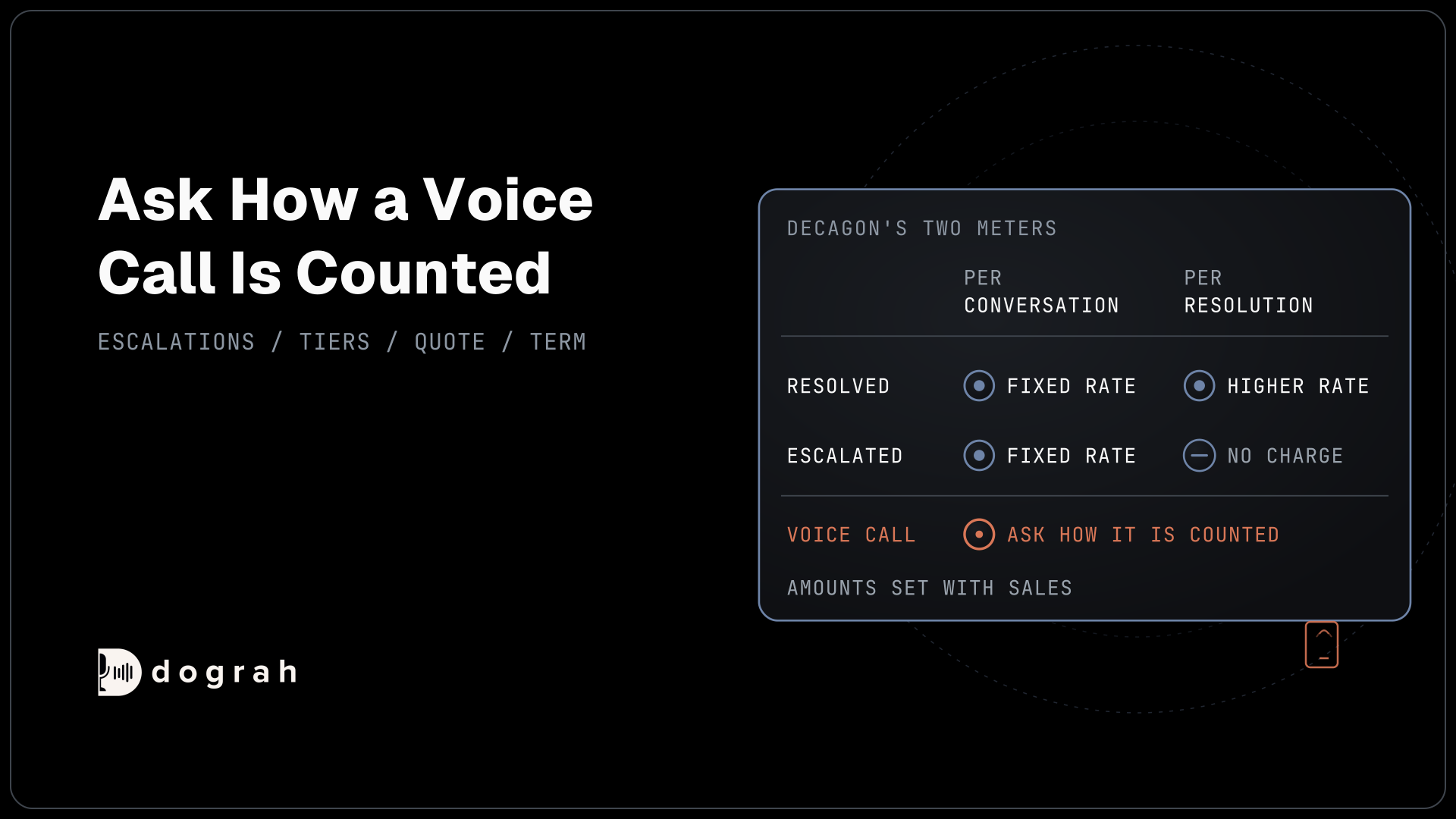

Decagon prices its AI agent per conversation, at a fixed rate for each one, or per resolution, at a higher rate with no charge for escalations. Amounts are set with its sales team, and most customers choose per conversation. Dograh, the open-source AI voice agent platform we build, runs self-hosted or on Dograh Cloud, which charges by the minute.
Key Takeaways
- Per-resolution pricing tends to favor agents that still escalate many conversations.
- Ask how voice calls are counted before you compare any quote.
- Per-conversation and per-minute prices measure different things, so convert first.
A Decagon quote looks simple until you ask what counts as a resolution or how a phone call is billed. We explain its two meters, the questions to ask, other vendors' published prices and what a Dograh minute is made of. It is one piece of our guide to Decagon alternatives.
How Decagon charges: two meters
Decagon explains its pricing in a post on pricing AI agents. It offers two models.
Per conversation is "a fixed rate for every incoming conversation, with flexible pricing for higher volumes." Every chat, email thread or call the agent handles counts once, whether it ends in a resolution or a handoff.
Per resolution is "a higher fixed rate for each fully resolved conversation, with no charge for escalations." You pay only when the agent closes the issue without a person. Decagon adds that larger resolution commitments lower the rate, and that the vast majority of its customers choose per-conversation pricing.
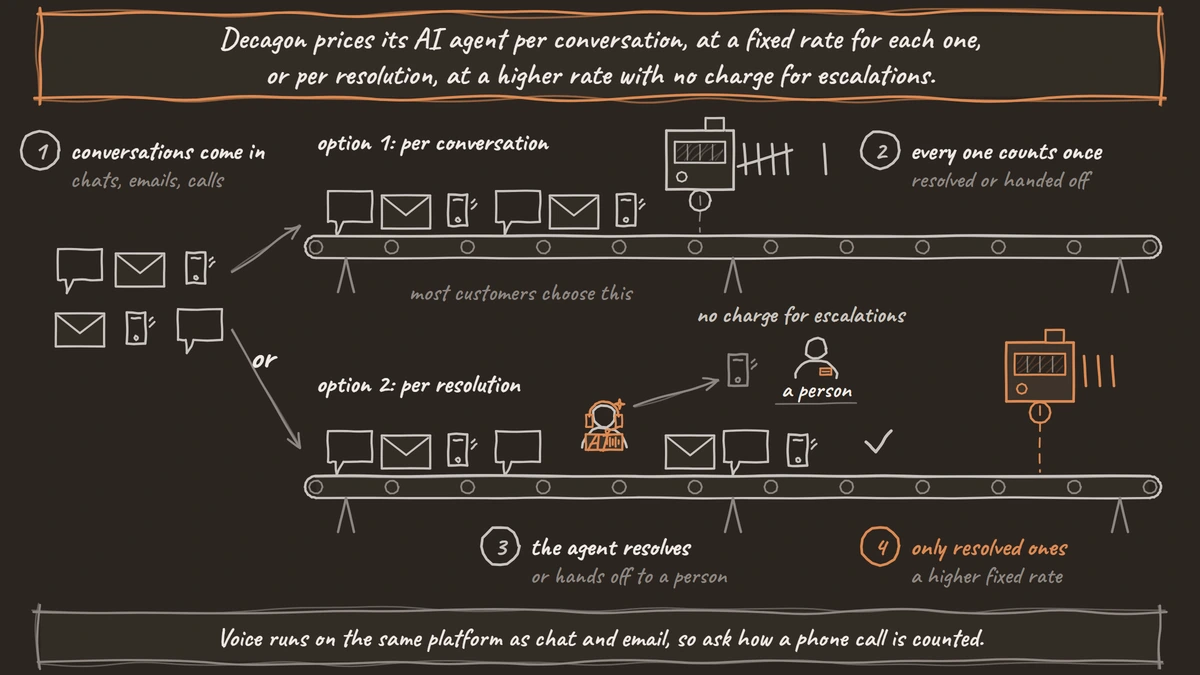
The post does not list amounts, and it describes conversations rather than minutes. Voice runs on the same platform as chat and email, so ask how a phone call is counted before you compare a quote with a per-minute voice platform.
When per-resolution costs less
The two meters cross at a point you can work out from your own numbers. This is our arithmetic, and it uses no Decagon figure.
Under per-conversation pricing, you pay the rate on every conversation. Under per-resolution pricing, you pay the higher rate only on the share the agent resolves. So per-resolution costs less only while its rate stays under the per-conversation rate divided by your resolution rate.
Say the agent resolves 60% of conversations. Per-resolution then costs less only if its rate is under 1.67 times the per-conversation rate. At a 40% resolution rate, the line moves to 2.5 times. At 80%, it drops to 1.25 times.
That is why a team early in its rollout, still escalating many conversations, can lean toward per resolution, while a mature agent that resolves most of them may be better off per conversation. Run the numbers on last quarter's volume, then on the volume you expect in a year.
What to ask in a Decagon quote
The questions below settle the figures that decide your bill. Ask each one in writing.
- What counts as a resolution? Ask whether a customer who comes back within a day, or a conversation the agent closes without the customer confirming, still counts.
- How is a voice call counted? One conversation per call, or by length, and whether a transferred call counts once or twice.
- What are the volume tiers? Ask where each step starts, and what happens to the rate if volume falls below a tier.
- Is anything billed beyond the rate? Ask about platform, setup, seat or integration fees, and whether any of them repeat each year.
- What is the term, and how do you leave? Ask about contract length, renewal, any minimum commitment and what export you get at the end.
- What does the service level cover? Uptime, support response and any credits when either is missed.
Write the answers into one sheet, so each vendor's quote can be lined up against the same questions.
Join the Dograh Community
Dograh is an OSS alternative to Vapi. Join our Slack community for queries, releases, best practices & community interactions.
Published prices to compare against
Several vendors publish their rates, which gives you reference points for a Decagon quote. Each counts a different unit, so read the unit column before the price.
| Product | Published price | Unit | What you still pay for |
|---|---|---|---|
| Intercom Fin | $0.99 | Per outcome, at most one per conversation. 50 a month minimum with another helpdesk | Fin Voice on custom pricing. Intercom seats if you use its helpdesk |
| Salesforce Agentforce | $2, or Flex Credits at $500 per 100,000 | Per conversation, or 20 credits per action and 30 per voice action | Salesforce user licenses |
| Vapi | $0.05 | Per minute of hosting | Models, voice and phone minutes |
| Retell AI | $0.07 to $0.31 | Per minute, depending on the models chosen | Concurrency beyond 20 calls, at $8 a month each |
Fin's pricing page counts outcomes such as a resolution, a handoff that follows your procedure, or a routing to self-serve. Agentforce pricing lets you pay per conversation or per action.
For a voice vendor that also prices through sales, our look at how PolyAI prices calls walks through the same questions.
What a Dograh minute is made of
The platform is priced by the minute, and the models and phone line sit on separate lines. Host it yourself and the platform line drops to zero per minute, while the servers, model keys and phone minutes stay on your bill. On Dograh Cloud, that platform line is a 1¢-a-minute platform fee.
The models are your choice. You can use Dograh's own, or bring your own keys for speech-to-text, the language model and the voice, and pay each provider at its own rate. The phone line is billed by your carrier. Our guide to what an AI voice agent costs per minute adds up all three lines.
To set a minute price beside a per-conversation quote, multiply by your average call length. A four-minute average call means four minutes of each line. The result is still a different unit, because a minute price covers the call itself, while Decagon's meters cover one agent across chat, email and voice. Our Dograh vs Decagon comparison covers what else differs.

Open Source Alternative to Vapi / Retell
Self-hosted voice agent platform — no per-minute fees
dograh-hq/dograh
Star on GitHub
Glossary
- Per-conversation pricing
- A price charged for every conversation the AI agent handles, whether it resolves the issue or hands it to a person. Decagon's version uses a fixed rate with lower pricing at higher volumes.
- Per-resolution pricing
- A price charged only when the agent fully resolves a conversation without a person. The rate is higher than per conversation, and escalations are free.
- Resolution rate
- The share of conversations an AI agent closes without a person. It decides whether per-resolution or per-conversation pricing costs less for a given team.
- Platform fee
- The part of a voice AI price that pays for the software running the call, separate from model usage and phone minutes. Dograh Cloud charges it per minute, while a self-hosted install runs free of it.