
Dograh vs Decagon comes down to owning the platform or buying a managed support suite. Decagon runs one hosted agent across chat, voice and email, priced per conversation or resolution. Our side is the open-source AI voice agent platform we build, for phone and website conversations with models you pick. You can self-host it or run it on Dograh Cloud.
Key Takeaways
- Decagon's AOPs are written as text, while Dograh draws each call as a workflow.
- Decagon transfers with a summary. In Dograh, an HTTP API tool writes details first.
- Decagon suits chat-heavy helpdesks. Dograh suits phone-first teams that want the code.
Decagon and Dograh both answer phone and website conversations, and they differ on almost everything around that. We compare them row by row, then on the builder, model choice, call data and the route to a person, before saying who each one suits. For the full list of options, see our guide to Decagon alternatives.
Dograh and Decagon, row by row
The two products overlap on phone and website conversations, and differ on almost everything around them. The table puts Dograh's column first.
| Dograh | Decagon | |
|---|---|---|
| License | Open source, BSD-2-Clause, whole platform on GitHub | Code not public. A managed platform |
| Where it runs | Your servers with Docker Compose, Dograh Cloud, or on-prem and private cloud on Enterprise | Decagon's multi-region infrastructure |
| How you pay | Self-hosted: no per-minute platform fee. Dograh Cloud: a per-minute platform fee (see the last section). Models and phone extra | Per conversation, or a higher rate per resolved conversation with no charge for escalations. Amounts set by sales |
| Models | Dograh's models, your own keys, open-weight models on your servers, or speech-to-speech | AI providers such as OpenAI and Anthropic, plus Chord, its own speech model |
| Builder | Visual workflow builder with a plain-language prompt per node, plus an MCP server | AOPs written in plain language, versioned with Git. Duet drafts them from transcripts |
| Channels | Phone, inbound WhatsApp calls, and a website voice or chat widget. Email stays with your helpdesk | Chat, voice and email from one agent |
| Phone | Your own carrier: Twilio, Vonage, Plivo, Telnyx, Cloudonix, Exotel, Vobiz or Asterisk ARI, or your SIP trunk through Managed SIP | Amazon Connect, RingCentral or SIP trunking |
| Transfer | Calls the destination first and connects the caller once someone answers. Optional spoken introduction on Twilio | Transfer to human agents with a concise summary |
| Integrations | HTTP API tools, MCP tools, the Webhook node, Pre-Call Data Fetch and the API Trigger | Native connectors for Salesforce, Zendesk, Intercom and Kustomer, plus MCP and APIs |
| Compliance | Self-hosted, it sits inside your own perimeter, so no business associate agreement (BAA) under the Health Insurance Portability and Accountability Act (HIPAA) is needed with Dograh. Model providers that handle patient data may need their own, and the carrier may too, depending on what it stores | Security page lists SOC 2 Type II, HIPAA, GDPR and ISO 27001, among others. Google DLP redaction |
| QA and testing | QA node scores each step. Test Chat reruns or edits a turn. View Trace per call | Simulations at scale, live A/B Experiments and Watchtower, its always-on QA |
Decagon leads on channels and on the helpdesk side. Dograh leads on ownership: the code, where it runs, the models and the phone line are all yours to choose.
Builder: AOPs or a visual workflow
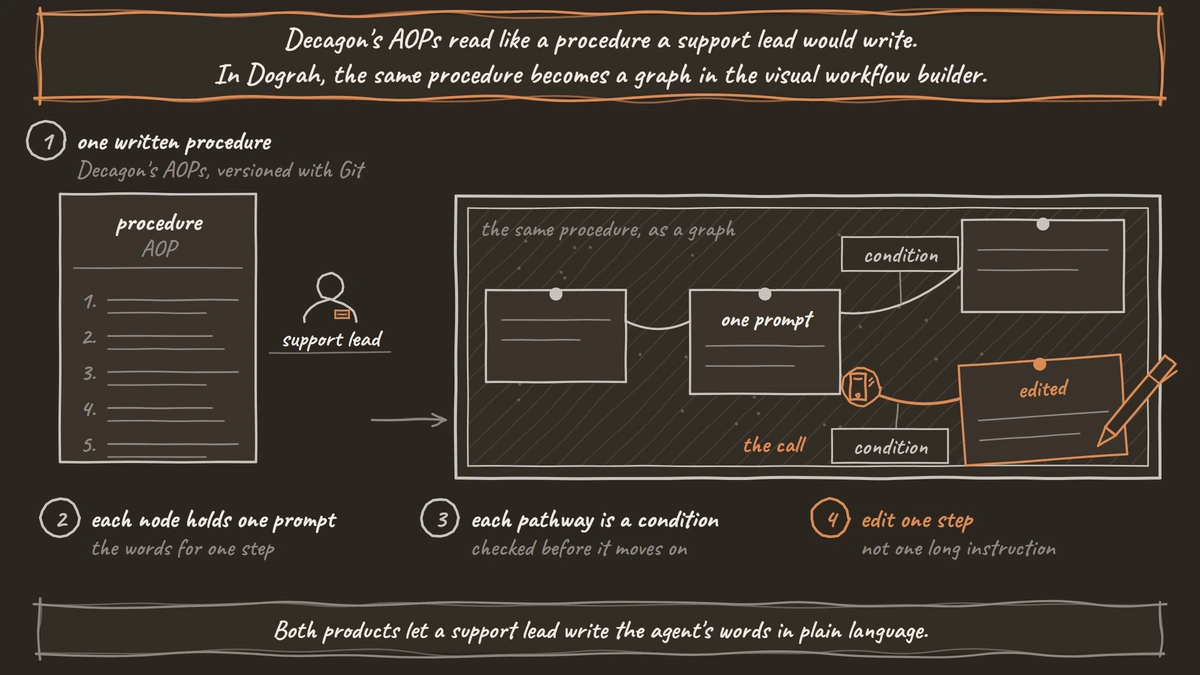
Both products let a support lead write the agent's words in plain language. They differ in how the call's structure is held.
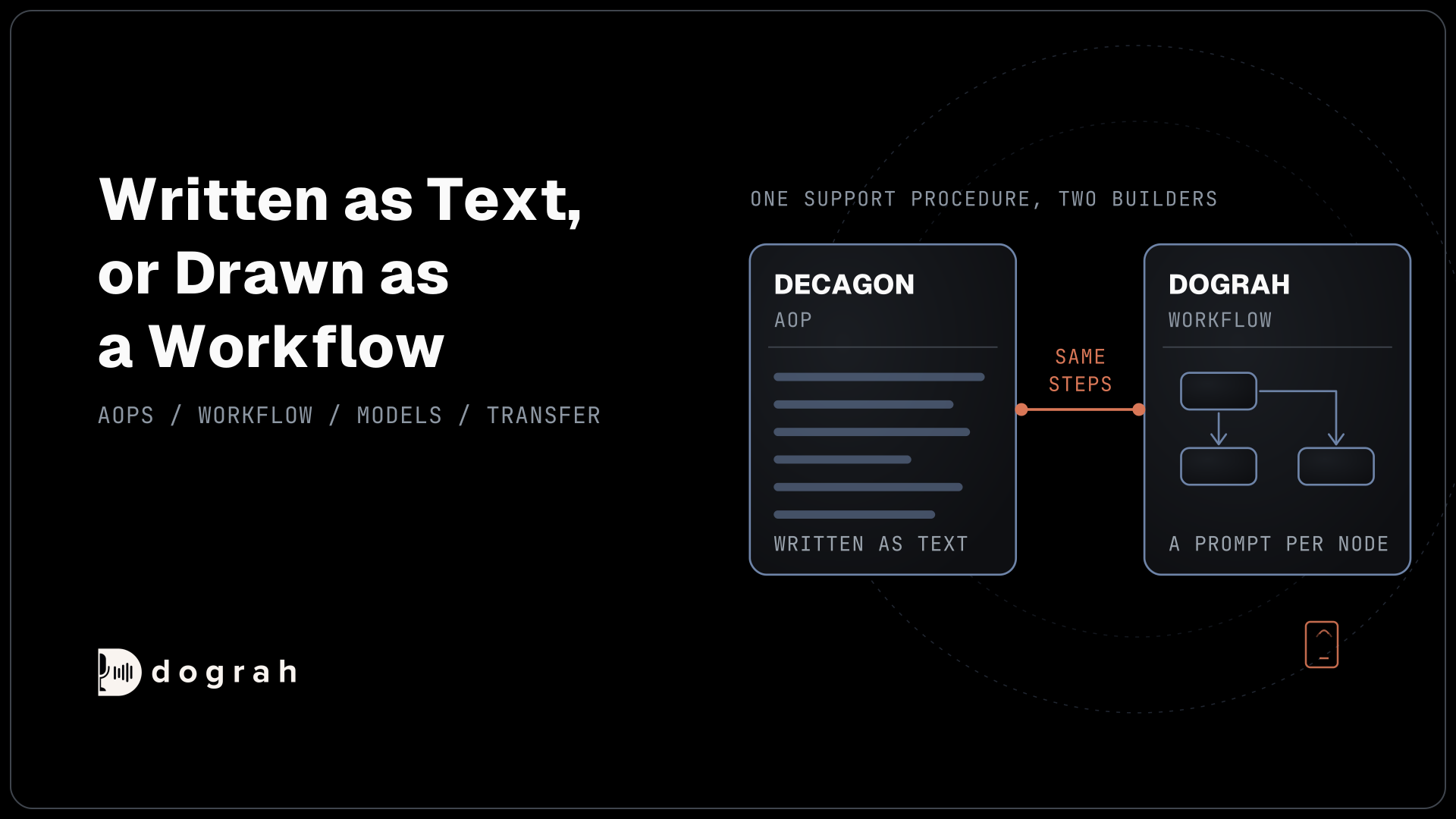
Decagon's AOPs read like a procedure a support lead would write, and engineers can version them with Git. Duet, Decagon's AI partner, drafts AOPs from uploaded transcripts and suggests changes.
In Dograh, the same procedure becomes a graph in the visual workflow builder. Each node holds one prompt, and each pathway out of it is a condition the model checks before it moves on. Small nodes make a long call easier to change, because you edit one step instead of one long instruction. An AI assistant can also draft and edit agents through the MCP server.
Testing works step by step too. In Test Chat you can rerun any of your messages, or edit it and rerun from that point, to compare replies without starting over. Tool calls already sent to your systems are not undone. After real calls, the QA node scores each step on its own. Our post on automated QA for voice agents shows how to read those scores.

Open Source Alternative to Vapi / Retell
Self-hosted voice agent platform — no per-minute fees
dograh-hq/dograh
Star on GitHub
Models and where call data goes
Decagon picks the models. Its agent runs on Decagon's infrastructure, uses AI providers such as OpenAI and Anthropic with zero data retention, and speaks through Chord, a speech model Decagon post-trained for customer conversations. Its Voice 3 release uses a duplex voice architecture, so the agent can listen, speak and act at once.
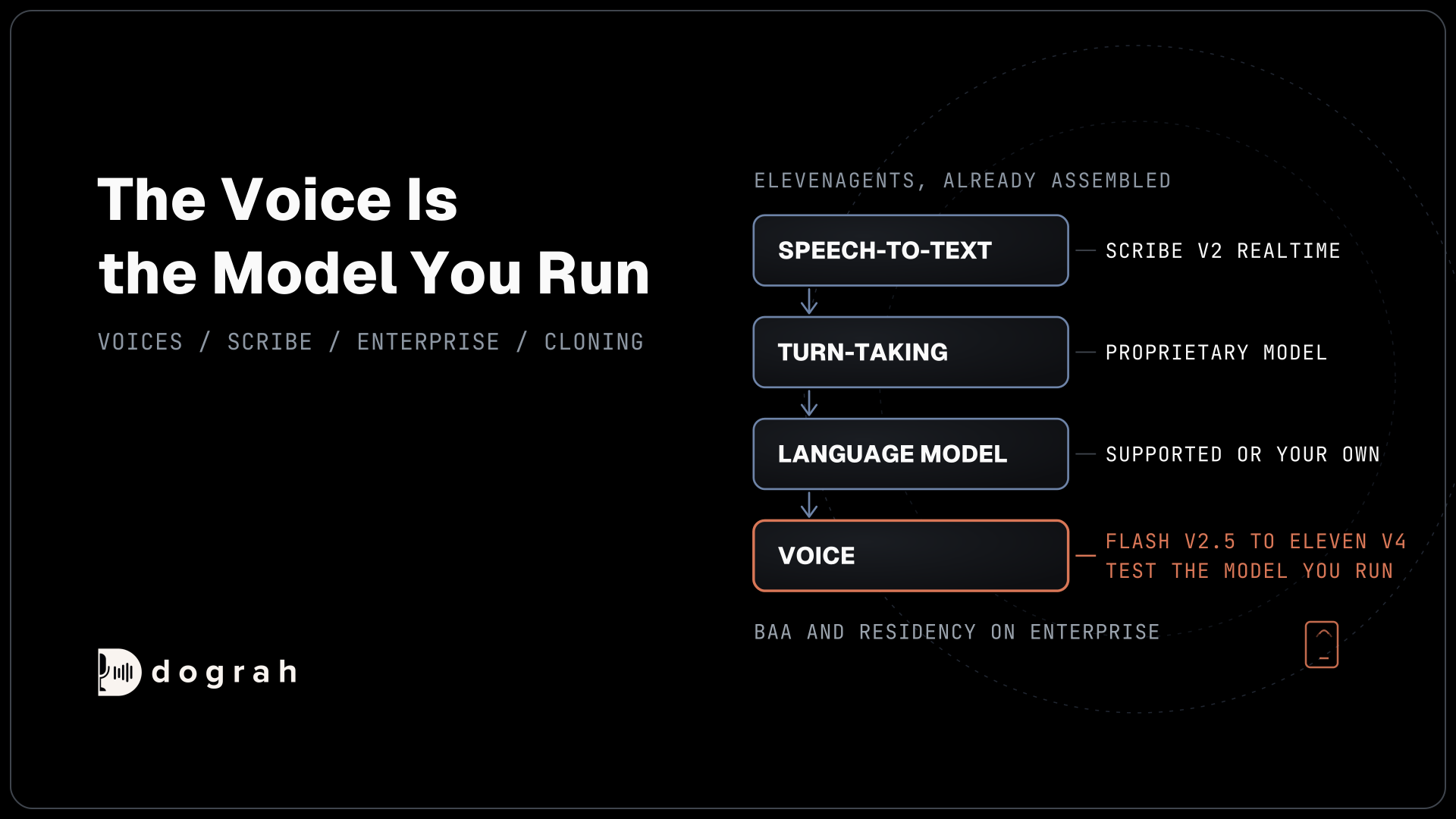
On the Dograh side, the platform handles the call flow, tools and telephony, while the speech and language models sit in their own layer that your support team picks. That can be Dograh's own models, your keys for providers such as OpenAI, Google, Deepgram or ElevenLabs, open-weight models on your servers, or a speech-to-speech model.
Your choice decides where the audio travels. With your own key, you hold the contract, but the audio still reaches that provider. Call audio, transcripts and recordings stay inside your perimeter only when the platform and the models both run on your servers. A self-hosted install sends anonymous usage telemetry by default. To switch it off, set ENABLE_TELEMETRY=false and remove POSTHOG_API_KEY.
Phone, transfer and the route to a person
Every support agent needs a clean way to a person. In a Gartner survey of 3,566 customers, 87% of customers said a company using generative AI for service must give them a way to reach a human agent.
Decagon Voice answers in more than 70 languages with automatic switching, places outbound calls, and transfers to human agents with a concise summary. It reaches callers through Amazon Connect, RingCentral or SIP trunking.
Dograh runs on the carrier you already use, from Twilio and Telnyx to Exotel or Asterisk ARI, and answers inbound WhatsApp voice calls. Transfer Call works on Twilio, Telnyx, Plivo, Cloudonix and Asterisk ARI. When the agent hands off, Dograh rings the support agent first and brings the customer onto the line only after that person picks up.
On Twilio, the customer and the support agent can each hear a brief spoken introduction before the two are joined. For anything longer, have the agent write the caller's details to your helpdesk with an HTTP API tool before the transfer, so the person who answers sees them on screen.
Who Decagon suits
Decagon suits a large support team that wants one managed agent across chat, email and voice, inside Salesforce, Zendesk or Intercom. Its support leads write AOPs in plain language, Duet drafts and refines them, and simulations and live experiments test changes before they reach customers. Decagon runs and tunes the agent under an enterprise contract.
It also suits teams that want redaction and certifications handled by the vendor. Google's data loss prevention (DLP) service redacts personal data from logs and transcripts after each conversation, and its security page lists HIPAA among its certifications. A self-hosted Dograh install meets that need another way: it sits inside your own perimeter, which keeps Dograh off your list of business associate agreements (BAAs). Any model provider that hears patient audio may still need its own BAA, and so may the carrier, depending on what it keeps. If the servers run in a cloud account, that cloud provider needs one too. Our post on HIPAA-compliant voice AI counts every vendor that hears the call.
Join the Dograh Community
Dograh is an OSS alternative to Vapi. Join our Slack community for queries, releases, best practices & community interactions.
When Dograh is the stronger fit
Dograh fits teams whose main support channel is the phone, and who want the platform in their own hands. You can read and change the code, run it on your own servers with Docker Compose, keep your carrier, and swap models whenever a better one ships.
It also fits teams that want a published platform rate. Run it on your own servers and there is no per-minute platform fee, though the support budget still pays for those servers, the model keys and the phone minutes. Dograh Cloud adds a 1¢-a-minute platform fee instead. That unit is a minute of call time, while Decagon's are conversations and resolutions, so compare them on your own volume. Our breakdown of Decagon pricing shows how its two meters work.
Whichever you pick, test on a real phone line, because a support call usually lands as 8 kHz audio and the browser demo you watched ran at 16 kHz.
Glossary
- Agent Operating Procedure (AOP)
- Decagon's format for an agent's workflow, written in plain language by a support team and versioned with Git by engineers. Decagon's Duet can draft AOPs from transcripts.
- Duplex voice architecture
- A voice design where the agent can listen, speak and act at the same time instead of taking strict turns. Decagon's Voice 3 uses one, with a fast model for talking and a more capable one for reasoning and tools.
- Data loss prevention (DLP) redaction
- Automatic detection and masking of personal data such as card or account numbers in stored text. Decagon uses Google's DLP service to clean logs and transcripts after a conversation ends.
- Business associate agreement (BAA)
- A contract under HIPAA between a healthcare provider and a vendor that handles patient data on its behalf. Self-hosting Dograh removes Dograh from that list, though model providers and the carrier may still need one.