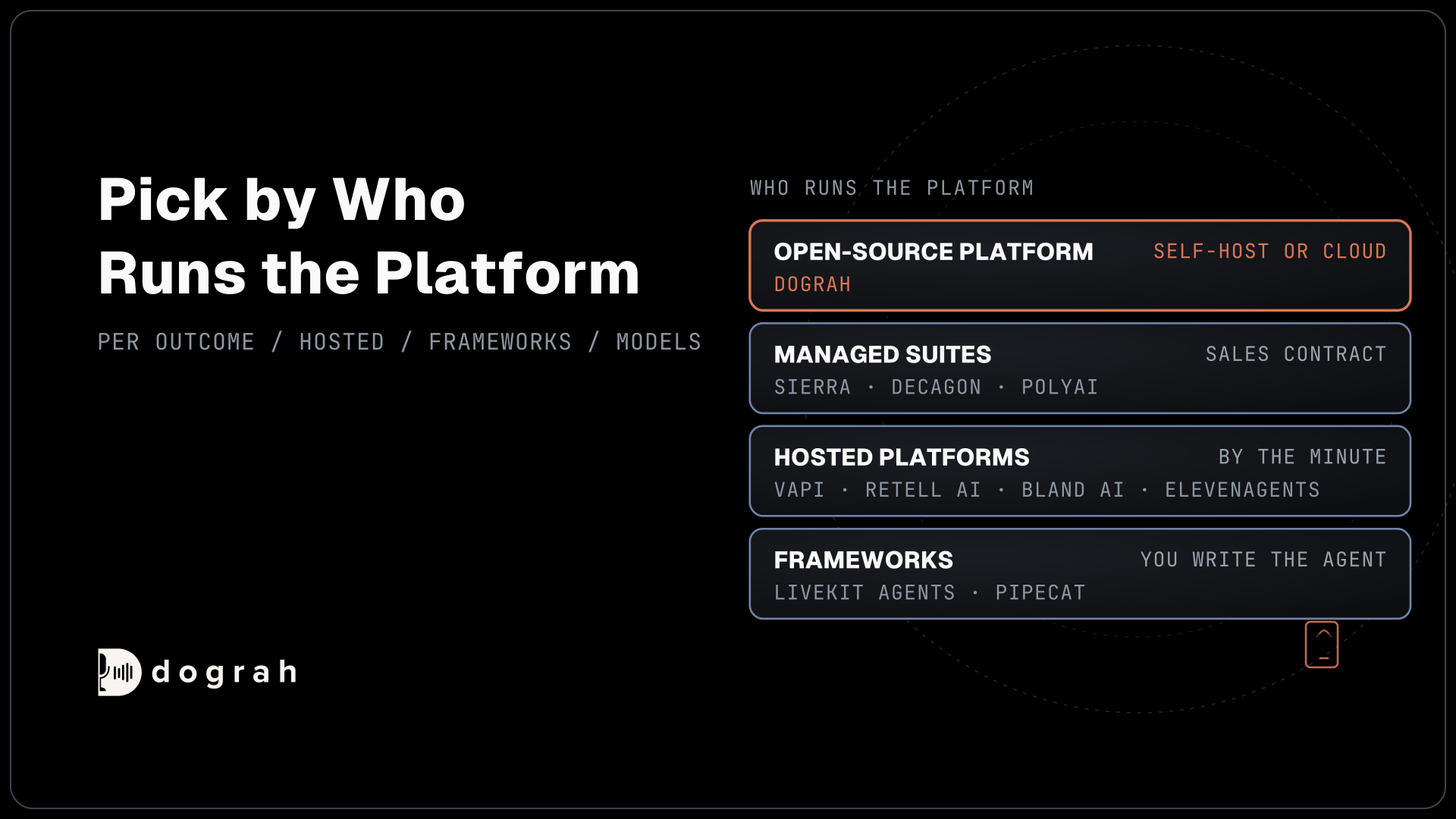

Sierra alternatives for phone agents split by who runs the platform. Decagon and PolyAI sell managed customer service agents, while Vapi, Retell AI, Bland AI and ElevenAgents are hosted developer platforms. Dograh, the open-source AI voice agent platform we build, lets your team choose every model, and you can self-host it or run it on Dograh Cloud.
Key Takeaways
- Sierra charges per agreed outcome, with the rate and outcome rules set in your contract.
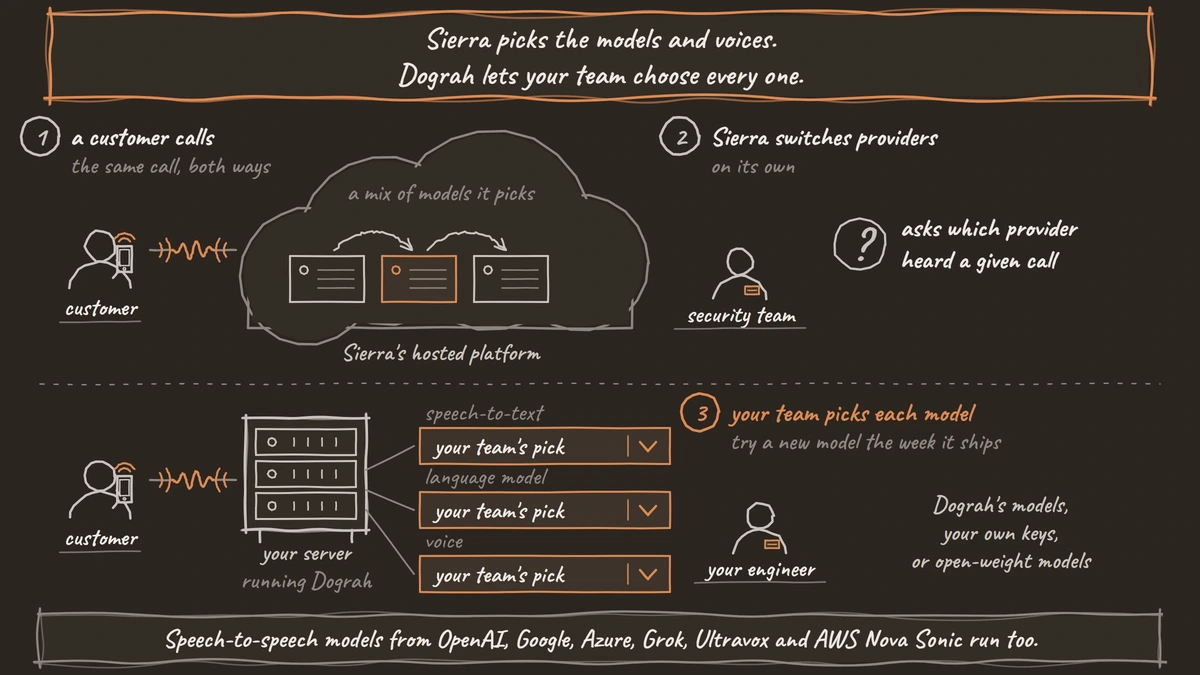
- Sierra picks the models and voices. Dograh lets your team choose every one.
- Voice is now Sierra's busiest channel, so compare alternatives on real phone calls.
Sierra's platform code is not public, and Sierra picks the models your agent runs on. This guide compares the field in one table, from support suites and hosted voice platforms to open-source Dograh, then covers how Sierra charges, when staying makes sense and how to move one number at a time.
What Sierra sells today
Sierra sells a hosted customer experience agent platform, and one agent can cover chat, SMS, WhatsApp, email, voice and ChatGPT. Sierra's product pages describe Agent Studio, where teams build agents with no code from building blocks called Journeys. Ghostwriter builds or changes an agent from a plain description of how it should behave, and developers get a declarative Agent SDK.
Sierra also sells people. Its expert agent development team has supported hundreds of deployments, so a customer can have Sierra's engineers build and tune the agent alongside its own staff. Around the agent sit Insights for reviewing conversations and Horizon for agents that follow a customer goal over days or weeks.
It is a large, fast-growing vendor, and that deserves saying plainly. In its latest growth update, Sierra reports more than $400 million in annual recurring revenue and says it works with almost half of the Fortune 50.
Voice is now its biggest channel. A year after launching voice, Sierra said in its voice anniversary post that it handles more phone calls than chats. That is why this guide compares phone agents. Sierra's email, SMS and ChatGPT channels sit outside the comparison, and on the Dograh side the channels are phone calls, inbound WhatsApp calls and a website voice or chat widget.
Why teams look past Sierra
Teams start looking at Sierra competitors for concrete reasons, and most of them come down to control.
The first is the code. Sierra sells a hosted platform by contract, through its sales team or Google Cloud Marketplace, and its platform code is not public. Its research team does publish benchmarks such as tau-bench under the MIT license. That is open research. The agent platform itself stays closed.
The second is the model layer. Sierra builds on what it calls a constellation of language models, mixing frontier and open-weight models with proprietary ones, and its trust and reliability page says it switches between providers on its own. Voices come from a set of voice models Sierra picks for each persona and language. That is convenient until your security team asks which provider heard a given call, or you want to try a new model the week it ships.
The third is the price unit. Sierra charges per outcome, and each outcome's definition and rate are agreed in your contract. That suits buyers who want to pay for results. Teams that forecast spend from call minutes, or want to start without a sales cycle, look for a per-minute platform instead.
The fourth is who builds. Changes run through Sierra's own tools or its team. Teams that want their own engineers to change the agent, and the platform under it, on any day they choose, look for code they can run on servers they control.
Sierra alternatives compared in one table
Five questions sort the field: the license, where it runs, how you pay, which models you can use and how agents get built. Prices come from each vendor's own pricing page. Latency is left out, because it depends on your models and phone path far more than on the platform, so measure it on your own calls.
| Product | Open source | Where it runs | How you pay | Models you can use | Builder |
|---|---|---|---|---|---|
| Sierra (baseline) | No. Its public GitHub holds research benchmarks | Sierra's hosted platform, by contract or through Google Cloud Marketplace | Per agreed outcome, set in your contract. Routing calls can be priced per conversation | Sierra's own mix of models, open-weight ones included, switched automatically | Agent Studio (no code), Agent SDK, Ghostwriter and Sierra's agent development team |
| Dograh | Yes, BSD-2-Clause | Your own servers with Docker Compose, Dograh Cloud, or on-prem and private cloud on Enterprise | Self-hosted: no per-minute platform fee. Dograh Cloud: a per-minute platform fee (see the Dograh section). Models and phone billed by their providers | Dograh's models, any supported provider with your own keys, open-weight models on your servers, or speech-to-speech models | Visual workflow builder with an AI-drafted first workflow, plus an MCP server. Your team builds |
| Decagon | No. Closed, managed platform | Decagon's cloud | Per conversation or per resolution, quoted by Decagon | Its own Chord speech model, with providers such as OpenAI and Anthropic | Agent Operating Procedures written in natural language, drafted with Duet |
| PolyAI | No | PolyAI's cloud on AWS, with US, EU and UK regions | Platform per minute, quoted by sales | PolyAI's own Raven model | Agent Studio |
| Vapi | No | Vapi's cloud | $0.05/min hosting, plus models and phone | Your own model keys or a custom LLM | Assistants and Squads, close to code. Visual Workflows retired in August 2026 |
| Retell AI | No | Retell's cloud, with a dedicated server add-on | $0.07 to $0.31/min, from $0.055/min voice infrastructure | A choice of language models, including OpenAI's realtime speech-to-speech | Visual Conversation Flow builder |
| Bland AI | No | Bland's cloud. On-prem or VPC on Enterprise | Start $0.14/min. Build $0.12/min plus $299/mo | Bland's own models under one rate | Bland Agents, the successor to Pathways |
| ElevenAgents | No. Closed platform with public SDKs | ElevenLabs' cloud. Private deployment in your own AWS or GCP account on Enterprise | Plans with included minutes. Extra minutes $0.08, LLM and carrier on top | ElevenLabs' own speech models, with hosted LLMs or your own | Visual Workflows, tests and A/B experiments |
| LiveKit Agents | Yes, Apache-2.0 | Your servers, or LiveKit Cloud | Free to self-host | Any model you wire in | Framework. Your developers write the agent and the product around it |
| Pipecat | Yes, BSD-2-Clause | Your servers, or Pipecat Cloud | Free to self-host | Any model you wire in | Python framework from Daily. Your developers write the agent and the product around it |
Among the options you can run yourself, Dograh is the one whose open code ships the builder, telephony, call history and QA. LiveKit Agents and Pipecat are frameworks.
Dograh: the open-source Sierra alternative
Dograh's code is open under BSD-2-Clause, and its GitHub repository holds the whole platform. That covers telephony, Campaigns for outbound lists, HTTP API tools that read and write your systems during the call, call traces and QA that scores each step of a call.
The biggest difference from Sierra is who picks the models. Sierra bundles its models into the service, whereas Dograh is the orchestration layer. It runs the call flow, tools and telephony and leaves the speech and language models as a layer your team fills. That can be Dograh's own models, your own keys for providers such as OpenAI, Google, Azure, AWS Bedrock and Groq, or an open-weight model behind an OpenAI-compatible endpoint such as Ollama or vLLM. Speech-to-speech models from OpenAI, Google, Azure, Grok, Ultravox and AWS Nova Sonic run too.
With bring your own key (BYOK), the contract moves to your team, but the call audio still reaches that provider. Audio stays in-house only when the models run on your own servers too, as our post on BYOK vs managed models explains.
Where Sierra has Journeys, Dograh agents take shape in the visual workflow builder, one node per step with pathways between them. Describe your use case and an AI drafts a starting workflow, which your team then edits node by node, or an AI assistant creates and edits agents through Dograh's MCP server. Your engineers own every change, and because the code is open, they can change the platform as well.
Dograh connects to the carrier you already use: Twilio, Vonage, Plivo, Telnyx, Cloudonix, Exotel, Vobiz or Asterisk ARI, or Dograh SIP. It can also answer inbound WhatsApp voice calls, and WhatsApp messages stay with your messaging tool. The same agent can run as a text chat on your website, where a chat lasts up to an hour and starts fresh on each page load.
Escalation to a person runs through Transfer Call on Twilio, Telnyx, Plivo, Cloudonix and Asterisk ARI. Your agent's line is dialled first, and the customer joins only after somebody picks up, with an optional spoken introduction for both of them on Twilio.
Self-hosting puts real work on your team. Self-hosting with Docker Compose runs 10 calls at once by default, a limit you can raise, and the servers and updates sit with you. Out of the box it also reports anonymous usage telemetry, which stops once you set ENABLE_TELEMETRY=false and delete POSTHOG_API_KEY. CRMs and helpdesks connect through HTTP API tools, MCP tools, the Webhook node and the API Trigger, and callers answer by voice.
On price, running it yourself removes the per-minute platform fee, and what you pay instead is servers, model keys and phone minutes. Dograh Cloud charges a 1¢-a-minute platform fee and includes 10 concurrent calls. Our row-by-row comparison with Sierra goes through every difference.

Open Source Alternative to Vapi / Retell
Self-hosted voice agent platform — no per-minute fees
dograh-hq/dograh
Star on GitHub
Other customer service agent suites
The closest matches to Sierra sell a managed agent and the people who help build it.
Decagon is the nearest. It sells one managed agent across chat, voice and email, built from Agent Operating Procedures written in natural language, with Duet to help draft them and its own Chord speech model for voice. It charges per conversation or per resolution, and our guide to Decagon alternatives covers its field.
PolyAI is voice-first. Its agents run on its own cloud on AWS, on its own Raven model, and the platform is priced per minute through sales. Our guide to PolyAI alternatives compares it in depth.
Intercom Fin, Ada and Salesforce Agentforce are support suites that added voice, and each runs its agent on the vendor's cloud. Fin's pricing page lists $0.99 per outcome, with one outcome billed per conversation, while Fin Voice is on a custom plan. Like Sierra, these suites suit a team that wants one vendor across its support channels more than a team that wants the platform's code.
Hosted voice agent platforms
Hosted voice platforms sell the agent platform by the minute, so you can sign up, build and compare without a sales contract.
Vapi is a developer platform with a $0.05-a-minute hosting fee, with models and phone billed on top. An add-on for the Health Insurance Portability and Accountability Act (HIPAA) costs $2,000 a month. Building there means Assistants and Squads, closer to code than Sierra's studio.
Retell AI publishes $0.07 to $0.31 a minute for a full agent, from $0.055 for its voice infrastructure, with 20 concurrent calls free and $8 a month for each extra one. Teams that like Sierra's studio will find a visual Conversation Flow builder there, and Retell sells OpenAI's realtime speech-to-speech models.
Bland AI runs its own speech and language models under one rate: $0.14 a minute on Start, or $0.12 plus $299 a month on Build, with on-prem or VPC deployment on Enterprise. ElevenAgents charges $0.08 for each extra minute, with the language model on top and the phone line billed by your carrier. Our guide to Vapi alternatives compares these hosted platforms in more depth.
Each of them bills the minute whether or not the call resolves anything. That is the plainest difference from Sierra's outcome model, and it makes spend easy to forecast from call volume.
Open-source routes to replacing Sierra
Open source and self-hosting are different things. Self-hosting is about where software runs, while open source means anyone can read, change and run the code with no contract.
Open chat tools cover part of Sierra's chat side. Rasa Open Source is Apache-2.0 and now in maintenance mode, Chatwoot is MIT outside its separately licensed enterprise folder, and Zammad is AGPL-3.0. They handle messages and tickets, and none of them answers a phone call.
LiveKit Agents (Apache-2.0) and Pipecat (BSD-2-Clause) handle phone and web audio, but they are frameworks your developers build on. Dograh is built on a fork of Pipecat. In our experience Pipecat is an excellent base, but production adds phone integrations, call history, QA on live calls and the call lifecycle, which is the part Dograh ships. If you are weighing a framework against a full platform, our roundup of the best open-source voice AI platforms sets them side by side.
If open source is your main reason for leaving, our post on the open-source alternative to Sierra sorts these layers one by one and shows how to run Dograh with your own models.
How Sierra charges
Sierra uses outcome-based pricing. Its pricing post says it is paid only when its agent completes a task, such as a resolved support conversation, a saved cancellation, an upsell or a cross-sell, with clear criteria for each outcome agreed upfront.
When a conversation goes unresolved or needs escalating, there is no charge in most cases. Routing or greeter-style calls can be priced per conversation instead, whatever the outcome. The rate itself comes from your contract, so ask how each outcome is defined, what counts when a person finishes the job, which calls fall under per-conversation pricing and whether build work by Sierra's team is billed separately.
Per-outcome and per-minute prices are different units, so compare them on your own call volumes and resolution rates. Our breakdown of Sierra pricing explains the model, what is usually free and how buying through Google Cloud Marketplace changes the bill.
When staying on Sierra makes sense
Sierra is the better fit for some teams. Large consumer brands that want one agent across chat, email, SMS, WhatsApp, voice and ChatGPT get it from one vendor. So do teams that want the vendor's own engineers to build and tune the agent.
Its testing goes further than most. Agent Studio runs simulations and regression suites, plus Voice Sims that check how an agent copes with noisy lines and different speakers before launch. Immutable releases let a team roll an agent back instantly.
Compliance is the other reason. Sierra lists SOC 2, HIPAA, GDPR, PCI, FedRAMP High, CCPA, CSA STAR, ISO 27001 and ISO 42001, holds PCI DSS Level 1 Service Provider certification, and sends card data through dedicated PCI infrastructure kept apart from its language models. If your buyers want those certifications from the vendor itself, Sierra gives them that.
Self-hosted Dograh answers the compliance need another way. Because it runs inside your own perimeter, Dograh never joins your list of business associate agreements (BAAs). Your cloud host and any model provider that touches patient data still sign one, and the carrier may need to as well, depending on what it stores. For payments, an HTTP API tool asks your own payment provider to send its secure link, so the agent never takes card numbers.
What moving off Sierra takes
Moving can happen one number at a time, with Sierra answering the rest until each rebuilt agent passes its tests. Treat each Sierra Journey, with its goals and guardrails, as the spec. Your team can redraw a Journey node by node, or let an AI assistant produce a first version through Dograh's MCP server and then review each node by hand.
Systems Sierra reached through its pre-built integrations connect through HTTP API tools, MCP tools, the Webhook node or Pre-Call Data Fetch, which loads the caller's record before the agent speaks. Your developers write those connections once, against your own APIs. For the whole move, our walkthrough on migrating from Sierra to Dograh covers rebuilding each Journey and switching one number at a time.
Numbers that already sit with your own carrier can point at Dograh as each agent is ready. Numbers held anywhere else move by a port or a divert that your carrier sets up. Test every rebuilt agent on a real phone line, which is also where Transfer Call gets its first real run.
Join the Dograh Community
Dograh is an OSS alternative to Vapi. Join our Slack community for queries, releases, best practices & community interactions.
Picking your Sierra alternative
Pick by the reason you started looking. If you want one vendor to build and run an agent across every support channel, compare Decagon and the support suites with Sierra. If you want a hosted platform billed by the minute, Vapi, Retell AI, Bland AI and ElevenAgents sell that. LiveKit Agents and Pipecat suit teams that would rather write the agent in code.
If you want the platform's code, your own choice of models and calls on servers you control, Dograh answers the reasons most of these searches start with. Run it from GitHub with Docker Compose, or start on Dograh Cloud.
Whichever you shortlist, run the same script on a real phone line and add a step that reads key details back to the caller. Sierra's own tau-Entity study found that the best realtime voice model it tested, GPT Live 1, captured a spoken detail correctly in 60.3% of regular calls across six languages. A phone line makes that harder still, since callers usually arrive as 8 kHz audio instead of the 16 kHz a browser demo gets.
Each part of this guide has its own deep dive:
Glossary
- Outcome-based pricing
- A price model where the vendor is paid when its agent completes an agreed task, such as a resolved conversation or a saved cancellation, rather than per minute or per seat. Sierra uses it, with each outcome defined in the contract.
- Orchestration layer
- The part of a voice agent that runs the call flow, turn-taking, tool calls and telephony. The speech and language models are a separate layer, and in Dograh you choose them yourself.
- Bring your own key (BYOK)
- Using your own account with a model provider instead of the platform's. You hold the contract and the bill, but the call audio still goes to that provider.
- Immutable release
- A saved version of an agent that never changes once published, so a team can switch back to it if a newer version misbehaves. Sierra's releases capture prompts, code, model versions and knowledge.