
For phone agents, the open-source alternative to Sierra is a full voice agent platform that answers the call itself. Dograh, the open-source AI voice agent platform we build, is licensed under BSD-2-Clause, works with any model and has a visual builder. You can self-host it or run it on Dograh Cloud, while Sierra sells a hosted platform by contract.
Key Takeaways
- Sierra publishes its research benchmarks under MIT, while its agent platform stays closed.
- Open chat tools such as Rasa and Chatwoot handle messages and run no phone agent.
- Calls stay on your servers only when the models run there too.
Sierra does publish code on GitHub, but only research benchmarks, never the platform that answers your calls. We map which open tools replace which part, then show how Dograh runs on your servers or our cloud with any model, and what open source asks of your team. It builds on our guide to Sierra alternatives.
Is Sierra open source?
Sierra's agent platform is not open source. Sierra sells a hosted platform by contract, through its sales team or Google Cloud Marketplace, and the platform code is not public.
What Sierra does open is its research. Its GitHub organization publishes benchmarks such as tau2-bench, a test of how well AI agents use tools while talking to simulated users, under the MIT license. That is useful to anyone testing agents, Dograh's users included. It is a benchmark, though, and running it gives you no agent to put on a phone line.
Self-hosting and open source also get mixed up in this search. Self-hosting is about where software runs. Open source means anyone can read, change and run the code under a published license, with no contract. A vendor can offer one without the other, so check both before you call a product open.
Which open-source tools replace which part
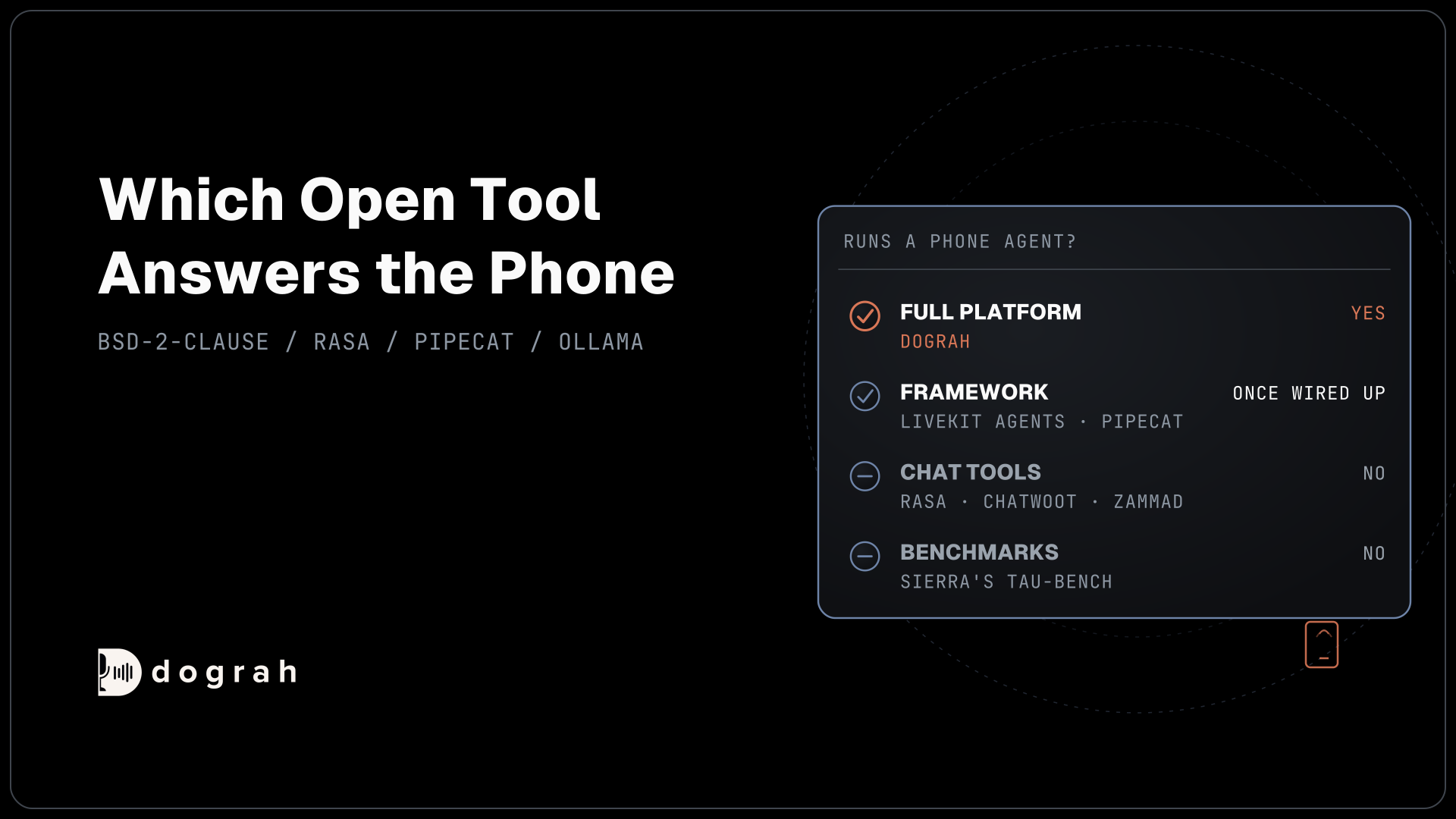
Open tools replace different layers of Sierra, and only one layer answers the phone.
| Layer | Open-source examples | License | Runs a phone agent | What your team still builds |
|---|---|---|---|---|
| Full voice agent platform | Dograh | BSD-2-Clause | Yes, on your carrier, Dograh SIP or inbound WhatsApp calls | Your agents and the connections to your systems |
| Voice agent framework | LiveKit Agents, Pipecat | Apache-2.0, BSD-2-Clause | Yes, once your developers wire it up | The builder, call history, QA and phone wiring |
| Chat and helpdesk tools | Rasa Open Source, Chatwoot, Zammad | Apache-2.0 (Rasa, in maintenance mode), MIT outside Chatwoot's enterprise folder, AGPL-3.0 (Zammad) | No | A separate voice stack for calls |
| Research benchmarks | Sierra's tau-bench and tau2-bench | MIT | No | Everything. A benchmark only scores agents |
Chat tools cover part of Sierra's chat side. Rasa Open Source handles dialogue, while Chatwoot and Zammad are support inboxes. Voice is now Sierra's busiest channel, so for most teams leaving Sierra the phone agent is the part to replace first.
LiveKit Agents and Pipecat handle phone and web audio, but your developers build the product around them. Dograh itself is built on a fork of Pipecat. For a team leaving a hosted product, the gap between a framework and a finished platform is the real question, and our list of the best open-source voice AI platforms maps it out.
Running Dograh on your own servers or Dograh Cloud
Dograh runs in two ways, and the code is the same in both. Its whole platform sits in its GitHub repository under the BSD 2-Clause license, which lets you use, change and sell it as long as you keep the copyright notice.
That license matters most to teams that want to rebrand the agent or sell what they build on it, and our post on BSD-licensed voice AI explains what it allows. Nobody can withdraw the code you already run, whatever happens upstream.
Self-hosting with Docker Compose brings up the full platform on one server, and our guide on how to self-host a voice AI agent with Docker walks through it. A self-hosted install runs 10 calls at once by default, and you can raise that limit. Anonymous usage telemetry is on at first, and ENABLE_TELEMETRY=false plus removing POSTHOG_API_KEY turns it off.
The cloud version is the same platform run for you, for teams that want the open code without the servers. On your own servers, the open code carries no per-minute platform fee, and the spend moves to those servers, your model keys and phone minutes. Dograh Cloud charges a 1¢-a-minute platform fee, and its Enterprise plan adds on-prem or private-cloud deployment with data residency.
Any model, including ones on your servers
Sierra chooses the models for you. Its trust and reliability page describes a constellation of language models that mixes frontier and open-weight models with proprietary ones, switched between providers on Sierra's side.
Here your team makes that choice. Dograh is the orchestration layer that handles the call flow, tools and telephony, and the speech and language models are a layer you plug in yourself. You can use Dograh's own models, your own keys for providers such as OpenAI, Google, Azure, AWS Bedrock and Groq, or speech-to-speech models from OpenAI, Google and others.
A provider key changes who holds the contract, and the call audio still travels to that provider. Full data sovereignty needs the third option: open-weight models on your own servers. An OpenAI-compatible endpoint such as Ollama or vLLM serves the language model, and Speaches serves local speech-to-text and voices. With self-hosted Dograh and local models, the call audio never has to leave your infrastructure.
Building agents without Sierra's team
Sierra pairs its studio with an agent development team that has supported hundreds of deployments. With Dograh, your own team builds, and the tools are made for that.
In place of a vendor team, your staff draw each agent in the visual workflow builder, with a node for every step and pathways linking them. Describe your use case and an AI drafts a starting workflow, which you then edit node by node. An AI assistant can also create and edit agents through Dograh's MCP server. In Test Chat, you can rerun any of your messages, or edit one and rerun from that point, to compare replies without starting over.
Once calls are live, QA scores each step of a call on test calls and live calls, with a sample rate you set. The same agent can answer phone calls, inbound WhatsApp calls and a website widget that runs by voice or as a text chat, where a chat lasts up to an hour. For handoffs, Transfer Call covers Twilio, Telnyx, Plivo, Cloudonix and Asterisk ARI, ringing your colleague first and adding the caller once that line is answered.

Open Source Alternative to Vapi / Retell
Self-hosted voice agent platform — no per-minute fees
dograh-hq/dograh
Star on GitHub
What open source asks of your team
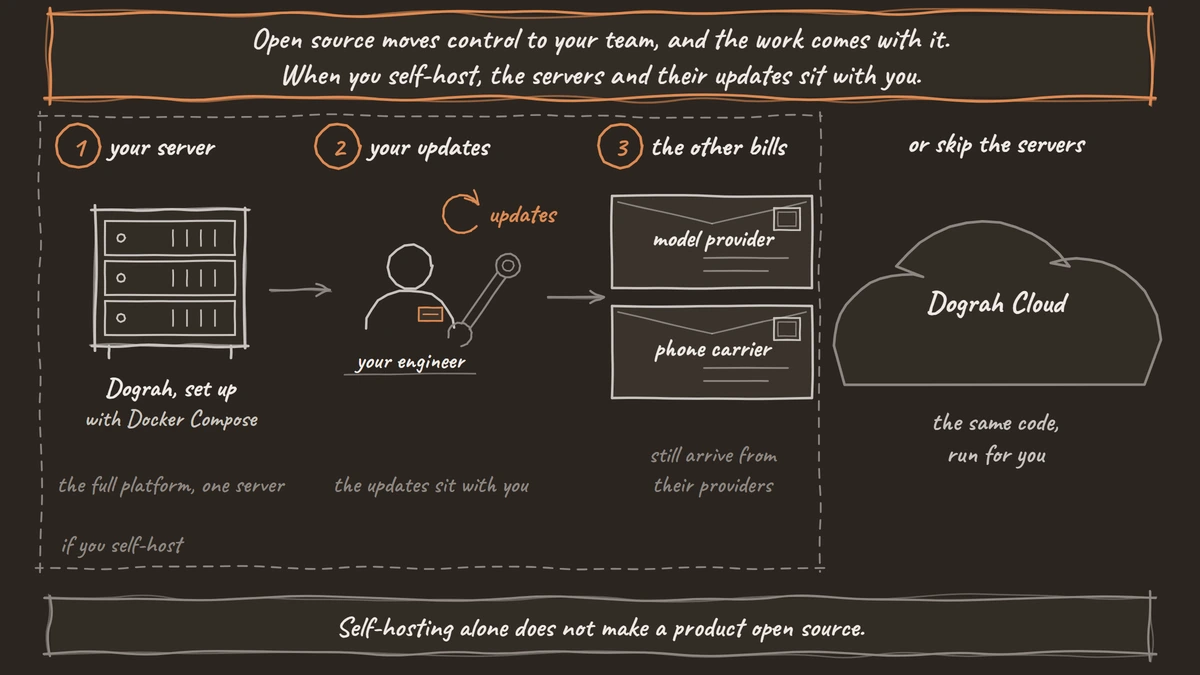
Open source moves control to your team, and the work comes with it. When you self-host, the servers and their updates sit with you, and model and phone bills still arrive from their providers. Teams that would rather skip the servers can run the same code on Dograh Cloud.
Some Sierra features have no one-for-one twin. Sierra covers email, SMS and ChatGPT, while Dograh covers phone calls, inbound WhatsApp calls and the website widget. CRMs and helpdesks connect through HTTP API tools, MCP tools and the Webhook node, written once against your own APIs. Version History lets you open any earlier agent version read-only and compare it with the one before, and to go back, you copy what you need and publish a new version.
If you are weighing the two products feature by feature, our Dograh vs Sierra comparison puts them in one table. Either way, put your rebuilt agent on a real phone line before cutover, because most callers come through at 8 kHz, half the 16 kHz a browser demo hears.
Join the Dograh Community
Dograh is an OSS alternative to Vapi. Join our Slack community for queries, releases, best practices & community interactions.
Glossary
- Open source
- Software whose code anyone can read, change and run under a published license, with no contract. Self-hosting alone does not make a product open source.
- BSD 2-Clause license
- A permissive open-source license that lets you use, change, sell and rebrand the code, as long as you keep the copyright notice. Dograh is released under it.
- Orchestration layer
- The part of a voice agent that runs the call flow, turn-taking, tool calls and telephony. The speech and language models are a separate layer, and in Dograh you choose them.
- Data sovereignty
- Keeping call audio and data on infrastructure you control. In Dograh it takes the self-hosted platform plus open-weight models on your own servers, since a provider key still sends audio to that provider.