
Choosing Dograh vs Sierra comes down to owning the platform or buying outcomes. Sierra sells a hosted customer experience agent platform, priced per agreed outcome under contract. Dograh, the open-source AI voice agent platform we build, lets your team pick every model and build agents itself, and you can self-host it or run it on our managed cloud.
Key Takeaways
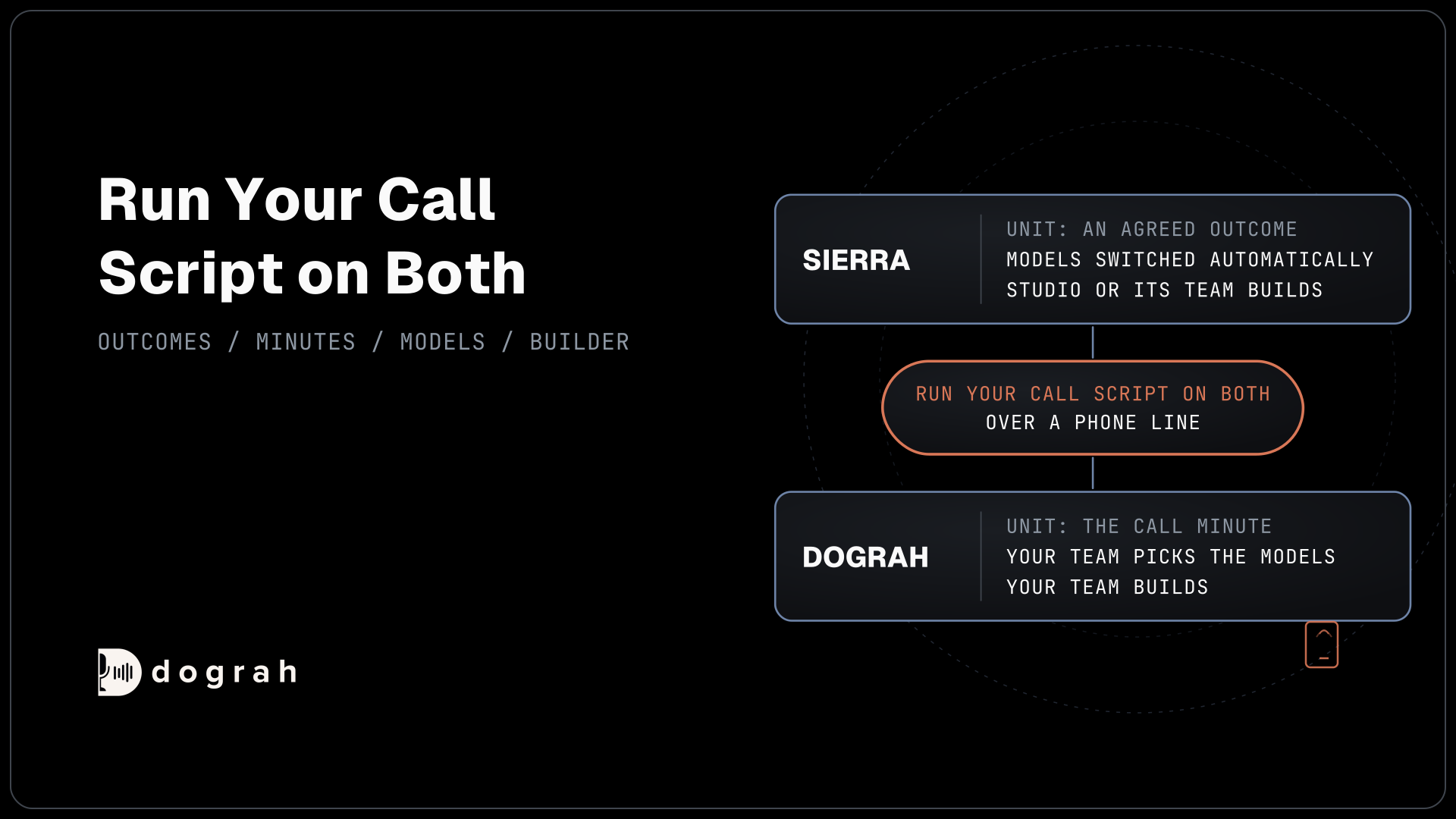
- Sierra charges per agreed outcome, while Dograh's unit is the call minute.
- Sierra covers email, SMS and ChatGPT. Dograh covers phone and web conversations.
- Sierra leads on vendor certifications, instant rollback and a team that builds for you.
Teams usually start weighing up Sierra once they want to change the agent themselves or know which model handled each call. We put the two side by side on license, hosting, models, builder and pricing, then say who Sierra suits and when Dograh fits better. For the wider field, see our guide to Sierra alternatives.
Dograh and Sierra, row by row
Sierra rents a hosted agent and the team to build it, while Dograh is open-source software your team runs and changes.
| Row | Sierra | Dograh |
|---|---|---|
| License | Closed platform. Its public GitHub holds research benchmarks under MIT | Open source under BSD-2-Clause, the whole platform |
| Where it runs | Sierra's hosted platform, bought by contract or through Google Cloud Marketplace | Your own servers with Docker Compose, Dograh Cloud, or on-prem and private cloud on Enterprise |
| How you pay | Per agreed outcome, such as a resolved conversation, set in your contract. Routing calls can be priced per conversation | Self-hosted: no per-minute platform fee. Dograh Cloud: a per-minute platform fee (see the pricing section). Models and phone billed by their providers |
| Models | Sierra's own mix of models, switched automatically. Voices from models Sierra picks per persona | Dograh's models, any supported provider with your own keys, open-weight models on your servers, or speech-to-speech models |
| Builder | Agent Studio (no code), Agent SDK, Ghostwriter and an agent development team | Visual workflow builder with an AI-drafted first workflow, plus an MCP server. Your team builds |
| Channels | Chat, SMS, WhatsApp, email, voice and ChatGPT | Phone calls on your carrier or Dograh SIP, inbound WhatsApp calls, and a website voice or chat widget |
| Testing | Simulations, regression suites, Voice Sims and immutable releases with instant rollback | Test Chat with rerun and edit-and-rerun, QA scored per step on test and live calls, and simulations through Tuner |
| Compliance | SOC 2, GDPR, PCI DSS Level 1, FedRAMP High, ISO 27001 and ISO 42001 listed, among others | Self-host inside your own perimeter (see the last section). Enterprise adds compliance support |
| Payments | Card data through Sierra's dedicated PCI infrastructure, kept apart from its language models | An HTTP API tool asks your payment provider to send a secure link, so the agent never takes card numbers |
The rows show two different bets. Sierra asks you to trust its models and its team. Dograh hands you the code and the choices, along with the work of running them.
Who picks the models and voices
Sierra picks the models, and Dograh lets you pick them. Sierra's trust and reliability page describes a constellation of language models that mixes frontier and open-weight models with proprietary ones, and says it switches between providers automatically to keep the agent performing. Its Voice Personas run on voice models Sierra chooses for each persona and language.
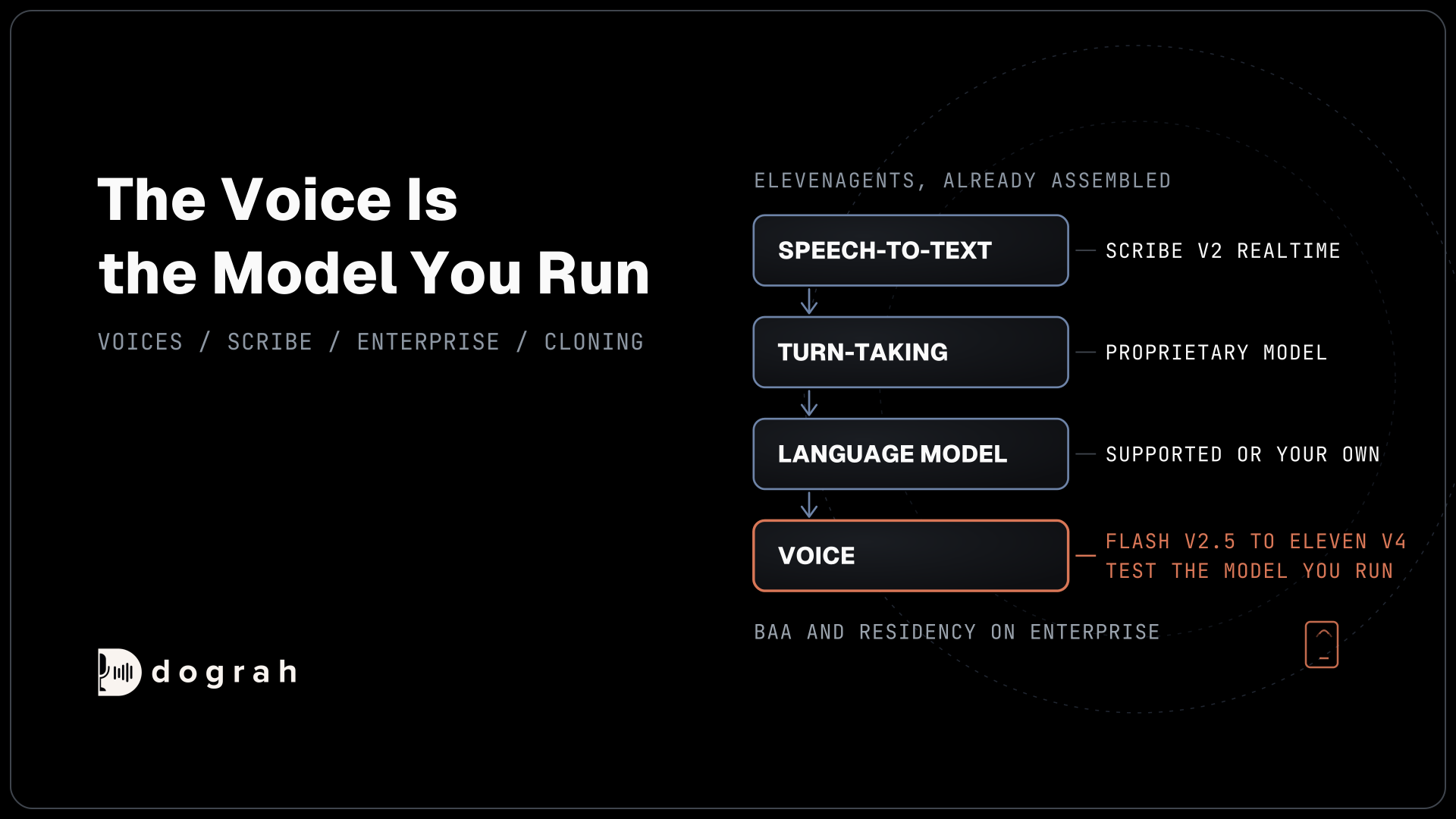
In Dograh, the orchestration layer covers the call flow, tools and telephony, and your team fills the speech and language layer with whatever models it trusts. That can be Dograh's own models, your own keys for providers such as OpenAI, Google, Azure, AWS Bedrock and Groq, or open-weight models on your own servers through an OpenAI-compatible endpoint. Speech-to-speech models from OpenAI, Google, Azure, Grok, Ultravox and AWS Nova Sonic run there as well.
A provider key you bring puts the contract in your name, yet the audio still reaches that provider. The audio stays in-house only when Dograh and the models both run on your servers, which our post on the open-source alternative to Sierra walks through.
Building and changing an agent
Sierra gives you several ways to build, plus its own people. Agent Studio builds agents with no code from Journeys, the Agent SDK is a declarative language for developers, and Ghostwriter builds or edits an agent from a plain description. Sierra's product page also offers an expert agent development team that has supported hundreds of deployments.
With Dograh, your own team builds and changes the agent. The visual workflow builder turns each call into a map your team can read: one node for every step, with pathways deciding where the caller goes next. Describe your use case and an AI drafts a starting workflow, and an AI assistant can also create and edit agents through Dograh's MCP server.
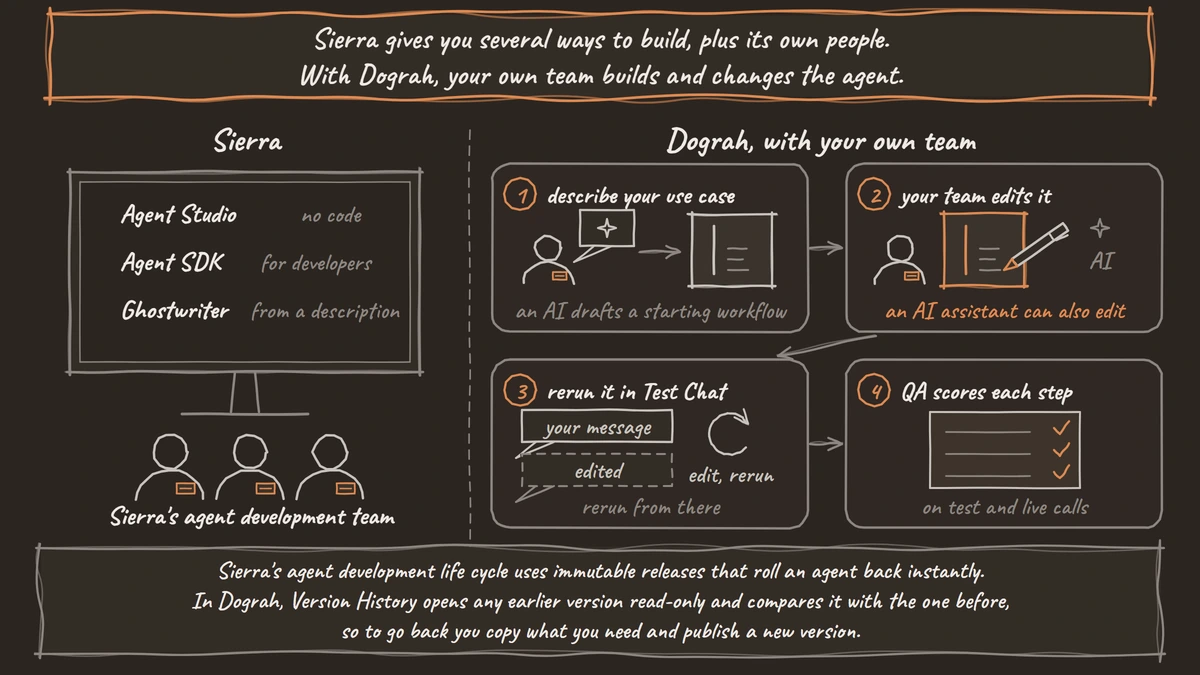
Testing differs most on releases. Sierra's agent development life cycle uses immutable releases that roll an agent back instantly. In Dograh, Version History opens any earlier version read-only and compares it with the one before, so to go back you copy what you need and publish a new version. Test Chat lets you rerun a message, or edit it and rerun from there, and QA scores each step of test and live calls.
Our post on testing voice agents before you go live sets out the order to run those checks, from Test Chat to a real phone line.

Open Source Alternative to Vapi / Retell
Self-hosted voice agent platform — no per-minute fees
dograh-hq/dograh
Star on GitHub
Outcomes or minutes: how each charges
The two products charge for different things, so compare them on your own call volumes and resolution rates. Sierra is paid when its agent completes an agreed task, such as a resolved conversation or a saved cancellation, with the criteria set upfront in your contract. Unresolved and escalated conversations carry no charge in most cases, and routing calls can be priced per conversation.
On the other side, the unit is the call minute, and what you pay depends on where you run it. A self-hosted install has no per-minute platform fee at all, so the spend sits in servers, model keys and phone minutes. Dograh Cloud charges a 1¢-a-minute platform fee and includes 10 concurrent calls, with models billed by their providers.
Outcome-based pricing shifts the risk of a failed call to the vendor. Minute pricing makes spend track call volume, whatever the result. Our breakdown of Sierra pricing covers what is usually free and the questions to settle in a Sierra contract.
Who Sierra suits
Sierra suits large consumer brands that want one agent across chat, email, SMS, WhatsApp, voice and ChatGPT from one vendor. It also suits teams that want the vendor's own engineers to build and tune the agent, and buyers who would rather pay for resolved outcomes than for minutes.
Regulated buyers who want certifications held by the vendor itself are a strong fit too. Sierra lists FedRAMP High and ISO 42001 among its standards, holds PCI DSS Level 1 Service Provider certification, and keeps payment data on dedicated infrastructure away from its language models. Its testing tools, from Voice Sims to regression suites, and instant rollback suit teams that ship agent changes often across many brands.
When Dograh is the stronger fit
Dograh fits teams that want to own the platform and choose every model. Its code is open, so your security team can read what it approves, and your engineers can change the platform as well as the agent. Calls run on your servers or Dograh Cloud, on the carrier you already use: Twilio, Vonage, Plivo, Telnyx, Cloudonix, Exotel, Vobiz or Asterisk ARI.
When a call needs a person, Transfer Call works on Twilio, Telnyx, Plivo, Cloudonix and Asterisk ARI. The person taking over is rung first, and the customer is put through once they answer. Twilio users can add a short spoken introduction that both of them hear before the line joins.
Self-hosted Dograh also meets compliance needs without a vendor in the middle. Under the Health Insurance Portability and Accountability Act (HIPAA), a platform running inside your own perimeter leaves Dograh out of your business associate agreements (BAAs). Those go to your cloud host and any model provider that sees patient data, plus the carrier if what it stores calls for one. Our guide to compliant AI voice agents follows the data through each layer.
Self-hosting with Docker Compose runs 10 calls at once by default, and the servers and updates sit with your team. Before go-live, set ENABLE_TELEMETRY=false and remove POSTHOG_API_KEY if you want the default anonymous usage telemetry off. Then run your real call script on both products over a phone line, where callers mostly arrive at 8 kHz rather than the 16 kHz of a browser demo.
Join the Dograh Community
Dograh is an OSS alternative to Vapi. Join our Slack community for queries, releases, best practices & community interactions.
Glossary
- Outcome-based pricing
- A price model where the vendor is paid when its agent completes an agreed task, such as a resolved conversation or a saved cancellation. Sierra uses it, with each outcome defined in the contract.
- Immutable release
- A saved agent version that never changes once published, so a team can switch back to it instantly. Sierra's releases capture the agent's prompts, code, model versions and knowledge.
- Orchestration layer
- The part of a voice agent that runs the call flow, turn-taking, tool calls and telephony. The speech and language models are a separate layer, and in Dograh you choose them.
- PCI DSS Level 1
- The highest validation level of the Payment Card Industry Data Security Standard for service providers that handle card data. Sierra holds it, and Dograh keeps card numbers off the call instead.