
For phone and website conversations, the open-source alternative to Decagon is Dograh, the AI voice agent platform our team builds and publishes under BSD-2-Clause. You can self-host it or run it on Dograh Cloud, with any model you pick. Open chat projects cover chat only, and Rasa is self-hosted under its own license.
Key Takeaways
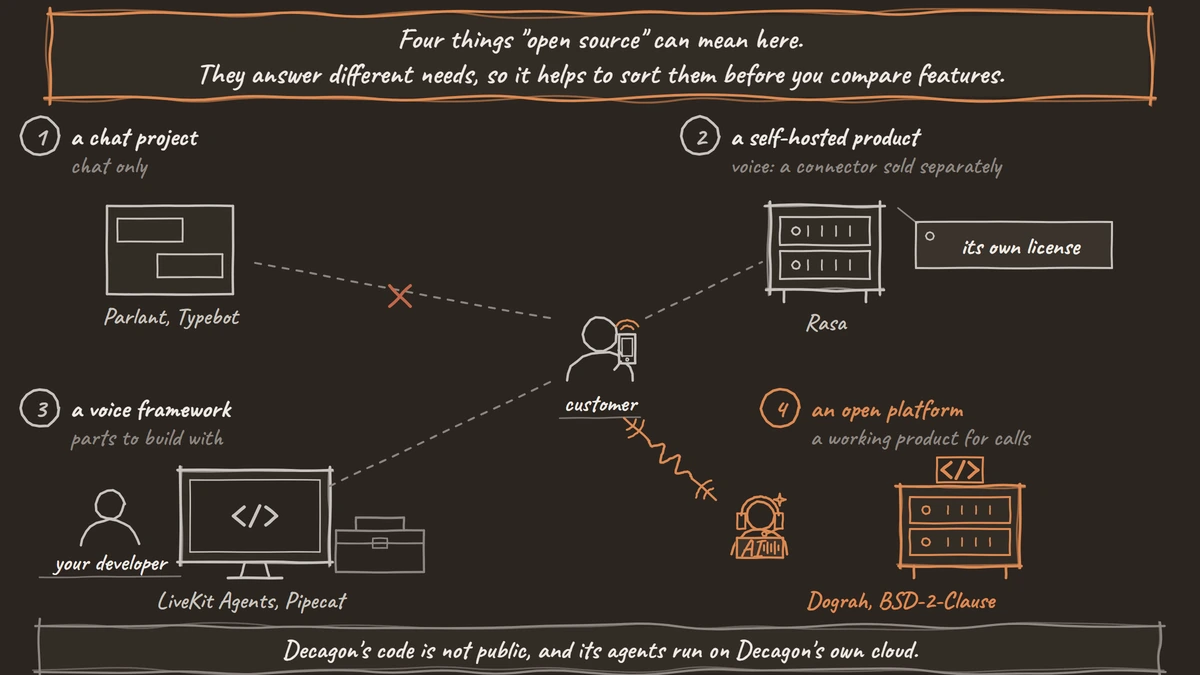
- Decagon's code is not public, and its agents run on Decagon's own cloud.
- Check the license before the server: self-hosted is not open source.
- Call data stays in-house when the models also run on your servers.
Plenty of tools get called an open-source Decagon alternative, yet some only handle chat and others just run on your servers. We sort what open source means here, show how Dograh opens the whole platform with any model you choose, and say where Decagon still fits better. It sits under our guide to Decagon alternatives.
Four things "open source" can mean here
An open-source Decagon alternative can mean a chat project, a self-hosted product or a voice framework, all under one label. They answer different needs, so it helps to sort them before you compare features.
| Option | License | Answers phone calls | Where it runs | What you still build |
|---|---|---|---|---|
| Dograh | BSD-2-Clause, whole platform | Yes, on your own carrier, plus a website voice or chat widget | Your servers, or Dograh Cloud | The agent's flow and prompts in a visual builder |
| Decagon (baseline) | Code not public | Yes, with chat and email in the same agent | Decagon's multi-region cloud | AOPs, with Decagon's team |
| Parlant | Apache-2.0 | No, built for chat agents | Your servers | Channels, voice and the support product around it |
| Typebot | Source-available (Functional Source License) | No, a chatbot builder | Your servers, within the license's terms | Voice, and any use the license restricts |
| Rasa | Free Developer Edition license or Enterprise. The Apache-2.0 Rasa Open Source repo is in maintenance mode | Through an AudioCodes connector sold separately | Your servers or private cloud | The agent in Rasa's own framework |
| LiveKit Agents | Apache-2.0 | Yes, once your developers wire telephony | Your servers or LiveKit Cloud | The whole product in code |
| Pipecat | BSD-2-Clause | Yes, once your developers wire telephony | Your servers or Pipecat Cloud | The whole product in code |
The chat projects can replace the chat side of Decagon. The voice frameworks give your developers parts to build with. Dograh is the row where the open code is already a working product for calls.
Self-hosted is not the same as open source
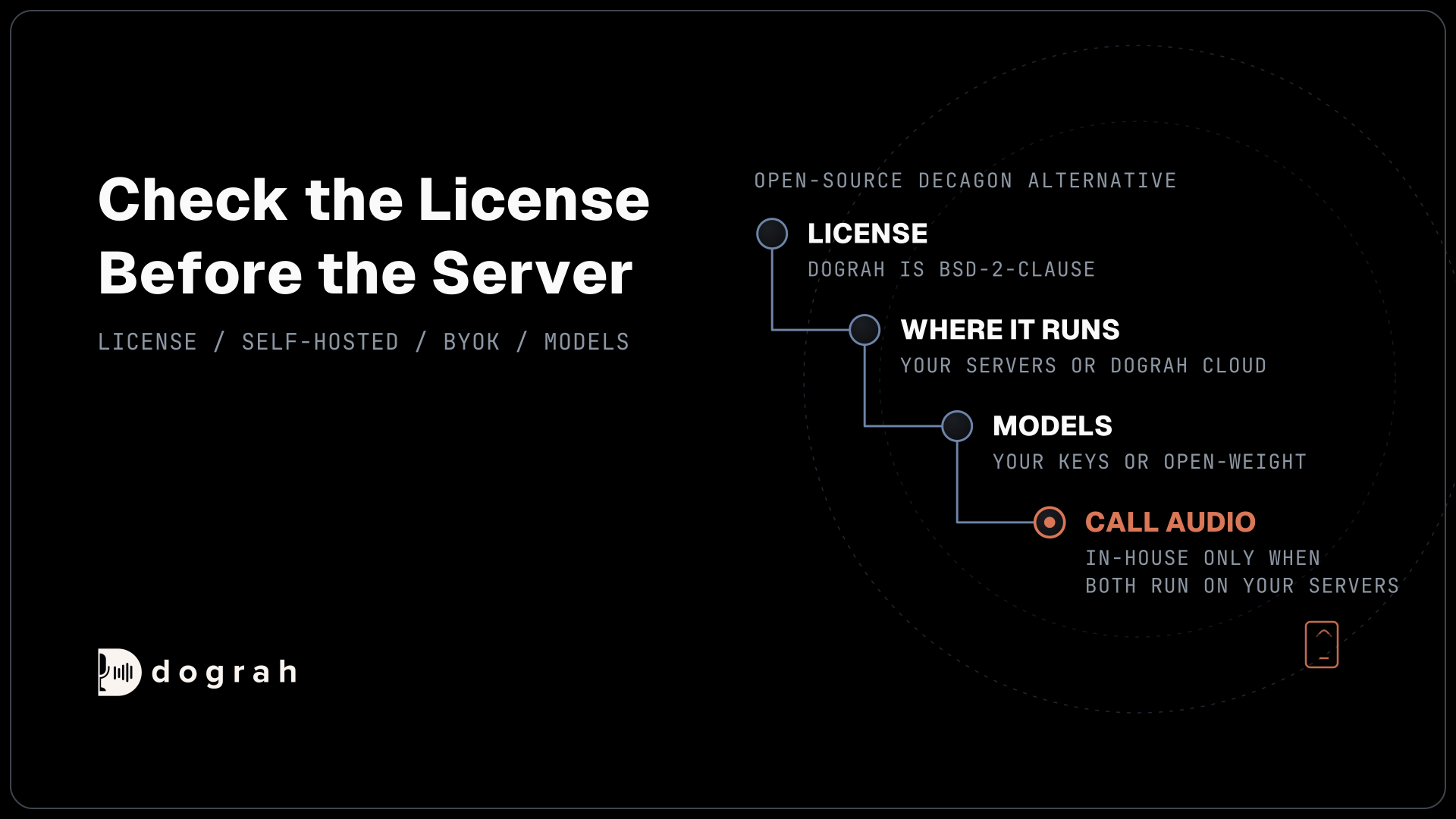
Self-hosted says where the software runs. Open source says what you may do with the code, and that decides whether you can fork it and keep running it if the vendor changes course. Our post on what a BSD license allows covers that in plain terms.
Rasa shows the gap well. Today's Rasa platform runs on your own servers under a free Developer Edition license, for one bot and up to 1,000 external conversations a month, or under an Enterprise license. The Rasa Open Source repository is still Apache-2.0, but it now says it is in maintenance mode, and new work goes to the newer platform.
Typebot uses a source-available license, the Functional Source License. You can read and self-host the code, but the license limits competing commercial use for a period before the code becomes Apache-2.0. Decagon's own AOPs can be versioned with Git by your engineers, which keeps the agent's instructions in your hands, while the platform that runs them stays Decagon's. According to Decagon's security page, it runs on multi-region infrastructure and uses AI providers such as OpenAI and Anthropic with zero data retention.
Dograh: the whole platform under BSD-2-Clause
Dograh's code is open under the BSD 2-Clause license, and its GitHub repository holds the full platform, not SDKs around a closed service. Your team can change it and run it with no contract.
You choose where it runs. Self-hosting with Docker Compose puts it on your own servers, with 10 calls at once by default. Or the hosted service runs the same platform for you. On your own servers there is no per-minute platform fee to pay, only the servers, model keys and phone minutes. Dograh Cloud runs it for a 1¢-a-minute platform fee.
Agents are built in the visual workflow builder. Each node holds a prompt in plain language, so a support lead writes what the agent says while the canvas shows the order of the call. An AI assistant can also create and edit agents through the MCP server, and each step can be scored by automatic QA.
The open platform covers the phone and the website. It works with carriers such as Twilio, Telnyx, Plivo and Vonage, and answers inbound WhatsApp voice calls. The website widget runs as voice or as a text chat. A chat lasts up to an hour, ends after a quiet spell you set (30 minutes by default), and doesn't carry history across page loads. Email stays with your helpdesk, which the agent reaches through HTTP API tools, MCP tools and the Webhook node.

Open Source Alternative to Vapi / Retell
Self-hosted voice agent platform — no per-minute fees
dograh-hq/dograh
Star on GitHub
Any model, including ones on your own servers
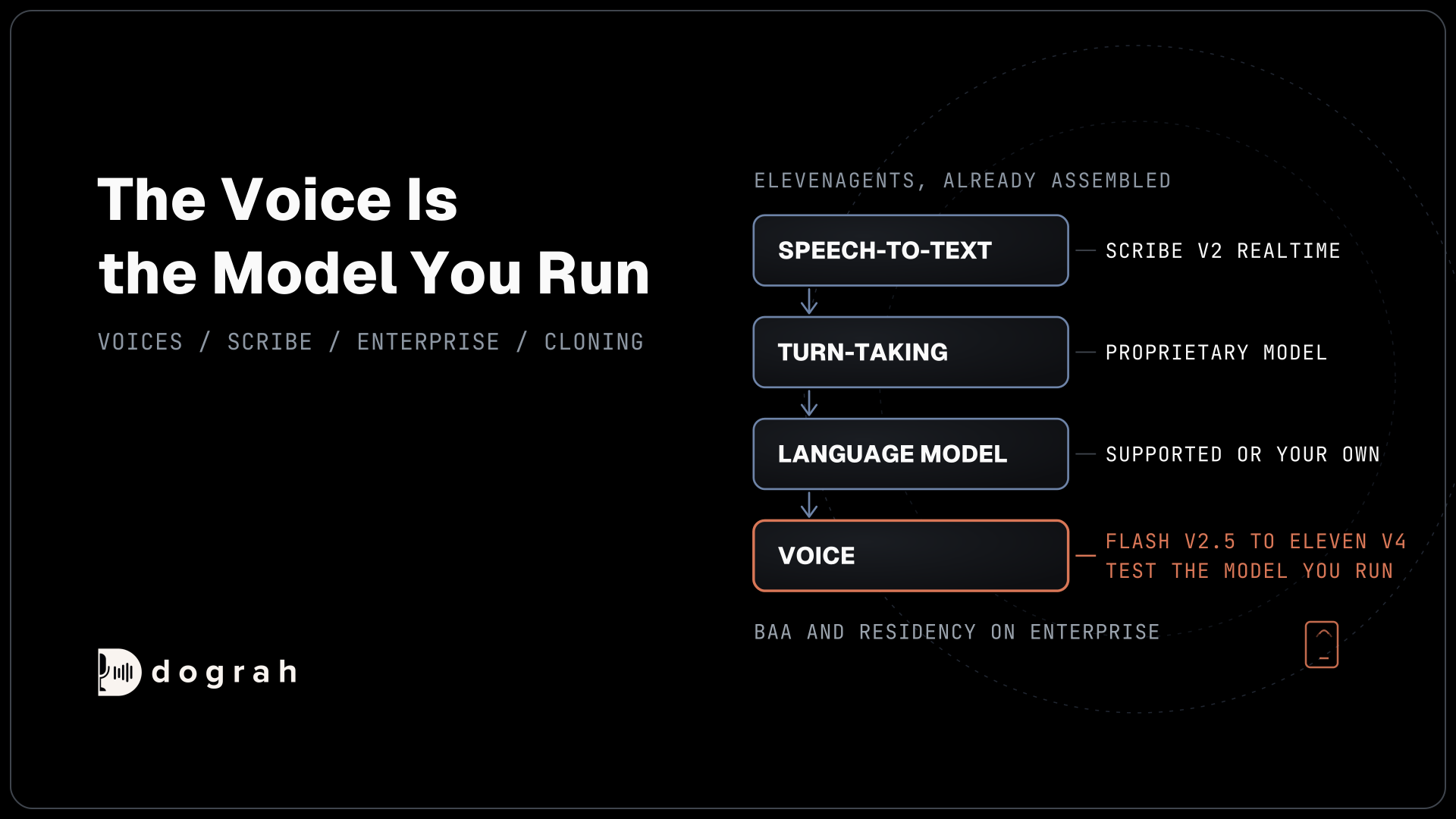
The second half of owning the platform is choosing the models. As the orchestration layer, Dograh runs the call flow, tools and telephony, and the speech and language models are a separate layer you set, where Decagon's agent runs on the AI providers Decagon picks.
In Dograh you can use its own models, your own keys for providers such as OpenAI, Google, Deepgram or ElevenLabs, or open-weight models served on your own machines through an OpenAI-compatible endpoint. Speech-to-speech models are supported too.
Where the call audio goes depends on that choice. With your own key, you hold the contract and the bill, but the audio still reaches that provider. Our post on BYOK vs managed models explains the difference. Call audio, transcripts and recordings stay inside your own perimeter only when the platform and the models both run on your servers. In that setup, note that self-hosted installs report anonymous usage telemetry unless you set ENABLE_TELEMETRY=false and remove POSTHOG_API_KEY.
Where Decagon is still the closer fit
Decagon suits teams whose support runs mostly through chat and email inside one helpdesk. One agent answers all three channels there, with native connectors for Salesforce, Zendesk and Intercom, and a managed team that keeps tuning it.
Its builder tools are aimed at support leads who prefer writing to drawing. Duet drafts AOPs from transcripts and simulations test them at scale. Google's DLP service also redacts personal data from logs and transcripts after each conversation. If those are the reasons you bought Decagon, an open platform for calls answers a different question.
If the phone is your main channel and you want the code and the models in your own hands, an open platform is the better fit. Our Dograh vs Decagon comparison goes through the two row by row, including builder, transfer and compliance.
Join the Dograh Community
Dograh is an OSS alternative to Vapi. Join our Slack community for queries, releases, best practices & community interactions.
Glossary
- Source-available license
- A license that lets you read and often self-host the code but limits how you use it, for example banning competing commercial use for a period. Typebot's Functional Source License is one, and it is not open source.
- Orchestration layer
- The software that runs a voice call: the flow, turn-taking, tool calls, telephony and handoffs. The speech and language models are a separate layer that it calls.
- Open-weight model
- A model whose trained weights you can download and run on your own hardware. Running open-weight speech and language models next to a self-hosted platform keeps call audio inside your perimeter.
- Maintenance mode
- A project state where the code stays available but gets only fixes, not new features. Rasa Open Source is in maintenance mode, with new work going to Rasa's newer platform.