
Parloa suits large customer-service teams that want a managed AI agent platform for voice and chat, connected to the contact center they already run and priced per minute through a volume package. The trade is closed code running in Parloa's cloud. For teams that want to own the platform, Dograh is open source, self-hosted or on Dograh Cloud.
Key Takeaways
- Parloa prices voice per minute, with rates set by each use case's complexity.
- Parloa Zones pick the data region, and Parloa still runs and processes the calls.
- Best fit is a large team already on Genesys, Five9, Avaya, Amazon Connect or Cisco.
Parloa is one of the best-funded AI agent companies in customer service, and it sells through its own team. This review covers what it sells, how it prices, where call data sits, who it fits and what to ask in the deal, then where open-source Dograh fits for on-prem buyers.
Parloa at a glance
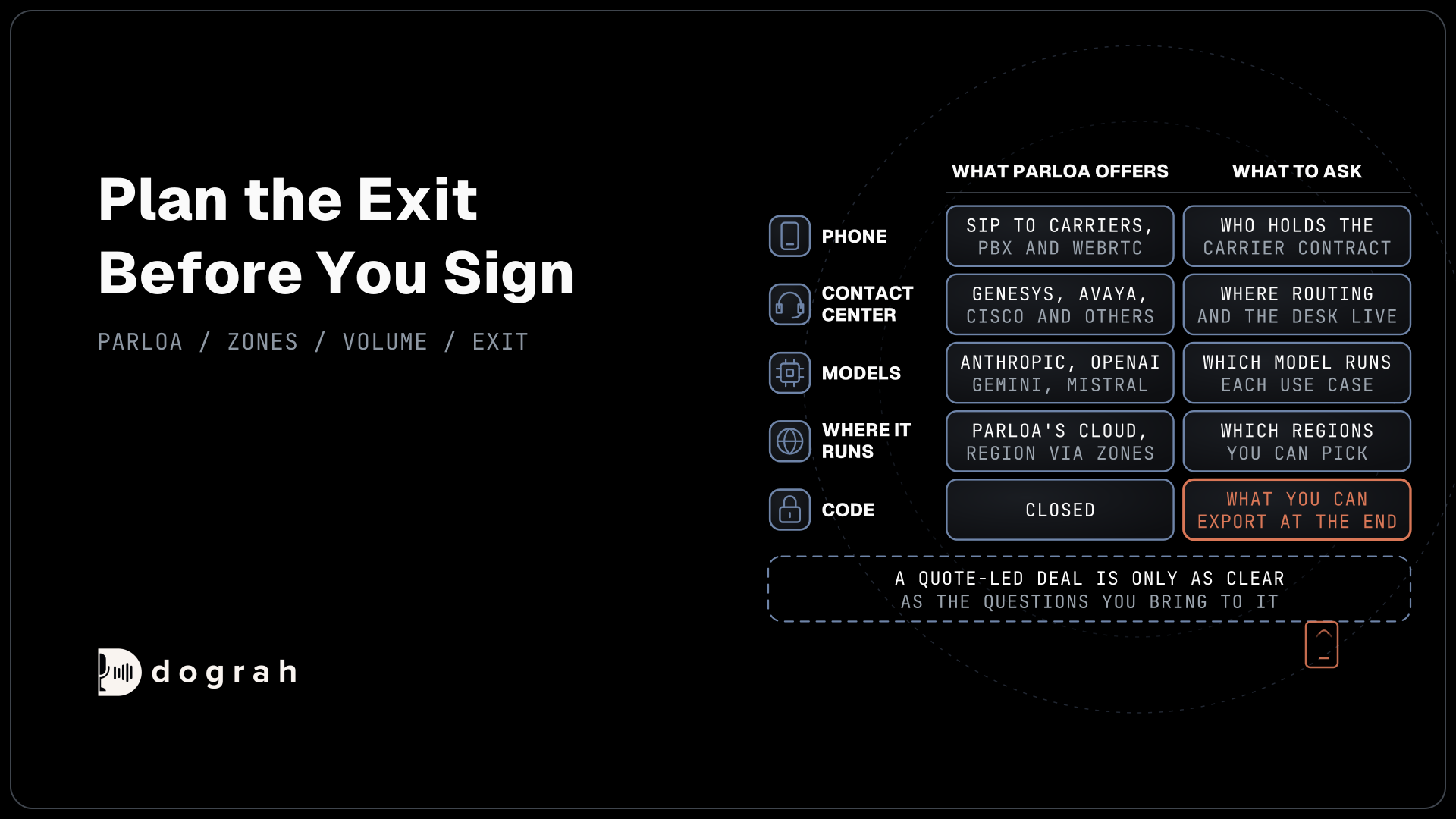
Parloa calls its product the AI Agent Management Platform, or AMP, and it covers building, testing and running AI agents for phone and chat. The table sums up what it offers and what to ask about each part. The connector list comes from Parloa's integrations page.
| Area | What Parloa offers | What to ask |
|---|---|---|
| Product | AI agents for voice and chat, built and managed in one platform | Which tools your deal includes |
| Phone connection | SIP into telephony, contact centers, PBX systems and WebRTC | Who holds the carrier contract |
| Contact centers | Connectors for Genesys, Five9, Avaya, Amazon Connect, Cisco and others | Where routing and the human agent desk live |
| Languages | Over 140 languages and variants | Test yours on real phone calls |
| Calls at once | "Unlimited concurrent calls" | How that is written into the contract |
| Language models | Anthropic, OpenAI, Google Gemini, Microsoft Azure, Amazon Bedrock, X.AI and Mistral | Which model runs each use case |
| Where it runs | Parloa's cloud, with the legal region chosen through Parloa Zones | Which regions you can pick |
| Code | Closed | What you can export at the end |
| Pricing | Per minute for voice, per interaction for chat, through a volume package | The rate for each use case |
What Parloa sells for voice and chat
Parloa sells the software and the service around an AI agent's whole life, from the first build to daily tuning. Agent Builder lets teams create agents without code, and Navigator turns written guidance and existing standard operating procedures into agents. Performance Lab simulates and evaluates conversations before release, and Parloa Lens reviews them after.
Voice is where Parloa puts most of its effort. Its conversation infrastructure connects over SIP to phone carriers, contact centers, PBX systems and WebRTC, handles barge-in and turn-taking, and encrypts voice with SRTP. Parloa states that its agents speak over 140 languages and variants, and that unlimited concurrent calls run with built-in redundancy. Chat runs on the same platform, so one agent definition can serve both channels.
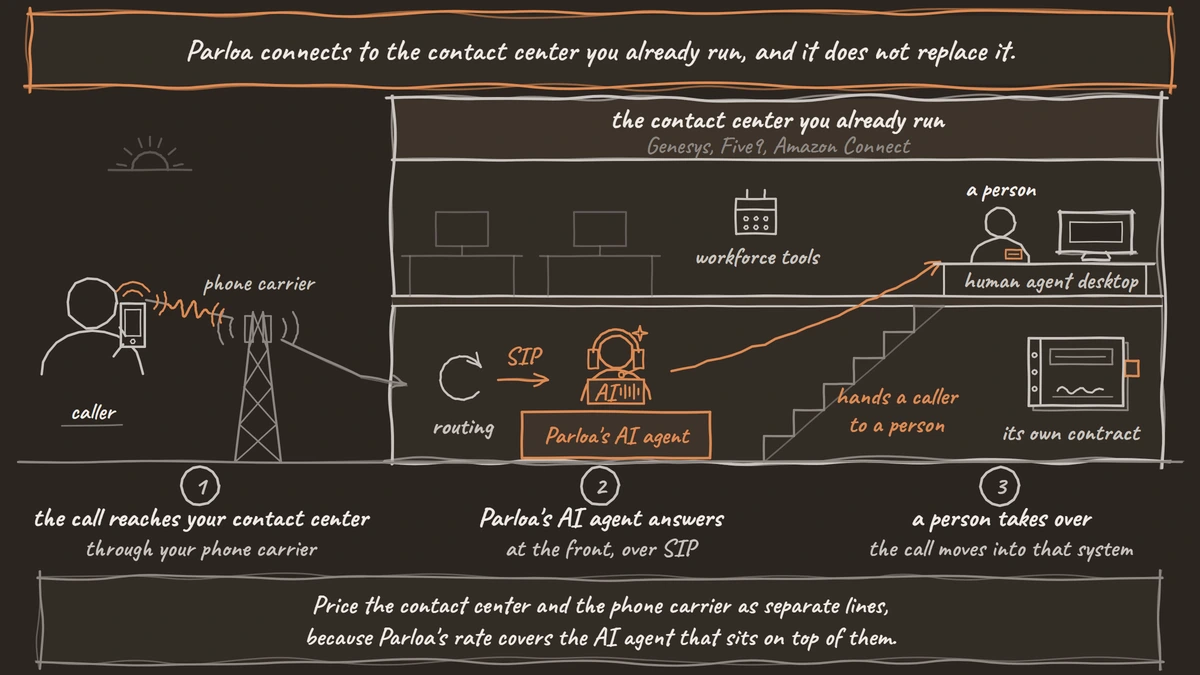
Parloa connects to the contact center you already run, and it does not replace it. Routing, the human agent desktop and workforce tools stay with Genesys, Five9, Amazon Connect or whichever system you use. When the AI agent hands a caller to a person, the call moves into that system, which has its own contract.
The company behind it is large and well funded. Parloa raised a $350 million Series D at a $3 billion valuation in January 2026, has 380 employees in New York, Berlin and Munich, and names Allianz, Booking.com, SAP and Swiss Life among its customers. Big rollouts often run with partners such as McKinsey, Deloitte Canada, TELUS Digital and Thoughtworks.

Open Source Alternative to Vapi / Retell
Self-hosted voice agent platform — no per-minute fees
dograh-hq/dograh
Star on GitHub
How Parloa is priced
Parloa charges for use, and the rate for each use case is set in the deal. It bills per minute for voice and per interaction for chat, and its rates reflect the complexity of each use case. A simple status check costs less per minute than a call that needs more reasoning and more systems.
You pick a volume package based on expected needs and apply it across your use cases. Parloa says new use cases follow the same logic without new contracts, that costs drop on their own as agents get faster, and that outcome-based pricing is possible where it fits. The first number for your own volume comes from a conversation with Parloa's team. Our breakdown of Parloa pricing covers what drives the rate and what to ask in the quote.
Where your call data sits
Parloa runs in its own cloud, and Parloa Zones decide the legal region for your data. Announced in September 2026, Zones keep transcripts, personal details, logs and analytics in the region you choose, along with the services that process them, such as transcription and model inference. A separate control plane manages configuration such as agents, phone numbers and channels.
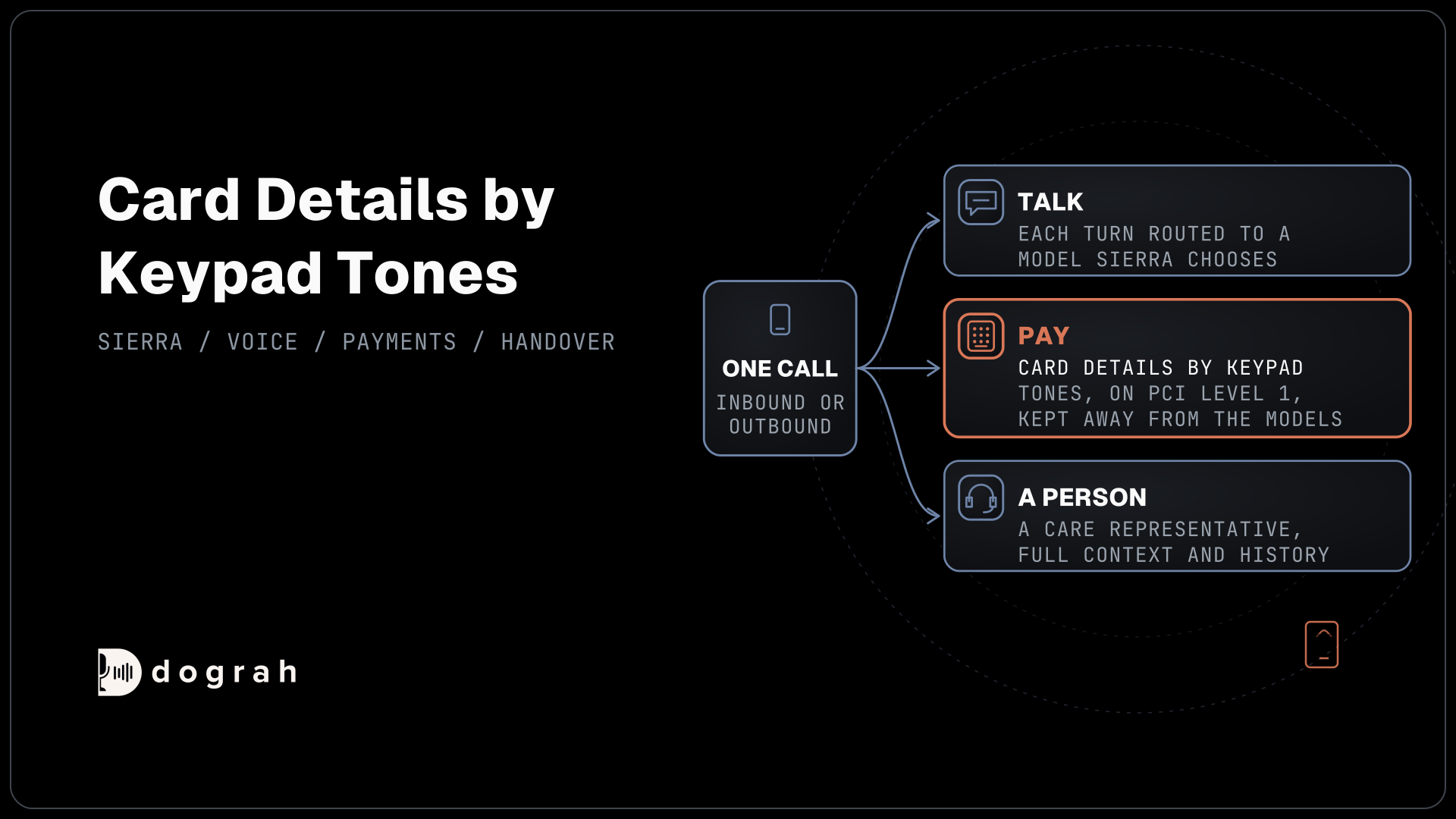
Parloa's trust center lists its hosting as a "Major Cloud Provider" without naming it, and lists Google, Twilio, Datadog, MongoDB and Microsoft as subprocessors. Parloa names ISO 27001, SOC 2 Type 1 and 2, PCI DSS and HIPAA among its certifications, and also covers GDPR, DORA and the EU AI Act. Personal details are redacted in real time, and card data goes to a separate process with no language model in it.
Those controls are real, and they still leave one gap. The code is closed, so your security team reviews documents and audits, not the software that handles each call. A chosen region keeps the data in a country, and Parloa still holds it. Buyers who need calls on servers they run themselves are asking a different question, which our guide to on-prem voice AI platforms covers in full.
Who Parloa fits, and who it does not
Parloa fits a large business-to-consumer service team that already runs a major contact center and wants AI agents on top of it. Insurers, travel companies and retailers with high call volume in many countries get the most from it. They need the language range, they already pay for Genesys, Five9, Avaya, Amazon Connect or Cisco, and they would rather a vendor and its partners carry the rollout than build it in-house.
It fits less well when control matters more than service. A team that must read the code, run the platform on-prem or keep call audio inside its own network gets Parloa's cloud in a chosen region, not its own servers. The same goes for a team that wants a published rate before a sales call, or a small team whose volume will not justify a volume package. Our roundup of Parloa alternatives groups the other options by why buyers look elsewhere.
Join the Dograh Community
Dograh is an OSS alternative to Vapi. Join our Slack community for queries, releases, best practices & community interactions.
What to ask in a Parloa deal
A quote-led deal is only as clear as the questions you bring to it. Start with the rate for each use case you plan to automate, and what makes one use case count as more complex than another. Then ask how big the committed volume is, how long it runs and what happens to minutes you do not use.
Next, ask about control, such as which regions Zones offers today, which language model runs each use case and whether you can change it. Ask how uptime and support are written into the contract, since those terms are agreed in the deal rather than shown on the site.
Finally, plan the exit before you sign. Ask in what form transcripts, recordings and agent definitions come out if you leave, and how long that takes. Price the contact center and the phone carrier as separate lines, because Parloa's rate covers the AI agent that sits on top of them.
Where Dograh fits
Dograh fits the buyer who needs the code open and the calls on their own servers, which Parloa's cloud service does not offer. The whole platform is open source under the BSD 2-Clause license, so your team can read every line that touches a call. You can run it with Docker Compose on a server with at least 8 GB of RAM and 4 vCPUs, use Dograh Cloud, or choose on-premise or private-cloud deployment on the Enterprise plan.
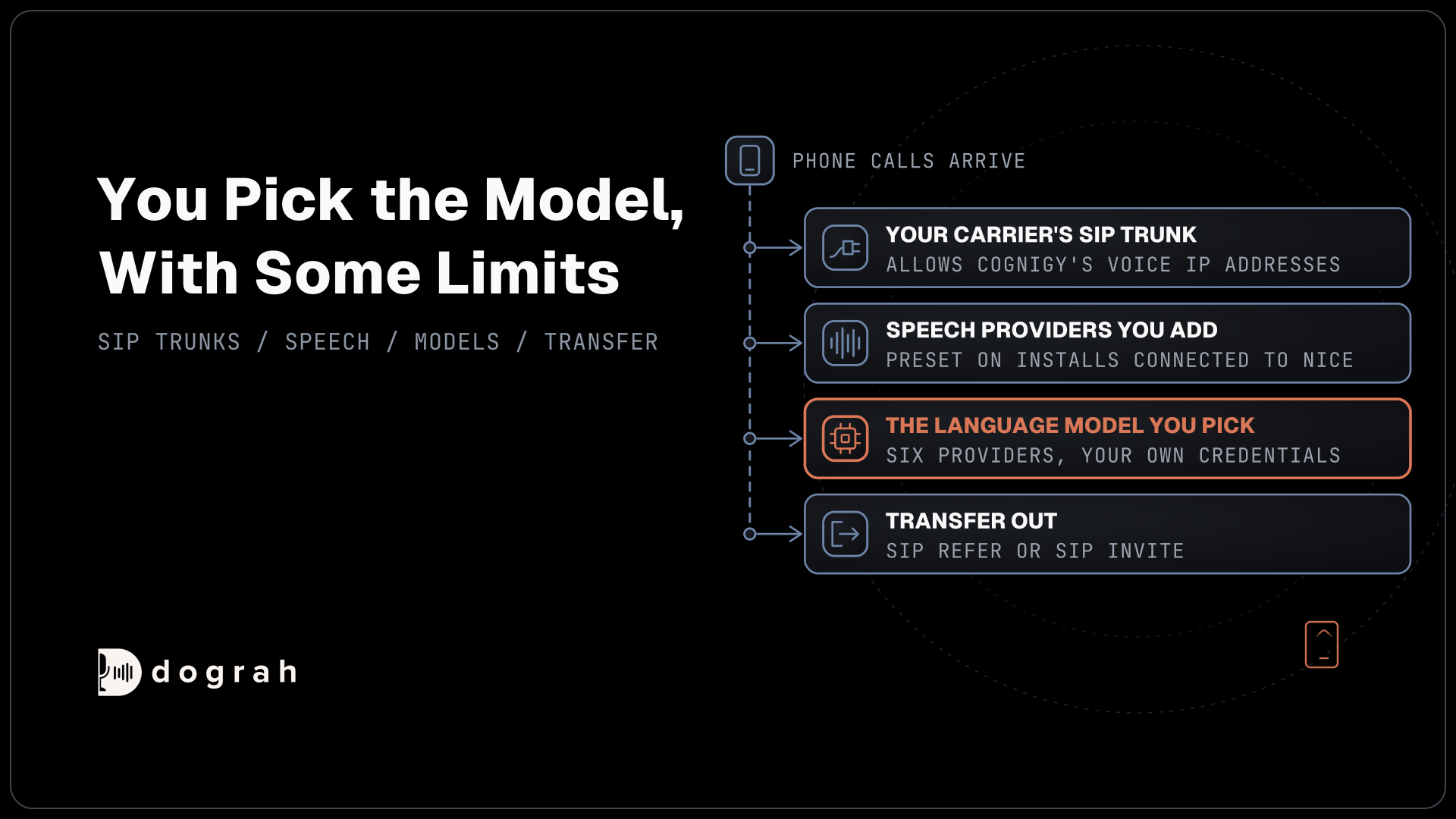
Agents are built in the Agent Builder. You describe the agent, approve the requirements it lists, and test what it builds, with the canvas open for hand edits. Dograh is the orchestration layer that runs the call flow, tools and telephony, and the speech and language models are a separate layer you choose. For each agent you pick the speech-to-text, LLM and voice provider, from Dograh's own models to your own keys or open-weight models on your hardware. A provider key moves the contract to you, while only local models keep the call audio in your network.
For the handoff Parloa does through contact-center connectors, Transfer Call works on Twilio, Telnyx, Plivo, Cloudonix and Asterisk ARI. Dograh calls the destination first and connects the caller only when someone answers, and an unanswered, busy or failed attempt comes back to the agent so the call goes on. Business systems connect through HTTP API tools during the call and a Webhook node after it. Dograh's QA step then scores every step of test and live calls.
On your own servers, the data, the cost and the upkeep sit with you. Self-hosted Dograh has no per-minute platform fee, but servers, model keys and phone minutes still cost money. Dograh Cloud charges a 1¢-a-minute platform fee. Support comes from the community on open source and from custom SLAs on Enterprise. Our row-by-row comparison with Parloa goes through both platforms in detail.
Glossary
- AI Agent Management Platform (AMP)
- Parloa's name for its product, covering the build, testing and running of AI agents for voice and chat. It includes Agent Builder, Navigator, Performance Lab and Parloa Lens.
- Parloa Zones
- Parloa's way of keeping customer data and the services that process it in a chosen legal region. The data stays in that region, and Parloa still runs the platform that holds it.
- Subprocessor
- A company a vendor uses to process customer data on its behalf. Parloa's trust center lists Google, Twilio, Datadog, MongoDB and Microsoft.
- Orchestration layer
- The part of a voice agent that runs the call flow, turn-taking, tool calls and the phone connection. The speech and language models sit in a separate layer you can swap.