
Dograh vs Parloa comes down to who runs the platform and how you pay. Parloa is a closed, managed platform priced per minute in each contract, and Parloa or a partner often carries the rollout. The open-source platform we build runs on your own servers or Dograh Cloud, with models you pick.
Key Takeaways
- Choose by who should run the platform, your team or Parloa.
- Parloa leads on native contact-center connectors, languages and managed rollouts.
- Open code on your own servers keeps call records on hardware you control.
Parloa sells AI phone agents for customer calls as a managed service under contract. Open-source Dograh gives you the same kind of agent on your own servers or as a hosted service. Below, we compare the two on builders, models, call data, cost and where each one wins.
Dograh and Parloa, row by row
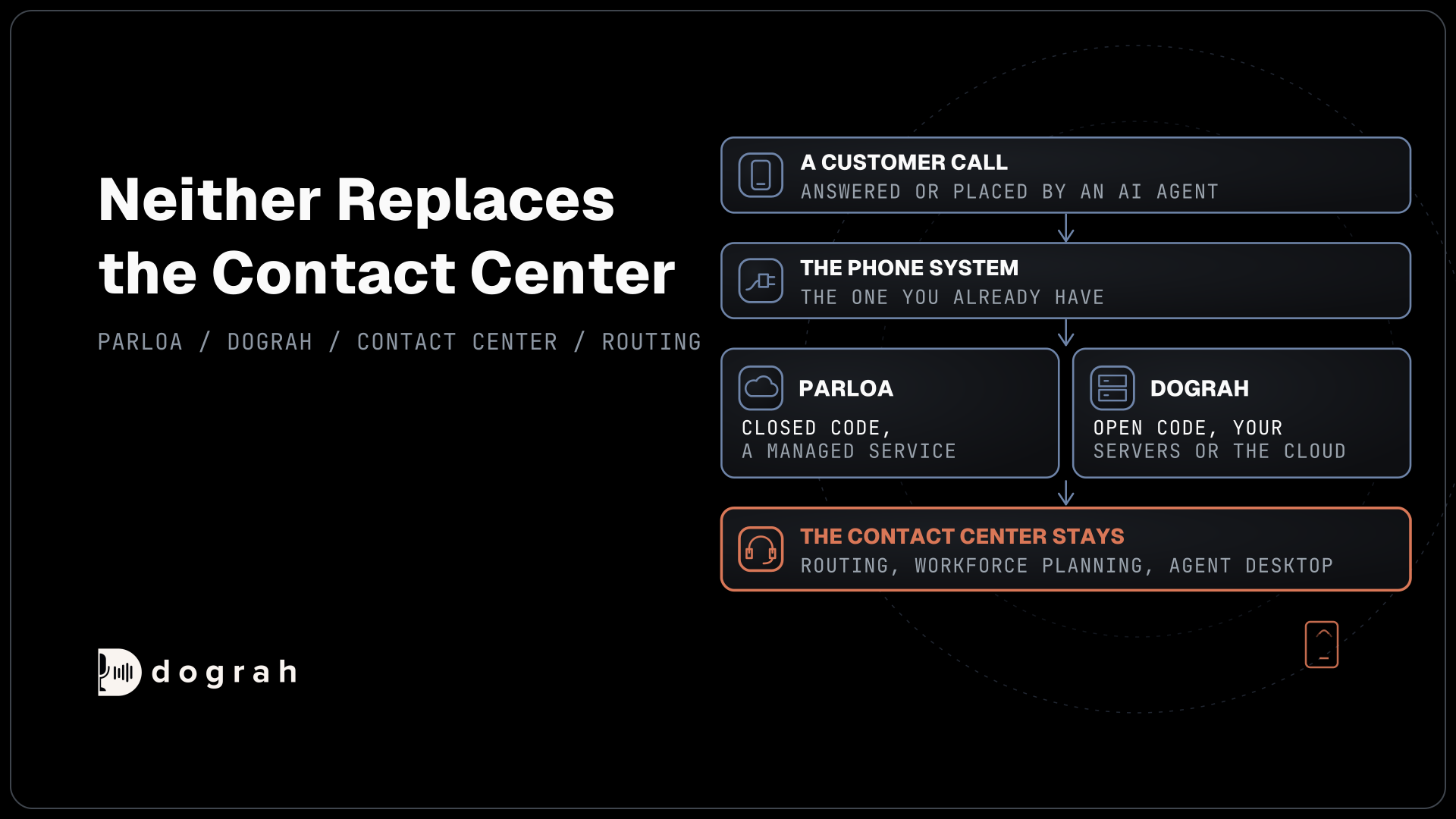
Both products run AI agents that answer and place customer calls, and both plug into the phone system and contact center you already have. Neither replaces the contact center, so routing, workforce planning and the human agent desktop stay where they are. The split is in the first row.
| Parloa | Dograh | |
|---|---|---|
| Source code | Closed | Open source, BSD 2-Clause |
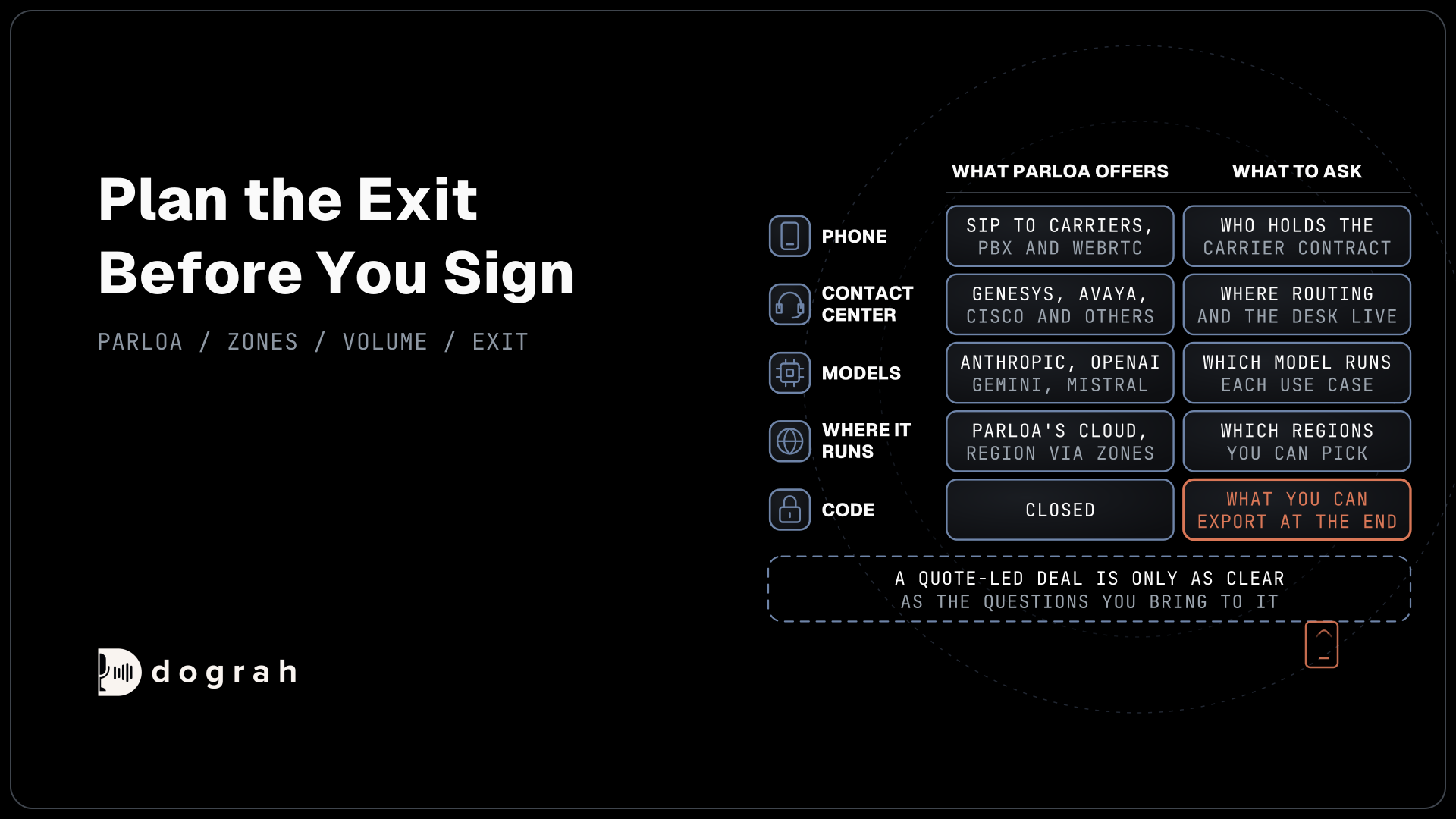
| Where it runs | Parloa's cloud, legal region chosen with Zones | Your own servers with Docker Compose or Helm, Dograh Cloud, or on-premise and private cloud on Enterprise |
| Where call data lives | Parloa, in the chosen region | Your own database and storage when self-hosted, Dograh Cloud when hosted |
| Who builds the agent | Your team in Agent Builder and Navigator, often with Parloa or a partner | Your team, with the Agent Builder or the canvas |
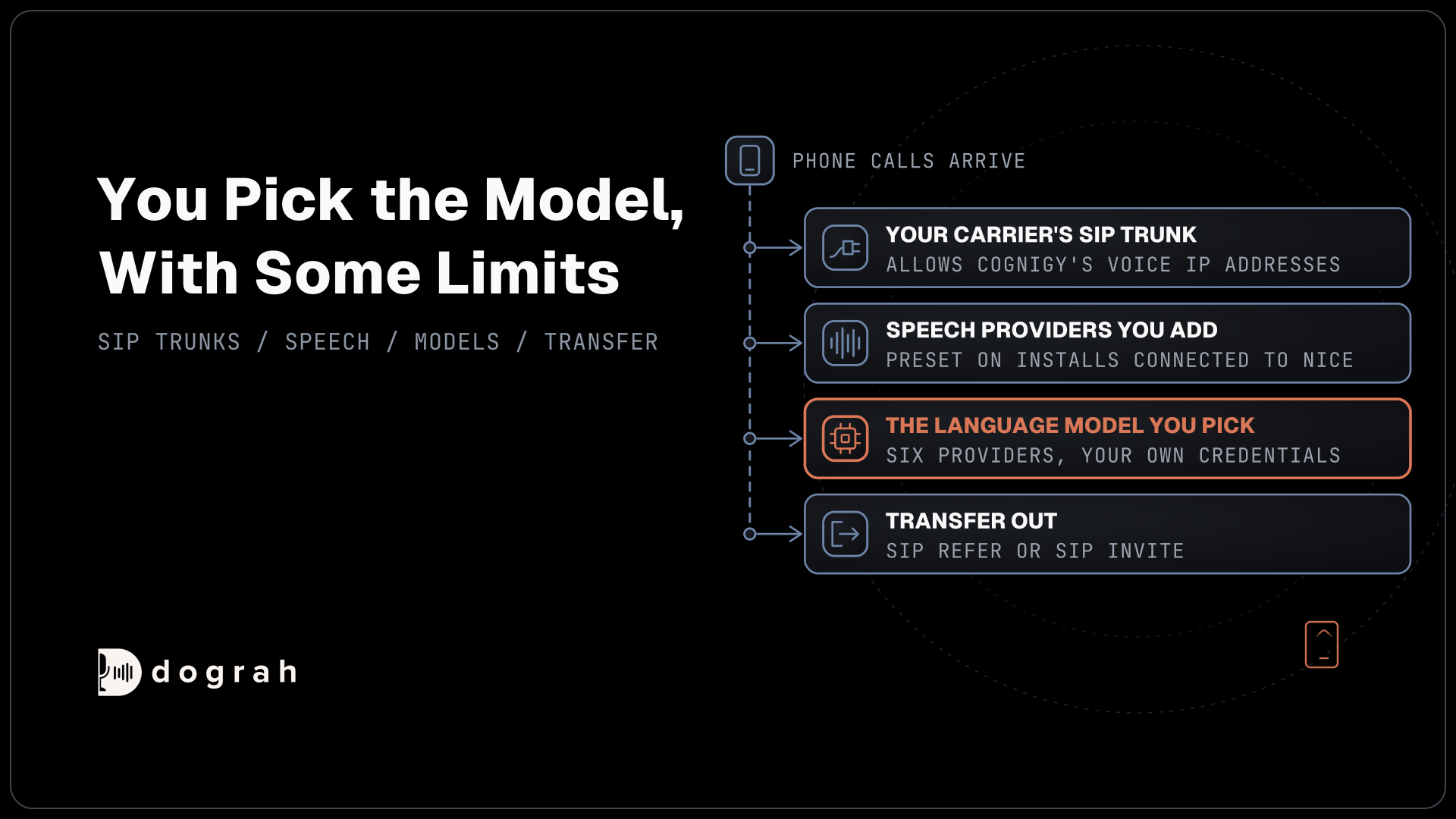
| Model choice | Anthropic, OpenAI, Google Gemini, Microsoft Azure, Amazon Bedrock, X.AI and Mistral listed | Speech-to-text, LLM and voice picked for each agent, on Dograh's models, your own keys or open-weight models you host |
| Phone and contact center | SIP to telephony, CCaaS, PBX and WebRTC, connectors for Genesys, Five9, Avaya, Amazon Connect and Cisco | Twilio, Telnyx, Plivo, Vonage, Exotel, Vobiz, Cloudonix, or your PBX through Asterisk ARI |
| Languages | Over 140 languages and variants | Set by the speech and voice models you pick, with Multilingual (Auto-detect) speech-to-text |
| Compliance listed | ISO 27001, SOC 2 Type 1 and 2, PCI DSS and HIPAA, plus DORA, GDPR and the EU AI Act | SSO, SAML and audit logs on the Enterprise plan, and a self-hosted install sits inside your own controls |
| Price model | Per minute for voice, per interaction for chat, rates by use-case complexity | No per-minute platform fee self-hosted, $0.01 a minute platform fee on Dograh Cloud |
| Published rate | Set through Parloa's team in each deal | Published, before any sales call |
| Calls at once | Unlimited concurrent calls, per Parloa | 10 included on Cloud pay as you go, 10 by default self-hosted and raised in settings |
| Support | By contract, with partners on large rollouts | Community support on open source, priority support on Custom volume, custom SLAs on Enterprise |
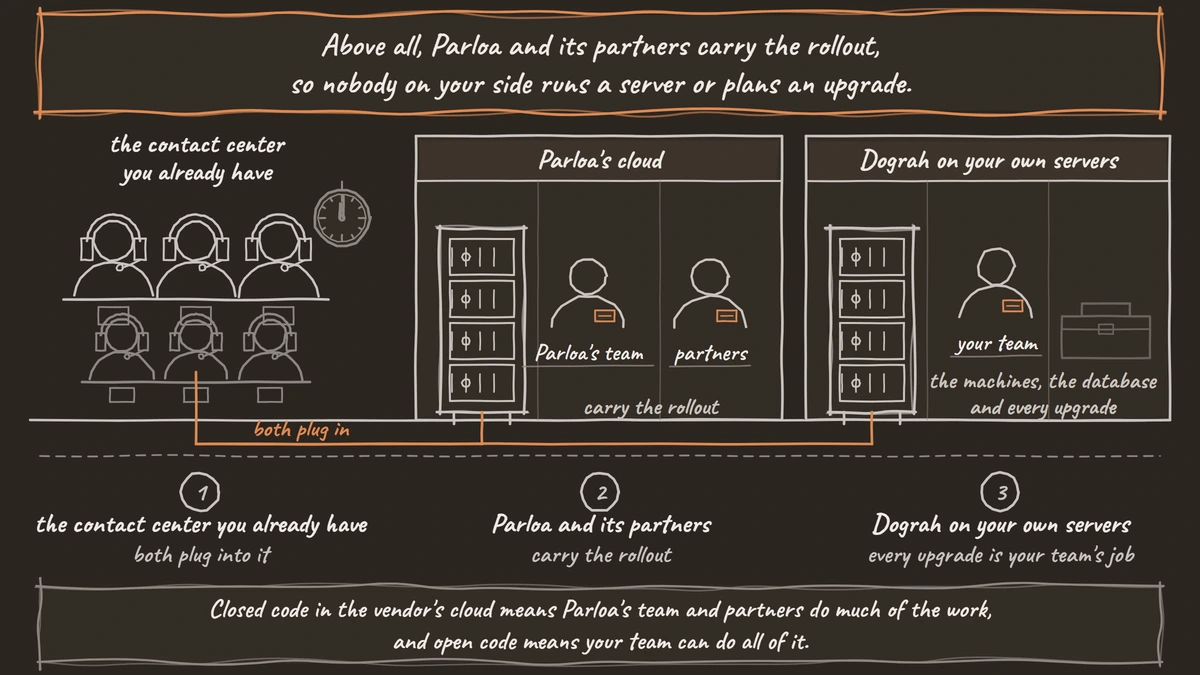
Most rows follow from the first two. Closed code in the vendor's cloud means Parloa's team and partners do much of the work, and open code means your team can do all of it. Our Parloa review covers Parloa on its own terms.
Who builds the agent and who changes it
Parloa gives business teams a no-code Agent Builder, and its Navigator turns written guidance and existing procedures into agents. Simulated conversations test an agent before it goes live. Large rollouts often run with Parloa's team or partners such as McKinsey, Deloitte Canada, TELUS Digital and Thoughtworks, which suits a company that wants the work done for it.
Dograh puts the same job in your team's hands, with the code in its GitHub repository. On the Create an agent page you describe the calls the agent should handle, review the plan under Your agent requirements, and pick Approve & build or Request changes. Test agent publishes version 1, and every node stays editable on the canvas, which is also the way to build on a self-hosted install without a Dograh Service Key.
Business systems connect through tools you configure. Pre-Call Data Fetch on the Start Call node loads the caller's record before the greeting, an HTTP API tool reads or writes your CRM during the call, and a Webhook node sends results after it. A QA step scores every step of test and live calls, and View Trace shows the speech-to-text, AI and voice time of each turn.
Handing a caller to a person works through Transfer Call on Twilio, Telnyx, Plivo, Cloudonix and Asterisk ARI. Dograh calls the destination first and connects the caller only when someone answers, and a busy, failed or unanswered attempt returns the caller to the agent. Parloa ships ready connectors for the big contact-center suites, so on Dograh that handoff goes to a queue phone number your team sets up.

Open Source Alternative to Vapi / Retell
Self-hosted voice agent platform — no per-minute fees
dograh-hq/dograh
Star on GitHub
Model choice on each platform
Parloa lists language models from Anthropic, OpenAI, Google Gemini, Microsoft Azure, Amazon Bedrock, X.AI and Mistral, and its OpenAI partnership brings early model access inside the platform. Which model runs a given agent is part of how Parloa builds and runs your agents, so ask your Parloa team how that choice is made and who can change it.
Dograh works as the orchestration layer, running the call flow, tools and telephony, and the speech and language models stay a separate layer you select. For each agent you pick the speech-to-text, LLM and voice provider, using Dograh's own models, a provider on your own key, or open-weight models served on your hardware. Bring your own key and the contract moves to you, though the audio still goes to that provider. Only local models keep the caller's voice inside your network.
Where call data lives
On Parloa, the data question is answered by Parloa Zones, which keep transcripts, personal details, logs and analytics, and the services that process them, in the legal region you choose. Parloa's security controls add real-time redaction of names and account numbers, a separate non-LLM process for card data, role-based access with single sign-on, and retention set to each customer's requirements. The platform still runs on machines Parloa manages, with subprocessors named in its trust center.
A self-hosted Dograh install keeps runs and transcripts in Postgres and recordings in MinIO, on servers you control. The Docker install needs at least 8 GB of RAM and 4 vCPUs, a Helm chart covers Kubernetes, and the Enterprise plan adds on-premise or private-cloud deployment with data residency. Paired with open-weight models, no part of a call leaves your network.
Getting data out is a menu item rather than a request. Download Report in an agent's settings exports its calls as a CSV file, Download Workflow saves the agent definition, and Upload Agent Definition loads it into another install. That covers moving from Dograh Cloud to your own servers, or keeping a copy of every agent in your own repository.
Cost shape, contract or published fee
Parloa prices voice per minute and chat per interaction, with rates set by how complex each use case is. You pick a volume package, commit to it once and spread it across use cases, and Parloa supports outcome-based pricing when it fits. The rate itself comes from Parloa's team in each deal, and our Parloa pricing breakdown covers what to ask before you sign.
Running it yourself changes what you pay for. Self-hosted Dograh has no per-minute platform fee, but servers, model keys and phone minutes still cost money. Dograh Cloud charges a 1¢-a-minute platform fee. On your own servers, the machines, the database and every upgrade are your team's job, with community support for the open-source version and custom SLAs on the Enterprise plan.
Take an example month of 40,000 call minutes. On Parloa that month costs 40,000 times the rate in your contract, which may differ by use case. On Dograh Cloud the platform fee is 40,000 times $0.01, or $400, and speech, language and voice models and phone minutes are billed on top, at Dograh's model rates or by the providers you bring.
Join the Dograh Community
Dograh is an OSS alternative to Vapi. Join our Slack community for queries, releases, best practices & community interactions.
Where Parloa wins
Parloa is the stronger choice in several places, and they matter for large contact centers. It ships native connectors for Genesys, Five9, Avaya, Amazon Connect and Cisco, and for Salesforce, SAP, Zendesk and ServiceNow. Its agents speak over 140 languages and variants, it states unlimited concurrent calls, and it redacts personal details in real time while sending card data to a separate process.
It also lists ISO 27001, SOC 2, PCI DSS and HIPAA among its certifications, and covers GDPR, DORA and the EU AI Act. Above all, Parloa and its partners carry the rollout, so nobody on your side runs a server or plans an upgrade. A company that wants a managed service and has the budget for a contract will find that hard to match.
When Dograh fits your team
Dograh fits when you want code you can read and change, call records on servers you control, or models you choose for each agent, including local ones. It also fits when you want to see the fee before talking to sales and start building the same day on Dograh Cloud, then move the same agents to your own servers later.
It asks more of your team, since someone has to connect the contact center by phone number and, when self-hosted, run the install. If neither side is quite right, our list of Parloa alternatives covers hosted platforms and suites as well. The quickest test is to rebuild one Parloa use case on Dograh Cloud and run it on a test number for a week.
Glossary
- Parloa Zones
- Parloa's data residency option, announced in September 2026, which keeps transcripts, personal details, logs and the services that process them in a legal region the customer picks.
- Orchestration layer
- The part of a voice agent that runs call flow, turn-taking and tool calls and holds the phone connection. The speech and language models sit apart, in a layer you choose.
- Bring your own key (BYOK)
- Running a model provider under your own account within a platform. The contract moves to you, while the audio still travels to that provider.
- Volume package
- A committed amount of minutes or interactions bought up front at agreed rates. Parloa applies one package across the use cases a customer chooses.