
Parloa alternatives are divided into open-source platforms you run yourself, hosted platforms with published per-minute rates, and enterprise vendors priced by contract. For teams that want to own the platform, Dograh is the open-source AI voice agent platform, self-hosted or on Dograh Cloud. Vapi, Retell AI and Bland are hosted, and NiCE Cognigy sells by contract.
Key Takeaways
- Parloa prices each deal through its team, so the budget waits on a quote.
- Vapi, Retell AI, Bland and PolyAI publish per-minute rates you can price yourself.
- Dograh's full platform is BSD-licensed, and you can run it on your own servers.
Teams look past Parloa for three reasons, a price they can see early, control over code and data, and a wider scope than the AI agent. We compare every option in one table, start with open-source Dograh, then cover hosted platforms, contract vendors, a priced month, staying and moving.
Parloa alternatives in one table
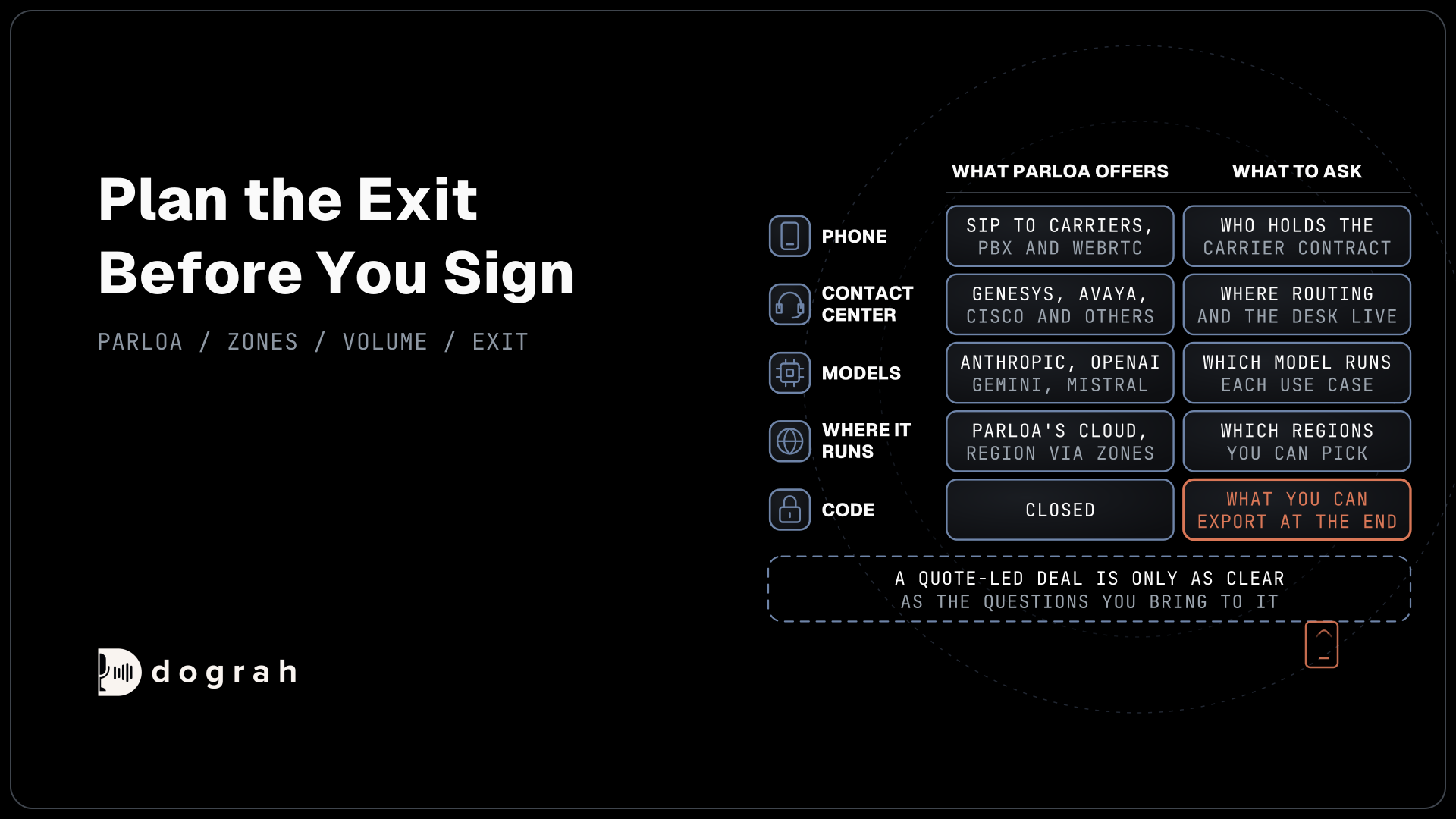
Parloa is the baseline row, and every option answers the same five questions. Parloa bills per minute for voice and per interaction for chat, with rates set in a volume package agreed with its team, and runs in its own cloud with the data region chosen through Parloa Zones.
| Option | Source code | Where it runs | How it bills | Contact-center fit | Models |
|---|---|---|---|---|---|
| Parloa (baseline) | Closed | Parloa's cloud, region chosen with Zones | Per minute for voice by quote, volume package | Connectors for Genesys, Five9, Avaya, Amazon Connect, Cisco and others | Picked from Anthropic, OpenAI, Gemini, Azure, Bedrock, X.AI and Mistral |
| Dograh | Open, BSD 2-Clause | Your servers, on-prem on Enterprise, or Dograh Cloud | Self-hosted, no per-minute platform fee. Dograh Cloud, 1¢/min platform fee. Models and phone extra | SIP carriers and your own PBX through Asterisk ARI, HTTP API tools to business systems | Dograh's models, your keys or open-weight models you host |
| Vapi | Closed | Vapi's cloud | $0.05/min hosting plus models and phone | Vapi numbers or your own carrier | Providers you choose, billed on top |
| Retell AI | Closed | Retell's cloud, on-prem through Enterprise sales | $0.055/min voice infrastructure plus model and $0.015/min telephony | Retell numbers, or your SIP trunk with no telephony charge | Retell's list of models |
| Bland | Closed | Bland's cloud, on-prem on Enterprise | Start $0.14/min. Build $0.12/min plus $299/mo | Calls through Bland's platform | Bland's own models, included in the rate |
| PolyAI | Closed | PolyAI's cloud | From $49/mo with 250 minutes, Enterprise by contract | EHR and CCaaS integrations on Enterprise | PolyAI's own models |
| NiCE Cognigy | Closed | Cognigy SaaS or inside NiCE CXone | Per conversation plus Voice Gateway lines, by contract | Native in NiCE CXone, built for Amazon Connect, Avaya and Genesys | Major LLM providers on your own credentials |
| LiveKit Agents and Pipecat | Open, Apache-2.0 and BSD 2-Clause | Your servers | Free to self-host | Whatever your team builds | Any, wired by your team |
Most closed rows keep your call audio and transcripts in the vendor's cloud, and only Retell AI and Bland offer on-prem, through enterprise deals. Dograh, LiveKit Agents and Pipecat are the only options in this table whose code you can run yourself, and Dograh alone arrives as a working platform, with the builder, phone connections, transfers and QA already in place.
Dograh: a whole platform you can own
Dograh is the answer for buyers who leave Parloa over control. The whole platform is open source under the BSD 2-Clause license, so your security team can read the code that handles every call. You can self-host it with Docker Compose on a server with at least 8 GB of RAM and 4 vCPUs, run it on Dograh Cloud, or take on-premise or private-cloud deployment with data residency on the Enterprise plan.
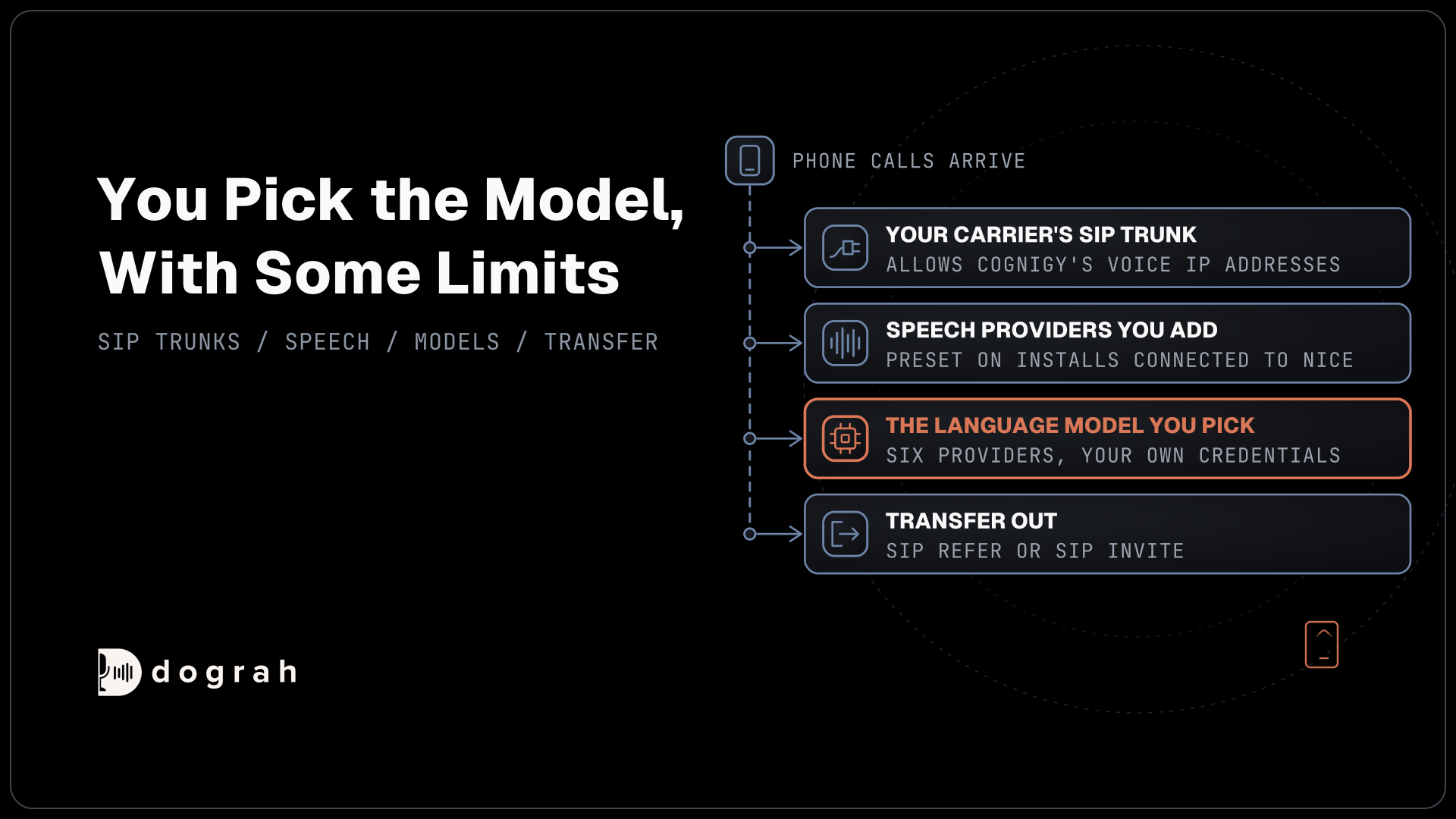
As the orchestration layer, Dograh handles the call flow, tools and telephony, while the speech and language models form a separate layer you control. Each agent gets its own speech-to-text, LLM and voice provider, whether that is Dograh's own models, your own keys or open-weight models on your hardware. With bring your own key, the contract moves to you while the audio still reaches that provider, so only local models keep calls fully inside your network. New agents start in the Agent Builder, where you describe the agent and approve a requirements card before it builds.
Calls come in over Twilio, Telnyx, Plivo, Vonage, Exotel, Vobiz, Cloudonix or your own PBX through Asterisk ARI. When a caller asks for a person, Transfer Call works on Twilio, Telnyx, Plivo, Cloudonix and Asterisk ARI. Dograh calls the destination first and connects the caller only when someone answers, and if nobody does, or the line is busy or fails, the agent carries on with the caller. Business systems such as a CRM or helpdesk connect through HTTP API tools during the call and a Webhook node after it, and a QA step scores each step of test and live calls.
On cost and hosting, self-hosted Dograh has no per-minute platform fee, but servers, model keys and phone minutes still cost money. Dograh Cloud charges a 1¢-a-minute platform fee. A self-hosted install runs 10 calls at once by default, a limit you can raise, and Cloud's pay as you go plan includes 10 with more on request. Running it yourself means your team owns the server, the database and every upgrade, with community support for the open-source version and custom SLAs on Enterprise.

Open Source Alternative to Vapi / Retell
Self-hosted voice agent platform — no per-minute fees
dograh-hq/dograh
Star on GitHub
Hosted platforms with a published rate
These platforms suit buyers who leave Parloa over price visibility, since each one shows a rate you can multiply by your own minutes. Vapi charges $0.05 a minute for hosting, with speech, the language model, the voice and the phone line billed on top. Without a package you get 4 calls at once, Core gives 10 for $29 a month, and HIPAA handling is a $2,000-a-month add-on.
Retell AI starts at $0.055 a minute for voice infrastructure, plus the language model and $0.015 a minute for telephony, with no charge on your own SIP trunk. Its own all-in range runs from $0.07 to $0.31 a minute, with 20 calls at once included and $8 a month for each extra. On-prem goes through its Enterprise sales team.
Bland's Start plan costs $0.14 a minute with its own models included, 10 calls at once and 100 calls a day. Build costs $0.12 a minute plus $299 a month, with 50 calls at once and 2,000 a day, and Enterprise adds on-prem. PolyAI's self-serve plans start at $49 a month for 250 minutes, then 30 cents a minute, on PolyAI's own models.
All four are closed, and the two without an on-prem tier, Vapi and PolyAI, keep call audio and transcripts in their own cloud. That trade suits plenty of teams, but it does not answer a buyer who left Parloa over control. Our guide to Vapi alternatives covers Vapi, Retell AI and Bland in full.
Enterprise vendors priced by contract
Some buyers leave Parloa over scope, because Parloa sells the AI agent and connects to a contact center you run separately. NiCE Cognigy is the main option for a single vendor. NiCE closed its purchase of Cognigy in September 2025 and sells it inside its CXone contact center or on its own. Cognigy counts each billable conversation, plus packages of concurrent lines on its Voice Gateway, all by contract.
Deployment has narrowed. Cognigy no longer offers on-premises installs to new customers, so a new buyer gets Cognigy's cloud or CXone. PolyAI's Enterprise tier is the other contract route, with agents built by PolyAI or a partner and CCaaS integrations. Our Parloa vs Cognigy comparison goes through the two in detail.
One vendor for the AI agent and the human desk keeps routing, reporting and handoffs in one place, which is a real advantage. Our post on AI call center software weighs a full suite against an AI layer on top of your current one.
Open frameworks: LiveKit Agents and Pipecat
LiveKit Agents and Pipecat give developers open building blocks and leave the product to them. LiveKit Agents is Apache-2.0, with its turn-detection models under a separate LiveKit Model License, and LiveKit Cloud's Ship plan costs $50 a month with 5,000 agent minutes, then $0.01 a minute. Pipecat is a BSD 2-Clause Python framework, and Dograh itself is built on a fork of it. With either one, your team writes the phone wiring, the contact-center handoff, call history and QA before the first customer call.
What 12,000 minutes a month costs
A priced month shows which options you can budget before a sales call. Take an example of 12,000 call minutes in a month, about 4,000 calls of three minutes, or roughly 130 a day, and price only the line each vendor bills for those minutes.
| Option | Platform line for 12,000 minutes | Still to add |
|---|---|---|
| Parloa | By quote | Set in the quote |
| Vapi | 12,000 x $0.05 = $600 | Speech, model, voice and phone |
| Retell AI | 12,000 x $0.055 = $660, plus 12,000 x $0.015 = $180 telephony, so $840 | The model. Retell's all-in range gives $840 to $3,720 |
| Bland Build | 12,000 x $0.12 + $299 = $1,739 | Phone time. Start's cap of 100 calls a day is too low at 130 |
| PolyAI Plus | $199 + 11,000 x $0.25 = $2,949 | PolyAI's models run inside the plan |
| LiveKit Cloud Ship | $50 + 7,000 x $0.01 = $120 | Models, phone and the product your team builds |
| Dograh Cloud | 12,000 x $0.01 = $120 | Your models and carrier |
| Dograh self-hosted | No platform fee | Servers, model keys and phone minutes |
| NiCE Cognigy | By contract | Set in the contract |
The rows count different things. Bland and PolyAI include their own models, while Vapi, Retell AI, LiveKit and Dograh still need models priced at each provider's rate. What the table does show is that seven of the nine rows can be worked out today and checked again whenever volume changes.
Join the Dograh Community
Dograh is an OSS alternative to Vapi. Join our Slack community for queries, releases, best practices & community interactions.
When staying on Parloa makes sense
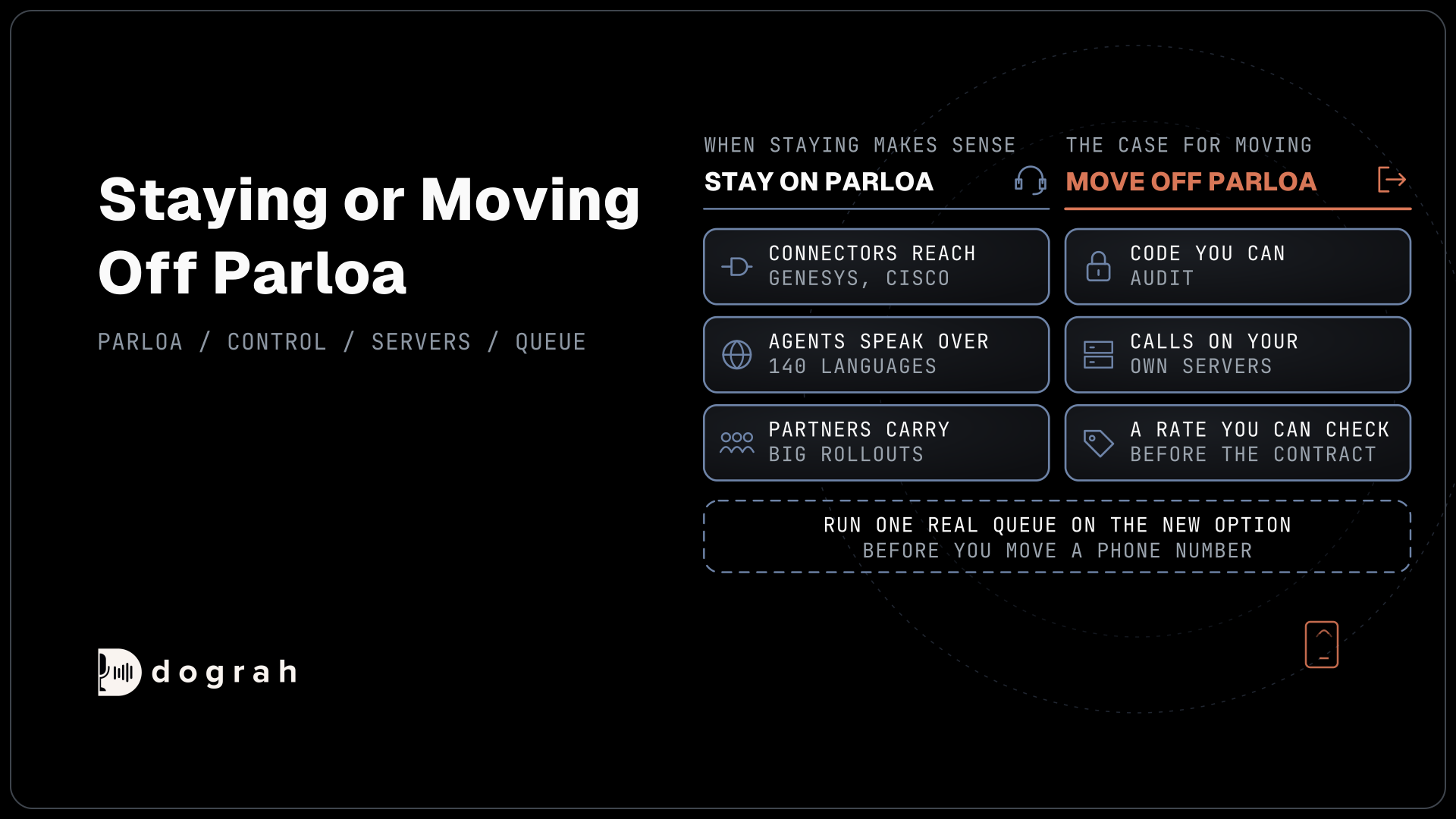
Parloa is the right call for many large service teams. Its connectors already reach Genesys, Five9, Avaya, Amazon Connect and Cisco, its agents speak over 140 languages and variants, and it redacts personal details in real time with card data sent to a separate process. Partners such as McKinsey, Deloitte Canada, TELUS Digital and Thoughtworks carry big rollouts.
If your team does not want to run servers, tune prompts or wire a contact center, that service is worth paying for. The case for moving starts when you need code you can audit, calls on your own servers, or a rate you can check before the contract.
What moving off Parloa takes
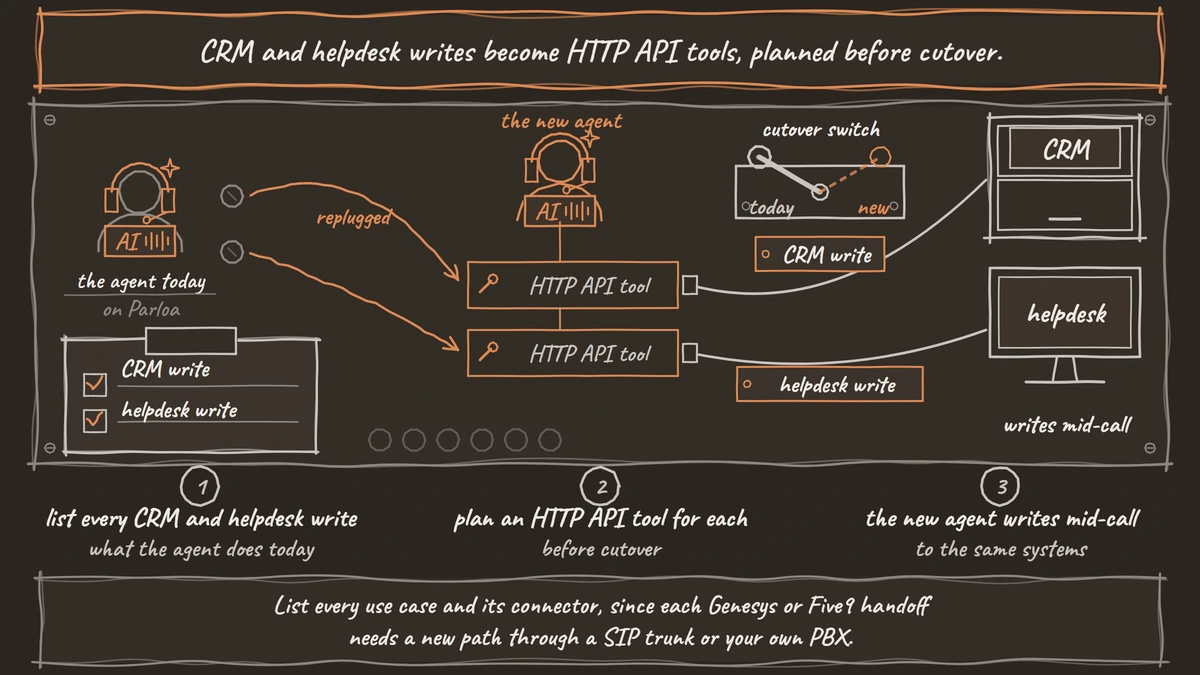
A move is a rebuild, so plan it as a short project. Before you give notice, ask Parloa in what form transcripts, recordings and agent definitions come out, and keep them as the spec for the new agent. List every use case and its connector, since each Genesys or Five9 handoff needs a new path through a SIP trunk or your own PBX.
On Dograh Cloud you describe each agent in the Agent Builder and approve its requirements card. A self-hosted install uses the builder with a Dograh Service Key, or you build the flow on the canvas. CRM and helpdesk writes become HTTP API tools, planned before cutover.
Then run both. Send one queue or one use case to the new agent, keep Parloa on the rest, and test every transfer over a real phone call, since a browser test call cannot run one. Our post on the open-source alternative to Parloa walks through the move step by step.
Picking your Parloa alternative
Start from where your calls must run and who will keep the agent working. If you want open source, your own servers or on-prem inside your network, start with Dograh, with an Enterprise contract behind it when you need one. If your developers want to build the product themselves, LiveKit Agents and Pipecat are sound bases. If a hosted rate suits you, price Vapi, Retell AI, Bland and PolyAI at your own minutes with models and phone added. And if one vendor for the contact center and the AI agent matters most, talk to NiCE about Cognigy. Whichever way you lean, run one real queue on the new option before you move a phone number.
Glossary
- Volume package
- A committed amount of usage bought up front and spent across use cases. Parloa sells voice minutes and chat interactions this way, with rates agreed in the deal.
- Billable conversation
- Cognigy's billing unit. A standalone conversation is capped at 50 user inputs in 24 hours, and inside CXone up to 10 minutes of a voice call counts as one conversation.
- Platform fee
- What a voice agent platform charges for running the call, apart from the models and the phone line. Vapi's is $0.05 a minute for hosting, and Dograh Cloud's is $0.01 a minute.
- Bring your own key (BYOK)
- Using your own account with a model provider inside the platform. You hold the contract and the bill, while the call audio still goes to that provider.