
Parloa vs Cognigy is a choice between two closed enterprise AI agent platforms. Parloa is independent, leads with voice and prices voice per minute. NiCE Cognigy is sold inside NiCE CXone or alone, covers voice and messaging, and bills per conversation. Both run in the vendor's cloud for new customers and set rates in each contract.
Key Takeaways
- Parloa bills voice per minute, while Cognigy bills per conversation plus voice lines.
- New Cognigy buyers get SaaS or CXone, since on-prem installs are closed to them.
- Parloa suits existing contact centers, and Cognigy suits teams buying into NiCE CXone.
Parloa and NiCE Cognigy both sell AI agents to large contact centers, and they differ in ownership, deployment and how a call is billed. We compare them in one table, then on calls, data, pricing and fit, and close with open-source Dograh for teams that want their own servers.
Parloa vs Cognigy in one table
Both platforms build AI agents that answer customer calls and hand the hard ones to people. The rows below come from each company's product pages and documentation, and the rest of the post explains the ones that change a buying decision.
| Parloa | NiCE Cognigy | |
|---|---|---|
| Owner | Independent, $350 million Series D in January 2026 | NiCE, since September 2025 |
| What it sells for voice | AI agent management platform for voice and chat | AI Agents for Voice, Voice Gateway, and Agent Copilot for human agents |
| Channels | Voice and chat on one platform | Voice, chat, webchat, WhatsApp and SMS |
| Contact-center fit | Connectors for Genesys, Five9, Avaya, Amazon Connect and Cisco | Native in NiCE CXone, built for Amazon Connect, Avaya and Genesys |
| Deployment and regions | Parloa's cloud, legal region chosen with Zones | Cognigy SaaS in Europe, US, UK or Australia, or inside NiCE CXone |
| On-prem for a new buyer | No on-prem option on Parloa's pages | No longer offered to new customers, existing installs keep running |
| Languages | Over 140 languages and variants | 100+ languages |
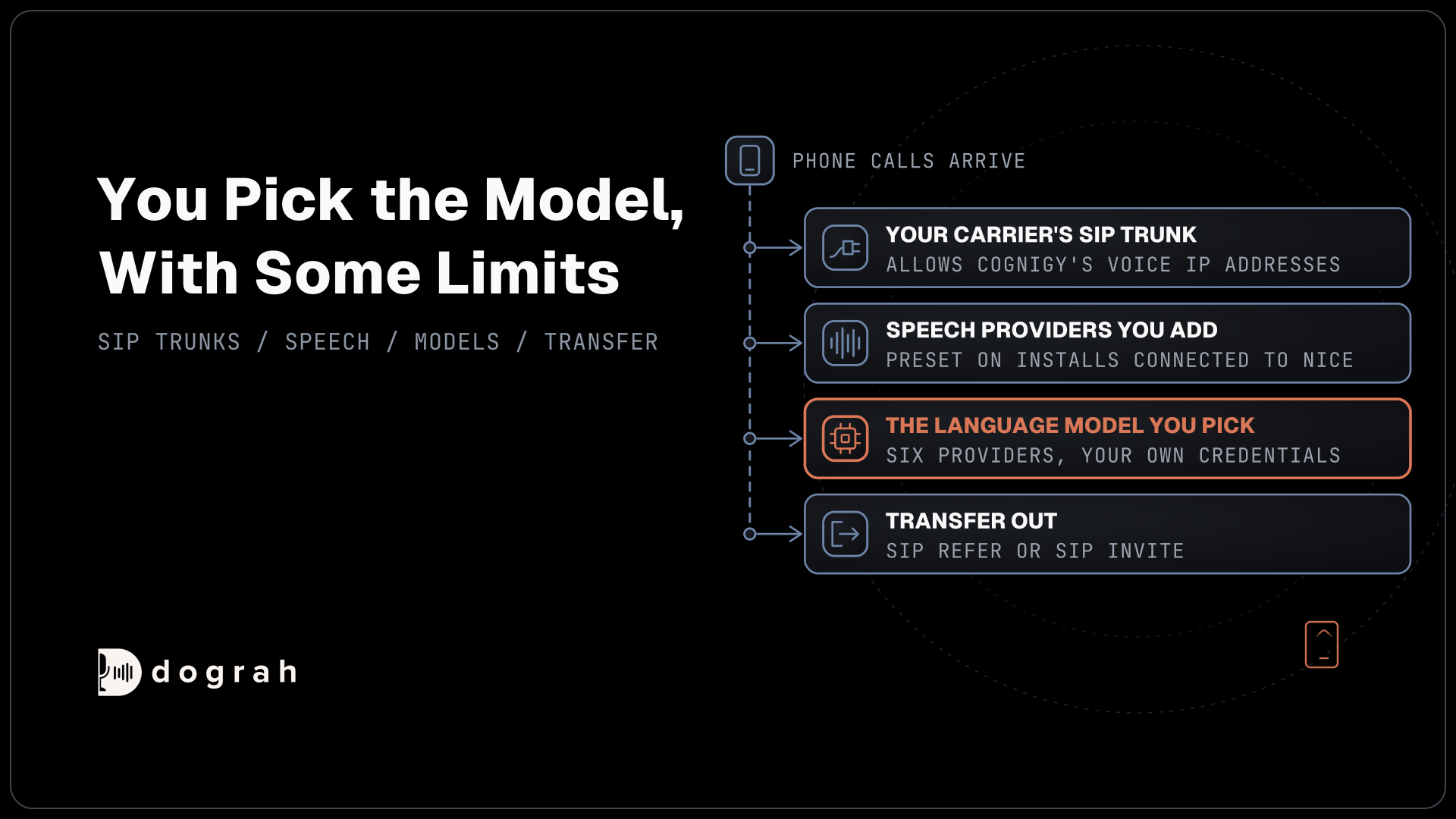
| Model choice | Anthropic, OpenAI, Google Gemini, Microsoft Azure, Amazon Bedrock, X.AI and Mistral listed | OpenAI, Azure, Anthropic, Amazon Bedrock, Google and Mistral on your own credentials, or included models on CXone |
| Handoff to people | Over SIP or the contact-center connectors | SIP REFER or SIP INVITE transfers |
| Pricing unit | Per minute for voice, per interaction for chat, volume package | Per conversation, plus Voice Gateway concurrent lines and Knowledge AI |
| Rates | Set by Parloa's team in each deal | Set in each license agreement |
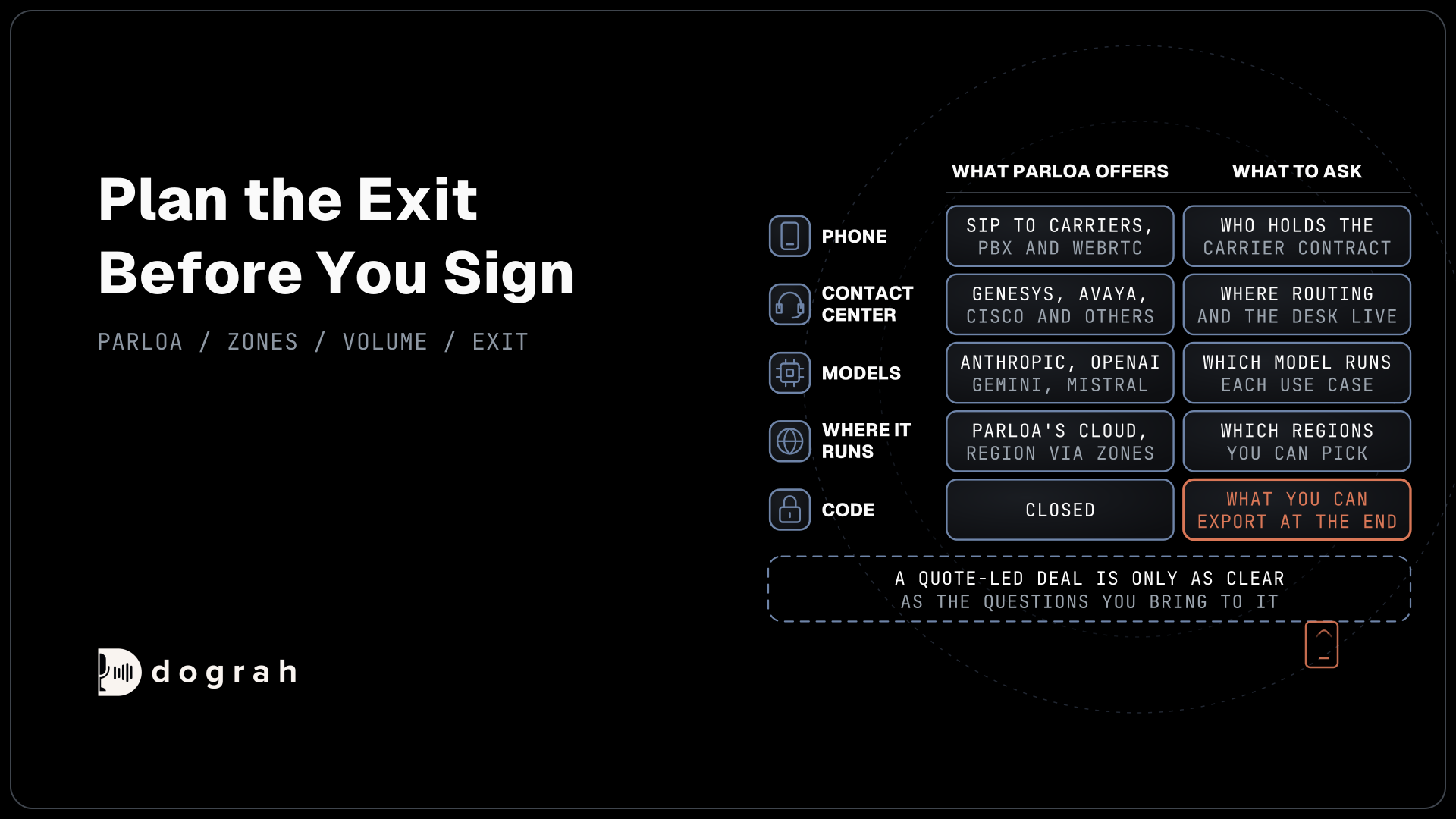
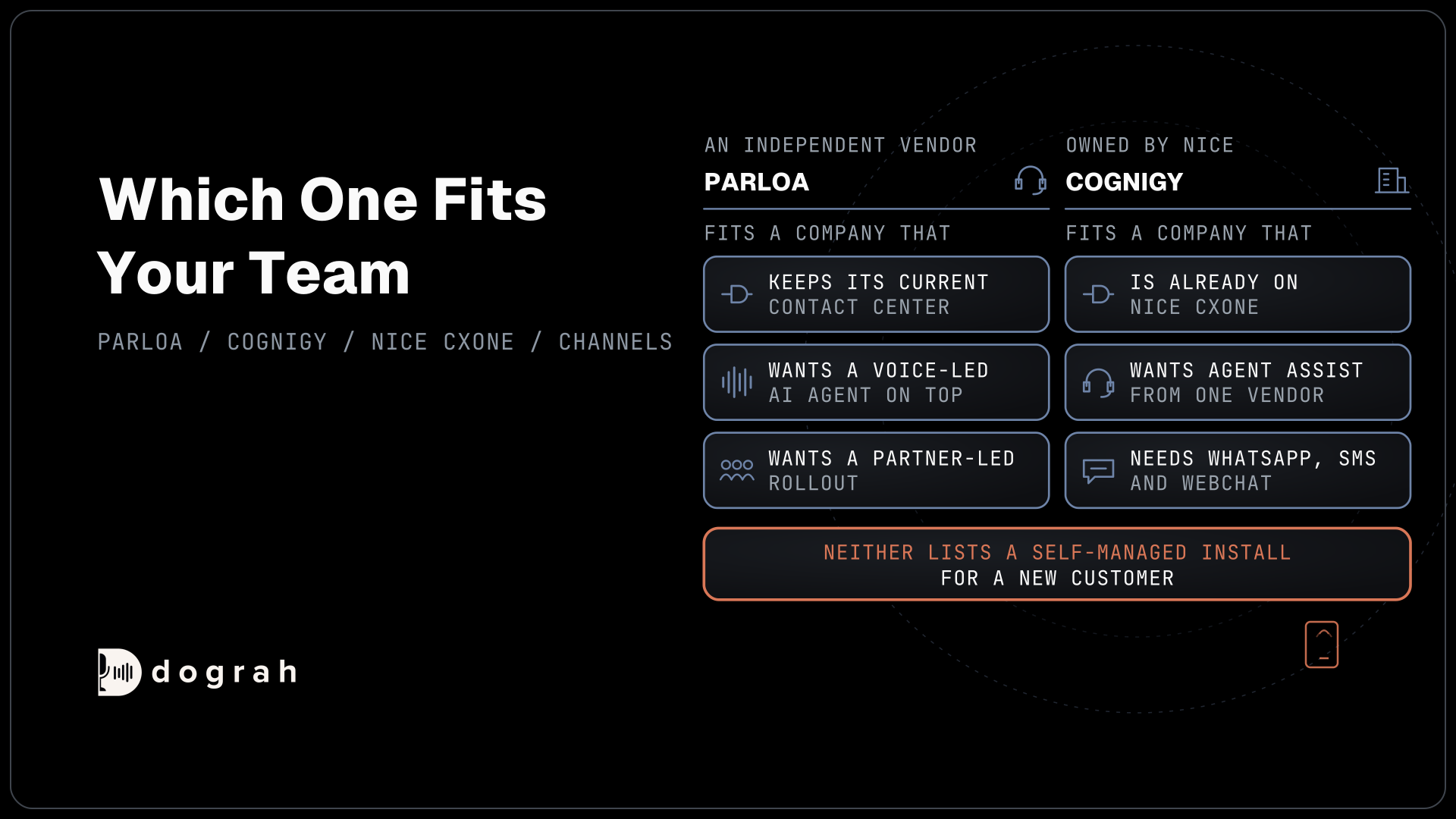
Neither column is open source, and neither lists a self-managed install for a new customer. The real differences sit in ownership, channels and the billing unit.
Who owns each and what they sell
Parloa is an independent company with offices in New York, Berlin and Munich. It raised a $350 million Series D at a $3 billion valuation in January 2026, led by General Catalyst. Its AI Agent Management Platform covers building agents in Agent Builder and Navigator, testing them in Performance Lab and reviewing calls in Parloa Lens, and Parloa calls itself voice-first. Large rollouts often run with partners such as McKinsey, Deloitte Canada, TELUS Digital and Thoughtworks, and our Parloa review covers who it fits.
Cognigy belongs to NiCE, which closed the acquisition on 8 September 2025 and sells Cognigy both inside its CXone contact-center platform and as an independent product. The product covers AI Agents for Voice and for Chat and Messaging, Voice Gateway for calls, Agent Copilot for human agents and Knowledge AI. A next-generation release on 12 November 2026 added an Agentic Experience Studio and default AI models included in the conversation price. Our Cognigy review goes deeper on the product.
How calls reach each platform
Parloa connects over SIP to your carrier, contact center, PBX or WebRTC. It states unlimited concurrent calls with built-in redundancy, adaptive barge-in and SRTP encryption for voice. Callers who need a person go to the contact center you already run, through SIP or one of the connectors for Genesys, Five9, Avaya, Amazon Connect and Cisco.
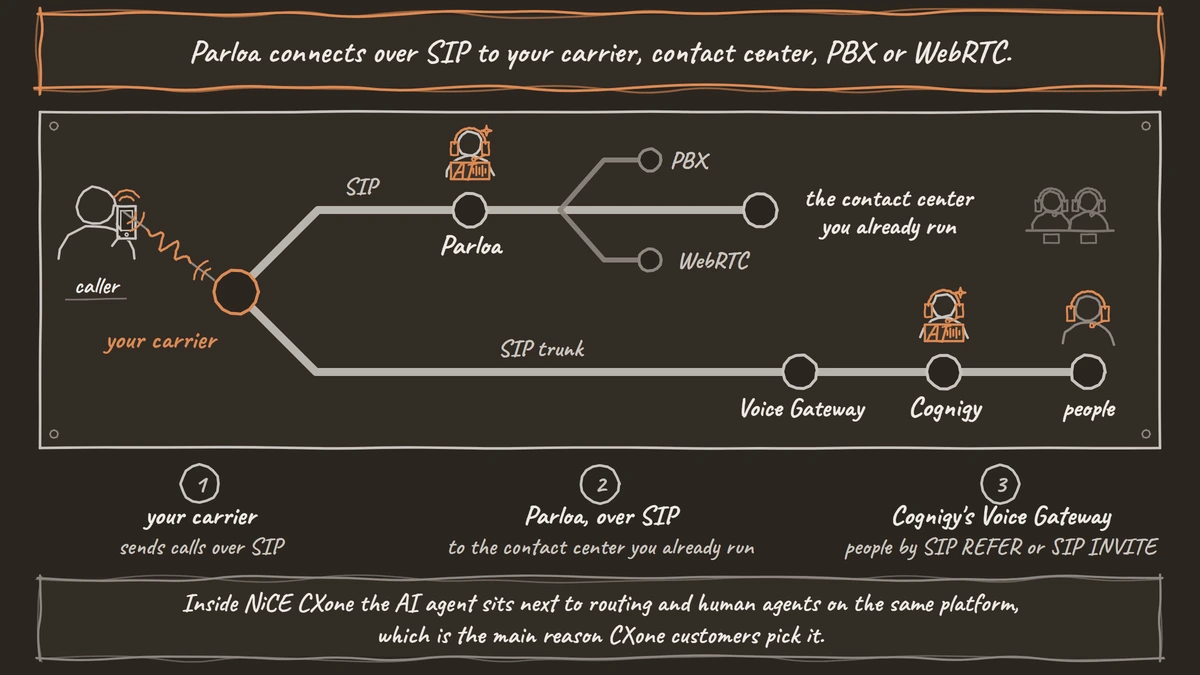
Cognigy takes calls through Voice Gateway, sold as packages of concurrent lines. Your carrier sends calls over a SIP trunk and must allow Cognigy's voice IP addresses, with G.711 as the preferred codec. Transfers to people go out by SIP REFER or SIP INVITE. Inside NiCE CXone the AI agent sits next to routing and human agents on the same platform, which is the main reason CXone customers pick it. Speech recognition and voices come from providers you add on your own credentials, such as Microsoft Azure, Google, Deepgram or ElevenLabs, or from a preconfigured provider on NiCE-integrated setups.
Deployment and where data sits
For a new buyer, both platforms run only in the vendor's cloud. Parloa Zones keep transcripts, personal details, logs and analytics, and the transcription and model services that process them, in the legal region you pick. Parloa's trust center lists its hosting as a major cloud provider and names subprocessors including Google, Twilio, Datadog, MongoDB and Microsoft.
Cognigy SaaS runs in a shared cloud environment in most cases, with clusters in Europe, the US, the UK and Australia, and NiCE CXone adds its own cluster locations. Cognigy no longer offers on-premises installations to new customers, while existing installs keep running and receive updates. So a buyer who needs servers it controls will not find that route at either vendor today.

Open Source Alternative to Vapi / Retell
Self-hosted voice agent platform — no per-minute fees
dograh-hq/dograh
Star on GitHub
Pricing, per minute or per conversation
Voice on Parloa is priced per minute and chat per interaction, and the rates depend on how complex each use case is. Parloa sells a volume package you commit to once and apply across use cases, with outcome-based pricing when it fits. Our Parloa pricing post covers what drives that rate.
Cognigy counts billable conversations, each limited to up to 50 caller inputs within a 24-hour period. Voice Gateway lines are a separate package, with any use above the package charged as an overage for that day, and Knowledge AI is billed by chunks and queries. Inside NiCE CXone, each block of up to 10 minutes of a call counts as one conversation. The Cognigy pricing breakdown covers the license in full.
Here is an example of how the units differ, with no rates attached. A 6-minute support call with fewer than 50 caller inputs is one Cognigy conversation, standalone or inside CXone, and 6 minutes on Parloa. A 25-minute call is three voice conversations inside CXone and 25 minutes on Parloa. Long calls and short calls move the two bills differently, so ask both vendors to price your real call-length mix.
Which one fits your team
Parloa fits a company that keeps its current contact center, such as Genesys, Five9 or Amazon Connect, and wants a voice-led AI agent on top of it. It also suits buyers who want an independent vendor and a partner-led rollout.
Cognigy fits a company already on NiCE CXone, or one that wants the AI agent, agent assist and the contact center from one vendor. It also covers more messaging channels, including WhatsApp and SMS, and it connects to Amazon Connect, Avaya and Genesys. A NiCE customer gets the tightest fit, while everyone else should weigh how much of the roadmap now follows NiCE's suite.
Join the Dograh Community
Dograh is an OSS alternative to Vapi. Join our Slack community for queries, releases, best practices & community interactions.
Where Dograh fits
Both vendors keep new customers on their own cloud. Cognigy's on-prem door is closed to new buyers and Parloa never listed one. Dograh is an open-source AI voice agent platform under the BSD 2-Clause license, so a team that needs the agent platform on its own servers can run it there. The Docker install needs a server with at least 8 GB of RAM and 4 vCPUs, a Helm chart covers Kubernetes, and the Enterprise plan adds on-premise or private-cloud deployment with data residency.
Dograh is the orchestration layer for the call flow, tools and telephony, with the speech and language models kept as a separate layer you choose. You pick the speech-to-text, LLM and voice provider for each agent, including open-weight models on your own hardware, which keep call audio inside your network. Callers reach it over Twilio, Telnyx, Plivo, Vonage, Exotel, Vobiz, Cloudonix or your own PBX through Asterisk ARI. Transfer Call hands callers to a queue's number. It calls the destination first and connects the caller only when someone answers, and a busy, unanswered or failed attempt hands the call back to the agent.
Hosting it yourself also changes the cost and the work. Self-hosted Dograh has no per-minute platform fee, but servers, model keys and phone minutes still cost money. Dograh Cloud charges a 1¢-a-minute platform fee. Your team runs the server, the database and every upgrade, with community support for the open-source version and custom SLAs on Enterprise.
Neither Parloa's contact-center connectors nor Cognigy's place inside CXone come with this route, so the handoff to your contact center goes by phone number and your systems connect through HTTP API tools. For teams that want the code and the servers, that trade is the point.
Glossary
- Billable conversation
- Cognigy's billing unit, limited to up to 50 caller inputs within 24 hours. Inside NiCE CXone, each block of up to 10 minutes of a voice call counts as one.
- Voice Gateway
- Cognigy's component that connects phone calls to its AI agents over SIP, licensed as packages of concurrent lines.
- Parloa Zones
- Parloa's data residency option, which keeps transcripts, personal details, logs and the services that process them in a legal region the customer picks.
- SIP REFER
- A SIP message that asks the phone system to move a call to another destination. Cognigy uses it, or a new SIP INVITE, to transfer callers.