
HappyRobot suits large freight teams that want a vendor to build and run carrier sales and check calls for them. It is closed and sold by demo, and its contract makes the workflows you build its property. For teams that want to own the stack, Dograh, the open-source AI voice agent platform, runs self-hosted or on Dograh Cloud.
Key Takeaways
- HappyRobot is deepest in freight, from carrier sales to proof-of-delivery chasing.
- It is bought by demo, with a yearly subscription plus usage credits per action.
- Its license makes the workflows and prompts you build HappyRobot's property.
HappyRobot sells AI workers to many of the largest US freight brokers. Below we cover what it sells, where its freight focus pays off, how it is bought, the workflow and data terms in its contracts, who it fits, and how open-source Dograh serves teams that want their own stack.
What HappyRobot sells today
HappyRobot sells "AI workers", agents built on its own platform that take calls, send emails and read documents for operations teams. Its homepage lists eight industries, among them logistics, utilities, airlines, insurance and telecom, so the product is wider than its freight name suggests. Logistics is still where it started and where its use cases go deepest.
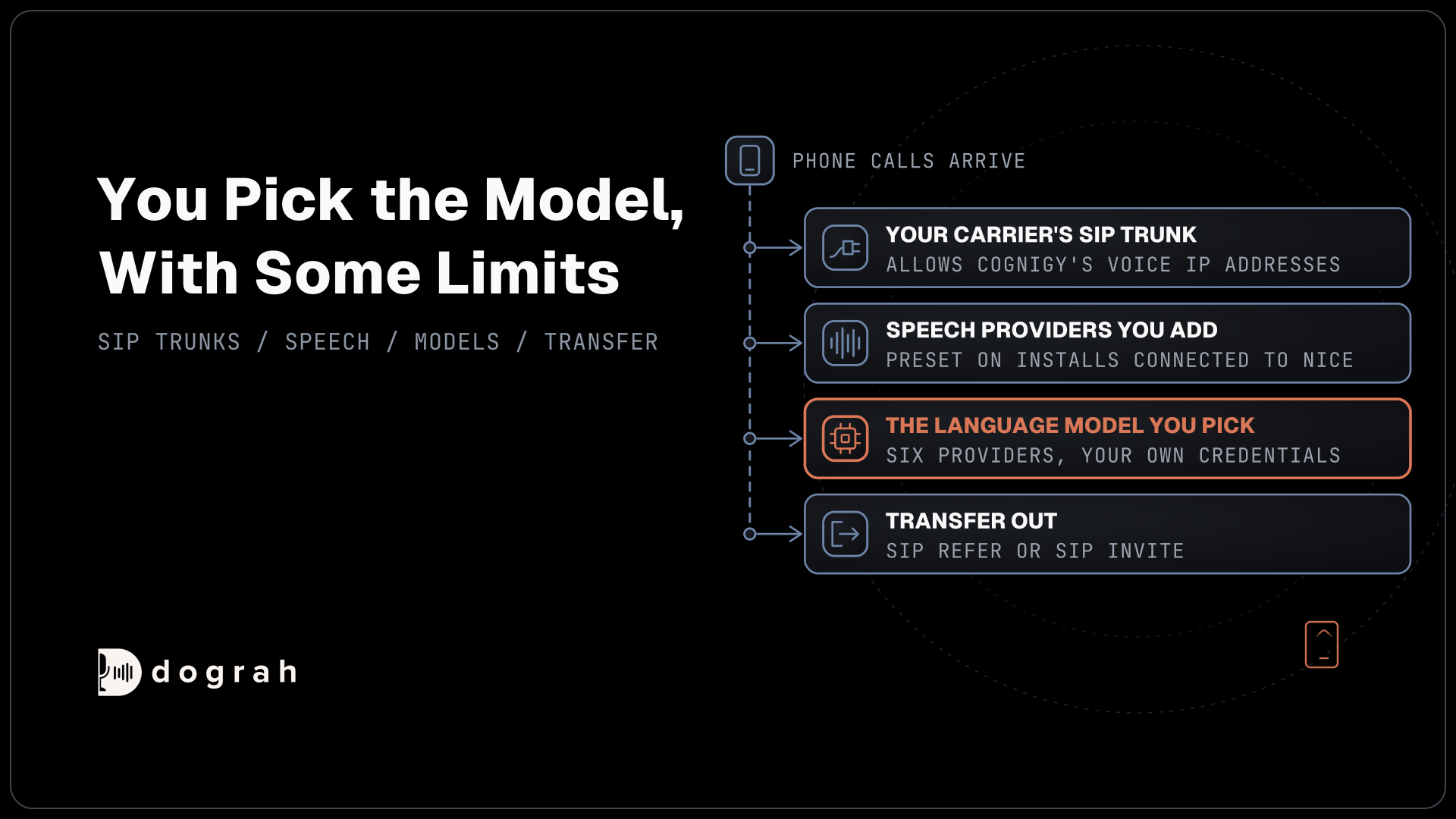
Under the agents sits a platform in three parts. Agents holds the workflows and the conversational and reasoning agents. Performance holds tests, audits and what HappyRobot calls self-improving agents, and Context holds memory, connections to outside systems and Edge, its data layer. Each AI step in a workflow has its own model field, with models from OpenAI, Anthropic, Google, Mistral, xAI and OpenRouter, and usage is counted in credits for speech-to-text, voice and the language model.
The company is large and well funded. In its Series C announcement, HappyRobot reported a $150 million round at a $1.2 billion post-money valuation and more than 150 enterprise customers, naming DHL, Kuehne + Nagel and Uber among them.
Where the freight focus is a real strength
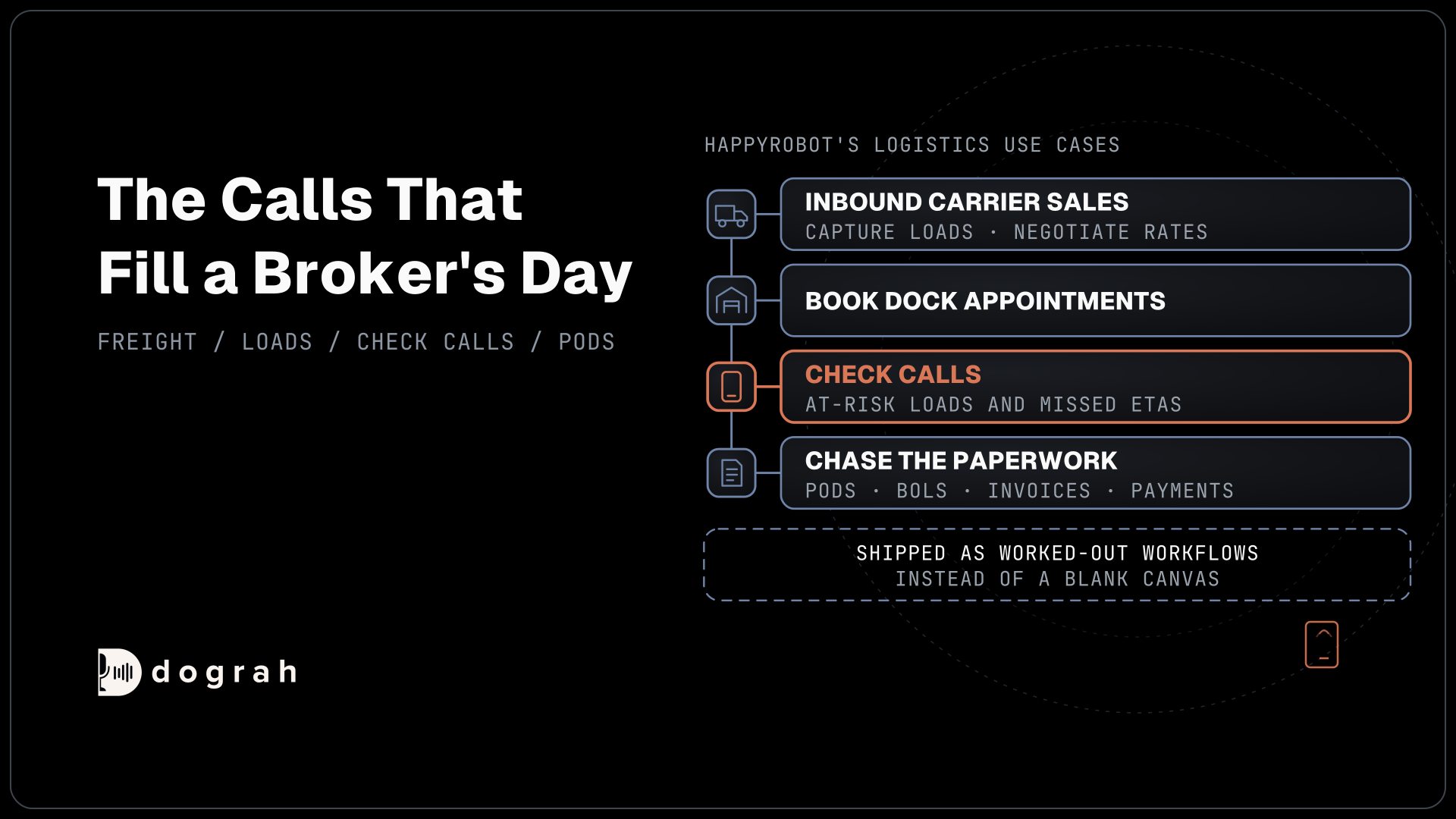
For a freight desk, HappyRobot's depth is real, and it shows in how specific the use cases are. HappyRobot's logistics page covers capturing inbound loads and negotiating rates, booking dock appointments, carrier check calls on at-risk loads and missed ETAs, and chasing PODs, BOLs, invoices and overdue payments. These are the calls that fill a broker's day, and HappyRobot ships them as worked-out workflows instead of a blank canvas.
The customer list backs that up. Forkast's report on the Series C says eight of the ten largest US freight brokers run HappyRobot agents in production, a figure the company itself reported. In HappyRobot's MODE Global story, the inbound carrier sales agent picks up every call, with carrier vetting and fraud screening running beside the conversation.
Delivery is the other strength. HappyRobot says first agents usually go live in 4 to 12 weeks and describes the work as an ongoing partnership, with forward-deployed engineers who build and tune agents next to the customer's team. For a broker with no engineers to spare, that service is much of what the money buys. Our post on AI voice agents for freight and trucking covers which of these calls to automate first.

Open Source Alternative to Vapi / Retell
Self-hosted voice agent platform — no per-minute fees
dograh-hq/dograh
Star on GitHub
How HappyRobot is bought and billed
HappyRobot is bought through a demo and a signed Order Form, with no self-serve plan. The structure is a 12-month platform subscription plus usage credits, where each action is a task an agent performs in a workflow, such as sending a message or writing to a system. Fees stay fixed for the first term, unused credits roll over month to month but expire when the term ends, and overages are invoiced monthly in arrears. Our post on HappyRobot pricing covers what drives the credit count and what to ask in the quote.
What the contract says about your workflows
The term that matters most for control is about ownership. HappyRobot's license agreement makes "all configurations, prompts, workflows, integrations, customizations" its intellectual property, "regardless of whether such materials were created by Happyrobot, Customer, or any third party". In plain words, a carrier sales flow your team designs on the platform belongs to HappyRobot.
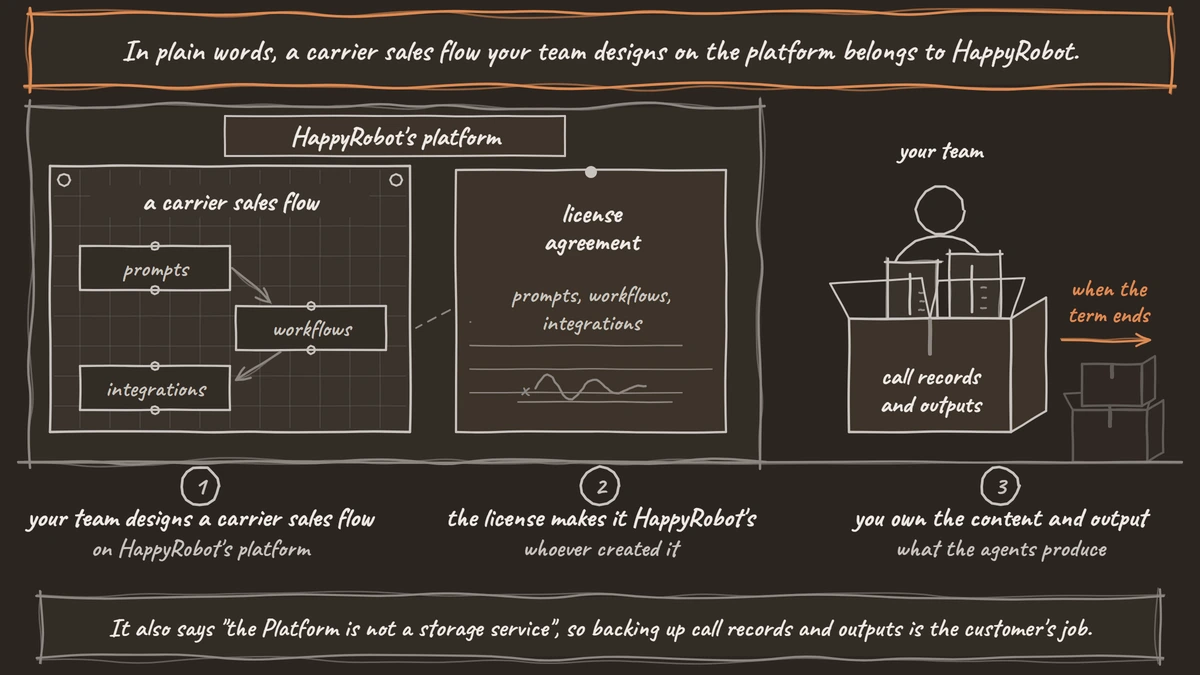
You do keep what the agents produce. The same agreement says the customer owns its content and the output, while HappyRobot keeps aggregate data and the "Learnings" from model improvements, provided they disclose nothing confidential about the customer. It also says "the Platform is not a storage service", so backing up call records and outputs is the customer's job.
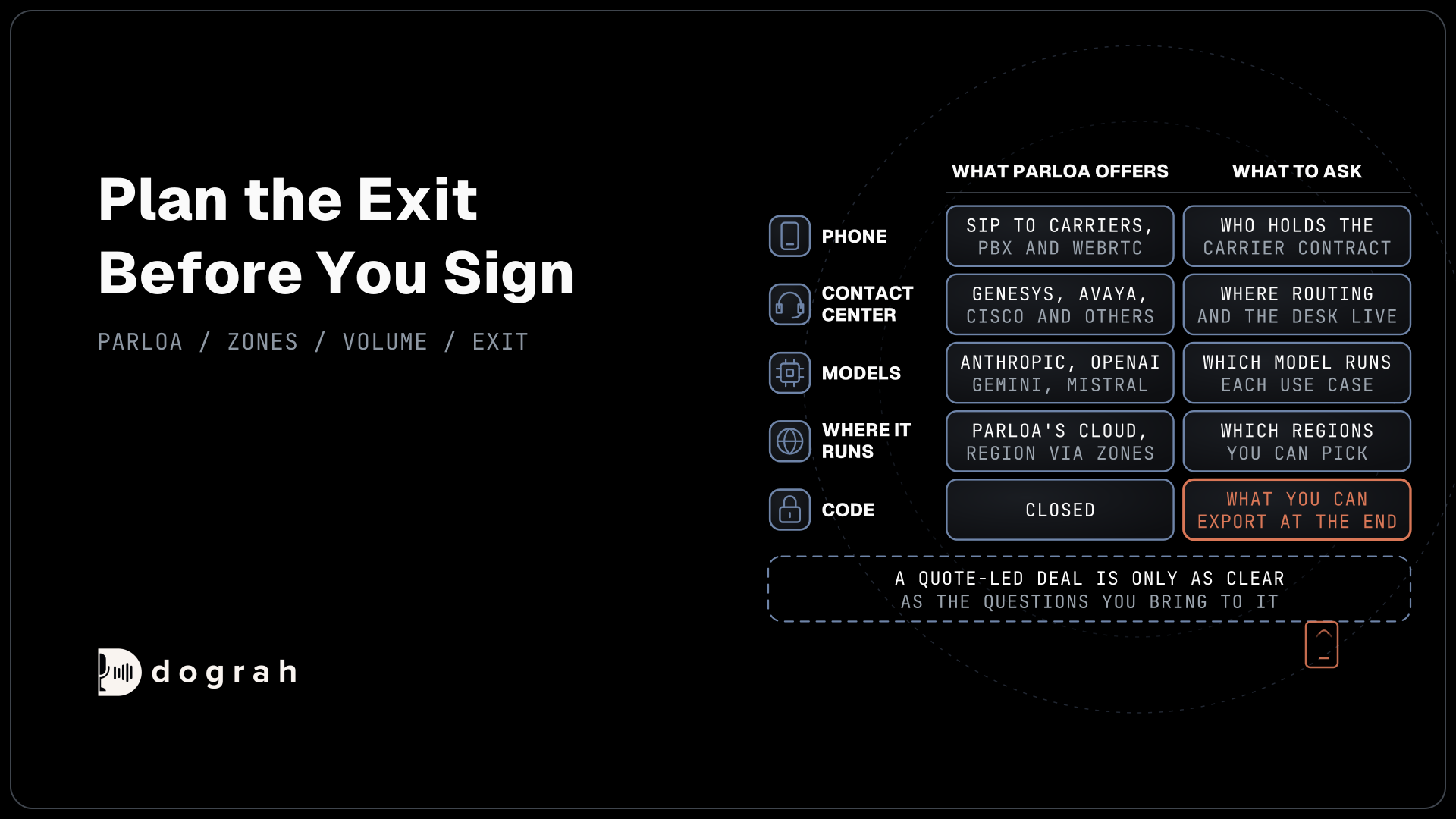
Read together, these terms shape the exit plan from the first week. Keep your own written spec for every workflow, export recordings and results on a schedule, and agree in the Order Form what HappyRobot hands over when the term ends.
Where call data goes and who reads the code
HappyRobot is closed source and runs in its own cloud, so the data question is answered by its contracts, and there is no code to read. Its data processing agreement lists the subprocessors that may touch a call, including OpenAI, Anthropic and Groq for language models, Twilio and Telnyx for telephony, Deepgram and Soniox for speech-to-text, ElevenLabs and Cartesia for voices, and AWS, Microsoft and Google for cloud. It allows transfers outside the European Economic Area under standard contractual clauses.
There are real controls on top. HappyRobot says each deployment's data in Edge is isolated and never used to train shared models, and that retention windows can be set per deployment. Its homepage shows SOC 2, ISO 27001, GDPR and HIPAA badges, among others. For a broker the remaining risk is plain. Rate talks, driver phone numbers and carrier details pass through a long list of companies, and nobody outside HappyRobot can inspect the code that routes them.
Join the Dograh Community
Dograh is an OSS alternative to Vapi. Join our Slack community for queries, releases, best practices & community interactions.
Questions to ask in a HappyRobot demo
A demo shows the agent at its best, so bring the questions that decide control. Ask which models and speech providers handle your calls by default, and whether you can pin them per workflow. Ask which region stores your call audio and transcripts, and for how long. Ask what you can export at the end of the term, given that the workflows stay with HappyRobot. Then ask which TMS and load board connections are ready for your stack today, and who builds and pays for any that are not.
Who HappyRobot fits
HappyRobot fits a large broker, carrier or shipper that wants freight workflows built and run by a vendor, with engineers alongside and a contract behind it. If procurement is routine for you and nobody on the team wants to own servers or prompts, a live carrier sales agent in a few weeks is hard to beat.
It fits less well a team that wants to read the code, choose its own carrier and models, keep call audio on its own servers or keep the workflows it builds. A smaller desk that wants to start this month without a sales cycle will find it a poor match too. Our ranking of the best AI voice agents for logistics compares the platforms open to that desk, and our guide to HappyRobot alternatives sorts the options by why teams leave.
Where Dograh fits
Dograh suits a freight team that wants to own the stack HappyRobot rents out. Its code is public under the BSD 2-Clause license, and you can self-host it with Docker Compose on a server with at least 8 GB of RAM and 4 vCPUs, run it on Dograh Cloud, or deploy on-prem on the Enterprise plan. A new agent starts in the Agent Builder, where you describe the call, approve the requirements it lists and test what it builds, and the canvas stays open for hand edits.
Your TMS connects through tools you set up on the agent. Pre-Call Data Fetch loads the load or carrier record as the call connects, an HTTP API tool reads and writes the TMS during the call, and a Webhook node sends the outcome after it. Campaigns dial a check-call list within weekday calling hours and retry busy or unanswered numbers. When a carrier needs a dispatcher, Transfer Call on Twilio, Telnyx, Plivo, Cloudonix or Asterisk ARI rings the dispatcher first and connects the carrier only when someone answers. If nobody answers, the line is busy or the call fails, the carrier stays with the agent and the call goes on.
Dograh is the orchestration layer that runs the call flow, tools and telephony, and the speech and language models are a separate layer you choose for each agent. That can be Dograh's own models, your own keys with a provider, or open-weight models on your own servers. With your own key the audio still reaches that provider, so rate talks and driver numbers stay in-house only when the models run on your servers too.
Self-hosted, the workflows and call records sit in your own database, which answers the ownership question in the contract section above. Self-hosted Dograh has no per-minute platform fee, but servers, model keys and phone minutes still cost money. Dograh Cloud charges a 1¢-a-minute platform fee. Running it yourself means your team owns the server, the database and every upgrade, with community support on the open-source version and custom SLAs on Enterprise.
Glossary
- Usage credit
- HappyRobot's unit of platform consumption, spent when an agent performs an action. Unused credits roll over month to month but expire at the end of the contract term.
- Subprocessor
- A company a vendor hires to process customer data for it, such as a speech-to-text or telephony provider. HappyRobot lists its subprocessors in its data processing agreement.
- Forward-deployed engineer
- A vendor engineer who works alongside the customer's team to build and tune agents. It speeds up launch, and the customer pays for it in the contract.
- Check call
- A call to a carrier or driver asking where a load is and when it will arrive, usually made when tracking data is missing or a load looks late.