
HappyRobot alternatives are divided into freight-specific AI vendors, hosted voice agent platforms and open-source platforms you run yourself. Teams that want to own the platform can run Dograh, the open-source AI voice agent platform, self-hosted or on Dograh Cloud. Vooma and Parade are the freight vendors, and Retell AI, Vapi and Bland are the hosted platforms.
Key Takeaways
- HappyRobot keeps the workflows you build, so plan the exit before you sign.
- Vooma and Parade bring freight workflows, while Retell AI, Vapi and Bland publish rates.
- Dograh is open source and self-hostable, with on-prem deployment on the Enterprise plan.
HappyRobot runs voice AI at many of the largest US brokers, but closed code, demo-only buying and a contract that keeps your workflows push some teams elsewhere. We compare the options in one table, start with open-source Dograh, then cover freight vendors, hosted platforms, staying, moving and picking.
HappyRobot alternatives in one table
HappyRobot is the baseline row, and every other option answers the same five questions. HappyRobot sells freight workflows built with its engineers, on a 12-month subscription plus usage credits, and our HappyRobot review covers the product in full.
| Option | Open source | Where it runs | How it is priced | Freight workflows built in | Who builds the agent |
|---|---|---|---|---|---|
| HappyRobot (baseline) | No | HappyRobot's cloud | 12-month subscription plus usage credits per action, by demo | Yes, carrier sales, check calls, scheduling, paperwork | HappyRobot's engineers with your team |
| Dograh | Yes, BSD 2-Clause | Your own servers with Docker Compose, Dograh Cloud, or on-prem on Enterprise | Self-hosted, no per-minute platform fee. Dograh Cloud, 1¢/min platform fee. Models and phone extra | No templates. Your TMS connects through HTTP API tools and Pre-Call Data Fetch | Your team, with the Agent Builder |
| Vooma | No | Vooma's cloud | By demo | Yes, quoting, load building, scheduling, carrier coverage, POD collection | Vooma with your team |
| Parade CoDriver | No | Parade's cloud | By demo | Yes, carrier calls and emails inside Parade's capacity platform | Parade with your team |
| Retell AI | No | Retell's cloud, on-prem through Enterprise sales | $0.055/min voice infrastructure, $0.07 to $0.31/min all-in | No | Your team |
| Vapi | No | Vapi's cloud | $0.05/min hosting plus models and phone | No | Your team |
| Bland | No | Bland's cloud, on-prem or VPC on Enterprise | Start $0.14/min. Build $0.12/min plus $299/mo | No | Your team |
| LiveKit Agents and Pipecat | Yes, Apache-2.0 and BSD-2-Clause | Your own servers | Free to self-host | No | Your developers, from a framework |
Every closed row runs your calls, rate talks and driver phone numbers through the vendor's cloud and the providers it picks, and nobody outside the vendor can read the code that routes them. Only the open-source rows let you run the code yourself, and Dograh is the one that arrives as a working platform with telephony, tools and transfers in place.
Dograh: open code, your servers and your TMS
Dograh's whole platform sits in its GitHub repository under the BSD 2-Clause license. You can self-host it with Docker Compose on a server with at least 8 GB of RAM and 4 vCPUs, run it on Dograh Cloud, or take on-prem deployment inside your own network on the Enterprise plan. New agents start in the Agent Builder, where you describe the call, approve the requirements it lists and test what it builds, with the canvas open for hand edits.
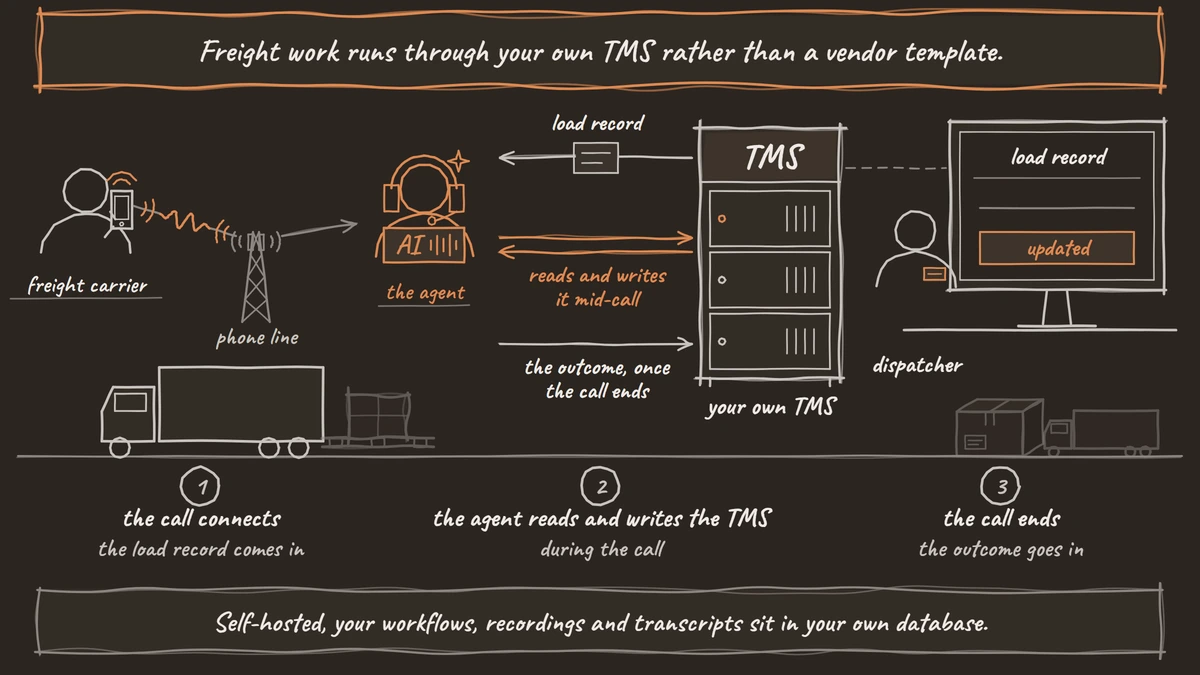
Freight work runs through your own TMS rather than a vendor template. Pre-Call Data Fetch pulls the load or carrier record when the call connects, an HTTP API tool reads and writes the TMS mid-call, and a Webhook node sends the outcome once it ends. Campaigns dial a check-call list within weekday calling hours, in one time zone per campaign, and retry busy or unanswered numbers. When a carrier needs a person, Transfer Call on Twilio, Telnyx, Plivo, Cloudonix or Asterisk ARI rings the dispatcher first and connects the carrier only when someone answers, and if nobody does, the carrier stays with the agent and the call goes on.
Dograh serves as the orchestration layer running the call flow, tools and telephony, and for each agent you choose the speech and language models as a separate layer. Pick Dograh's own models, your own keys with a provider, or open-weight models on your own servers. With your own key the audio still reaches that provider, so rate talks stay in-house only when the models run on your machines too.
Where the platform runs decides both the bill and who holds the records. Self-hosted, your workflows, recordings and transcripts sit in your own database, and there is no per-minute platform fee, though servers, model keys and phone minutes still cost money. Dograh Cloud charges a 1¢-a-minute platform fee. A self-hosted install runs 10 calls at once by default, a setting you can raise, and Cloud's pay as you go plan includes 10. Your team owns the server, the database and every upgrade, with community support on the open-source version and custom SLAs on Enterprise.

Open Source Alternative to Vapi / Retell
Self-hosted voice agent platform — no per-minute fees
dograh-hq/dograh
Star on GitHub
Freight-specific vendors: Vooma and Parade
Two vendors sell what HappyRobot sells, freight workflows that come ready to run. Vooma builds agents for brokers and carriers that quote loads, build them into the TMS from emails and PDFs, schedule with facilities, cover loads by posting to load boards such as DAT and Truckstop and answering carrier calls, track shipments and collect PODs. It names integrations with Turvo, McLeod, Aljex, DAT and Truckstop, among others, and says its agents deflect more than 65% of inbound calls.
Parade's CoDriver works inside Parade's capacity platform for brokers. It answers inbound carrier calls and emails, qualifies the fit and captures quotes, then syncs them to Parade. Both are closed, run in the vendor's cloud and start with a demo, so they trade one closed vendor for another with different freight strengths.
Customer service suites such as Sierra, Parloa and Cognigy sometimes appear on HappyRobot lists. They are built for consumer support across chat and voice, which is a different purchase from a broker's carrier calls, and our guide to Sierra alternatives covers that group.
Hosted platforms with published rates
Retell AI, Vapi and Bland publish prices you can multiply by your own minutes, and you build the freight workflow yourself. Retell AI charges $0.055 a minute for voice infrastructure and gives an all-in range of $0.07 to $0.31 a minute, with 20 calls at once included and $8 a month for each extra. Vapi charges $0.05 a minute for hosting before models and the phone line, and its HIPAA add-on costs $2,000 a month.
Bland's Start plan costs $0.14 a minute with 10 calls at once and 100 calls a day, and Build costs $0.12 a minute plus $299 a month for 50 at once and 2,000 a day. Bland lists on-prem or VPC on Enterprise, and Retell offers on-prem through Enterprise sales, both with closed code. Our ranking of the best AI voice agents for logistics compares these platforms for freight in detail.
Open-source frameworks: LiveKit Agents and Pipecat
LiveKit Agents and Pipecat hand developers solid building blocks, and the product is theirs to build. LiveKit Agents is Apache-2.0, and Pipecat is a BSD-2-Clause Python framework that Dograh itself is built on. With either one, your developers write the phone wiring, TMS calls, call history and checks before the first carrier gets an answer. Our guide to open-source voice AI frameworks compares them in depth.
Join the Dograh Community
Dograh is an OSS alternative to Vapi. Join our Slack community for queries, releases, best practices & community interactions.
When staying on HappyRobot makes sense
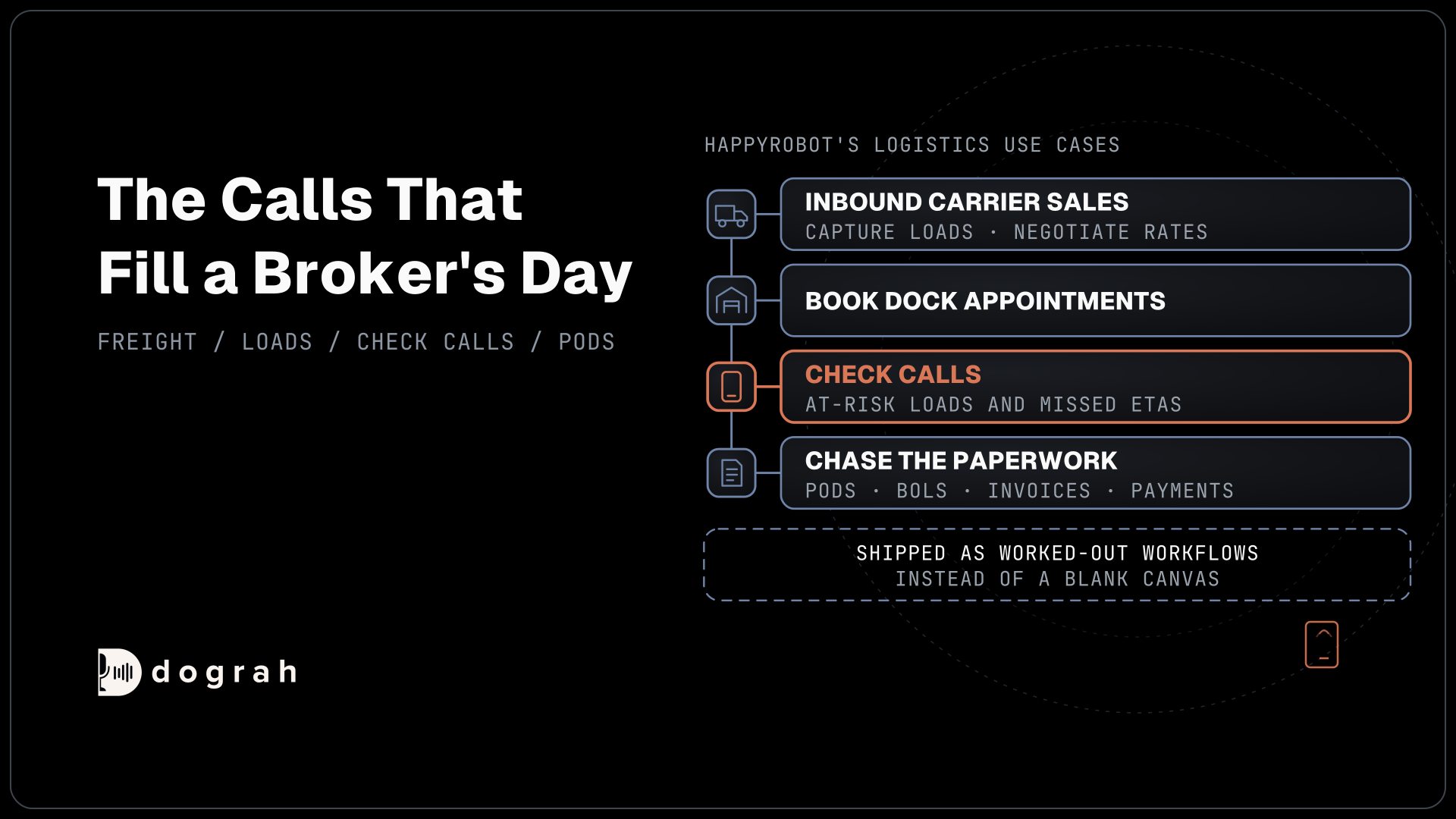
HappyRobot is a sound choice for a large broker, carrier or shipper that wants freight workflows built and run by a vendor. Its carrier sales, check call, dock scheduling and document chasing flows come ready, and according to Forkast's report on its Series C, eight of the ten largest US brokers run its agents in production, a figure the company reported.
Speed and service are the other reasons. HappyRobot says first agents usually go live in 4 to 12 weeks, with forward-deployed engineers working next to your team. If nobody on your side wants to own servers, prompts or TMS wiring, that is real work taken off your desk. The case for moving starts when you need the code, your own servers, or the workflows you build.
What moving off HappyRobot takes
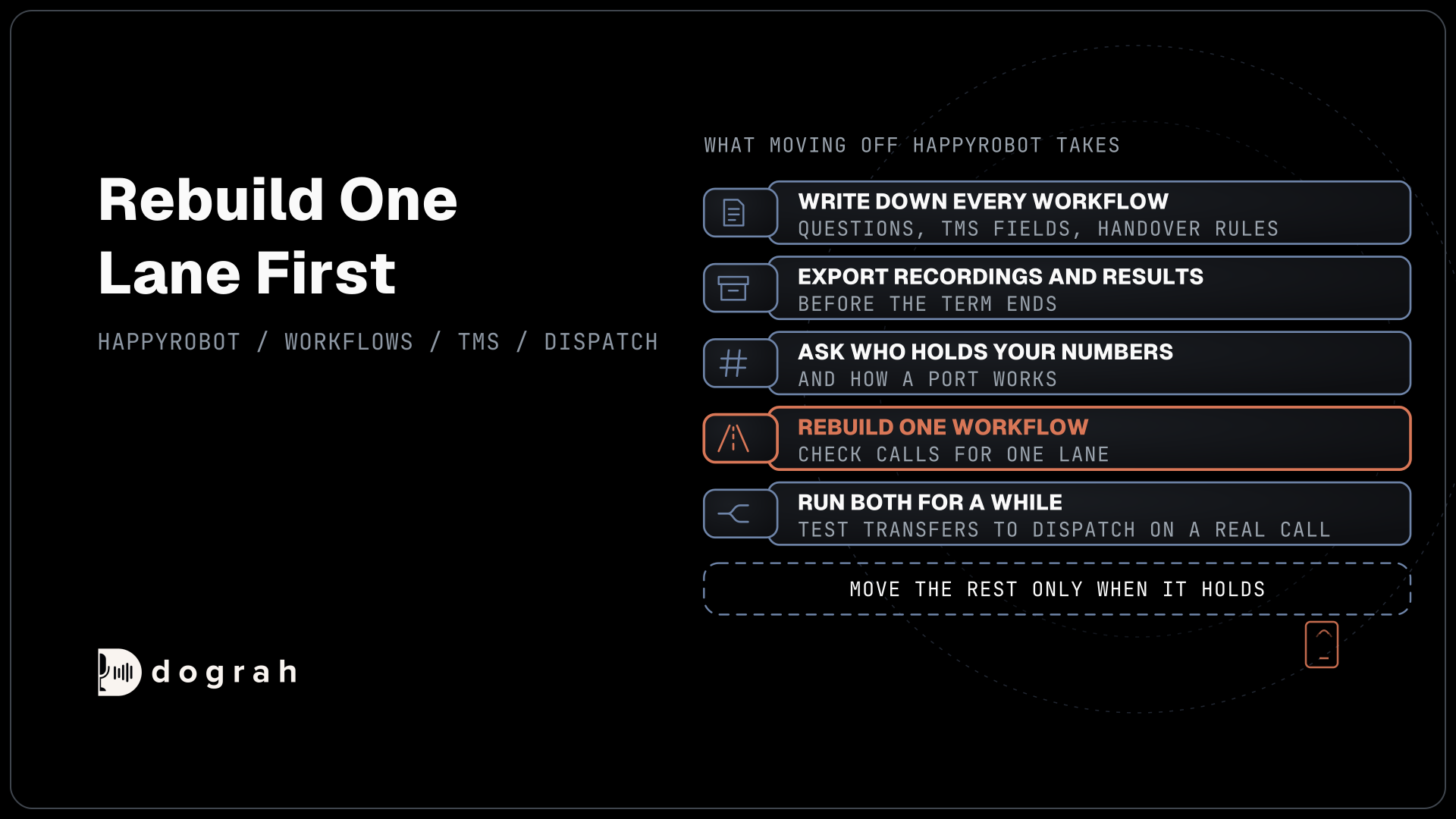
A move is a rebuild, and HappyRobot's contract decides how you plan it. HappyRobot's license agreement makes the configurations, prompts and workflows built on its platform its property, whoever built them. Write down every workflow in your own words while you still run it, including the questions, the TMS fields it reads and writes, and the rules for when it hands over to a person.
The same agreement says the platform is not a storage service, and the customer owns its content and output. Export recordings, transcripts and results before the term ends. Unused usage credits expire with the term, so time the switch to the renewal date. Our post on HappyRobot pricing covers those credit terms.
Phone numbers come next. Ask HappyRobot which carrier holds your numbers and how a port works before you set dates. On the new platform, rebuild one workflow first, such as check calls for one lane, and connect it to the TMS with the same fields the old one used.
Then run both for a while. Send one lane or one load type to the new agent, keep HappyRobot on the rest, and test every transfer to dispatch over a real phone call, because a browser test call cannot run a transfer.
Picking your HappyRobot alternative
Start from where the calls must run and who will keep the agent working. If you want open source, your own servers or on-prem inside your network, start with Dograh, with an Enterprise contract behind it when you need on-prem. If your developers would rather build the product themselves, LiveKit Agents and Pipecat are good bases. If you want freight workflows ready to run from a vendor, compare Vooma and Parade with HappyRobot at your volume. And if a hosted per-minute rate suits you, price Retell AI, Vapi and Bland with models and phone added. Whichever way you go, rebuild one lane first and move the rest only when it holds.
Glossary
- Usage credit
- HappyRobot's unit of platform consumption, spent when an agent performs an action in a workflow. Unused credits roll over month to month but expire when the contract term ends.
- Load board
- A marketplace such as DAT or Truckstop where brokers post loads and carriers find them. Freight-specific vendors connect agents to load boards so they can cover loads.
- Platform fee
- A voice agent platform's own charge for running the call, not counting the models or the phone line. Vapi, for example, charges $0.05 a minute to host a call.
- Orchestration layer
- What runs the call itself, meaning the call flow, turn-taking, tool calls and the phone connection. Speech and language models are a separate, swappable layer.