
Open-source alternatives to Parloa are divided into platforms that ship ready to take calls and frameworks your developers build on. For teams that want to own the platform end to end, Dograh is the open-source AI voice agent platform, self-hosted or on Dograh Cloud. LiveKit Agents and Pipecat are the frameworks.
Key Takeaways
- Parloa Zones choose a region, while self-hosting puts calls on servers you run.
- Dograh ships the builder, phone connections, transfers and QA as BSD-licensed code.
- Self-hosting makes the server, the database and every upgrade your team's job.
Parloa runs your phone agents in its own cloud, in a region you pick. This post is for teams that want them on open code they run. We compare the open options, start with Dograh, then cover where call data lives, rebuilding a contact-center call and the move itself.
Open-source Parloa alternatives in one table
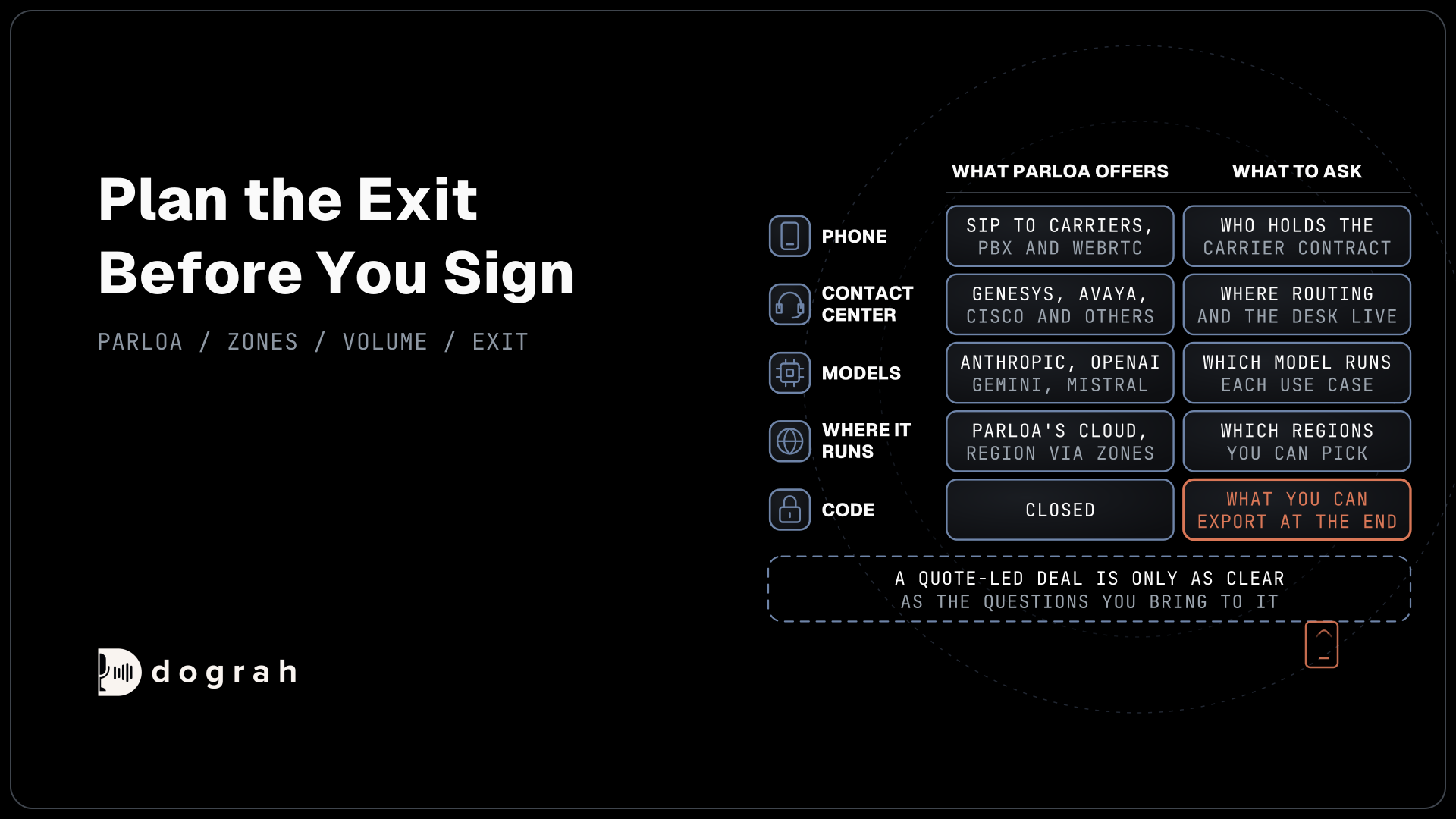
Going open source is a different purchase from Parloa's. You get code you can run and change, and your team takes on the running. Parloa sells a managed platform for voice and chat agents that connects over SIP to your carrier or contact center, and keeps your data in the legal region you choose.
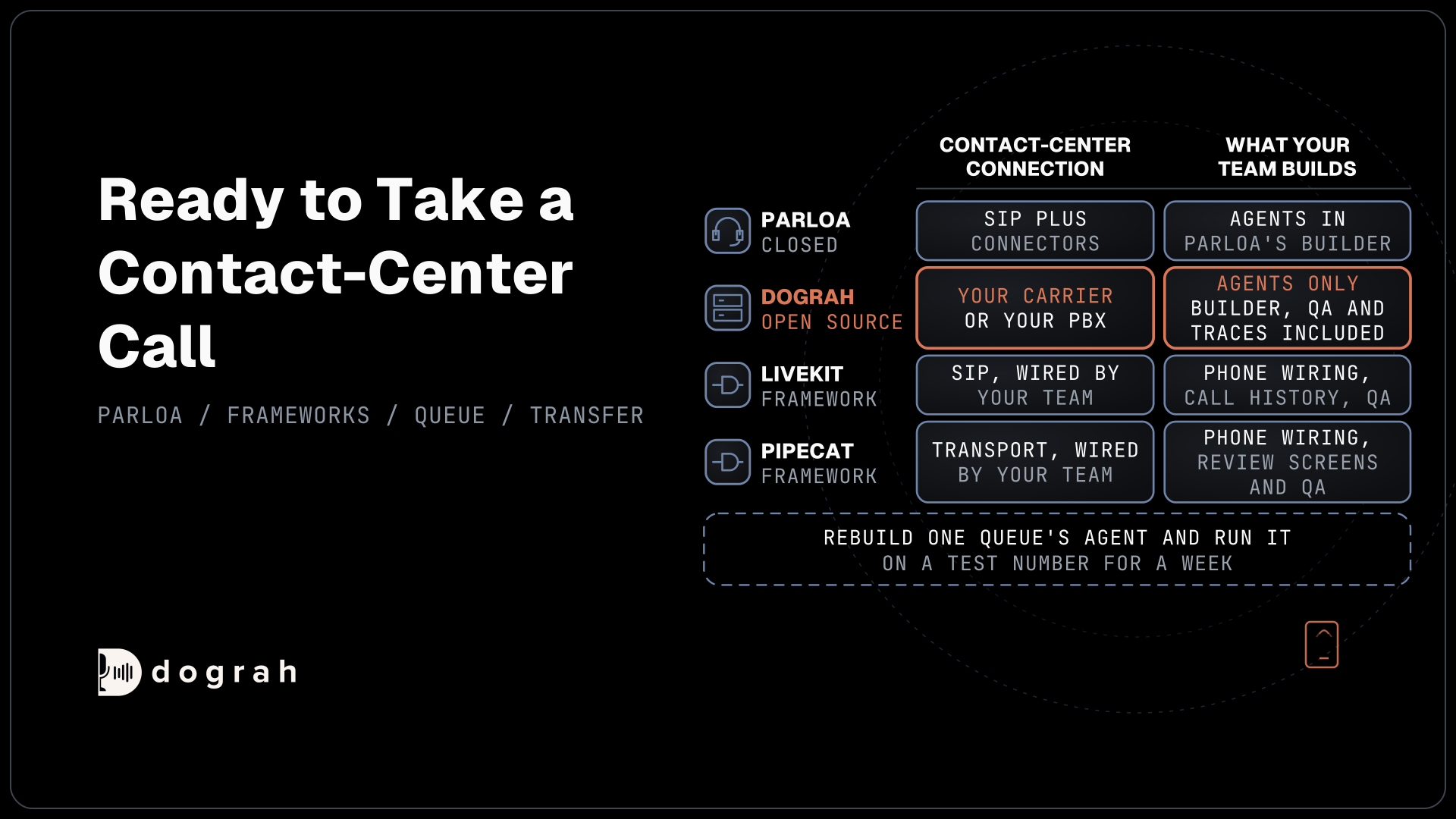
| Option | License | Where it runs | Who holds call audio and transcripts | Contact-center connection | What your team builds |
|---|---|---|---|---|---|
| Parloa (baseline) | Closed | Parloa's cloud, region chosen with Zones | Parloa, in the chosen region | SIP plus connectors for Genesys, Five9, Avaya, Amazon Connect, Cisco and others | Agents in Parloa's builder, with Parloa or a partner |
| Dograh | BSD 2-Clause | Your own servers, on-prem on Enterprise, or Dograh Cloud | Your own database and storage when self-hosted | Twilio, Telnyx, Plivo, Vonage, Exotel, Vobiz, Cloudonix, or your PBX through Asterisk ARI | Agents only, since the builder, transfers, QA and traces are included |
| LiveKit Agents | Apache-2.0, turn-detection models under the LiveKit Model License | Your own servers, or LiveKit Cloud | Wherever your team stores them | SIP, wired by your team | The phone wiring, call history, review screens and QA |
| Pipecat | BSD 2-Clause | Your own servers, or Pipecat Cloud | Wherever your team stores them | Your choice of transport, wired by your team | The phone wiring, call history, review screens and QA |
Only one open row arrives ready to take a contact-center call. The frameworks are sound foundations, and a team that picks one should plan for the product work between a working demo and a production phone line.
Dograh: a full platform you run yourself
Dograh puts the whole platform in its GitHub repository under the BSD 2-Clause license, from the call-flow builder to the phone connections. One Docker Compose file starts the stack, with Postgres for runs and transcripts, MinIO for recordings, Redis, nginx, a TURN server, the API and the UI, and a Helm chart covers Kubernetes. The Docker install needs a server with at least 8 GB of RAM and 4 vCPUs, and the Enterprise plan adds on-premise or private-cloud deployment with data residency.
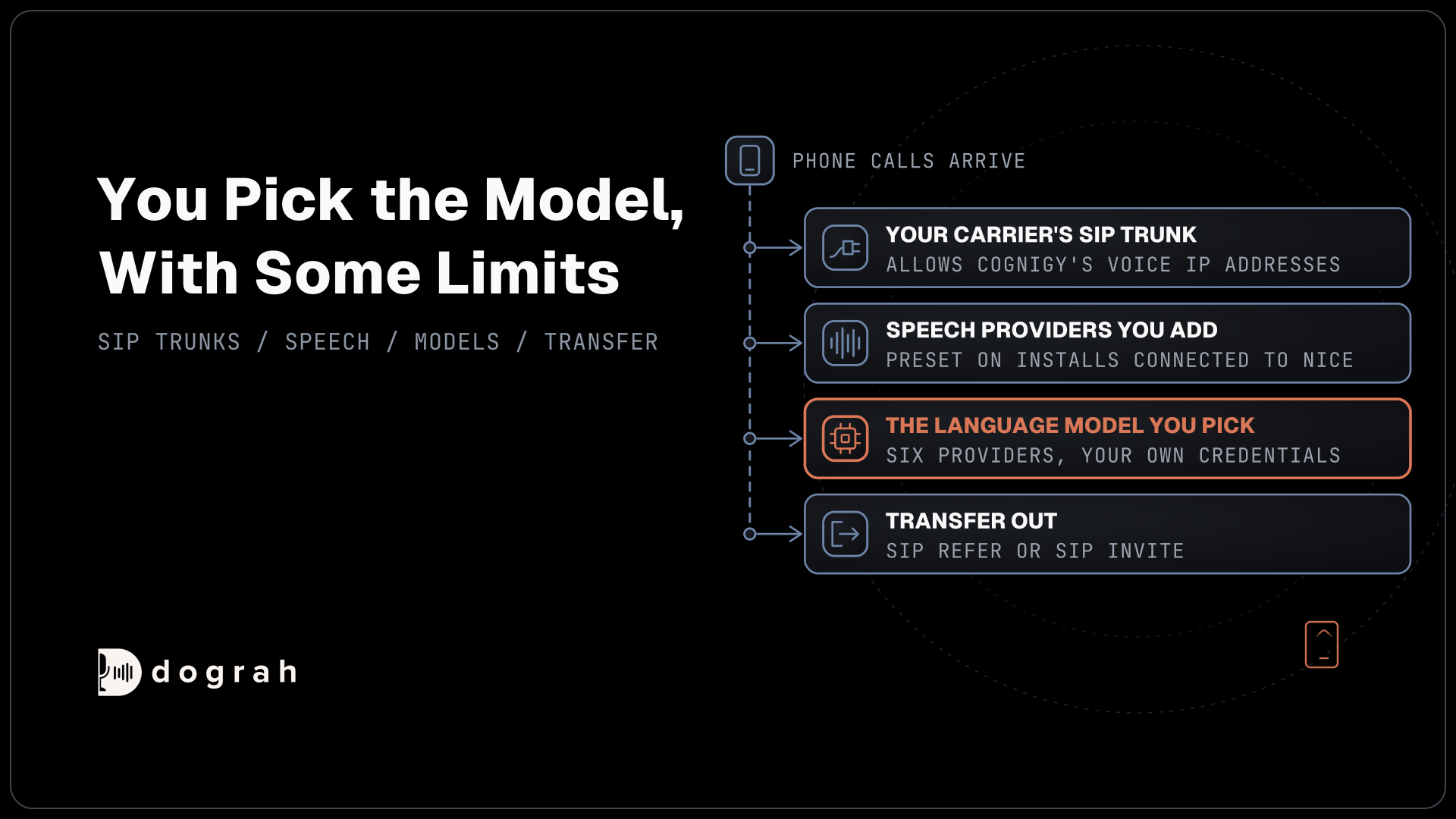
The call flow, tools and telephony run in Dograh as the orchestration layer, and you choose the speech and language models as a separate layer. For each agent you pick the speech-to-text, LLM and voice provider, from the platform's own models to your own keys or open-weight models served on your hardware. A provider key moves the contract to you while the audio still travels to that provider, so only local models keep the caller's voice inside your network. On a self-hosted install, the Agent Builder works with a Dograh Service Key, and the canvas is there to build or edit any flow by hand.
On your own servers, the cost and the upkeep are both yours to plan. Self-hosted Dograh has no per-minute platform fee, but servers, model keys and phone minutes still cost money. Dograh Cloud charges a 1¢-a-minute platform fee. A self-hosted install handles 10 calls at once by default, raised with the DEFAULT_ORG_CONCURRENCY_LIMIT setting, and your servers and carrier set the real ceiling. Your team keeps the server running, looks after the database and its backups, and applies each update to a newer release, with community support for the open-source version and custom SLAs on Enterprise.
Open code also means you can see and take out what the platform holds. Download Report in an agent's settings exports its calls as a CSV file, Download Workflow saves the agent itself, and Upload Agent Definition loads it into another install. Each call has a QA score per step and a trace that opens in Langfuse, showing the speech-to-text, AI and voice time of every turn.

Open Source Alternative to Vapi / Retell
Self-hosted voice agent platform — no per-minute fees
dograh-hq/dograh
Star on GitHub
A region you rent or servers you run
Parloa answers the data question with a region, and self-hosting answers it with a building you control. Parloa's Zones announcement says transcripts, personal details, logs and analytics stay in the legal region you pick, together with the transcription and model inference that process them. Configuration such as agents, phone numbers and channels runs through a separate control plane.
That is a strong answer for many buyers, and it has a limit. Parloa's trust center lists its hosting as a "Major Cloud Provider" and names Google, Twilio, Datadog, MongoDB and Microsoft as subprocessors. A region keeps the data in a country, and the vendor still runs the machines and holds the records. The code that handles each call is closed, so a security review reads documents and audit reports.
A self-hosted Dograh install keeps recordings in MinIO and runs and transcripts in Postgres, on hardware your team controls. With open-weight models on the same servers, the audio stays inside your network from the first word to the transcript. Our guide to on-prem voice AI platforms sets vendors that sell a region against those that run on your own servers.
Rebuilding a Parloa-style contact-center call
Most Parloa customers run the same shape of call, which looks up the caller, checks who they are, answers and hands off. Each step maps to a Dograh part you set up yourself. Pre-Call Data Fetch sits at the bottom of the Start Call node and pulls the caller's record from your CRM by phone number once the call connects, before the greeting plays.
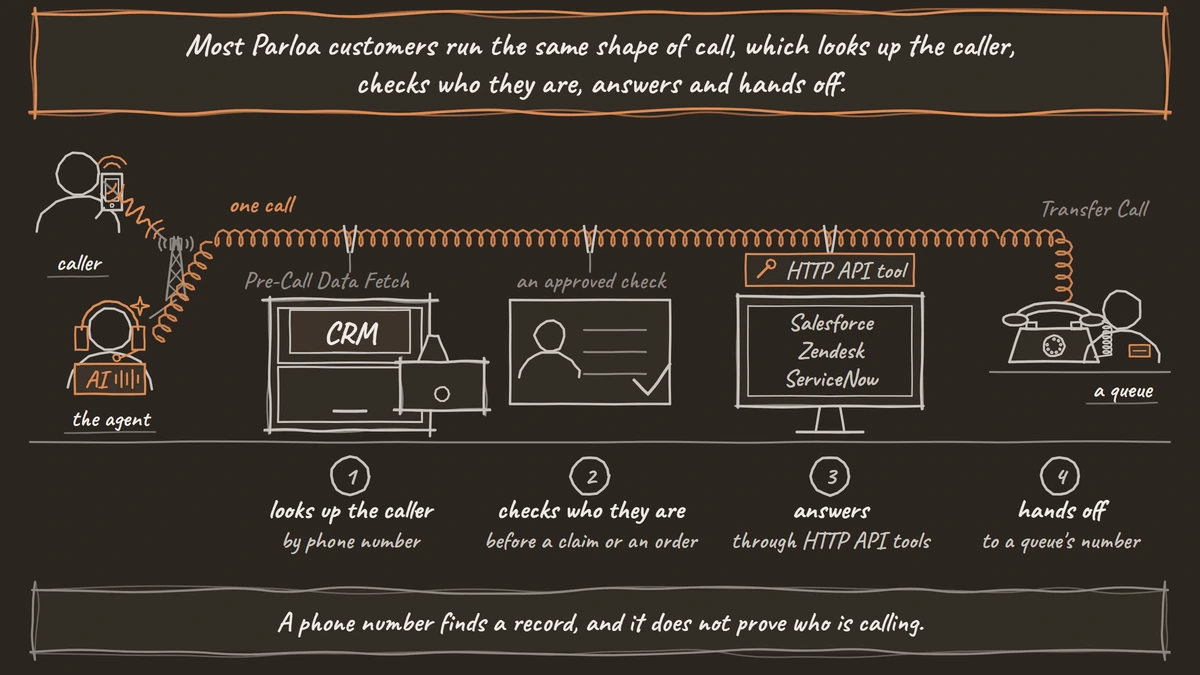
A phone number finds a record, and it does not prove who is calling. So the agent greets the caller, confirms identity with an approved check such as date of birth or the last digits of an account number, and only then talks about a claim, an order or an account. Your prompt sets that order, and the QA step shows on test calls whether the agent kept to it.
Answers and updates go through tools. An HTTP API tool reads or writes Salesforce, Zendesk, ServiceNow or your own system during the call, and a Webhook node sends the results after it ends. For callers who speak more than one language, the speech-to-text Language setting has a Multilingual (Auto-detect) option, and the Dictionary in the agent's Settings lists brand and product names the agent should hear correctly.
The handoff replaces Parloa's contact-center connectors. Transfer Call sends the caller to a queue's phone number on Twilio, Telnyx, Plivo, Cloudonix or Asterisk ARI. Dograh calls the destination first and connects the caller only when someone answers, and a busy, unanswered or failed attempt comes back to the agent so the call carries on. Write the caller's details to your system before the transfer, so the person who picks up can see them. Our post on open-source AI call center software covers the Asterisk, FreePBX and VICIdial side of that setup.
Open frameworks: LiveKit Agents and Pipecat
LiveKit Agents and Pipecat are the other open choices, and both are frameworks for developers. The LiveKit Agents repository is Apache-2.0, with its turn-detection models under a separate LiveKit Model License. Pipecat is BSD 2-Clause Python, and Dograh is built on a fork of it. To match what Parloa does on either one, your team writes the contact-center handoff, the CRM calls, the call history and the review tools. If hosted platforms with published rates are also on your list, our roundup of Parloa alternatives covers them.
Join the Dograh Community
Dograh is an OSS alternative to Vapi. Join our Slack community for queries, releases, best practices & community interactions.
When staying on Parloa makes sense
Some teams are better served by staying. Parloa ships native connectors for Genesys, Five9, Avaya, Amazon Connect and Cisco, redacts personal details in real time and sends card data to a separate process. Its agents speak over 140 languages and variants, and partners such as McKinsey and Thoughtworks carry large rollouts so nobody on your side runs a server.
Staying also makes sense when a chosen region satisfies your data rules and nobody on staff wants to own upgrades. Our Parloa review looks at who it fits in more detail. Move when you need code you can audit or call records on hardware you control.
What moving off Parloa takes
Plan the move as a short project in a fixed order. First, list every Parloa agent, the use case it serves and the contact-center queue it hands off to. Before you give notice, ask Parloa in what form transcripts, recordings and agent definitions come out, and keep them as the spec for the new agents.
Next, stand up Dograh on a server, give the install its own domain with SSL and connect your carrier, or your PBX through Asterisk ARI. Rebuild each agent with the Agent Builder or on the canvas, then add the Pre-Call Data Fetch endpoint, the HTTP API tools and the transfer numbers for each queue.
Then run both. Send one queue or one use case to the new agent, keep Parloa on the rest and compare transcripts and QA scores for a few weeks. Test every transfer over a real phone call, since browser test calls cannot run one, and move the next queue only once the first holds up.
Picking your open-source Parloa alternative
If open code and your own servers are why you are looking, Dograh comes first, as the open option that takes contact-center calls on day one, with on-prem on Enterprise when you want a contract behind it. If your developers would rather build the product layer themselves, start from LiveKit Agents or Pipecat. If a managed service with native contact-center connectors still matters most, stay with Parloa. Before you commit either way, rebuild one queue's agent and run it on a test number for a week.
Glossary
- Control plane
- The part of a platform that holds configuration, such as agents, phone numbers and channels, apart from the call data itself. Parloa Zones keep customer data in a region while a separate control plane manages configuration.
- Open-weight model
- A speech or language model whose weights you can download and run on your own servers. Only these keep call audio inside your network, since a hosted model receives the audio.
- Pre-Call Data Fetch
- A Dograh setting on the Start Call node that calls your endpoint once the call connects and loads the caller's record before the greeting plays.
- Orchestration layer
- The piece of a voice agent that manages call flow, turn-taking, tool calls and the phone link. The speech and language models form a separate layer you pick.