
Open-source AI call center software is a stack you assemble from separate projects. Asterisk or FreePBX runs the phones, VICIdial dials, an AI agent layer talks to callers and a QA layer checks the calls. Dograh, the open-source AI voice agent platform we build, fills the agent layer, and you can self-host it or run it on Dograh Cloud.
Key Takeaways
- Most open-source call center tools are a phone system or a dialer.
- VICIdial is still developed, with nightly builds of its main branch.
- Every layer, the AI agent included, can run on your own servers.
Search for open-source call center software and you mostly find phone systems and dialers, with the AI agent left to you. We map the four layers you assemble, check which projects are still maintained, and show what the stack still costs, with Dograh as the agent layer.
The four layers of an open-source call center
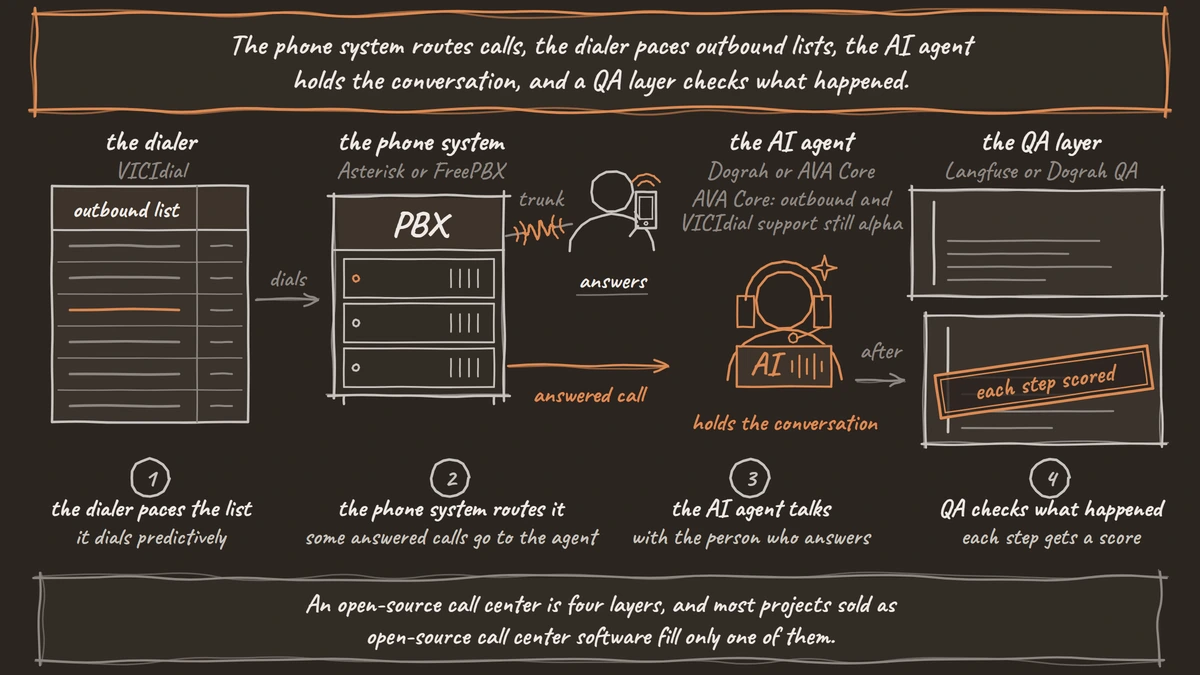
An open-source call center is four layers, and most projects sold as open-source call center software fill only one of them. The phone system routes calls, the dialer paces outbound lists, the AI agent holds the conversation, and a QA layer checks what happened. Each layer has its own open projects and its own license.
| Layer | Open project | License | What to know |
|---|---|---|---|
| Phone system | Asterisk | GPL-2.0 | The call engine many open setups run on |
| Phone system | FreePBX | GPL-3.0 framework | A web admin on top of Asterisk |
| Phone system | FreeSWITCH | MPL-1.1 | A separate switch, joined to an AI agent over a SIP trunk |
| Dialer | VICIdial | AGPLv2 | Maintained, with nightly builds of its main branch |
| AI agent | Dograh | BSD 2-Clause | A full voice agent platform, joined to Asterisk through ARI |
| AI agent | AVA Core | MIT | A bot for Asterisk and FreePBX, outbound and VICIdial support still alpha |
| AI agent | Microsoft call-center-ai | Apache-2.0 | Archived proof of concept, Azure only |
| QA and tracing | Langfuse | MIT core | Self-hosted tracing for language model calls |
| QA and tracing | Dograh QA | BSD 2-Clause | Scores each step of a call |
Why build it on your own servers
The main reason to assemble an open stack is that the calls, recordings and transcripts never have to leave your servers. In healthcare and finance, sending call data to a third-party service is often a compliance problem, so a team there may have no hosted option at all. With every layer open, the whole call center can run in your own data center or private cloud.
Licensing is the second reason. By the project's own count, VICIdial is used by tens of thousands of organizations in over 100 countries, with no per-user license fees, and the phone systems carry no license fee either. Your spend moves to servers, carriers and models, which you pick.
AI is already part of how these teams work. Of 1,505 contact center professionals and CX leaders surveyed in the UK, the Netherlands, Sweden, Norway and Denmark, 78% use AI to analyze customer interactions, according to a OnePoll survey for Puzzel. An open stack lets you add that analysis without sending the calls to a vendor.
The models need the same thought as the software. A self-hosted agent that calls hosted speech and language models on your own keys still sends the audio to those providers, because bringing your own key moves the contract and leaves the data path as it was. Full data control comes only when open-weight models run on your own hardware too, next to the PBX and the agent.
The phone system: Asterisk, FreePBX or FreeSWITCH
The phone system is the base layer, and it is the one most people mean by open-source call center software. Asterisk is the call engine, licensed GPL-2.0, and FreePBX adds a web admin on top with a GPL-3.0 framework, so an admin can edit queues and routes in a browser. FreeSWITCH is a separate switch under MPL-1.1. Our list of the best open-source IVR software compares the three on licenses and setup.
None of them holds a conversation with AI on its own. An AI agent joins Asterisk or FreePBX through the Asterisk REST Interface (ARI), which lets an outside app answer and control calls, while FreeSWITCH usually reaches the agent over a SIP trunk. Our guide to open-source IVR and AI phone systems walks through both connections and how calls come back to your staff.
The dialer: VICIdial is still maintained
VICIdial is a widely used open-source dialer, and it is still maintained. It is AGPLv2 licensed, with no software licensing cost, and the VICIDIAL Group maintains it. It runs on Asterisk and dials predictively, placing calls ahead of free agents.
The release history can make it look stale, since the last packaged download is revision 3344 from January 2021. Development has moved on since then. The project publishes nightly builds of its main branch every day, and its history document was updated in 2026.
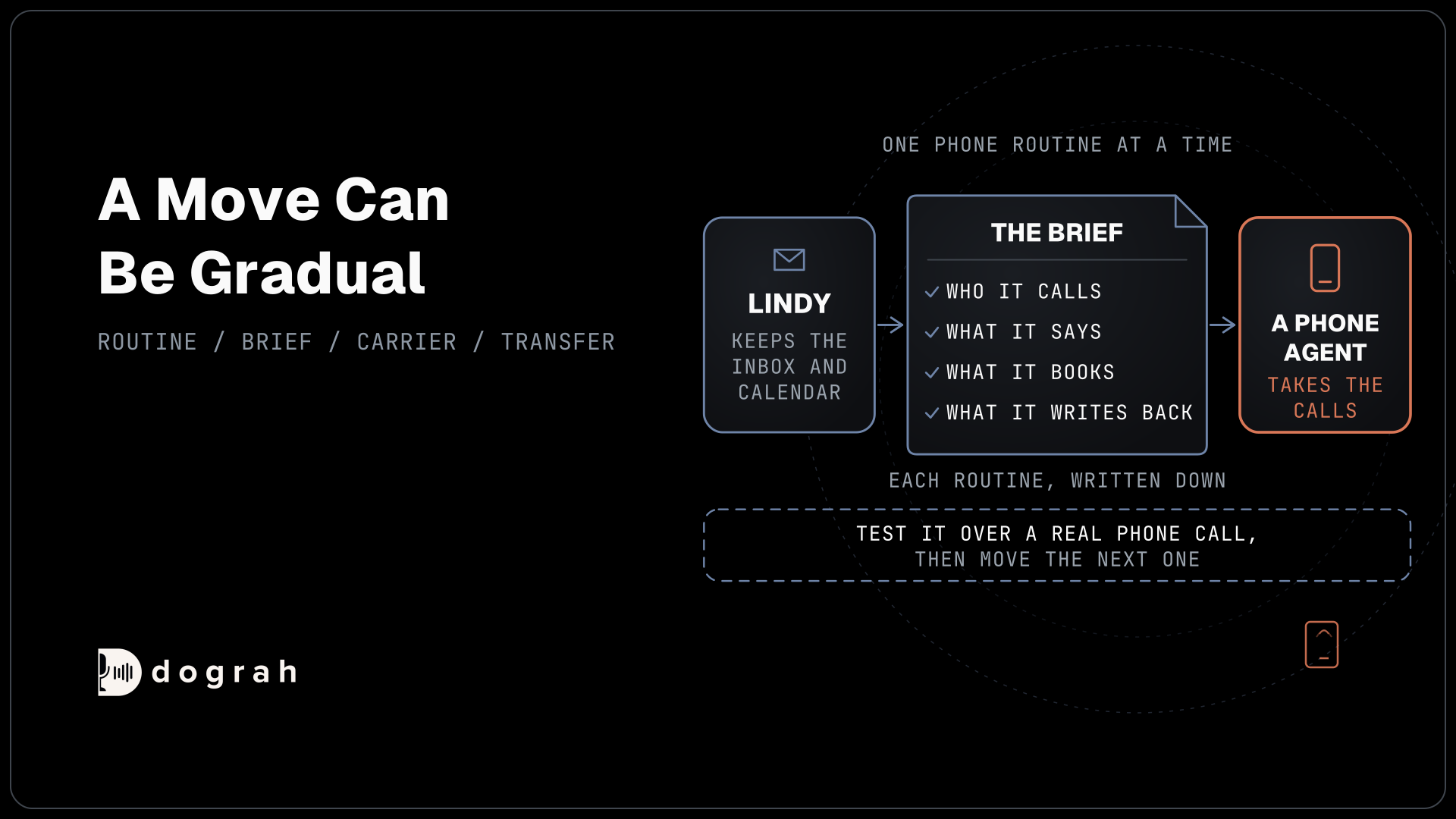
With an AI agent added, VICIdial keeps pacing and placing the calls, and some answered calls go to the agent instead of a person, as a remote agent. Our post on the open-source predictive dialer with an AI agent covers that handoff, the write-back and the abandonment rules.

Open Source Alternative to Vapi / Retell
Self-hosted voice agent platform — no per-minute fees
dograh-hq/dograh
Star on GitHub
The AI agent layer: what is actually open
The AI agent is a separate layer, and few projects cover it in full. AVA Core, formerly Asterisk AI Voice Agent, is an MIT-licensed bot for Asterisk and FreePBX with realtime or modular speech and language models, though its outbound campaigns and VICIdial integration are still marked alpha. Our list of free and open-source AI call bots covers it and similar projects in depth.
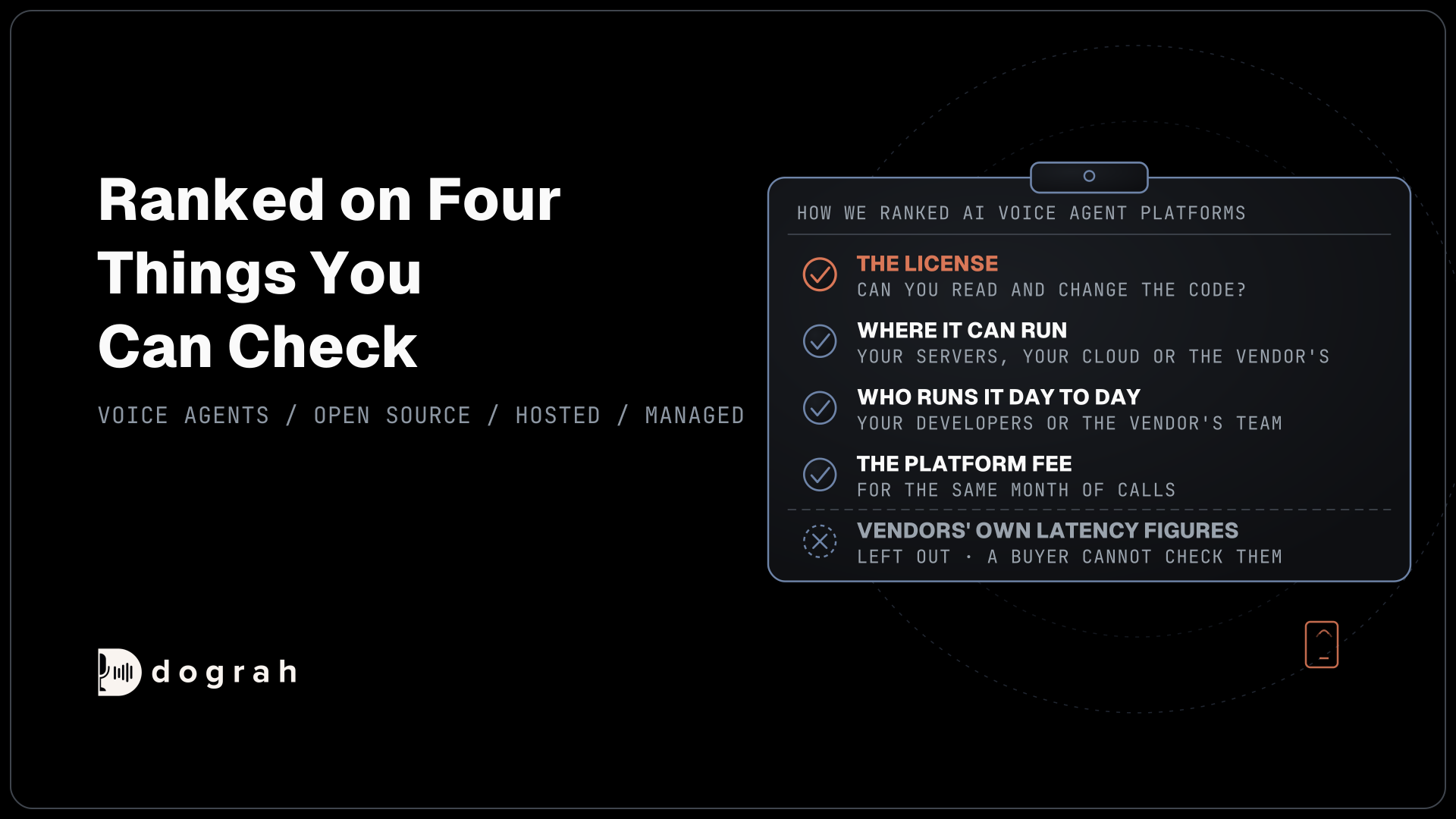
An open license does not mean someone still maintains the code. Microsoft's call-center-ai is Apache-2.0, but the repository is archived and read-only, and its README calls it a proof of concept that is not intended for production. It also runs only on Azure services, so it cannot sit inside your own data center. Check the last activity and the README before you build on any repository.
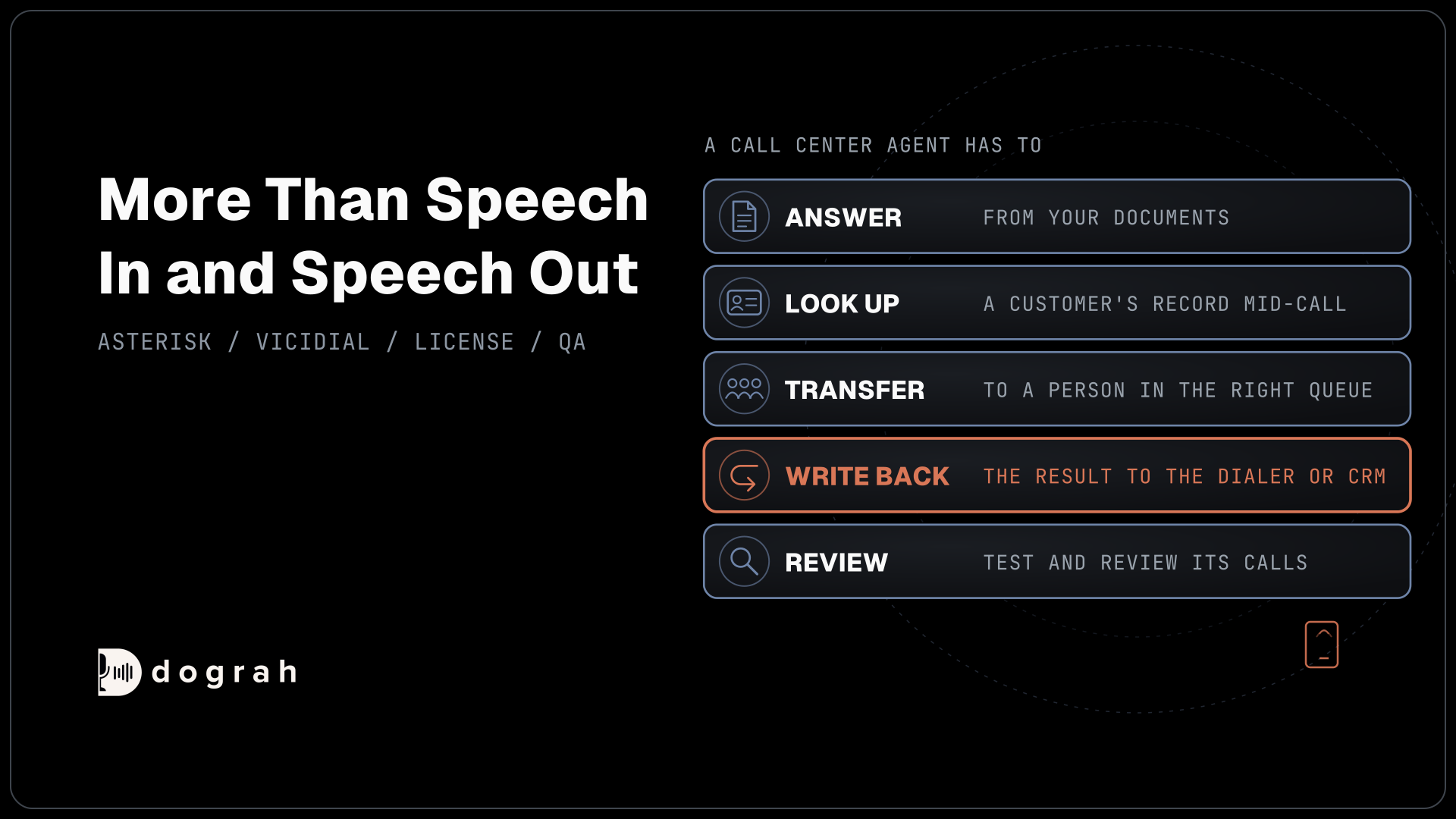
A call center agent also needs more than speech in and speech out. It has to answer from your documents, look up a customer's record mid-call, hand the caller to a person in the right queue, and write the result back to the dialer or CRM. Judge each project on those jobs, along with how you test and review its calls, since a bridge that only connects audio to a model leaves the rest for your developers to build.
Commercial contact center suites sit outside this stack and price per seat, with their own AI agents inside. Our list of the best AI call center software compares those suites with AI voice layers.
Checking calls with QA and traces
The last layer checks what the agent did on real calls. Langfuse is an open-source tracing tool with an MIT core that you can self-host for free, and it records each language model call with its inputs, outputs and timing.
For voice, you also want the call-level view. Dograh's QA step scores each step of a call separately, with its own tags, score, sentiment and summary, on test calls and on a sample rate of live calls you set. Each call's View Trace button opens its trace in Langfuse, so one self-hosted tracing setup covers both. In our experience, reviewing a random 5 to 10% of live calls catches problems a dashboard hides.
What the stack still costs
The software is free to license, and the running costs are not. As an example, take a 20-seat team adding an AI agent to Asterisk and VICIdial. Asterisk, FreePBX and VICIdial carry no license or per-seat fee, and self-hosted Dograh carries no per-minute platform fee.
What you still pay for is the infrastructure around them. That means servers for the phone system, the dialer and the agent, the SIP trunk and every minute your carrier bills, and either model keys for hosted speech and language models or GPUs for open models on your own hardware. Staff time for upgrades and on-call support is a real cost as well, since nobody else runs the stack for you. Budget the agent by minutes of talk rather than by seats, because its model and carrier bills follow call minutes.
Join the Dograh Community
Dograh is an OSS alternative to Vapi. Join our Slack community for queries, releases, best practices & community interactions.
Where Dograh fits
Dograh is the AI agent layer, built to sit beside the PBX and dialer you already run. It connects to an existing Asterisk or FreePBX through Asterisk ARI, and calls enter it through a Stasis application in your dialplan. Recent Asterisk releases with the chan_websocket module carry the audio.
On a VICIdial setup, the VICIdial integration lets the agent take answered calls as a remote agent. It can hang up, transfer an interested caller to a VICIdial in-group, and write lead fields and outcomes back so AI calls appear in the same reports. It is an advanced organization feature, switched on as External PBX integrations in Platform Settings.
Without a dialer, Campaigns dial the list themselves through your PBX. Automatic retries cover busy and unanswered calls, and contacts who reached voicemail can be tried again with Redial Campaign once the campaign completes. Calling hours run in one time zone per campaign, so split a national list by time zone.
When a caller needs a person, Transfer Call works on Asterisk ARI as well as Twilio, Telnyx, Plivo and Cloudonix. Dograh calls the destination first and connects the caller only once someone answers. A self-hosted install runs 10 calls at once by default, raised with one environment setting, and your servers and trunk set the real ceiling.
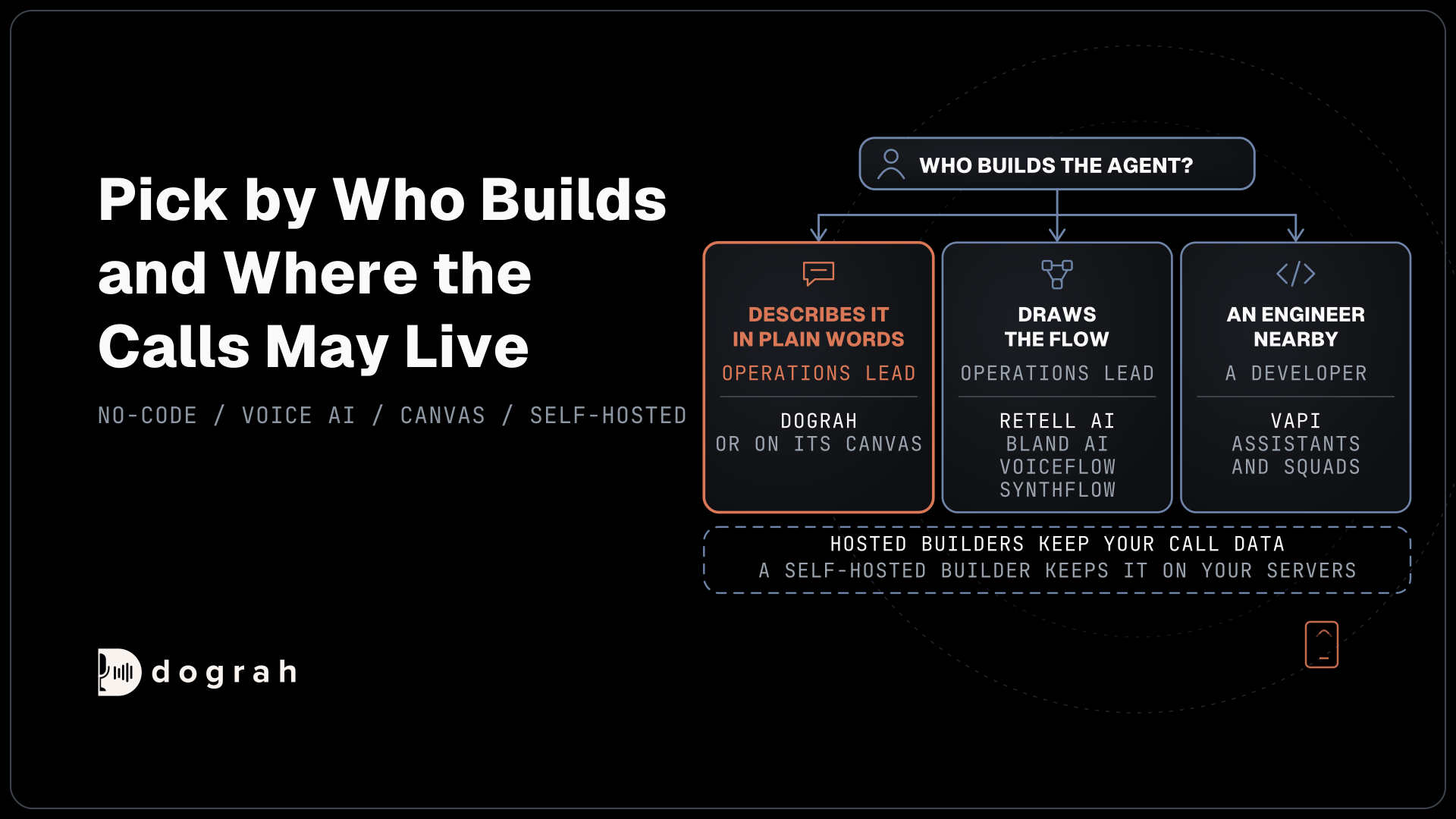
You build the agent itself in the Agent Builder by describing it and approving the requirements it shows, or on the canvas. A self-hosted install needs a Dograh Service Key to use the builder, and on Cloud its use is billed in Dograh credits.
On price, self-hosted Dograh has no per-minute platform fee, yet servers, model keys and phone minutes still cost money. Dograh Cloud, for teams that want it run for them, charges a 1¢-a-minute platform fee.
Self-hosting also makes the server, the database and every upgrade your team's work, the same as for Asterisk and VICIdial. Help on the open-source edition comes from the community in Dograh's Slack, and Enterprise adds a dedicated account manager, custom SLAs and on-prem or private-cloud deployment.
Glossary
- Asterisk REST Interface (ARI)
- Asterisk's interface that lets an outside application answer, control and bridge calls. An AI agent uses it to join an existing Asterisk or FreePBX without replacing the phone system.
- In-group
- A VICIdial queue that routes calls to a set of human agents. An AI agent can transfer an interested caller to an in-group so a person picks up from there.
- Nightly build
- A snapshot of a project's main branch published every day. VICIdial ships its ongoing work this way, while its last packaged download dates from January 2021.
- Remote agent
- A VICIdial agent seat that is not a person at a desk, such as an AI agent. The dialer hands it answered calls the same way it would hand them to a human.