
Free and open-source AI call bots include AVA, formerly Asterisk AI Voice Agent, under MIT for Asterisk and FreePBX, and sip-to-ai under Apache-2.0, which bridges SIP calls to realtime voice models. Dograh, the open-source AI voice agent platform we build, is the full-platform option, and you can self-host it or run it on Dograh Cloud.
Key Takeaways
- AVA and Asterisk AI Voice Agent are one MIT project under two names.
- Free code still leaves speech, language model, server and phone bills.
- Check the license and the last commit before trusting an open-source label.
Plenty of phone bots call themselves free and open source, and the labels do not always hold. We check each project's license and activity, describe what it connects to, price a month of calls on free code, and show the gap a framework leaves and how Dograh fills it.
Open-source AI call bots at a glance
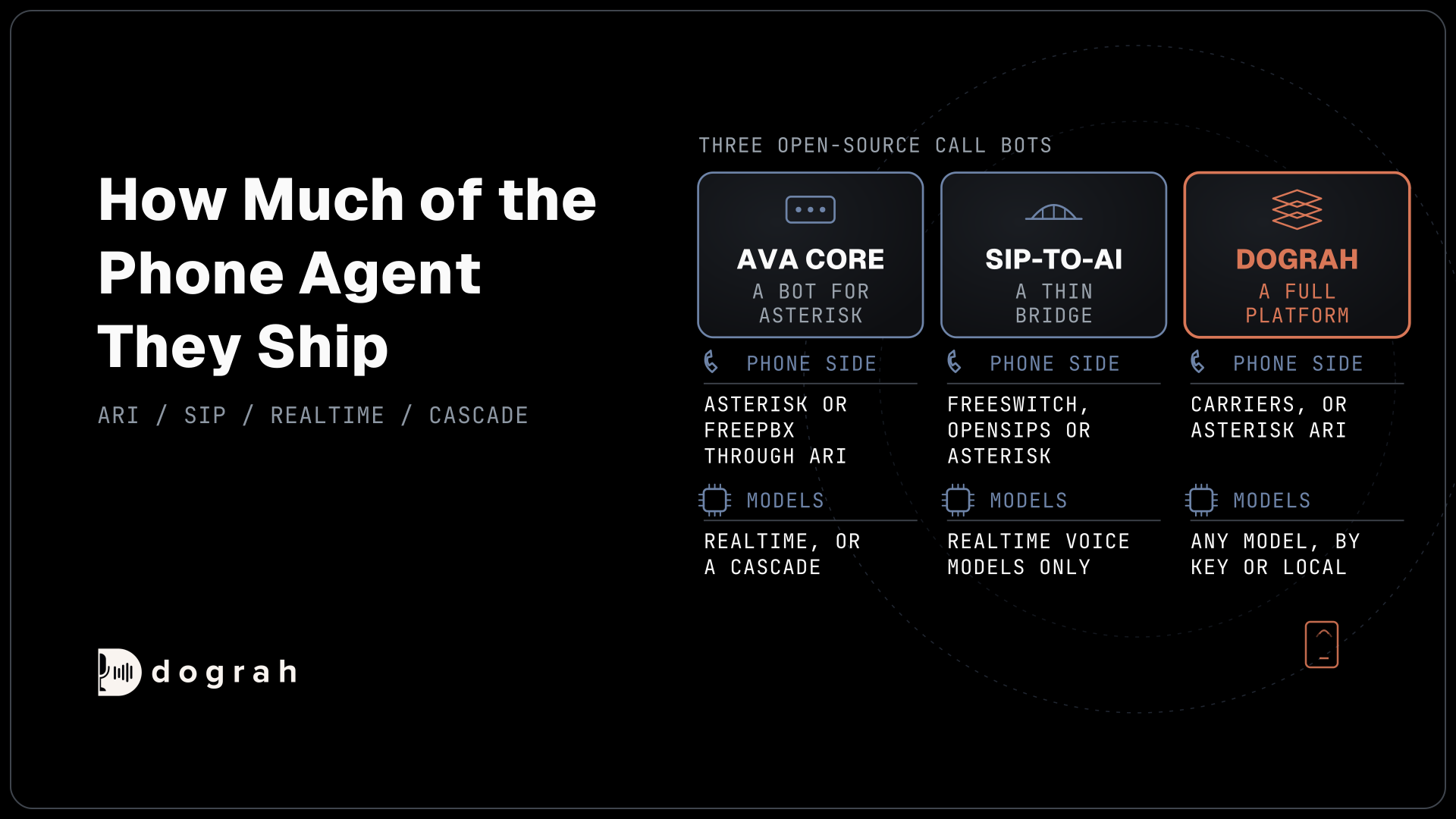
Each project below connects a phone call to AI models, and they differ in how much of the phone agent they ship. Two are maintained bots or bridges, one is an archived proof of concept, and one is a full platform.
| Project | License | Connects to | Models | Status |
|---|---|---|---|---|
| AVA Core, formerly Asterisk AI Voice Agent | MIT | Asterisk 18+ or FreePBX through ARI | Realtime providers, or separate speech-to-text, language model and voice, local or cloud | Maintained. Outbound and VICIdial support still alpha |
| sip-to-ai | Apache-2.0 | FreeSWITCH, OpenSIPS or Asterisk over SIP and RTP | Realtime voice models only, such as OpenAI Realtime, Deepgram Voice Agent and Gemini Live | Maintained |
| Microsoft call-center-ai | Apache-2.0 | Azure Communication Services | Azure OpenAI and Azure speech | Archived proof of concept |
| Dograh | BSD 2-Clause | Twilio, Vonage, Plivo, Telnyx, Exotel, Vobiz, Cloudonix, Asterisk ARI | Any speech and language model by key or local, or speech-to-speech | Maintained full platform |
Check the license before you trust the label
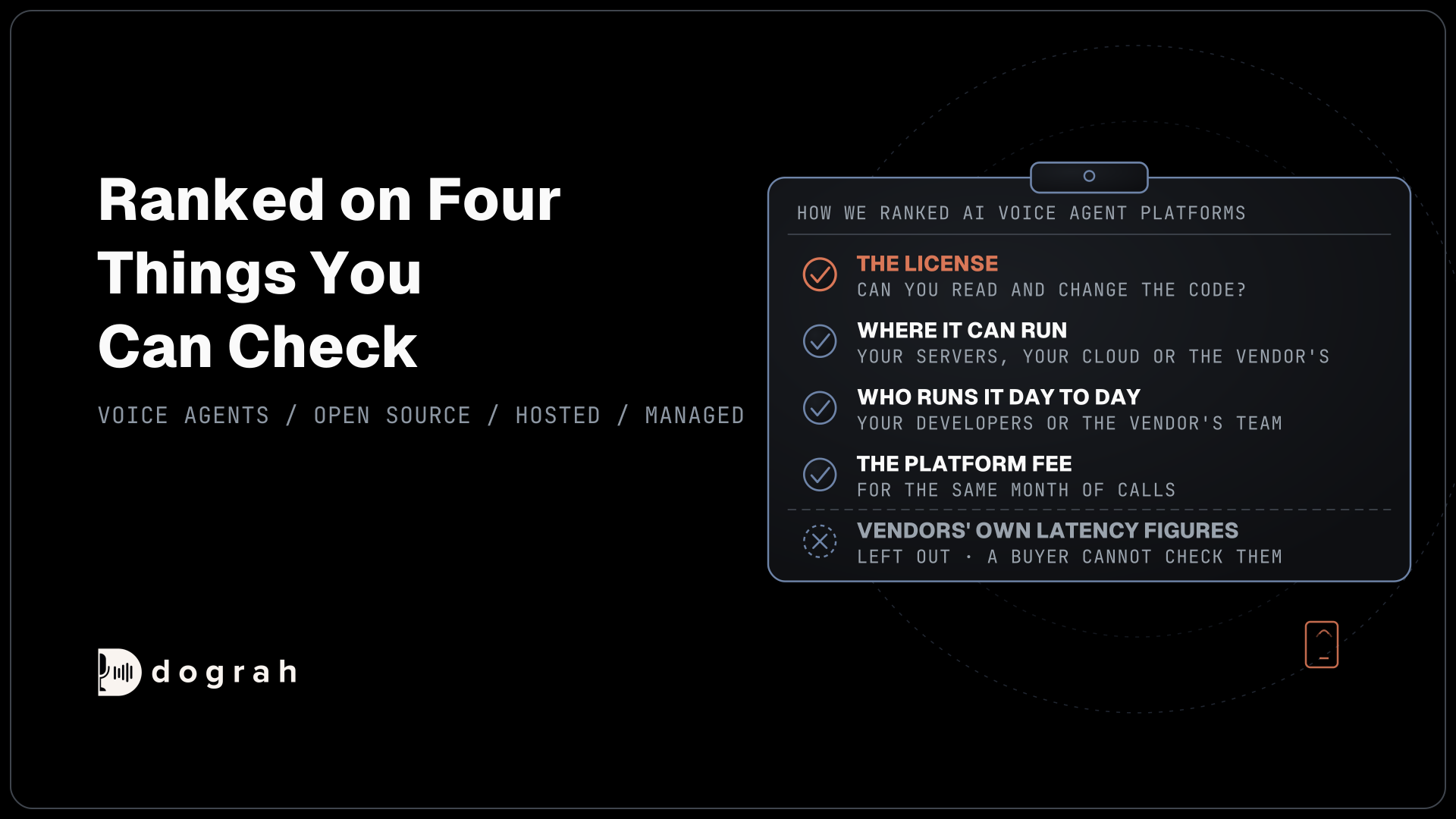
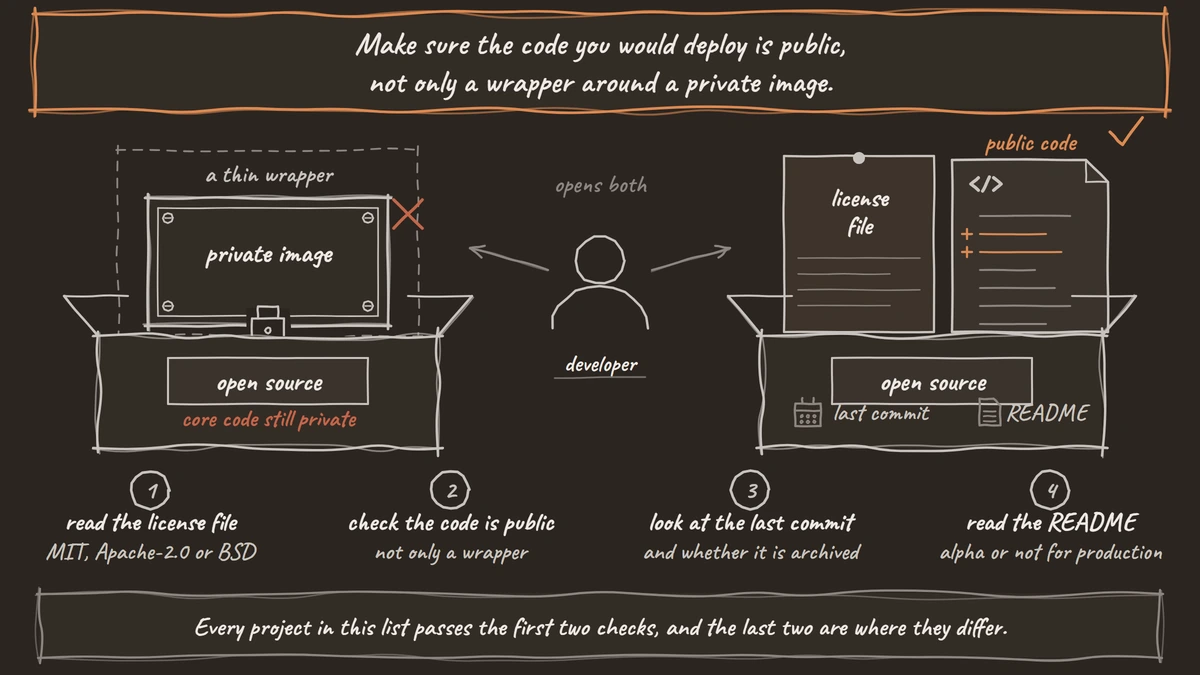
An "open-source" label is a claim, so read the license file in the repository before you plan around it. One project was launched on a forum as open source and free, and the maintainer later said the core code was still private for now.
Four checks settle most projects. Find the license file and read its name, since MIT, Apache-2.0 and BSD let you run the code commercially while others add limits. Make sure the code you would deploy is public, not only a wrapper around a private image. Look at the last commit and whether the repository is archived. Read the README for anything marked alpha, experimental or not for production. Every project in this list passes the first two checks, and the last two are where they differ.
AVA, formerly Asterisk AI Voice Agent
AVA Core is the most complete free bot for an existing Asterisk or FreePBX system. The repository was renamed from Asterisk AI Voice Agent, and the old address now redirects to the same project, so the two names describe one MIT-licensed codebase. AVA's README describes it as an open-source AI voice agent for Asterisk and FreePBX, managed through a self-hosted Admin UI.
It connects through ARI, so it needs Asterisk 18 or later, or FreePBX, plus Docker Compose v2 on a Linux x86_64 machine. Cloud configurations start at 2 CPU cores and 4 GB of memory, and running the models locally needs more. You choose a realtime provider such as Deepgram, OpenAI Realtime, Google Live, ElevenLabs or xAI Grok, or a cascade pipeline with separate speech-to-text, language model and voice.
The tool list covers transfers, voicemail, hang-up, calendar booking, email, HTTP summaries and MCP. Two limits are written into the README itself. Outbound campaigns and the VICIdial integration remain alpha, and FreeSWITCH setup is maintained by the community. A commercial AVA Operator layer exists alongside it, while AVA Core stays MIT and free. If you are wiring a FreePBX box for any AI agent, our FreePBX and AI voice agent setup covers trunks, routes and ARI.
sip-to-ai, a thin bridge to realtime models
sip-to-ai does one job, connecting a SIP call straight to a realtime voice model. The project is Apache-2.0 and written in pure Python, streaming RTP audio from FreeSWITCH, OpenSIPS or Asterisk to OpenAI Realtime, Deepgram Voice Agent, Gemini Live or xAI Grok Voice.
The audio leaves the phone side as G.711 μ-law at 8 kHz, the standard narrowband phone codec. The bridge does no voice activity detection or barge-in of its own, so the model decides when the caller has stopped talking and when to stop speaking. A cascade pipeline with separate speech-to-text, language model and voice needs a separate gateway project.
Test any bridge like this over a real phone line before you trust it. Most phone calls still arrive as 8 kHz audio, against 16 kHz in a browser test, and how much that hurts depends on the model and the phone path. A realtime model that sounds sharp in a web test can mishear names and numbers on a call.
That makes it a good fit for a developer who wants the shortest path from a SIP trunk to a speech-to-speech model and plans to build the rest, since transfers, data lookups, call records and reporting all sit outside the bridge.
Microsoft call-center-ai is archived
Microsoft's project is a reminder that an open license and a maintained project are different things. Microsoft's call-center-ai is Apache-2.0 and can place or take calls, gather claim details and transfer to a person. The repository is now archived and read-only, and its README calls it a proof of concept that is not intended for production. It also runs only on Azure services, from Communication Services to Azure OpenAI, so it cannot run on your own servers.

Open Source Alternative to Vapi / Retell
Self-hosted voice agent platform — no per-minute fees
dograh-hq/dograh
Star on GitHub
Free software is not free calls
The software line can be $0 and the month still costs money, because speech, the language model, the server and phone minutes all bill by use. As an example, take 1,000 calls of three minutes each, 3,000 minutes a month, through sip-to-ai and Deepgram's Voice Agent API, which bundles speech-to-text, the language model and the voice.
| Line | Rate | 3,000 minutes |
|---|---|---|
| sip-to-ai software | Apache-2.0 | $0 |
| Deepgram Voice Agent API, Standard | $0.075 a minute | $225 |
| Twilio inbound minutes | $0.0085 a minute | $25.50 |
| Server for the bridge and the PBX | Your choice | Yours to price |
That is $250.50 before the server, or about 25 cents for each three-minute call, and Deepgram's $200 of free credit for new accounts covers most of the first month, about 2,670 minutes, and nothing after it. A SIP trunk from another carrier bills at its own rate, and a larger language model in a cascade pipeline can change the total a lot. Our guide to free AI answering services prices the server and number side of a self-hosted setup.
Local models move the bill rather than remove it. Open speech and language models on your own hardware stop the per-minute model charges, and a GPU server takes their place. Size that server for your busiest hour of calls, since every call in progress needs its share of the GPU.
Join the Dograh Community
Dograh is an OSS alternative to Vapi. Join our Slack community for queries, releases, best practices & community interactions.
Frameworks leave the product to you
A framework sits one level below these bots and bridges. Pipecat (BSD-2-Clause) and LiveKit Agents (Apache-2.0) give developers the code to run a voice pipeline, and Vocode (MIT) is a library whose README asks for community maintainers. None of them is a phone agent you can switch on.
On a framework or a bridge, your developers still build the parts callers and staff notice. That list includes the place where prompts and flows are edited, the phone setup and transfers, calling lists and retries, data lookups during the call, and a record of every call to review. Our guide to the best open-source voice AI platforms lists that build work before the first real phone call.
Where Dograh fits
For open-source and on-prem buyers who want the whole phone agent, Dograh is the full-platform option. The code is BSD 2-Clause, and it runs on your own servers with Docker, with at least 8 GB of memory and 4 vCPUs, or on Dograh Cloud. Enterprise adds on-prem or private-cloud deployment with support.
On an existing PBX, it joins through Asterisk ARI, the same path AVA uses, and it also works with Twilio, Vonage, Plivo, Telnyx, Exotel, Vobiz and Cloudonix. Dograh is the orchestration layer, running the call flow, tools and telephony, while the speech and language models are a separate layer you choose. That can be a cascade with any providers on your own keys, a speech-to-speech model, or open models on your own hardware.
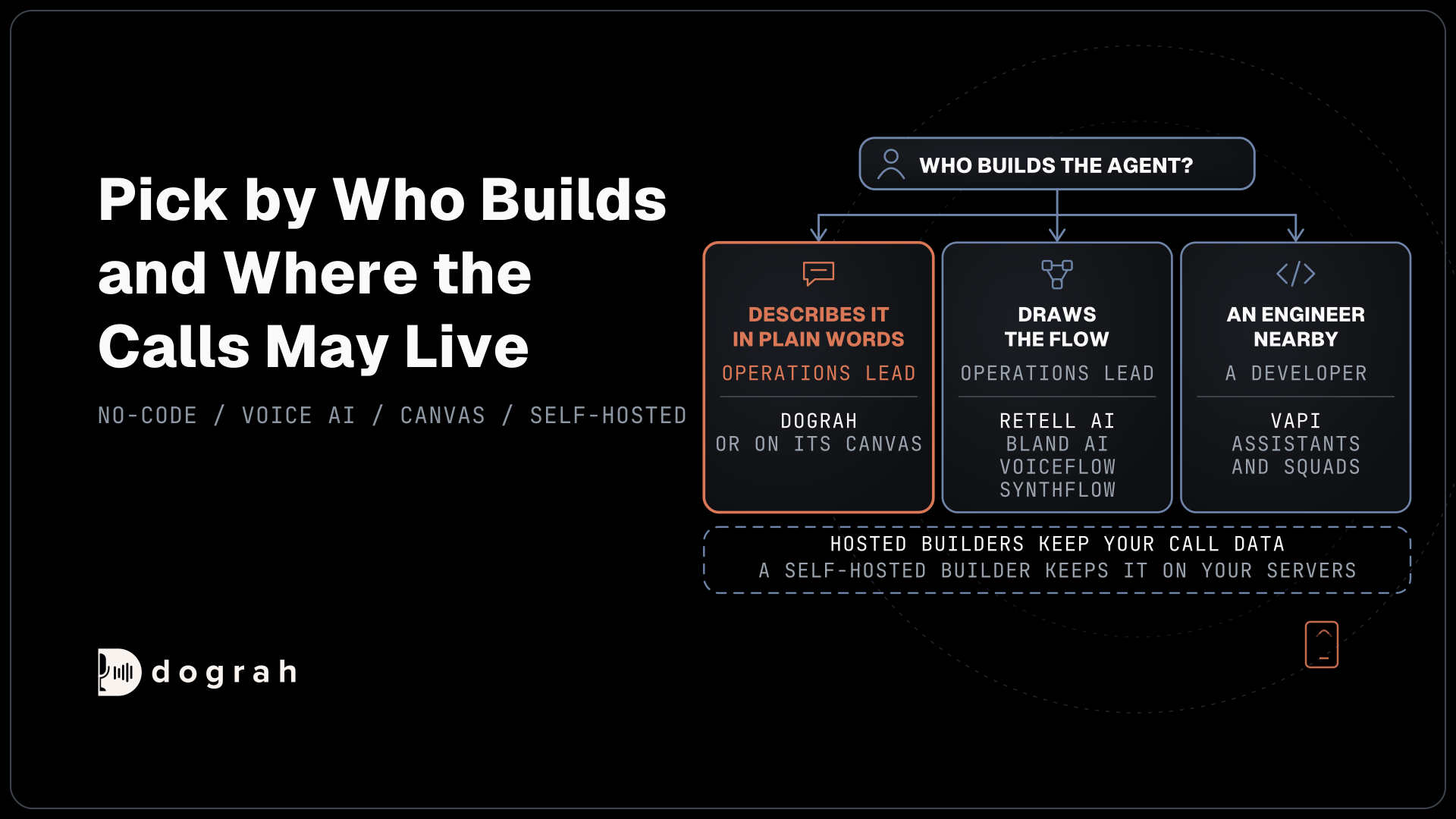
Around the call, it ships the parts a bridge leaves out. You build agents in the Agent Builder or on the visual canvas, look up records before the greeting with Pre-Call Data Fetch, act mid-call through HTTP API tools, dial lists with Campaigns, and review each call's transcript, trace and per-step QA score. Self-hosted, the Agent Builder needs a Dograh Service Key, and on Cloud it is billed in Dograh credits.
Transfer Call hands a caller to a person on Asterisk ARI, Twilio, Telnyx, Plivo and Cloudonix. Dograh rings the destination first and connects the caller only when someone answers. If nobody picks up, the caller stays with the agent and the call goes on.
Pre-recorded clips let the agent play its most common lines as real recordings, with text-to-speech covering the rest, which trims the voice bill. Like the bots above, self-hosted Dograh has no per-minute platform fee, and servers, model keys and phone minutes still cost money. Dograh Cloud carries a 1¢-a-minute platform fee for teams that would rather not run it.
Self-hosting means the server, the database and the upgrades are your team's to run. The open-source edition is supported by the community in Dograh's Slack, and Enterprise adds a dedicated account manager and custom SLAs. If you are assembling a whole call center from open parts, our post on open-source AI call center software maps the other layers.
Glossary
- Speech-to-speech model
- A single model that hears the caller and speaks the reply, such as OpenAI Realtime or Gemini Live, in place of separate speech-to-text, language model and voice steps. sip-to-ai connects only to models of this kind.
- G.711 μ-law
- The standard phone codec in North America and Japan, carrying narrowband audio at 8 kHz. sip-to-ai sends calls to the model in this format.
- Barge-in
- The caller talking over the agent and the agent stopping to listen. sip-to-ai leaves this to the realtime model, while a platform handles it in its own turn-taking.
- Cascade pipeline
- A voice agent built from separate speech-to-text, language model and text-to-speech steps. It allows any mix of providers, and AVA and Dograh both support it.