
The best on-prem voice AI platforms fall into open-source platforms you run, closed vendors with an on-prem contract, and speech engines. Dograh, the open-source AI voice agent platform, ranks first because the platform and its models can run on your servers, and it also runs on Dograh Cloud. Bland AI and Retell AI sell closed on-prem deals.
Key Takeaways
- Judge on-prem by four tests. Platform location, model location, license and support.
- Bland and Retell sell closed on-prem through sales. Vapi's own FAQ says it offers none.
- A platform on your servers with hosted models still sends every call's audio out.
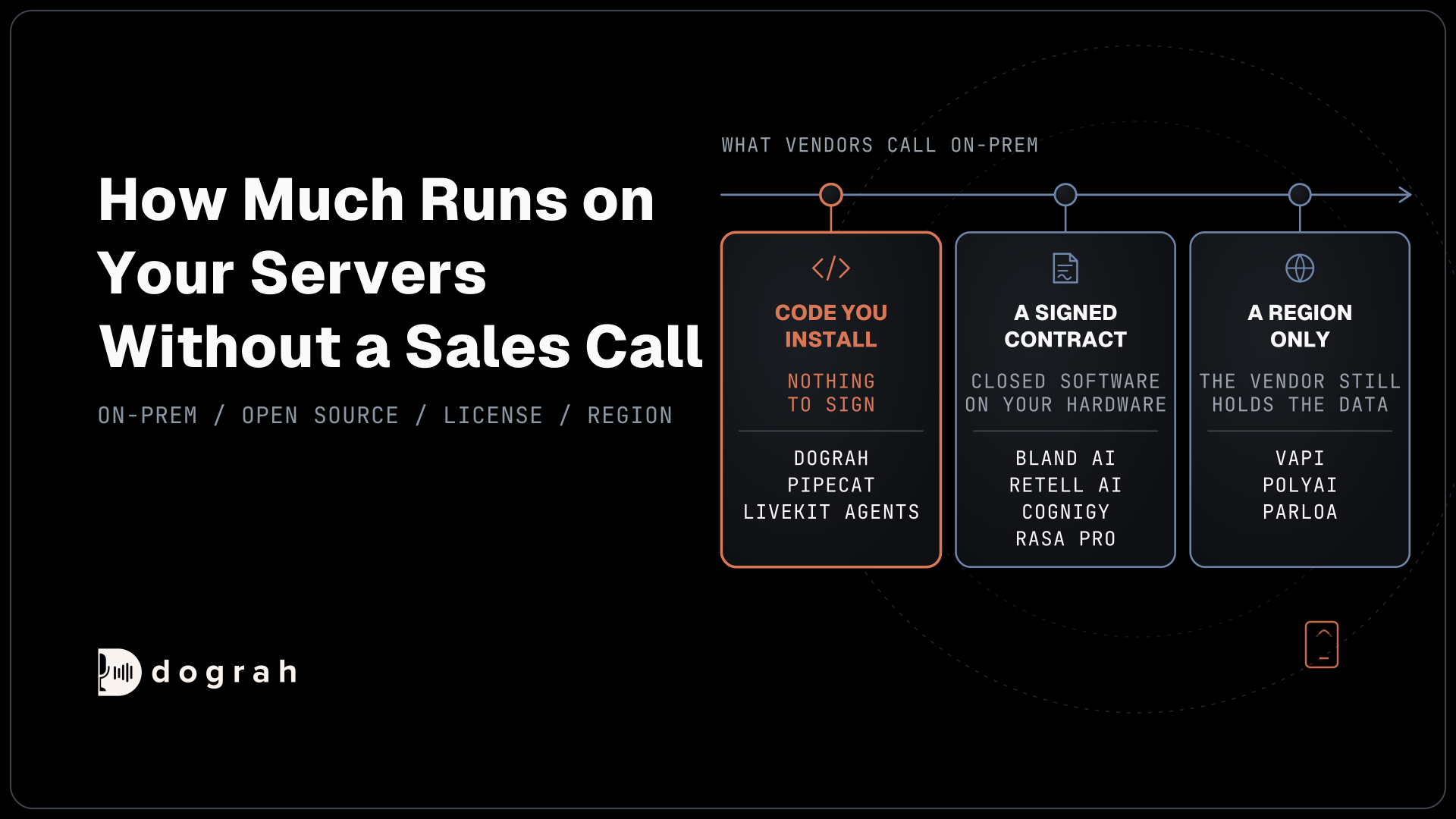
On-prem is a word vendors use for different deals, from a contract clause to code you install. We set four tests first, rank the platforms that pass them, led by open-source Dograh, then cover speech engines you can run in-house and vendors that only sell a region.
Four tests for an on-prem voice AI platform
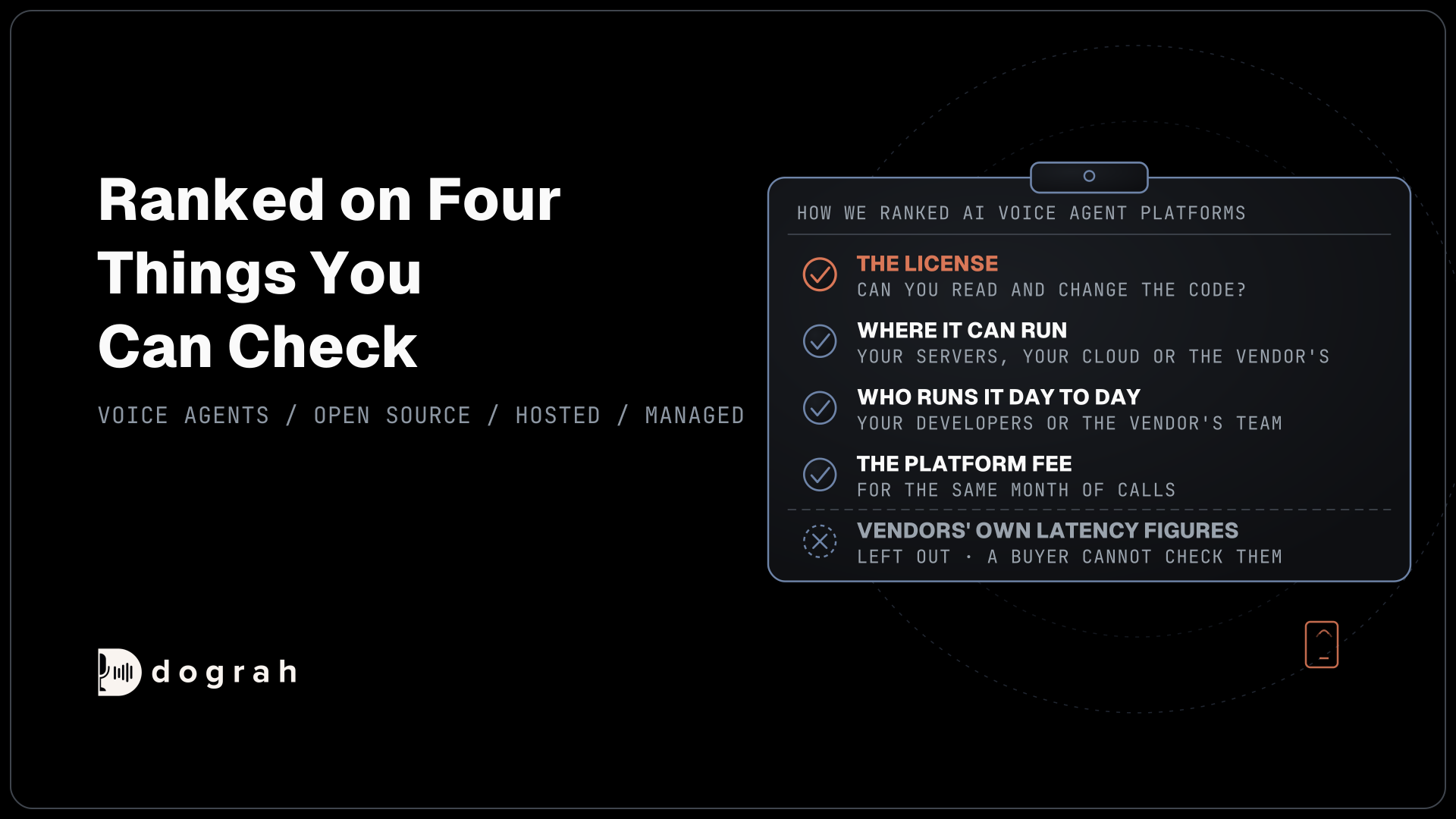
On-prem only means something once you know which part of the call runs where, so we score every option on four tests. The first is where the platform runs. That is the software that holds the conversation, calls your tools and talks to the phone line. A vendor can install it in your data center or your own cloud account, or keep it on its own cloud and promise only a region.
The second test is where the models run. Speech-to-text, the language model and the voice can each sit on your hardware or at a provider. If any one of them is hosted, the audio or the text of every call goes to that provider, so a platform on your servers with hosted models is only half on-prem.
The third test is the license. Open code under BSD 2-Clause or Apache-2.0 lets you install and read the software without signing anything. A closed product on your hardware still runs on the vendor's terms, and some installs must keep calling the vendor's servers to stay licensed.
The fourth test is support. Someone has to patch the servers, upgrade the platform and answer the alert at 2 a.m. With a contract the vendor shares that work. With open source your team owns it, with community help unless you buy more.
The ranking rewards how much runs on your servers without a sales call. In our experience, banks and health systems treat on-prem as a compliance requirement rather than a preference, because their call data cannot go to a third-party SaaS product.
On-prem voice AI platforms compared
The table scores each option on the four tests, with open code first and the closed vendors after it. Speech engines are not agent platforms, so they get their own section further down.
| Platform | Kind | Where the platform runs | Where the models run | License | How you get on-prem |
|---|---|---|---|---|---|
| Dograh | Full agent platform | Your servers or Dograh Cloud | Your pick, local open-weight models included | BSD 2-Clause | Install it yourself, or the Enterprise plan |
| Pipecat | Framework | Your servers | Your pick | BSD 2-Clause | Install it, then build the platform parts |
| LiveKit Agents | Framework | Your servers | Your pick | Apache-2.0, turn detector under the LiveKit Model License | Install it, then build the platform parts |
| Bolna | Agent platform | Your cloud or data center | Inside your environment | MIT core, hosted APIs closed | Enterprise contact |
| Rasa Pro | Conversational AI platform | Your Kubernetes, on-prem or private cloud | Connected by you | Proprietary | Paid license, voice connector bought separately |
| Cognigy (NiCE) | Agent platform | Your Kubernetes, linked to Cognigy's billing | Set in your contract | Proprietary, license key | Signed license agreement |
| Bland AI | Hosted agent platform | Bland's cloud, on-prem or VPC on Enterprise | Bland's own models | Closed | Enterprise contract |
| Retell AI | Hosted agent platform | Retell's cloud, VPC or on-prem through sales | Models from Retell's list | Closed | Sales conversation |
| Vapi | Hosted agent platform | Vapi's cloud, with an EU region | Your pick by key | Closed | Not offered |
Dograh, the open platform you run anywhere
Dograh takes first place because every part of the call can run on hardware you control, and nothing needs a contract to install. The whole platform is open code under BSD 2-Clause, from telephony and campaigns to the visual workflow builder, call traces and QA. You install it with Docker Compose on one server, or with Helm, as our guide to deploying a voice agent on Kubernetes with Helm shows.
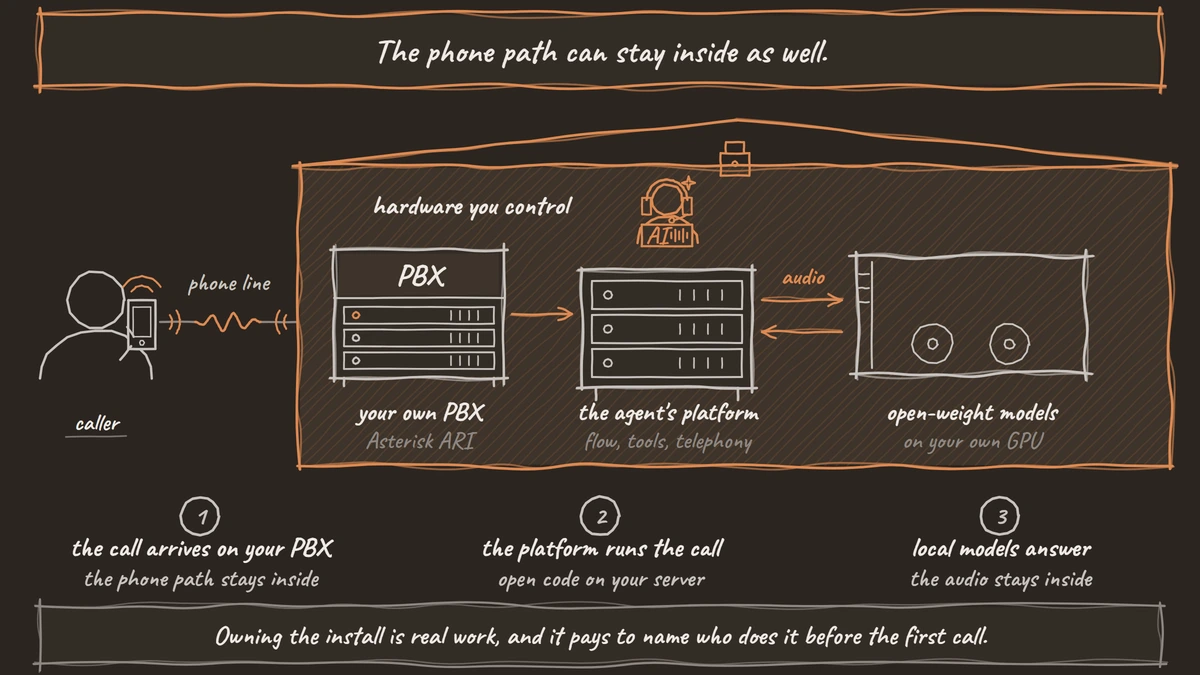
The platform is the orchestration layer that runs the call flow, tools and telephony, and the speech and language models are a separate layer you choose. Each model can be one of Dograh's managed models, a provider on your own key, or an open-weight model on your own GPU behind an OpenAI-compatible server such as Speaches, set up under Providers and Models. Your own key changes who you sign with, and the audio still reaches that provider. Local models are what keep it inside.
The phone path can stay inside as well. Dograh connects to your own PBX through Asterisk ARI, and also to Twilio, Vonage, Plivo, Telnyx, Exotel, Vobiz and Cloudonix. Transfer Call hands a caller to a person on Twilio, Telnyx, Plivo, Cloudonix or Asterisk ARI lines. It rings the destination first and joins the caller only once someone picks up, and if nobody answers or the line is busy, the caller stays with the agent.
A self-hosted install runs 10 calls at once by default, and DEFAULT_ORG_CONCURRENCY_LIMIT raises it, so your servers and carrier set the real ceiling. Running it yourself carries no per-minute platform fee, though servers, model keys and phone minutes still cost money. On Dograh Cloud the platform fee is 1¢ per minute, and Pay as you go includes 10 calls at once, with more on request. The Enterprise plan adds on-prem deployment inside your own data perimeter for teams that want help with the install.
For an air-gapped install, two choices matter. Set ENABLE_TELEMETRY=false in the environment variables, since self-hosted installs send anonymous usage telemetry by default, and build agents on the canvas, because the Agent Builder needs a Dograh Service Key. Our post on air-gapped voice agents covers the rest of a zero-egress setup.
Owning the install is real work, and it pays to name who does it before the first call. The server, the database and every upgrade belong to your team. Open-source users get help from other builders in the Dograh community Slack, and the Enterprise plan adds custom SLAs.

Open Source Alternative to Vapi / Retell
Self-hosted voice agent platform — no per-minute fees
dograh-hq/dograh
Star on GitHub
Other open-source options you run
Three more open options run entirely on your servers, but each leaves more for you to build or license. Pipecat, under BSD 2-Clause, and LiveKit Agents, under Apache-2.0, are frameworks. They give you the real-time voice pipeline in code, and your engineers write the phone handling, the agent editor, campaigns and call history. LiveKit's turn detection models sit under the separate LiveKit Model License, so read that one too before you ship.
Bolna's core is MIT, and its on-premise package runs as containers inside your cloud or data center, with audio, logs and transcripts kept in your environment. The package goes through Bolna's enterprise team, and its hosted APIs and playground stay closed.
Jambonz is a telephony layer for SIP trunks and call routing rather than an agent platform, and self-hosting it takes a paid per-session or per-cluster license. Our ranking of the best open-source voice AI platforms reads each of these licenses line by line and covers what you build on a framework before the first call.
Closed vendors that sign an on-prem contract
Four closed products can run inside your perimeter, and each gets there through a contract. You run their software without being able to read or change it.
Bland offers on-prem or VPC deployment on its Enterprise plan only, and the Start and Build plans leave it out. Bland's language model, voices and transcription are its own, so part of the contract is whether those models come inside your perimeter too. The self-serve plans are hosted, at $0.14 a minute on Start and $0.12 a minute plus $299 a month on Build.
Retell AI's enterprise security post says enterprises can choose cloud, VPC or on-prem deployment, with air-gapped operation, through its sales team. Hosted, Retell charges $0.055 a minute for voice infrastructure, with all-in rates from $0.07 to $0.31 a minute depending on the models.
Cognigy, now part of NiCE, installs on your Kubernetes clusters with a license key from a signed agreement. Its installation prerequisites require nodes to reach Cognigy's container registry and its billing endpoint, so it runs on your hardware while staying connected to the vendor. Our guide to NiCE CXone AI alternatives covers when that route suits a NiCE shop.
Rasa Pro is self-managed on-prem or in a private cloud on Kubernetes, under a proprietary license. Voice runs through an IVR connector to AudioCodes VoiceAI Connect, bought separately, and the free Developer license covers one bot with up to 1,000 external conversations a month. Rasa Open Source, the older project, is in maintenance mode.
Speech engines you can run on-prem
Speech engines are not agent platforms, but they close the model gap when your platform runs in-house. Pair one with a self-run platform and transcription or voice stays on your hardware.
Deepgram sells self-hosted containers for your VPC or on-prem hardware on Enterprise, and they need NVIDIA GPUs. Speechmatics lists on-prem containers, virtual appliances, hybrid deployments and on-device use on Enterprise. Cartesia says its models can run on-premise or in a VPC once you talk to its sales team.
Azure AI Speech containers are the strictest about the connection. Standard containers must stay connected to Azure for metering, and running them disconnected needs a request form and approval. Open-weight speech models are the route with no license server at all, though each model carries its own license to read.
Join the Dograh Community
Dograh is an OSS alternative to Vapi. Join our Slack community for queries, releases, best practices & community interactions.
Vendors that sell a region, not on-prem
Several well-known platforms come up in on-prem searches but sell data residency, which is a different promise. Vapi's FAQ answers the question directly, saying Vapi does not support on-premise deployments, and it offers an EU region instead. PolyAI lists data residency in the US, UK, EU and APAC and hosts on AWS. Parloa deploys through regional Zones, and ElevenLabs Agents runs on ElevenLabs' cloud. A region keeps data in a country, while the vendor still holds it.
Picking your on-prem voice AI platform
Start from the most sensitive data on the call and work outward. If no audio or transcript may leave your network, you need a platform and models that both run on your servers. That means Dograh with open-weight models, or a framework your engineers finish themselves.
If a signed contract is acceptable and you would rather not run the platform, Bland's Enterprise plan or Retell's sales-led option puts their closed software inside your perimeter. Ask in writing which models come with it and what the install reports back to the vendor.
If you already run NiCE and like Cognigy, its licensed install is the shortest step, as long as your network allows the connections to its registry and billing endpoint. If only transcription worries you, a Deepgram or Speechmatics container beside your current setup may be enough.
Whichever way you go, test on a real phone line before rollout. Most phone calls still reach the agent as 8 kHz audio, while a browser demo runs at 16 kHz, so a model that sounds right in the lab can mishear callers on the network. Our post on why on-prem will win enterprise voice AI makes the longer case for owning the stack.
Glossary
- Air-gapped install
- A deployment with no connection to outside networks at all. For a voice agent it means the platform, every model and the phone path run inside, and settings such as usage telemetry are switched off.
- Licensed install
- Closed software installed on your hardware that needs a signed license key to run. Some, such as Cognigy's Kubernetes install, also keep connecting to the vendor's registry and billing endpoint.
- Open-weight model
- A speech or language model whose weights you can download and run on your own GPU. Its license decides commercial use, and it is the only kind that keeps call audio off a provider's servers.
- Data residency
- A vendor's promise to store and process data in a named region such as the EU. The vendor still runs the software and holds the data, so residency is not on-prem.