
NiCE CXone AI alternatives are divided into a self-managed Cognigy install, on-prem suites, hosted on-prem contracts and open source. Dograh is the open-source platform that ships ready to use and runs on your servers. Avaya and Cisco sell the on-prem suites, and Bland and Retell AI offer on-prem contracts on Enterprise plans.
Key Takeaways
- NiCE already lets you choose the model. Hosting is the real question.
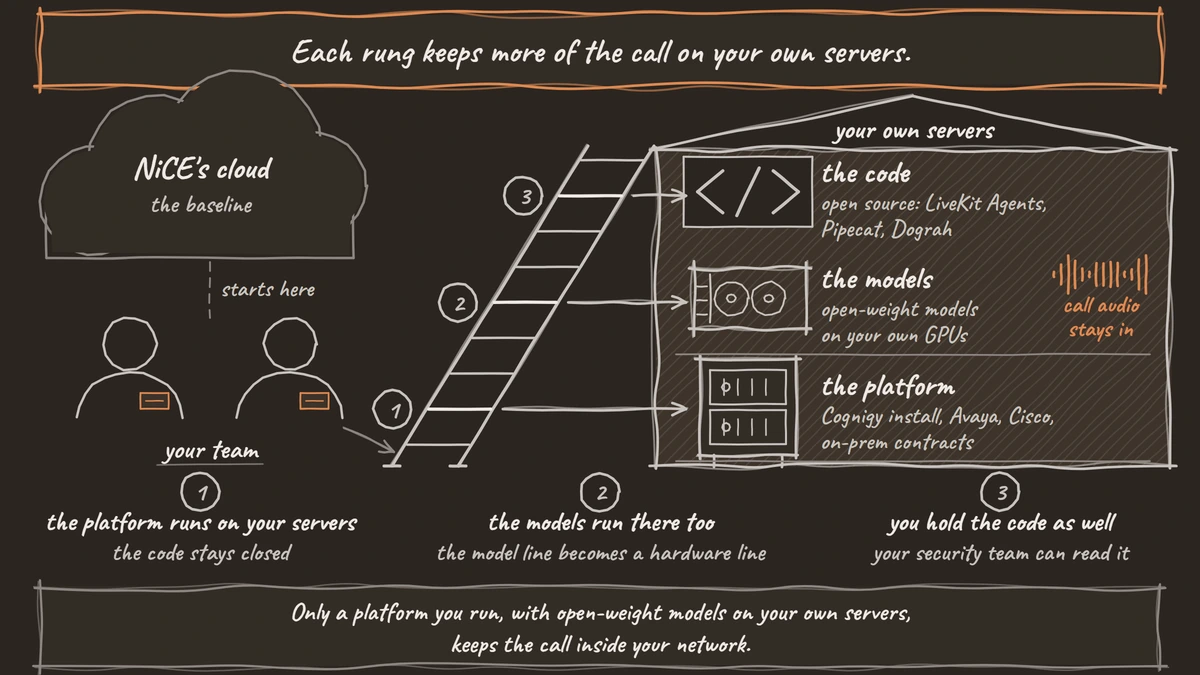
- Each option up the ladder keeps more of the call on your servers.
- Only a self-hosted platform with local models, such as Dograh, keeps call audio in-house.
NiCE's AI agents are strong in the cloud, but some teams need the AI layer under their own control. We cover why teams leave and compare every option in one table, then turn to Dograh before the other self-hosting routes, from Cognigy installs to open-source frameworks, and a priced month.
Why teams look for a NiCE CXone alternative
NiCE's AI agents are capable, so the reason teams look elsewhere is rarely the AI itself. It is the bill, and above all where the platform runs.
NiCE sells its AI agents on top of seat-based suites. Seat prices start at $110 per agent a month for the Omnichannel Suite, then $135 for Essential, $169 for Core and $209 for Complete, billed monthly in arrears. The Ultimate Suite costs $249 per agent a month plus $0.25 per session, and it includes AI Agents for Self-Service, which are priced on request as an add-on below it.
The AI itself is flexible on models. The agents are powered by NiCE Cognigy, and NiCE calls its approach LLM-agnostic, naming OpenAI, Azure OpenAI, Anthropic, Google Gemini, Mistral and Amazon Bedrock, plus custom and fine-tuned models. NiCE also says the agents can handle up to 25,000 concurrent conversations on chat or voice. Model choice and scale are covered.
Where the platform runs is the open question. CXone runs in NiCE's cloud, and every model it calls runs in that model vendor's cloud. With bring your own key (BYOK), the contract moves to you, while the caller's audio and transcript still travel to that provider. Only a platform you run, with open-weight models on your own servers, keeps the call inside your network. Our post on on-prem voice AI for BPOs traces every place a call goes in each setup.
NiCE CXone alternatives in one table
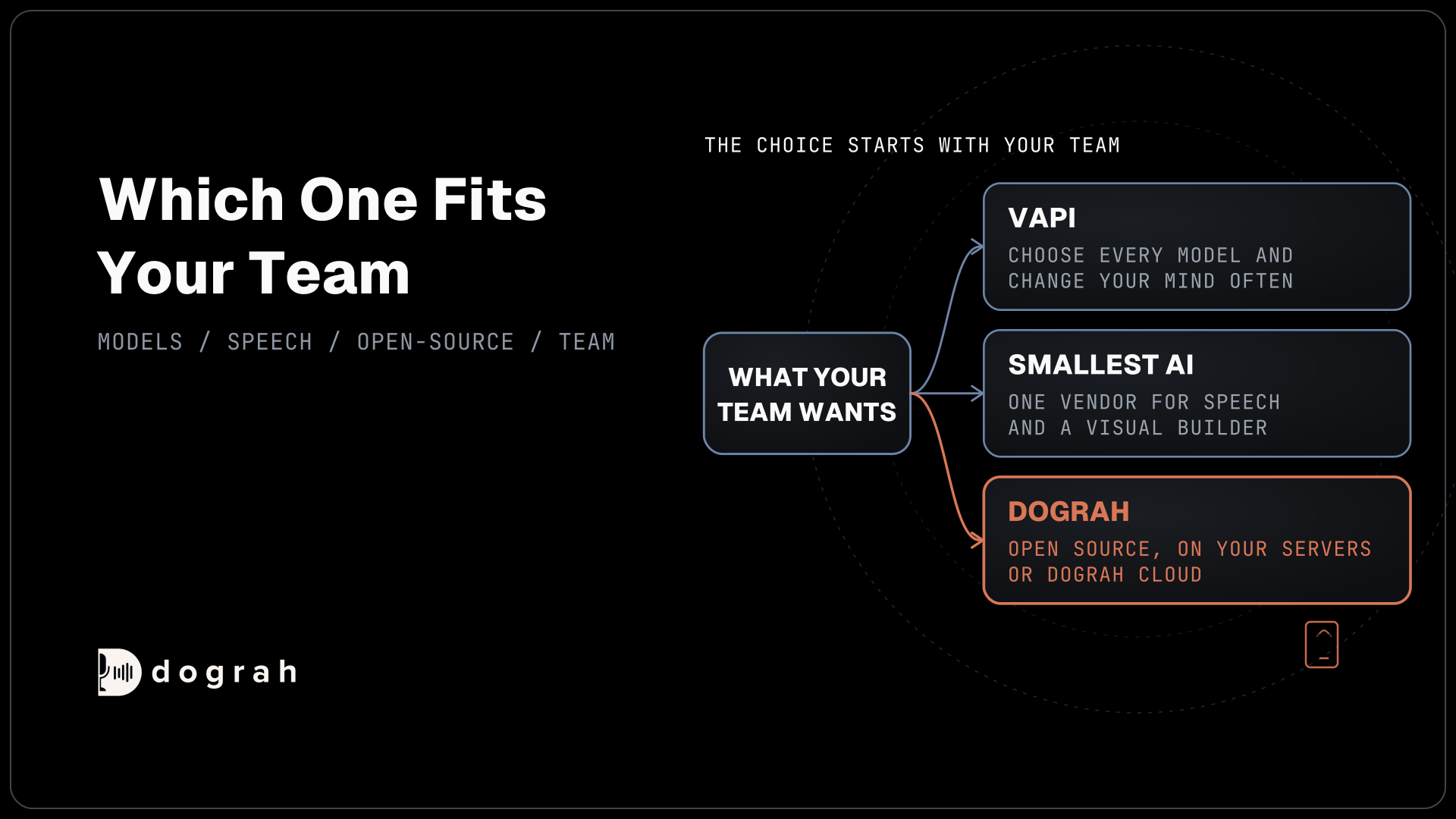
Each option keeps a different share of the call on your own servers. The table shows what runs where on each option, with NiCE in the cloud as the baseline and Dograh, the platform we build, next. The sections after it take the options in the same order.
| Option | Open source | Where the platform runs | Where the models run | List price | What you get, and what's missing |
|---|---|---|---|---|---|
| NiCE CXone AI agents (baseline) | Closed | NiCE's cloud | Your pick of hosted LLM vendors | $110 to $249 per agent, AI add-on or Ultimate sessions | Capable hosted agents with a choice of model vendors. The platform and the models run in vendor clouds. |
| Dograh | Open source, BSD 2-Clause | Your servers | Any model by key, or open-weight models on your servers | No platform fee self-hosted, plus servers, keys and phone | A full platform you can read and run. Your team handles the servers and upgrades. |
| Self-managed Cognigy | Closed | Your Kubernetes clusters | Ask NiCE | License, per your contract | NiCE's agent tooling on your own clusters. Closed code, and the terms depend on your contract. |
| Avaya Aura, Cisco UCCE | Closed | Your hardware or a dedicated private cloud | The suite's own self-service | Quote | A contact center on your hardware. Self-service is closer to a smart IVR, and the move is a full suite migration. |
| Bland or Retell AI on-prem | Closed | Your environment, on Enterprise | The vendor's stack | Enterprise contract | The vendor's software in your environment. Closed code, and some models may still call out. |
| Deepgram or Speechmatics self-hosted | Closed | Transcription only, on your hardware | Speech-to-text on your GPUs | Enterprise contract | Transcription stays local. The platform and the language model can still run elsewhere. |
| LiveKit Agents, Pipecat | Open source | Your servers, once you build the platform | Any model you wire in | Free code, plus your build | Open code to build on. The phone wiring, builder and QA are yours to build. |
Dograh: the open-source NiCE CXone alternative you run
Dograh is an open-source AI voice agent platform under the BSD 2-Clause license, and every part of it can run on your own servers. Unlike a framework, it ships the finished product: a visual flow builder, telephony, call transfer, call history, and QA that scores each step of each call, on test calls and live ones. For a NiCE team, the platform and the models can both sit inside your network, with code your security team can read line by line.
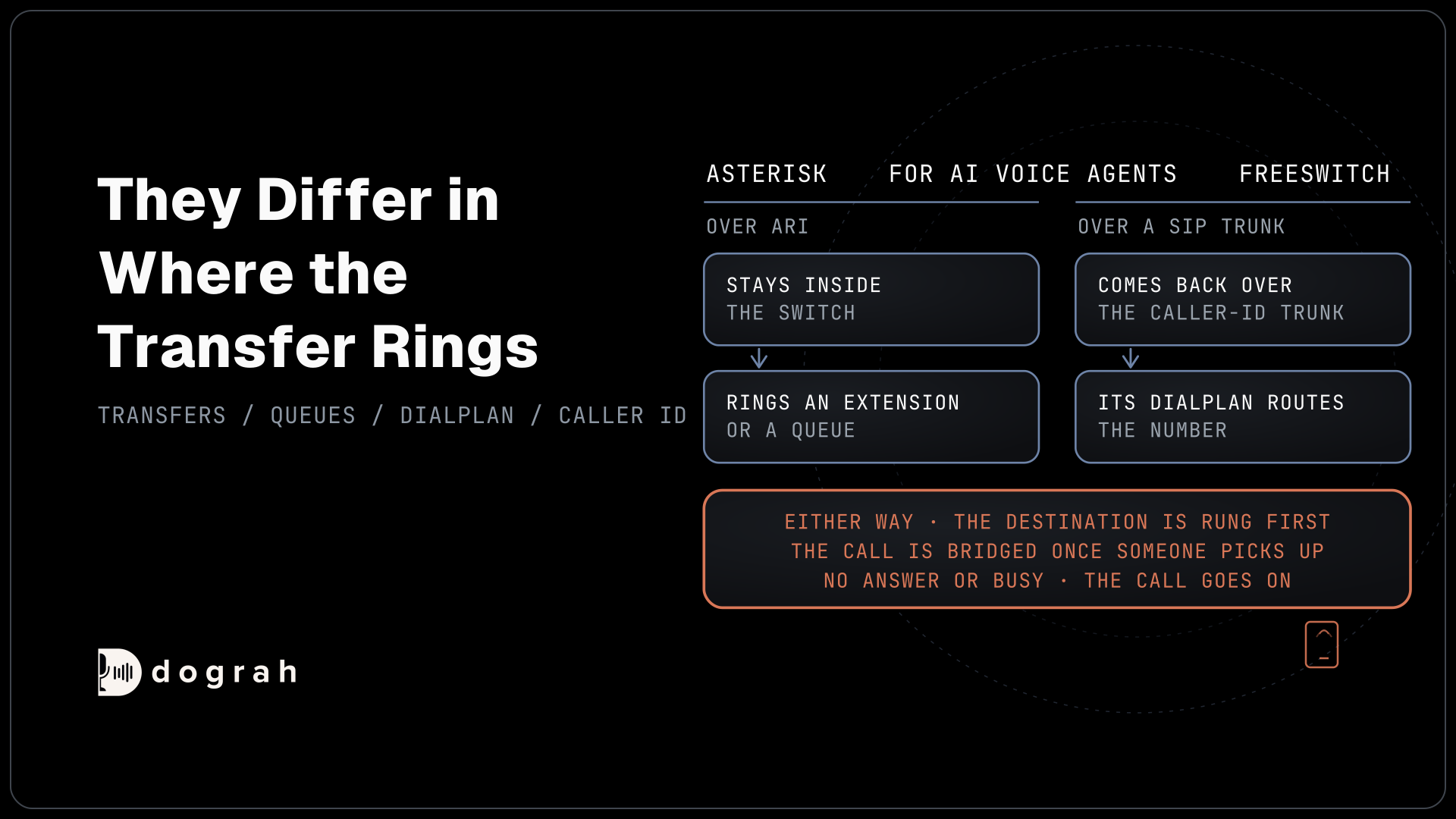
Your existing phone system can stay. A self-hosted install connects to your own Asterisk through Asterisk ARI, or to Twilio, Vonage, Plivo, Telnyx, Cloudonix or your own SIP trunk, and your numbers stay in your own carrier account. Transfer Call works on Twilio, Telnyx, Plivo, Cloudonix and Asterisk ARI. The caller hears hold music while Dograh calls the destination, and when nobody picks up, transfer_failed comes back to the agent and the conversation carries on.
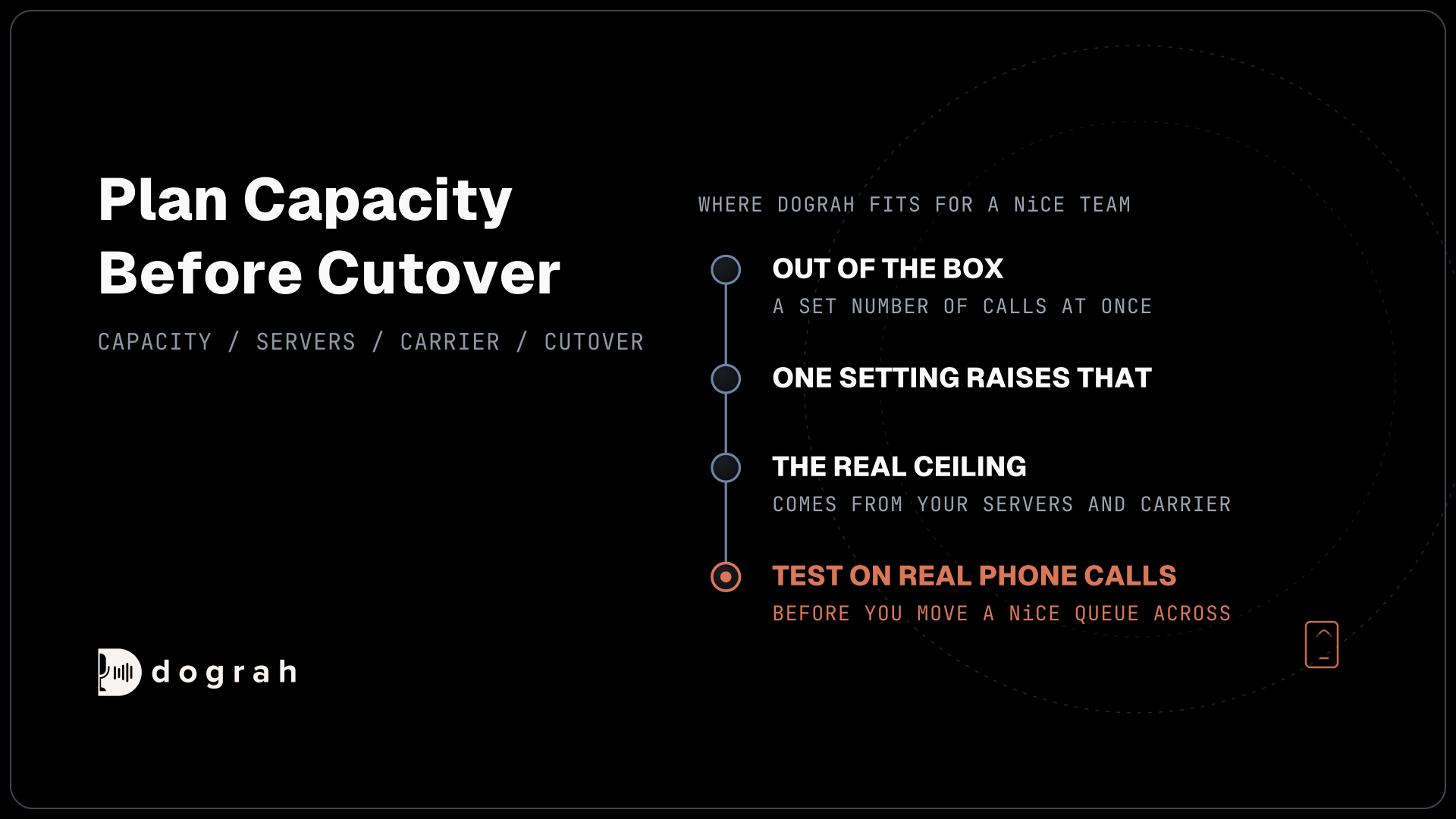
Most teams start with Docker Compose on a server with at least 8 GB of RAM and 4 vCPUs, with no GPU needed while your models come through API keys. Kubernetes teams can try the Helm chart, which is still in alpha, and Dograh Enterprise adds on-prem deployment inside your data perimeter. Self-hosted Dograh has no per-minute platform fee, but servers, model keys and phone minutes still cost money. Dograh Cloud charges a 1¢-a-minute platform fee. Self-hosted, it takes 10 calls at once and one setting raises that, while Cloud's pay as you go plan includes 10.
Dograh runs the call flow, tools and telephony, and it is not itself a model. You fill the model layer with Dograh's own models, any supported provider on your own API key, or open-weight models you host. Only that last option keeps call audio inside your network, because with your own key the audio still travels to that provider.
Each call keeps a turn-by-turn trace on your own servers, and QA scoring runs on the share of test and live calls you pick.
Self-hosting is real work. Your team runs the server and the database and applies each upgrade, with community support on the open-source version and custom SLAs on Enterprise. Moving from CXone touches only the AI layer, since human agents and digital channels stay in CXone and the voice agent hands calls to them by phone transfer. Our guide to Genesys Cloud AI alternatives sorts other suites by what you keep.
Other NiCE CXone alternatives
The remaining routes keep the code closed, and they differ in how much of the call they bring in-house. They run from a Cognigy install that keeps you with NiCE, through full on-prem suites, to hosted platforms that sign an on-prem contract.
Staying with NiCE: a self-managed Cognigy install
The smallest step keeps you inside NiCE's family. Cognigy documents a self-managed installation that runs on Kubernetes clusters and needs a Cognigy license to activate.
Who may buy that install, and at what price, is set in your contract. So ask NiCE directly whether your agreement allows a self-managed Cognigy deployment, which features come with it, and whether the speech and language models can run locally too. If the answer is yes, you keep NiCE's agent tooling and move the platform onto your own clusters. You still run a closed product, and your team takes on its upgrades.
This route suits a center that likes Cognigy and mainly needs the platform inside its own perimeter. It suits less well a team that wants to read the code or change how calls are handled.
On-prem suites: Avaya and Cisco
The classic on-prem answer is a different suite altogether. Avaya sells the Avaya Aura platform for on-premises use and Avaya Aura Private Cloud, which Avaya describes as entirely dedicated to your organization, with a path that combines on-premises and cloud.
Cisco sells Unified Contact Center Enterprise as on-premises software. Its self-service is conversational interactive voice response with natural language processing, so it is closer to a smarter IVR than to an AI agent platform.
Both keep the contact center on hardware you control, and both are closed source. A move from CXone to either one is a full suite migration, with routing, reporting and seats rebuilt. Check what the suite's own self-service can do before you assume it matches NiCE's agents. A natural-language IVR handles routing and simple requests well, while multi-step tasks such as rebooking or claims intake need an agent that calls your systems during the conversation.
Many teams that already run Avaya or Cisco keep them and add an AI agent beside them instead. Our post on connecting Cisco, Avaya or Teams Phone to an AI voice agent covers that wiring.
Hosted voice platforms with an on-prem contract
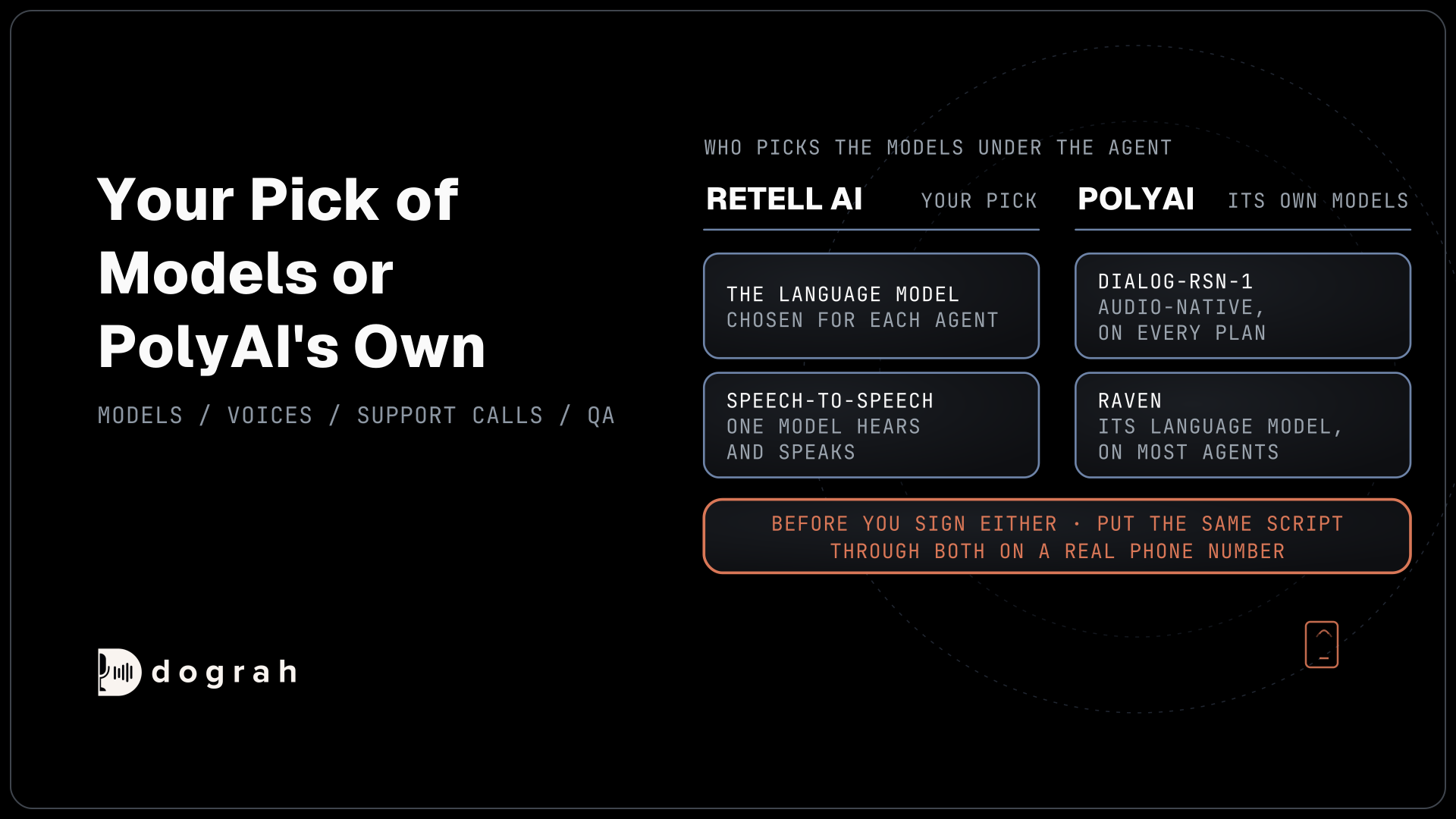
Some hosted voice agent platforms will install in your environment if you sign an enterprise deal. Bland lists on-prem or VPC deployment on its Enterprise plan, and Retell AI says enterprises can choose cloud, VPC or on-premises deployment, with air-gapped operation. Pricing for that option is a sales conversation.
These deals put the vendor's software on your hardware, but the code stays closed. You run what you cannot read or change, and upgrades arrive on the vendor's schedule. For a security team that needs to audit how calls are handled, that matters as much as where the servers sit. Before signing, ask which models run inside your environment and which still call out to the vendor's cloud, because an on-prem platform that sends audio to a hosted model has moved only half the call.
A narrower option covers one layer only. Deepgram offers self-hosted speech-to-text containers for your own VPC or on-prem hardware with NVIDIA GPUs, and Speechmatics lists on-prem containers and a virtual appliance on Enterprise. Those keep transcription local, while the platform and the language model can still run elsewhere.
Open-source frameworks: LiveKit Agents and Pipecat
Frameworks are the other open-source route, and like Dograh they leave you holding the code as well as the servers. LiveKit Agents and Pipecat are libraries for real-time voice: your engineers write the agent in code and also build the phone wiring, the editor and the call history around it. Our comparison of open-source voice AI frameworks covers each framework's license and scope. Dograh ships those parts ready, so the choice comes down to whether your team wants to build a product or run one.
What 200 agents cost, and what self-hosting changes
Here is a labeled example to show which lines move. A center has 200 agents and wants AI agents to handle 30,000 calls a month.
| Setup | Monthly line | How it is worked out |
|---|---|---|
| NiCE Complete | $41,800 | 200 x $209, before the AI agents add-on, which is priced on request |
| NiCE Ultimate, seats | $49,800 | 200 x $249, AI agents included |
| NiCE Ultimate, sessions | $7,500 | 30,000 x $0.25, if each conversation counts as one session |
| Self-hosted open-source platform | No platform line | Servers, model keys or your own GPUs, and phone minutes |
Ask NiCE how automated voice calls are counted as sessions before you budget the Ultimate line. The seat lines stay whichever AI you pick, because your people keep working in the suite.
On the self-hosted side the bill changes shape: the platform line drops out, and servers, model keys and phone minutes take its place, as the Dograh section explains. With open-weight models on your own GPUs, the model line becomes a hardware line, which you size from your busiest hour.
When staying on NiCE CXone makes sense
Staying put is the right call for some centers. If your contract and your auditors are comfortable with the AI layer running in NiCE's cloud, CXone already lets you choose among the major hosted model vendors, scales to large conversation volumes, and keeps the AI inside the suite your people use every day. A move only pays off when hosting, code access or the per-session bill is a real problem for you.
What moving off NiCE CXone takes
Plan the move in stages. Size capacity against your busiest hour, then move one queue or number at a time, with the CXone flow kept as the fallback. If the numbers sit in a Twilio account, saving an inbound workflow on a number switches it to Dograh at once, and removing it later leaves the number blank rather than switching it back, so copy each number's current settings first.
Test every transfer on a real phone call, because a browser test call cannot transfer, and listen to how the agent hears callers on the line itself, since phone audio is narrower than a browser demo. QA runs on those test calls too, so each step of the flow has its own score before a customer ever reaches it.
Join the Dograh Community
Dograh is an OSS alternative to Vapi. Join our Slack community for queries, releases, best practices & community interactions.
Picking your NiCE CXone alternative
If the platform, the models and the code all need to sit inside your network, start with Dograh: it fits a center that wants a finished voice agent platform it can run and read, with Enterprise on-prem when you need a contract behind it. If you like Cognigy and mainly need it inside your perimeter, ask NiCE about a self-managed install. If a full suite move is on the table anyway, price Avaya or Cisco. If you want a vendor to run its product on your hardware, compare the Bland and Retell AI on-prem contracts. Whichever way you lean, run one real call flow on your own servers before you move a queue.
Glossary
- Self-managed installation
- A vendor's platform installed and run by the customer on its own infrastructure under a license. Cognigy documents one on Kubernetes, with terms set in the customer's contract.
- Bring your own key (BYOK)
- Plugging your own model provider account and API key into a platform. The contract becomes yours, but the call audio still goes to that provider.
- Open-weight model
- A model whose weights can be downloaded and run on your own servers. Running speech and language models this way is what keeps call audio inside your network.
- Air-gapped operation
- Running a system with no connection to outside networks. Retell AI names it as part of its on-premises option.