
Genesys Cloud AI alternatives are divided into another suite, a voice agent beside Genesys and open source you run. Dograh is the open-source platform that ships ready to use and answers calls beside Genesys, while Vapi, Retell AI and Bland are hosted voice agents. NiCE CXone, Five9, Talkdesk and Amazon Connect are the other suites.
Key Takeaways
- Seat prices across the big suites are close. The AI meters differ more.
- A voice agent beside Genesys, like Dograh, keeps your routing, seats and reports.
- Only open source you run, with local models, keeps call audio in-house.
A large contact center rarely has to leave Genesys to change its AI. We cover why teams look past Genesys and compare every option in one table, then turn to Dograh before the other suites, the voice agents beside Genesys, the open-source frameworks and two priced examples.
Why teams look for a Genesys Cloud alternative
The search usually starts with the bill. Genesys charges $75 per user a month for CX 1, $115 for CX 2, $155 for CX 3 and $240 for CX 4, billed annually. Every plan includes virtual agents, and AI use is metered in Genesys Cloud Experience Units, with 250 named or 350 concurrent units per organization a month included. For phone lines you either use Genesys Cloud Voice or bring your own carrier.
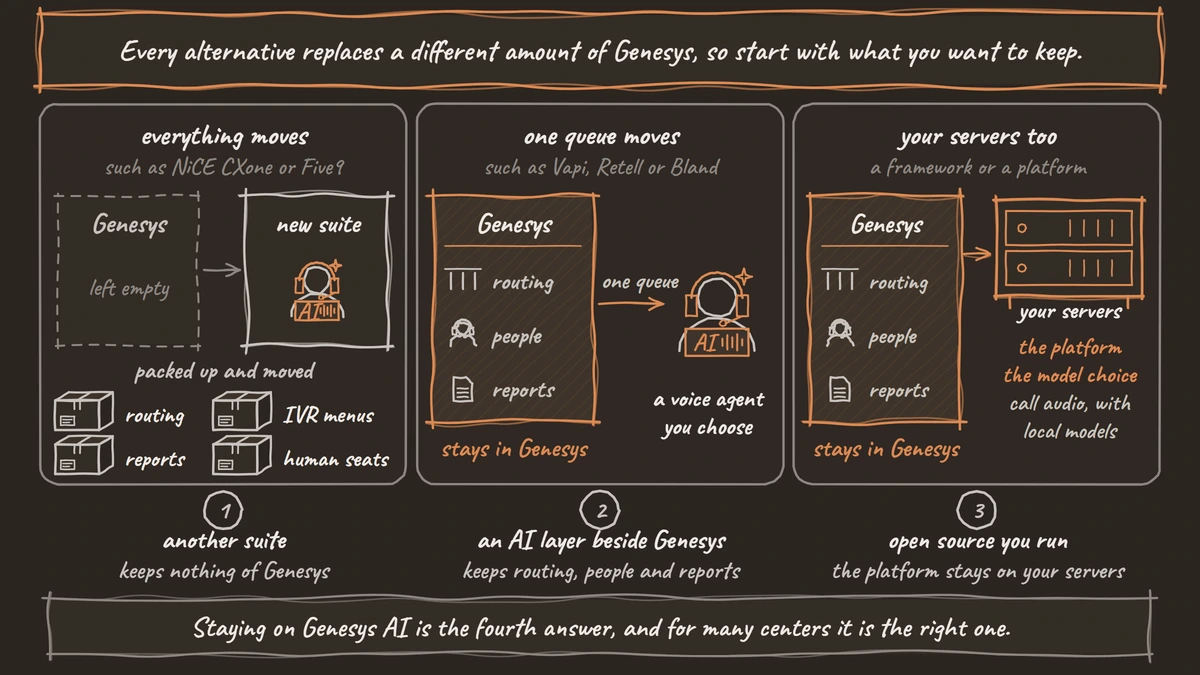
Every alternative replaces a different amount of Genesys, so start with what you want to keep. Moving to another suite means you keep nothing of Genesys. Routing, IVR menus, workforce tools, reports and human seats all move, and the AI comes with the new vendor. Adding a voice agent beside Genesys keeps all of that in place and sends one queue to the agent you choose. Running open source yourself goes one step further, because the platform, the model choice and, with local models, the call audio stay on your servers.
Staying on Genesys AI is the fourth answer, and for many centers it is the right one. Our post on Genesys Cloud AI vs open-source voice agents prices one month on Genesys' token meter and says who should stay.
Genesys Cloud AI alternatives compared
The table judges each option on what it lets you keep. Every figure is per month or per minute, as each vendor publishes it. Dograh, in the second row, comes next, followed by the suites, the voice agents beside Genesys and the frameworks.
| Option | Route | What stays in Genesys | List price | Where the AI runs |
|---|---|---|---|---|
| Genesys Cloud AI (baseline) | Suite | Everything, on Genesys | $75 to $240 per user, AI in Experience Units | Genesys' cloud, your carrier or Genesys Cloud Voice |
| Dograh | Open-source AI voice agent platform | Genesys, plus the platform and model choice | Self-hosted no platform fee. Cloud 1¢-a-minute platform fee. Models and phone on top | Your servers or Dograh Cloud |
| NiCE CXone | Suite | Nothing of Genesys | $110 to $209 per agent, Ultimate $249 plus $0.25 per session | NiCE's cloud |
| Five9 | Suite | Nothing of Genesys | Core $159 per seat, 50-seat minimum, AI add-on | Five9's cloud |
| Talkdesk | Suite | Nothing of Genesys | $85 to $225 per user, Autopilot in Talkdesk CXA | Talkdesk's cloud |
| Amazon Connect | Suite, pay per use | Nothing of Genesys | $0.038 per voice minute plus telephony | AWS |
| Vapi | Voice agent beside Genesys | Genesys routing, seats, reports | $0.05 a minute hosting, plus models and phone | Vapi's cloud |
| Retell AI | Voice agent beside Genesys | Genesys routing, seats, reports | $0.055 a minute voice infrastructure, plus model and phone | Retell's cloud |
| Bland | Voice agent beside Genesys | Genesys routing, seats, reports | $0.12 a minute plus $299 on Build, models included | Bland's cloud, on-prem on Enterprise |
| LiveKit Agents, Pipecat | Open-source framework | Genesys, plus your own code | Free code, plus your build and servers | Your servers |
Dograh: the open-source Genesys Cloud alternative
Dograh, the open-source AI voice agent platform we build, fits two of the three routes: a voice agent beside Genesys, or open source you run. It is BSD-2-Clause licensed with its code on GitHub, and it arrives complete: a visual flow builder, telephony, call transfer, call history, and QA that scores each step of each call on test calls and live traffic. Your people, workforce tools and digital channels stay in Genesys or whichever suite you choose, and Dograh answers the calls you route to it.
Getting calls in is a routing change on the Genesys side. On Dograh Cloud, Dograh Managed SIP gives your organization a SIP domain that a carrier or PBX connects to. Self-hosted, you connect your own Asterisk through Asterisk ARI, bring your own SIP trunk, or use a number on Twilio, Vonage, Plivo, Telnyx or Cloudonix.
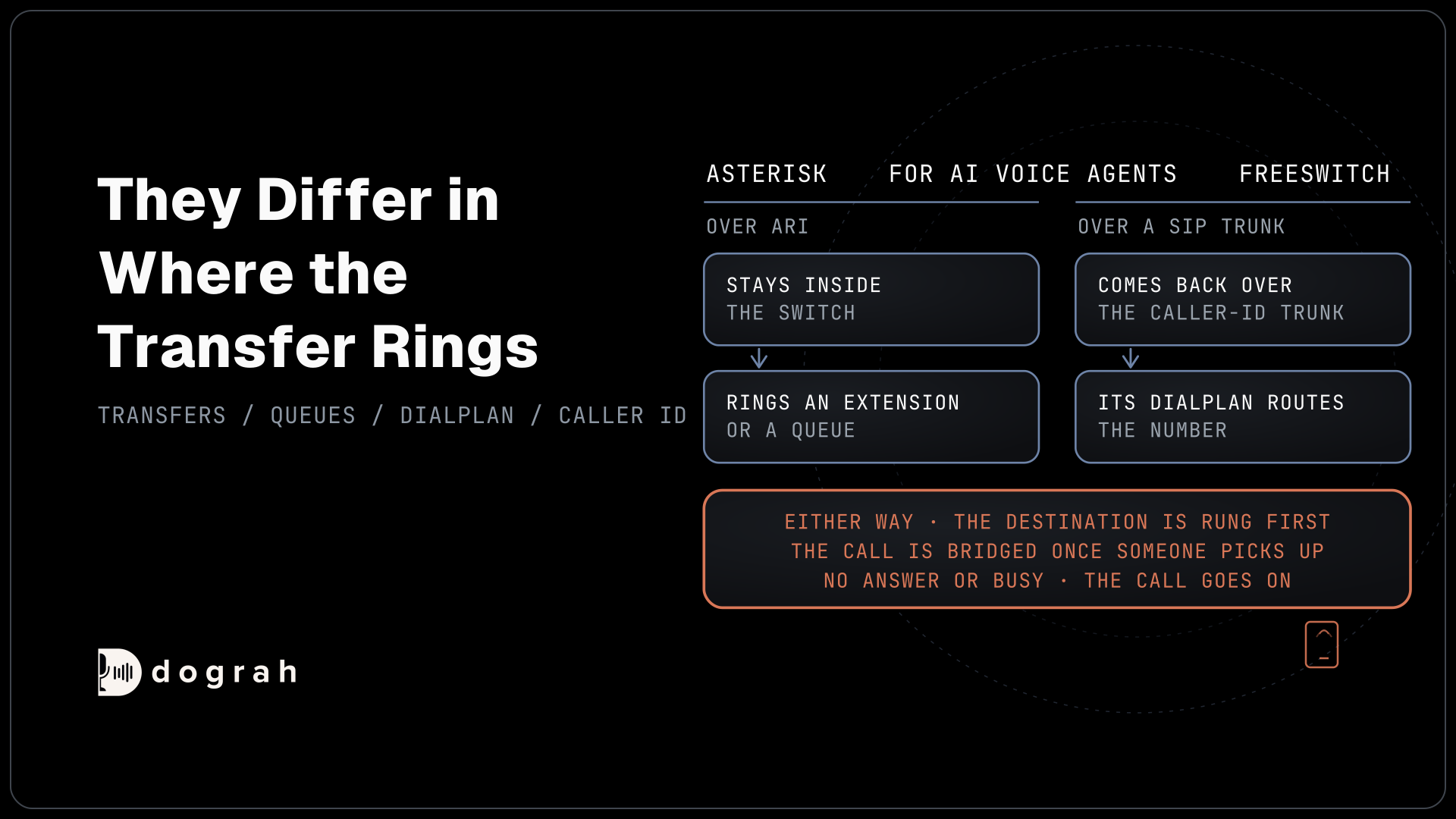
For a handoff to a person, Transfer Call dials the Genesys queue number first and connects the caller only when someone answers, with hold music meanwhile. If nobody picks up, the line is busy or the transfer fails, the agent gets transfer_failed back and the call continues. It works on Twilio, Telnyx, Plivo, Cloudonix and Asterisk ARI.
For a large center, deployment is the first decision. The self-hosted build runs on Docker Compose on a server with at least 8 GB of RAM and 4 vCPUs, and Dograh Enterprise runs on-prem inside your data perimeter for centers that cannot send call data out. Self-hosted Dograh has no per-minute platform fee, but servers, model keys and phone minutes still cost money. Dograh Cloud charges a 1¢-a-minute platform fee, which is $1,000 in the 100,000-minute example later on. You pick the models, from Dograh's own to any supported provider on your key or open-weight models you host, and only the open-weight route keeps call audio inside your network. Self-hosted, it handles 10 calls at once by default and one setting raises that, while pay as you go on Cloud includes 10.
A full trace records what the agent heard and said on every turn of every call, and built-in QA grades each step on a sample of calls you choose.
Running Dograh yourself means your team operates it. The server, the database and the upgrades are yours, the open-source edition is backed by community support, and custom SLAs come with Enterprise. For centers whose compliance rules keep call data in-house, that work is what buys the control.
Moving to another contact center suite
The other big suites sell the same shape as Genesys: human seats first, AI agents on top, all in the vendor's cloud. What changes is how the AI is metered and how much model choice you get.
NiCE CXone is the closest match in size. NiCE prices the Omnichannel Suite at $110, Essential at $135, Core at $169 and Complete at $209 per agent a month, and the Ultimate Suite at $249 plus $0.25 per session. Its AI Agents for Self-Service run on NiCE Cognigy, are included in Ultimate and are priced on request below it. NiCE calls its approach LLM-agnostic and names OpenAI, Anthropic, Google Gemini and Amazon Bedrock among the vendors it supports.
Five9 lists Digital at $119 and Core at $159 per seat a month, with a 50-seat minimum, and sells AI Agents as an add-on.
Talkdesk plans run from $85 to $225 per user a month, with its Autopilot virtual agent sold as part of Talkdesk CXA.
Amazon Connect breaks the seat pattern. Amazon Connect charges $0.038 per voice minute plus standard telephony, with no seat licenses and no upfront commitment, so the bill follows call minutes instead of headcount. Our comparison of Amazon Connect SIP trunk vs your own AI voice agent covers where an outside agent fits there.
Adding a voice agent beside Genesys
A voice agent beside Genesys replaces only the virtual agent. Genesys keeps routing, people and reports, and one queue or IVR branch sends calls to a phone number or SIP address that the voice agent answers. When a caller needs a person, the agent transfers the call back to a Genesys queue number. The live head-to-head linked above walks through the Genesys flow wiring, so we only compare the vendors here.
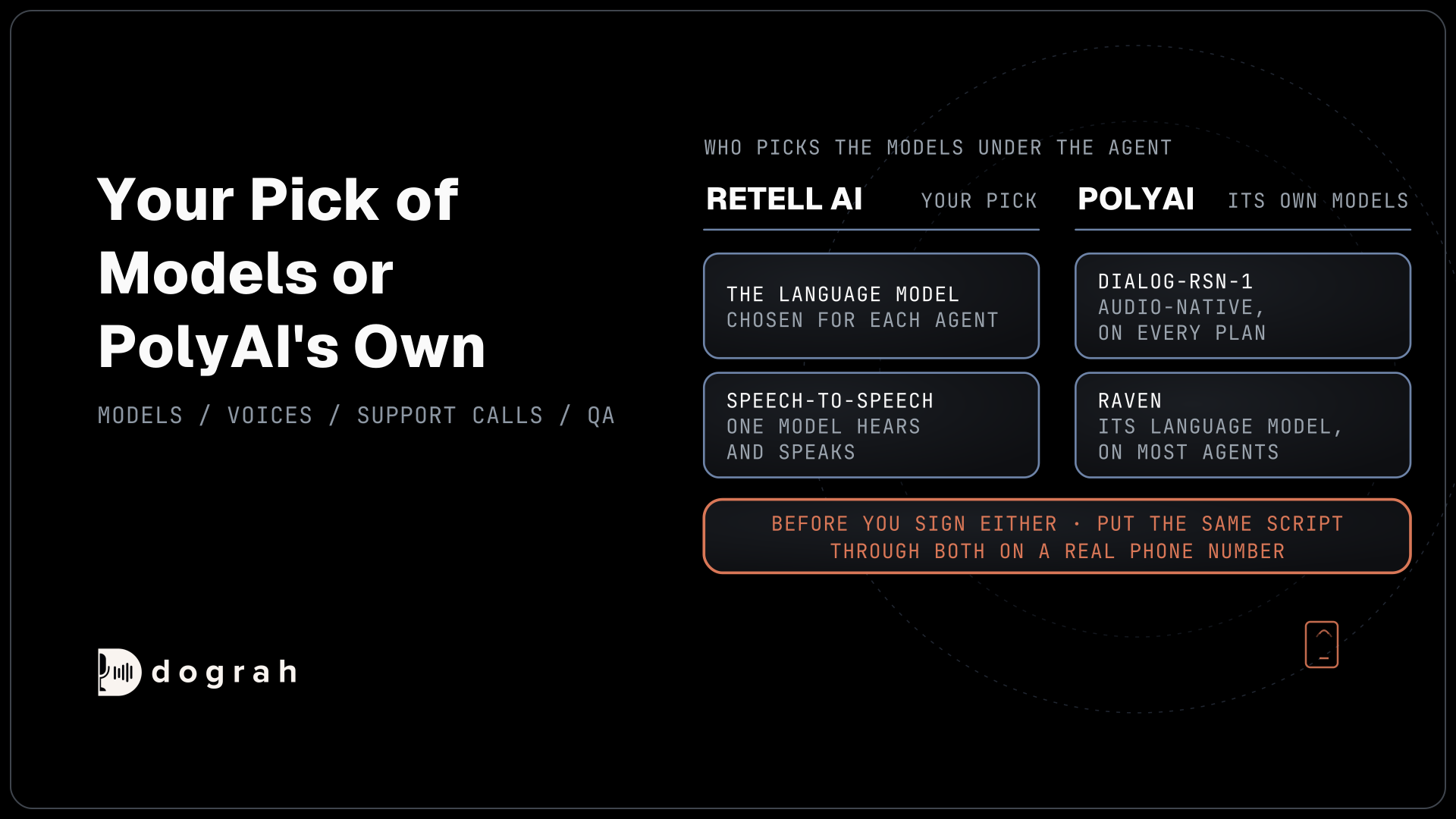
Vapi's hosting fee is $0.05 a minute, models are billed at cost, and its $29 Core package allows 10 calls at once against 30 on Pro, which starts at $999 a month. Retell AI charges $0.055 a minute for voice infrastructure, with 20 calls at once included and $8 a month for each extra line. Bland sells one rate with its own models included, $0.12 a minute plus $299 a month on Build with 50 calls at once and 2,000 calls a day, with on-prem deployment only on Enterprise.
Running open source yourself
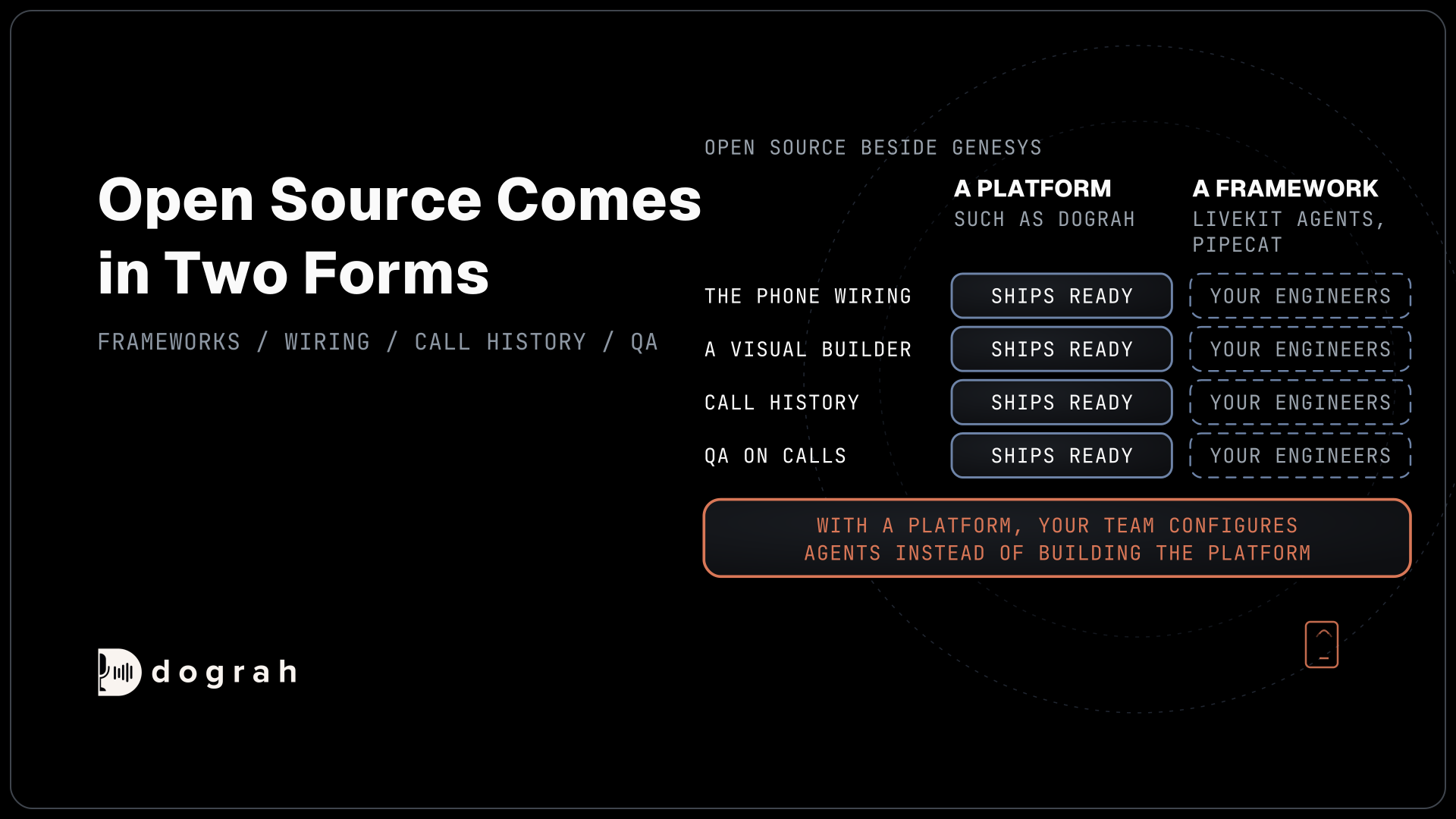
Open source is the route the usual roundups leave out, and it comes in two forms. Frameworks such as LiveKit Agents and Pipecat give you code libraries and leave the phone wiring, builder, call history and QA to your engineers. An open-source platform such as Dograh ships those parts ready, so your team configures agents instead of building the platform.
The bigger question is where the call audio goes. Using your own keys with hosted models changes whose contract it is, but the audio still goes to each model provider. The call stays inside your network only when a self-hosted platform runs open-weight models on servers you control.
Healthcare and finance centers that cannot send call data to a third party treat that as a compliance requirement. Our guide to NiCE CXone AI alternatives sets out every self-hosting option for a large center, from Cognigy installs to on-prem suites.
What 500 seats cost on each suite
The seat line is the number buyers compare first, so here it is for one example. Take a center with 500 agents and compare only the published seat price on a mid-to-upper plan, before any AI.
| Suite and plan | Seat line for 500 agents, per month | AI on top |
|---|---|---|
| Genesys CX 3 | 500 x $155 = $77,500, billed annually | Experience Units past the included allowance |
| Five9 Core | 500 x $159 = $79,500 | AI Agents add-on |
| Talkdesk Elite | 500 x $165 = $82,500 | Autopilot in Talkdesk CXA |
| NiCE Complete | 500 x $209 = $104,500 | AI Agents add-on, priced on request |
Three of the four sit within $5,000 a month of each other. NiCE Complete costs more, though its Ultimate Suite folds the AI agents in for $249 a seat plus the per-session charge.
The column that decides is the last one. Each suite meters AI differently, in tokens, add-ons or sessions, and most of those rates live in your contract. So ask every vendor for the AI line on your own call volume, in writing, before you compare seat prices.

Open Source Alternative to Vapi / Retell
Self-hosted voice agent platform — no per-minute fees
dograh-hq/dograh
Star on GitHub
One month of a voice agent at 100,000 minutes
Here is a labeled example of the platform line alone. Say the layer handles 20,000 five-minute calls a month, so 100,000 minutes.
| Platform | Platform line for 100,000 minutes | Still to add |
|---|---|---|
| Dograh Cloud | 100,000 x $0.01 = $1,000 platform fee | Your models and phone |
| Vapi | 100,000 x $0.05 = $5,000 hosting | Models and phone |
| Retell AI | 100,000 x $0.055 = $5,500 voice infrastructure | Model and phone |
Bland's Build rate already includes its models, so it is not a like-for-like line. Concurrency matters as much as price for a large center. Count the calls you need at once in your busiest hour, and check which plan covers them before you sign.
When staying on Genesys Cloud makes sense
Staying makes sense when Genesys already does the job. If voice, digital channels, workforce tools and reports already run there, its virtual agents may cover the calls you want automated, since every plan includes them. Each organization also gets 250 named or 350 concurrent Experience Units a month before the AI meter adds to the bill. A center whose AI use fits inside that allowance, and whose compliance rules allow call audio in Genesys' cloud, has little reason to move.
What moving off Genesys Cloud takes
How much moves depends on the route. Moving to another suite moves the whole center: routing, IVR menus, workforce tools, reports and human seats. Get the AI line for your own call volume in writing before you plan that move, because the seat prices are close and the AI meters are not.
A voice agent beside Genesys or open source you run moves one queue at a time. Pick a queue, route it to the new agent, and test every transfer back to its Genesys queue number over a real phone call, since a browser test call cannot run one. Start with that one queue, compare it with the same queue in your Genesys reports, and widen from there.
Join the Dograh Community
Dograh is an OSS alternative to Vapi. Join our Slack community for queries, releases, best practices & community interactions.
Picking your Genesys Cloud AI alternative
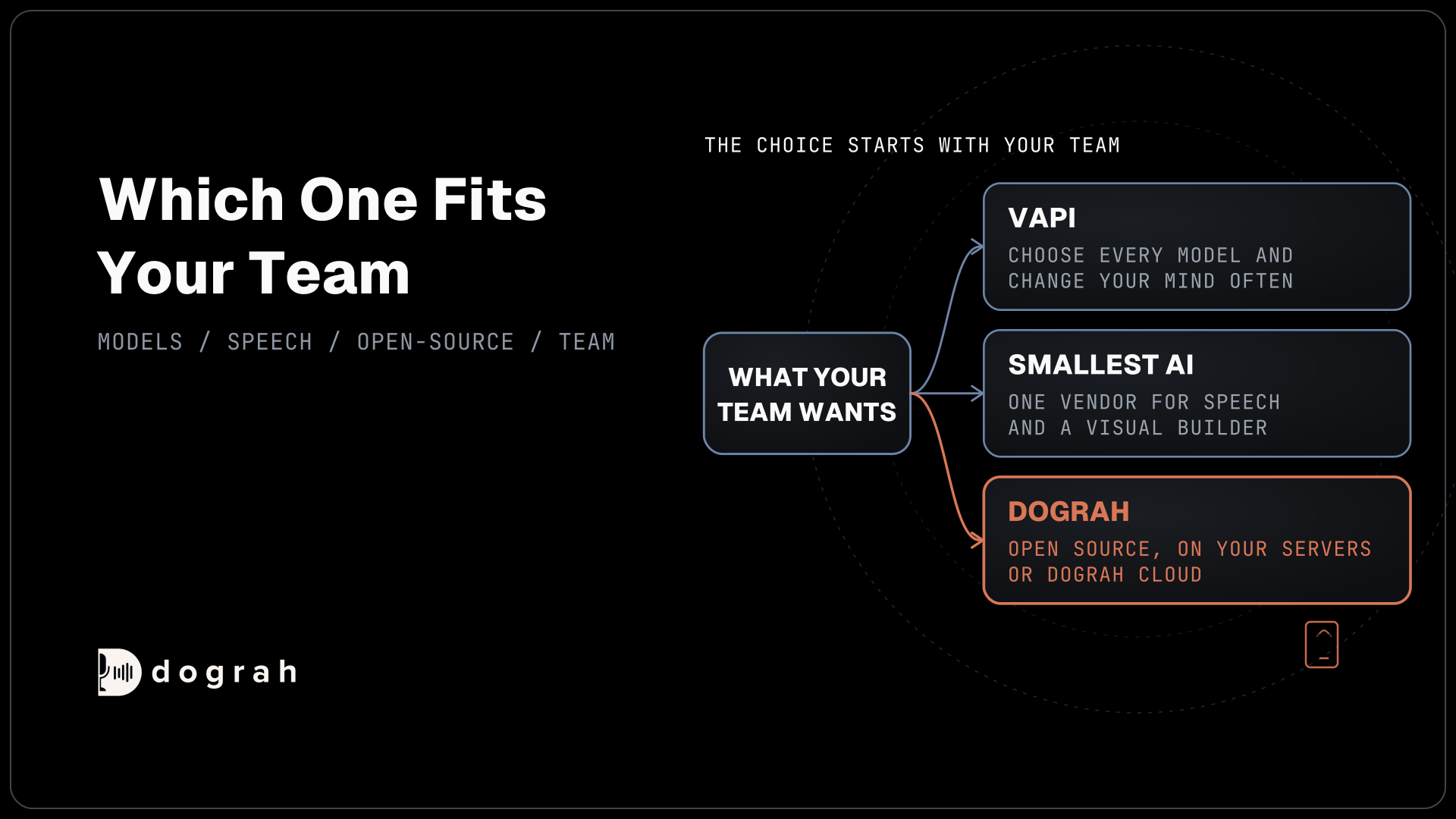
Start from what you want to keep. If you want Genesys for people and channels but your own voice agent, models and, with local models, call audio, start with Dograh, on your own servers or on Dograh Cloud. If you want to replace the whole center, compare NiCE CXone, Five9, Talkdesk and Amazon Connect on the AI line for your own volume rather than the seat price. If you want a hosted voice agent beside Genesys, Vapi, Retell AI and Bland are the usual shortlist, checked against your busiest hour's concurrency. If your engineers want to build the platform themselves, LiveKit Agents and Pipecat are the frameworks to start from. And if Genesys AI already does the job, stay.
Whichever route you take, prove it on one queue before you commit the center to it.
Glossary
- Genesys Cloud Experience Unit
- The unit Genesys uses to meter AI use on top of seats. Each organization gets 250 named or 350 concurrent units a month, and CX 4 adds 30 per named agent.
- Bring your own carrier (BYOC)
- A Genesys option where your own phone carrier delivers calls instead of Genesys Cloud Voice. It changes who carries the calls, while the platform still runs in Genesys' cloud.
- Voice agent beside a suite
- A voice agent platform that sits next to a contact center suite to answer one queue or IVR branch, handing callers back to the suite's queues by phone transfer. The suite keeps routing, seats and reports.
- Per-session charge
- A usage fee billed for each automated conversation on top of the seat price. NiCE lists $0.25 per session on its Ultimate Suite.