
Genesys Cloud AI sells virtual agents inside seat plans of $75 to $240 a user a month, then meters AI use in tokens. Dograh, the open-source AI voice agent platform we build, can sit beside it or replace its AI, with no seats or tokens. You can self-host it or run it on Dograh Cloud.
Key Takeaways
- Genesys charges per human seat, then counts AI in tokens per interaction.
- Each agentic virtual agent interaction uses 1.2 tokens, priced in your contract.
- An open layer can take one queue first and hand callers back to Genesys.
For a large contact center, the AI question is rarely Genesys or nothing. We cover what Genesys Cloud AI includes, how seats and tokens add up in one month, where an open voice layer fits beside or instead of it, and who should stay, with Dograh as the open example.
What Genesys Cloud AI includes
Genesys bundles its AI into the contact center plans. Genesys lists CX 1 at $75, CX 2 at $115, CX 3 at $155 and CX 4 at $240 per user per month, billed annually on an annual commitment. Every plan lists virtual agents and native AI. Genesys also notes that usage-based pricing may apply and that certain features need Genesys Cloud Experience Units, the AI tokens covered in the next section.
The flagship is the agentic virtual agent. Genesys runs it on its own large action models, configures it in AI Studio and deploys it inside Architect, the flow designer that already routes your calls. So the virtual agent lives in the same flows as your queues, IVR menus and human agents. For a center that already runs on Genesys, that is a real advantage.
Model choice works through connectors. Genesys lets customers bring their own AI into Agent Assist and Copilot through connectors, integrates third-party speech-to-text and text-to-speech, and lists Amazon Lex and Google bot integrations as add-ons. For phone lines, you either bring your own cloud carrier or use Genesys Cloud Voice. Genesys Cloud itself runs as a multi-tenant cloud service.
How Genesys meters AI on top of seats
Seats pay for people, and tokens pay for AI. Genesys's AI Experience guide sets the meter: a virtual agent interaction uses 0.5 tokens, an agentic virtual agent interaction uses 1.2 tokens, and voice bots use 1 token per 17 minutes, counted in 15-second steps.
Each organization gets a monthly allowance of 250 tokens on named-user plans or 350 on concurrent-user plans, and CX 4 adds 30 tokens per named agent. Unused tokens do not carry over, and use above the allowance is billed as overage. The dollar value of a token is set in your Genesys contract, so ask for it in writing before you model a year.
The two lines grow on different drivers. The seat line follows headcount, and the token line follows call volume. A center that automates more calls and trims seats sees one line shrink while the other grows, with both on the same vendor's invoice.
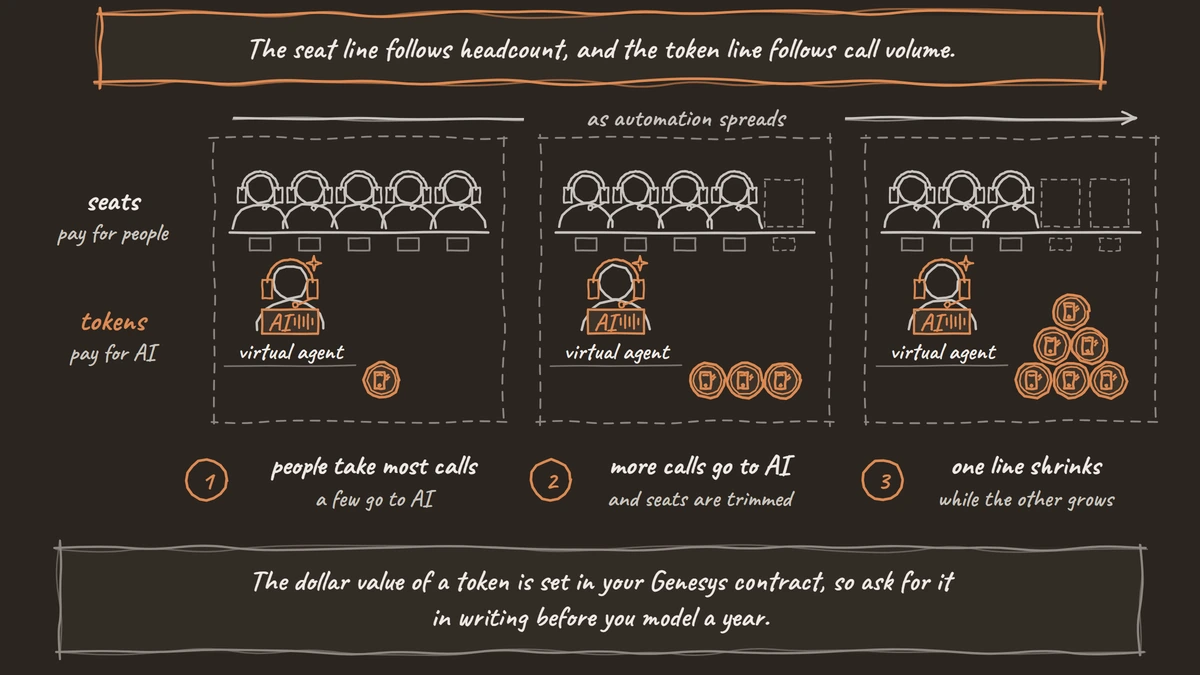
That matters more as automation spreads. Gartner predicts that by 2029 agentic AI will autonomously resolve 80% of common customer service issues without human intervention. If even part of that arrives, the token line becomes the number to plan around.
One month on both meters
Here is one worked example, built only from published units. A center has 100 named agents on CX 2. An agentic virtual agent answers 20,000 inbound calls a month first, and the average call lasts 4 minutes, so the agent handles 80,000 minutes.
On Genesys, the seats cost 100 x $115 = $11,500 a month. The AI line is 20,000 x 1.2 = 24,000 tokens. The 250-token allowance covers about 208 of those calls, which leaves 23,750 tokens billed as overage at your contract rate. Genesys also meters voice bots by time, and 80,000 minutes at 1 token per 17 minutes would be about 4,706 tokens, so ask which meter applies to your voice flows.
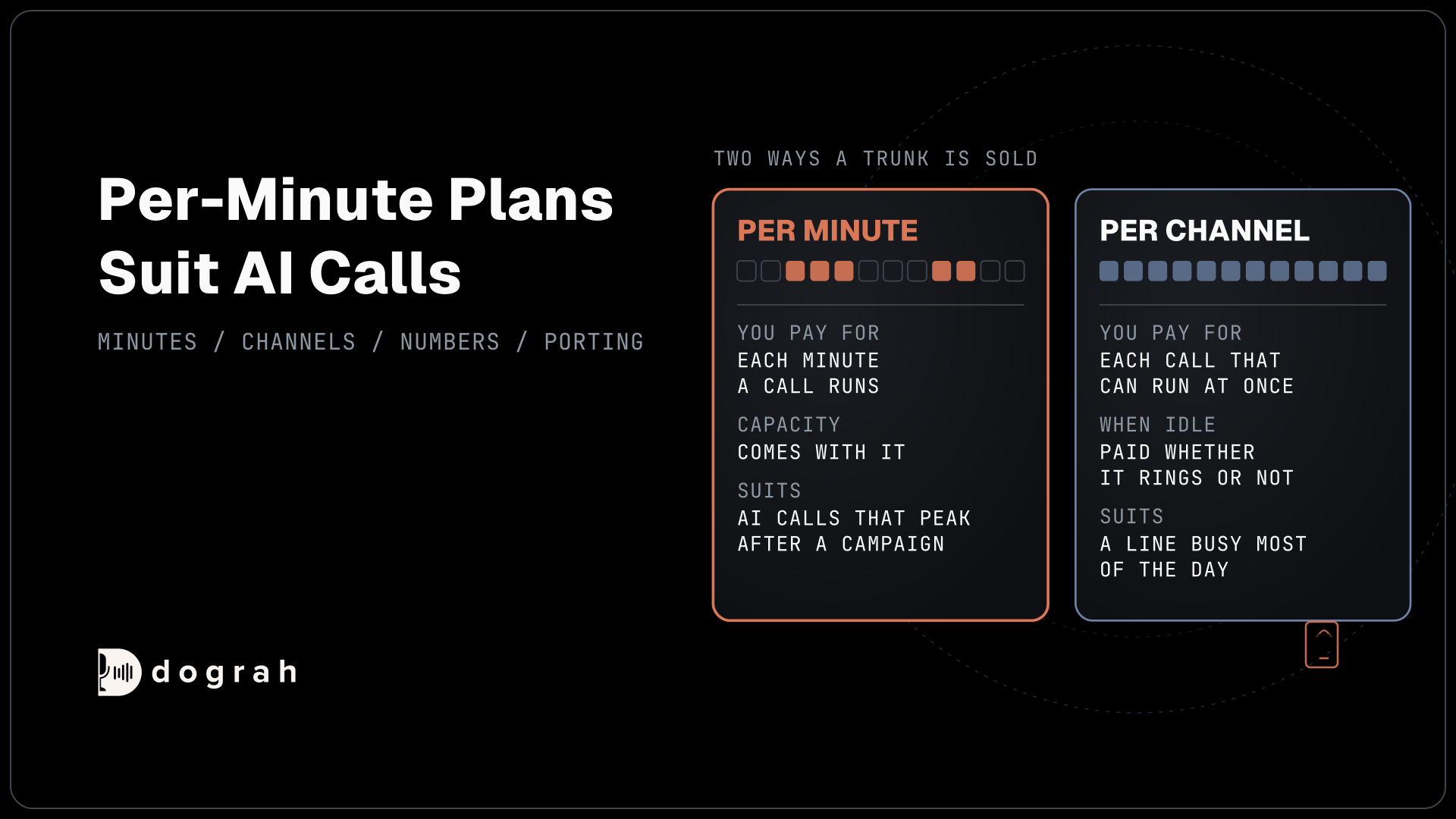
Now put an open layer beside Genesys for those 20,000 calls. The 100 seats stay, because your people still work in Genesys. The token line goes, and three other lines replace it. Self-hosted Dograh has no per-minute platform fee, but servers, model keys and phone minutes still cost money. Dograh Cloud charges a 1¢-a-minute platform fee. On Cloud, the 80,000 minutes add $800.
The model and phone lines depend on which providers you pick, and our breakdown of what an AI voice agent costs per minute prices each part. Check peak calls too. Dograh Cloud's pay-as-you-go plan includes 10 calls at once, and higher concurrency comes through Dograh's sales team. A 100-seat center's busiest hour will usually need that conversation.
Where an open voice layer fits beside Genesys
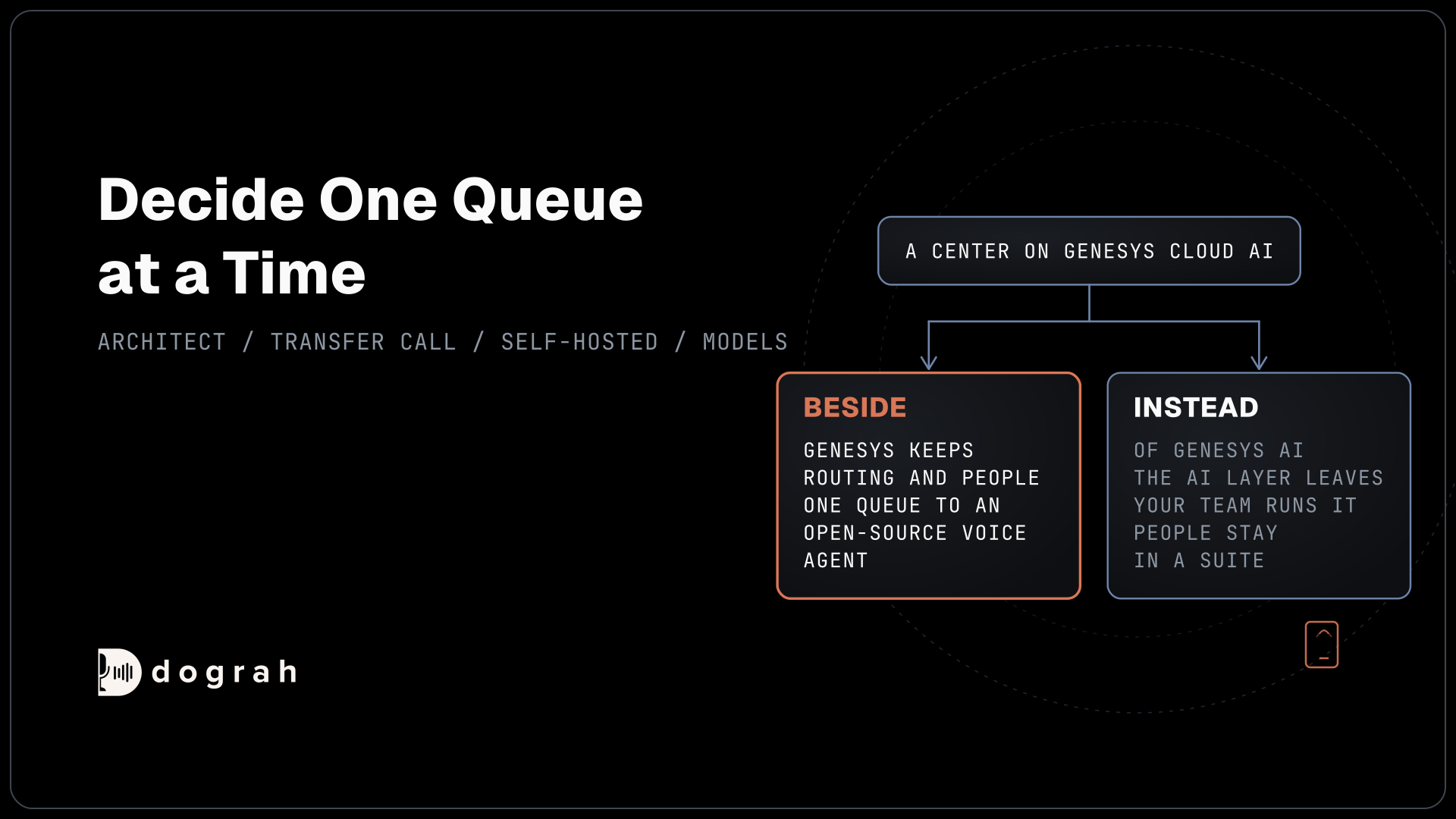
Beside means Genesys keeps routing, people and workforce tools, and one queue or IVR branch goes to an agent you run. In Architect, that branch transfers the call to a phone number or SIP address the voice agent answers. On Dograh Cloud, Dograh Managed SIP gives your organization a SIP domain that a SIP carrier or PBX can connect to. Self-hosted, your own Asterisk connects through Asterisk ARI, or you use a number on Twilio, Telnyx, Plivo or another supported carrier.
The agent still needs to know who is calling. Pre-Call Data Fetch sends the caller's number to your own endpoint once the call connects and loads the account details before the greeting plays. Your agent then verifies the caller before it shares anything from that record.
Handing back to people uses an ordinary phone transfer. The Transfer Call tool dials a Genesys queue number while the caller hears hold music, and connects them once someone answers. If no one picks up, the line is busy or the transfer fails, the result comes back to the agent as transfer_failed and the call carries on. It works on Twilio, Telnyx, Plivo, Cloudonix and Asterisk ARI.
Start with one call type, such as order status or password resets, and compare it with the same queue's numbers in your Genesys reports. Every call has a full trace showing what each turn heard and said, and a QA node scores each step after the call on a sample of calls you set. Our guide to AI voice agents for BPO and contact centers covers deflection and handoff routing in more depth.

Open Source Alternative to Vapi / Retell
Self-hosted voice agent platform — no per-minute fees
dograh-hq/dograh
Star on GitHub
Replacing Genesys AI outright
Instead means the virtual agent layer leaves Genesys entirely. That is a bigger move, and the work moves to your team. You run the servers if you self-host, pick the speech and language models, write and test the prompts on real phone lines, and read QA results every week.
It also has a clear boundary. Dograh is an AI voice agent platform, so your human agents, workforce management and digital channels still need a contact center suite. "Instead of Genesys AI" is a realistic project. "Instead of Genesys" is a different one, and it rarely starts with the voice agent.
The prize is control of the model layer and the data path, and the two are not the same thing. With bring your own key (BYOK), you hold the contract with the model provider, but the call audio still goes to that provider. Only self-hosted Dograh with open-weight models on your own servers keeps the audio inside your network. Our post on on-prem voice AI for BPOs follows where client call data goes in each setup.
Plan capacity before cutover. Self-hosted Dograh runs 10 calls at once by default, a limit you raise with one setting, and your servers and phone carrier set the real ceiling.
Genesys Cloud AI and an open layer, row by row
The two differ most in how you pay and who controls the model layer. The table puts Genesys's AI next to both ways of running Dograh.
| Genesys Cloud AI | Dograh self-hosted | Dograh Cloud | |
|---|---|---|---|
| How you pay | $75 to $240 per user per month, billed annually | No platform fee. Your servers, model keys and phone minutes | 1¢-a-minute platform fee, plus model keys and phone minutes |
| AI meter | Tokens: 0.5 per virtual agent interaction, 1.2 per agentic interaction, 1 per 17 voice bot minutes | None from Dograh | Per minute |
| Models | Genesys's large action models, connectors for Agent Assist and Copilot, third-party speech | Any LLM, STT and TTS with your own keys, or open-weight models on your servers | Dograh's models or your own keys |
| Where it runs | Genesys's multi-tenant cloud | Your servers | Dograh's cloud |
| Phone lines | Your own carrier or Genesys Cloud Voice | Twilio, Telnyx, Plivo, Vonage, Cloudonix, Asterisk ARI and more | Same carriers, or Dograh Managed SIP |
| Human agents and WEM | Included in the suite | Stay in your contact center platform | Stay in your contact center platform |
| Call review | Genesys reporting | Full call traces and a QA node per call | Full call traces and a QA node per call |
| Source code | Closed | Open source, BSD 2-Clause | Same open-source platform, run for you |
Join the Dograh Community
Dograh is an OSS alternative to Vapi. Join our Slack community for queries, releases, best practices & community interactions.
Who should stay on Genesys, and who should not
Stay on Genesys AI if your center already runs routing, workforce management and quality management there and wants one vendor contract. The agentic virtual agent sits in the Architect flows your team already knows.
Look at an open layer beside it when the token line starts to outgrow the seat line, or when you want to test a voice agent on one queue without a suite-wide change. Look at replacing Genesys's AI when the models must be your own, when call audio has to stay on your servers, or when your engineers need to see every turn of every call.
Either way, decide one queue at a time. If you are also weighing other suites, our Talkdesk AI Agents alternatives sorts the options by type, and our Five9 AI Agents review applies the same tests to Five9.
Glossary
- Genesys Cloud Experience Unit
- Genesys's AI token, the unit it uses to meter AI use. Each feature uses a set number, such as 1.2 tokens per agentic virtual agent interaction, and use above the monthly allowance is billed at your contract rate.
- Agentic virtual agent
- Genesys's self-service voice and chat agent that plans its own steps toward a goal, built on Genesys's large action models in AI Studio. It runs inside Architect flows next to queues and human agents.
- Architect flow
- The Genesys Cloud designer that decides where each call goes: menus, queues, bots and transfers. A branch in an Architect flow is where a call can be sent to an outside voice agent's number or SIP address.
- Dograh Managed SIP
- A SIP domain Dograh provisions for your organization on Dograh Cloud, so a SIP carrier or PBX can send calls straight to your agents. It is one way to route a contact center queue to an agent you run.