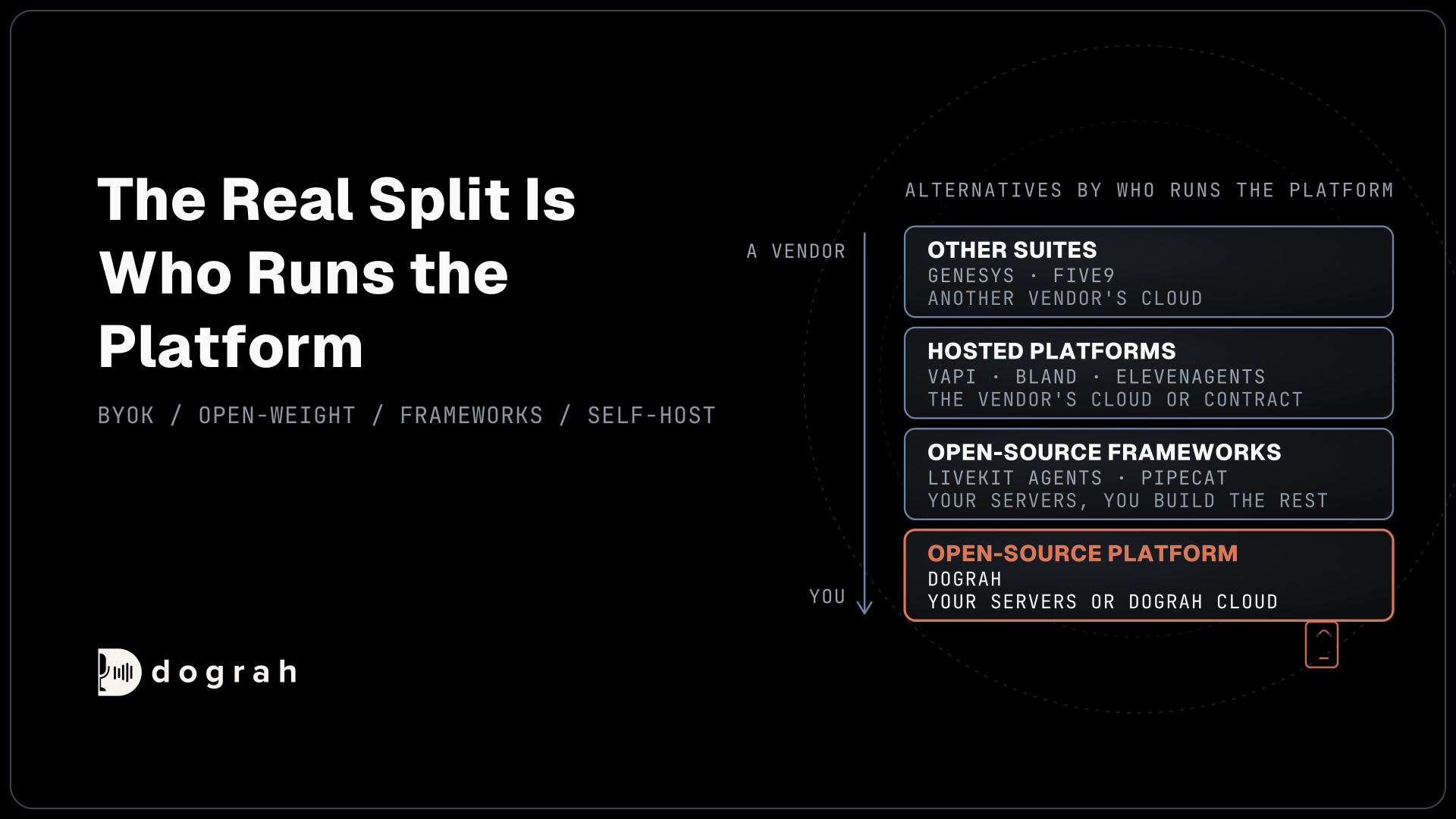

Talkdesk AI Agents alternatives fall into four types. There are other contact center suites like Genesys and Five9, hosted voice agent platforms like Vapi and Bland, open-source frameworks, and open-source platforms. For your own models and data, Dograh, the open-source AI voice agent platform we build, runs any model. You can self-host it or run it on Dograh Cloud.
Key Takeaways
- Talkdesk quotes its AI agents through sales, on top of seats from $85.
- Your own key moves the contract. Only local models keep the audio in.
- Moving only the AI layer keeps your numbers, routing and seats in place.
This guide is for contact center teams that want their own models and data. We cover what Talkdesk AI Agents offer, what that need requires, whether to replace the suite or only its AI layer, and each type of alternative. For open source on your own servers, Dograh comes last.
What Talkdesk AI Agents offer
Talkdesk sells AI agents on top of a seat-based contact center. Talkdesk lists Digital Essentials at $85, Voice Essentials at $105, Elite at $165 and Industry Experience Clouds at $225, each per user per month. Talkdesk Express, for US and Canadian businesses under 50 employees, includes 25 licences and $100 in free credit with no contract.
The AI products are priced separately. Autopilot, Navigator, Copilot and the analytics products are Talkdesk's customer experience automation (CXA) products, priced through sales, so your quote depends on how much you automate.
Autopilot is the voice and digital agent. Talkdesk describes it as an agentic AI virtual assistant that supports natural conversations in 59+ languages, hands customers to a human with context, and is watched live from the CXA Operations Center with guardrails. Above it, Talkdesk's AI agents platform orchestrates several AI agents, offers agents pre-trained for healthcare, financial services and retail, works with third-party AI agents, and uses the Model Context Protocol (MCP) to reach outside tools and services.
That is a strong package for a center that wants AI inside one vendor. The rest of this post is for teams whose next question is which model runs the call and where the call audio goes.
Own models and own data are two needs
"Our own models" can mean two different things, and they lead to different alternatives. The first is bring your own key (BYOK): you pick the speech and language providers and pay them under your own contract. The second is running open-weight models on your own servers.
With BYOK, the contract is yours, but the caller's audio and the transcript still travel to that provider. That suits a team that wants a specific model, its own rates or its own data terms. It does not keep the call inside your network.
Only local models do that. When the platform and the speech and language models all run on your servers, no third party hears the call. Recordings and transcripts then sit wherever the platform runs, so the data question also depends on whether the platform itself is something you can host.
A health insurer that must keep member calls in its own data center has the second need. A retailer that wants one particular voice at its negotiated rate has the first. So write down which need you have before you compare. A team that needs BYOK has several hosted options. A team that needs the audio to stay in has far fewer.
Replace the suite or only the AI layer
Replacing Talkdesk and replacing Talkdesk's AI agents are different projects. A full suite switch means rebuilding routing, IVR menus and integrations, porting numbers, retraining human agents and running both systems in parallel until the port completes. That is months of work, and it rarely starts with the voice agent.
Replacing only the AI layer is smaller. Talkdesk keeps your numbers, queues and human seats, and one call type goes to an agent you run on a number or SIP address. When the agent needs a person, it transfers the call back to a Talkdesk queue number. Our comparison of the best AI voice agents for BPOs tests that layer per client program.
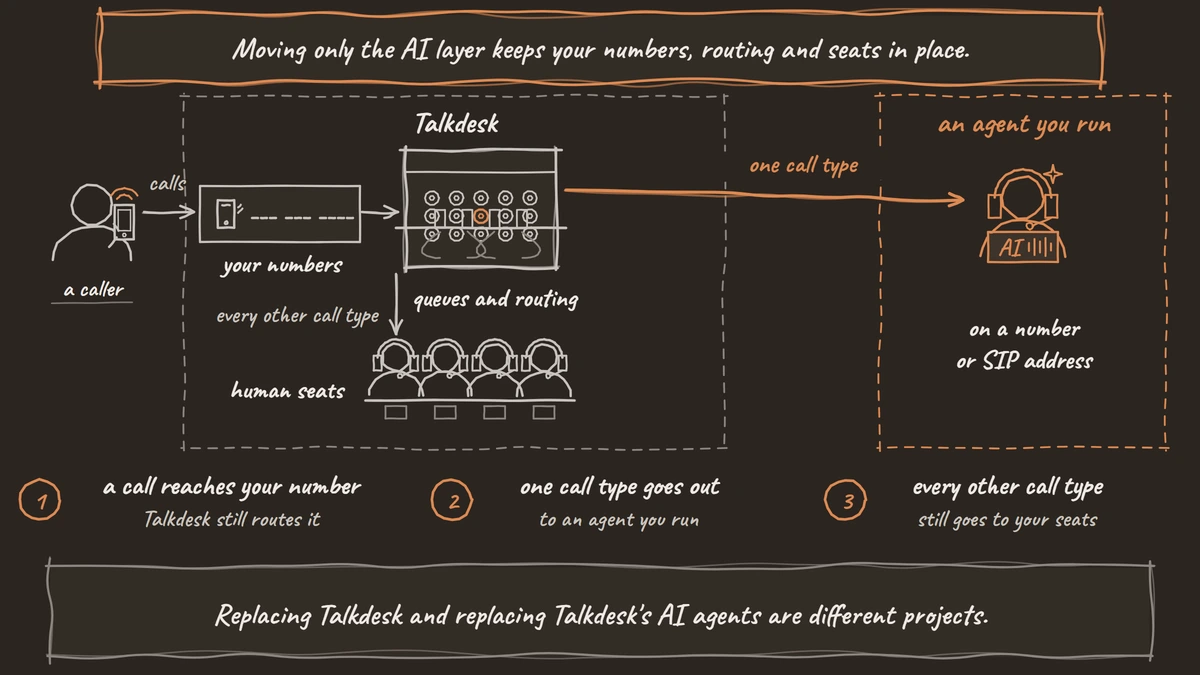
Most teams should start here. Prove one call type, such as order status or appointment changes, then decide whether the suite itself needs to move. The human agents never notice the change, except that the calls reaching them have already been through a first conversation.
Other contact center suites with AI agents
Moving to another suite changes the vendor more than the model question. Both main rivals sell AI agents inside a seat-based contact center, as Talkdesk does.
Genesys Cloud lists four plans from $75 to $240 per user per month and meters AI in tokens on top, with an agentic virtual agent using 1.2 tokens per interaction. Our post on Genesys Cloud AI vs open-source voice agents works through one month on both meters.
Five9 prices its Core bundle at $159 per seat per month with a 50-seat minimum, includes 3,000 AI minutes per bundled seat plus usage, and sells AI Agents as an add-on. Its GenAI Studio lets customers choose among third-party or proprietary models. Our Five9 AI Agents review gives the verdict.
Either suite fits a team that wants to leave Talkdesk and keep everything with one vendor. Neither changes where the platform runs, since both are cloud contact centers.

Open Source Alternative to Vapi / Retell
Self-hosted voice agent platform — no per-minute fees
dograh-hq/dograh
Star on GitHub
Hosted voice agent platforms
Hosted voice agent platforms replace the AI layer and leave the suite alone. You reach them through a phone number or SIP trunk, and they hand calls back to your queues by transfer.
Vapi is the developer option for BYOK. It connects your own transcriber, model and voice keys, can call a custom language model on your own server, and charges a hosting fee of $0.05 a minute, with models and phone billed on top. It runs only in Vapi's cloud.
Bland goes the other way on models. One per-minute rate covers its own speech and language models, so every call runs on Bland's stack rather than providers you pick, and on-prem or VPC deployment comes with its Enterprise contract. ElevenAgents, from ElevenLabs, brings ElevenLabs voices and publishes integration guides for Genesys and Five9.
All three fit a BYOK need, or none at all. None of them gives you code you can run yourself, so where the call audio goes is set by each vendor's cloud or contract.
Open-source frameworks
Open-source frameworks give you full control and leave you the build. LiveKit Agents and Pipecat are code libraries for real-time voice: you write the agent in code and run it wherever you like, with any model.
What they leave to your team is everything around the agent. Phone number wiring, a builder your operations staff can edit, call history, QA and campaign dialling are yours to build and run. For a contact center with a strong engineering team and a narrow use case, that can be the right trade. Our guide to the best open-source voice AI platforms compares the frameworks with ready platforms.
Talkdesk AI Agents alternatives compared
The real split is who runs the platform and whether the models can run on your servers. The table judges each type on that test.
| Option | Type | Models | Where it runs | What you pay |
|---|---|---|---|---|
| Talkdesk AI Agents (baseline) | Contact center suite | Talkdesk's agents, third-party agent interoperability | Talkdesk's cloud | $85 to $225 per user per month, AI quoted by sales |
| Genesys Cloud AI | Contact center suite | Genesys's large action models, connectors for assist features | Genesys's cloud | $75 to $240 per user per month, AI in tokens |
| Five9 AI Agents | Contact center suite | Third-party or proprietary models in GenAI Studio | Five9's cloud | Core $159 per seat, 50-seat minimum, AI Agents add-on |
| Vapi | Hosted voice agent platform | Your own keys, or a custom LLM on your server | Vapi's cloud | $0.05 a minute hosting, plus models and phone |
| Bland | Hosted voice agent platform | Bland's own models | Bland's cloud, on-prem or VPC on Enterprise | One per-minute rate, plus phone |
| LiveKit Agents, Pipecat | Open-source framework | Any model you wire in | Your servers | Free code, plus your build and run costs |
| Dograh | Open-source AI voice agent platform | Any LLM, STT and TTS with your keys, or open-weight models on your servers | Your servers, or Dograh Cloud | Self-hosted no platform fee. Cloud 1¢-a-minute platform fee. Models and phone on top |
Join the Dograh Community
Dograh is an OSS alternative to Vapi. Join our Slack community for queries, releases, best practices & community interactions.
Where Dograh fits
Dograh is the open-source platform type, built for the team that wants its own models and its own data without building a platform from a framework. It is open source under BSD 2-Clause, so you can self-host the whole platform or run the same code on Dograh Cloud.
On models, it covers both needs from the section above. In Models you choose any supported LLM, speech-to-text and voice provider with your own keys, Dograh's own models, or open-weight models running on your own servers. Self-hosted with local models, the call audio stays inside your network, and recordings and transcripts sit on your servers.
It also answers the parts of CXA that matter on calls. Transfer to Agent hands a live call from one agent to another with a labelled transcript, so a router agent can pass callers to a billing or claims agent.
For tools, the MCP tool lets an agent call tools on an outside MCP server during the call, and Dograh's own MCP server lets an AI assistant build and edit agents.
Beside Talkdesk, the agent answers a phone number, or on Dograh Cloud a Dograh Managed SIP address, that a Talkdesk flow transfers to, and Transfer Call sends callers back to a queue number on Twilio, Telnyx, Plivo, Cloudonix or Asterisk ARI. Every call has a full trace, and the QA node scores each step after the call.
Pre-recorded clips can play your most common lines, with text-to-speech as the fallback, so fixed lines sound the same on every call. Self-hosted Dograh has no per-minute platform fee, but servers, model keys and phone minutes still cost money. Dograh Cloud charges a 1¢-a-minute platform fee.
Start with one Talkdesk queue and measure it against Autopilot on the same calls. If the numbers hold, the suite question can wait.
Glossary
- Bring your own key (BYOK)
- Using your own account with a speech or language model provider inside a voice agent platform. The contract and rates are yours, but the call audio and transcript still reach that provider.
- Open-weight model
- A model whose weights you can download and run on your own servers, such as an open speech-to-text or language model. Running these locally is the only way to keep call audio inside your network.
- CXA (customer experience automation)
- Talkdesk's name for its AI layer, a platform that orchestrates several AI agents, including Autopilot for voice and digital self-service. Talkdesk prices it through its sales team.
- Contact center suite
- A cloud contact center, also called contact center as a service (CCaaS), that bundles routing, IVR, human-agent seats and reporting, such as Talkdesk, Genesys Cloud or Five9. AI agents are sold inside or on top of it.