
The best AI voice agents for BPOs are judged by where each client's call data goes and how many client programs one account can serve. Dograh, an open-source, self-hostable voice agent platform, runs on the BPO's own servers and serves several client lines from one agent. The others are hosted developer platforms, sales-led vendors and open frameworks.
Key Takeaways
- Judge every platform first on where each client's call data can run.
- Dograh can run on your own servers with no per-minute platform fee.
- Ask every vendor what the next caller hears once concurrency is full.
This post is part of our guide to AI voice agents for BPO and contact centers. The guide's section "Choosing a voice AI platform for a BPO" starts from one rule: "Judge platforms by tests a BPO can check before it signs a client, not by a demo call." Here are those tests, and thirteen platforms judged on them, starting with Dograh.
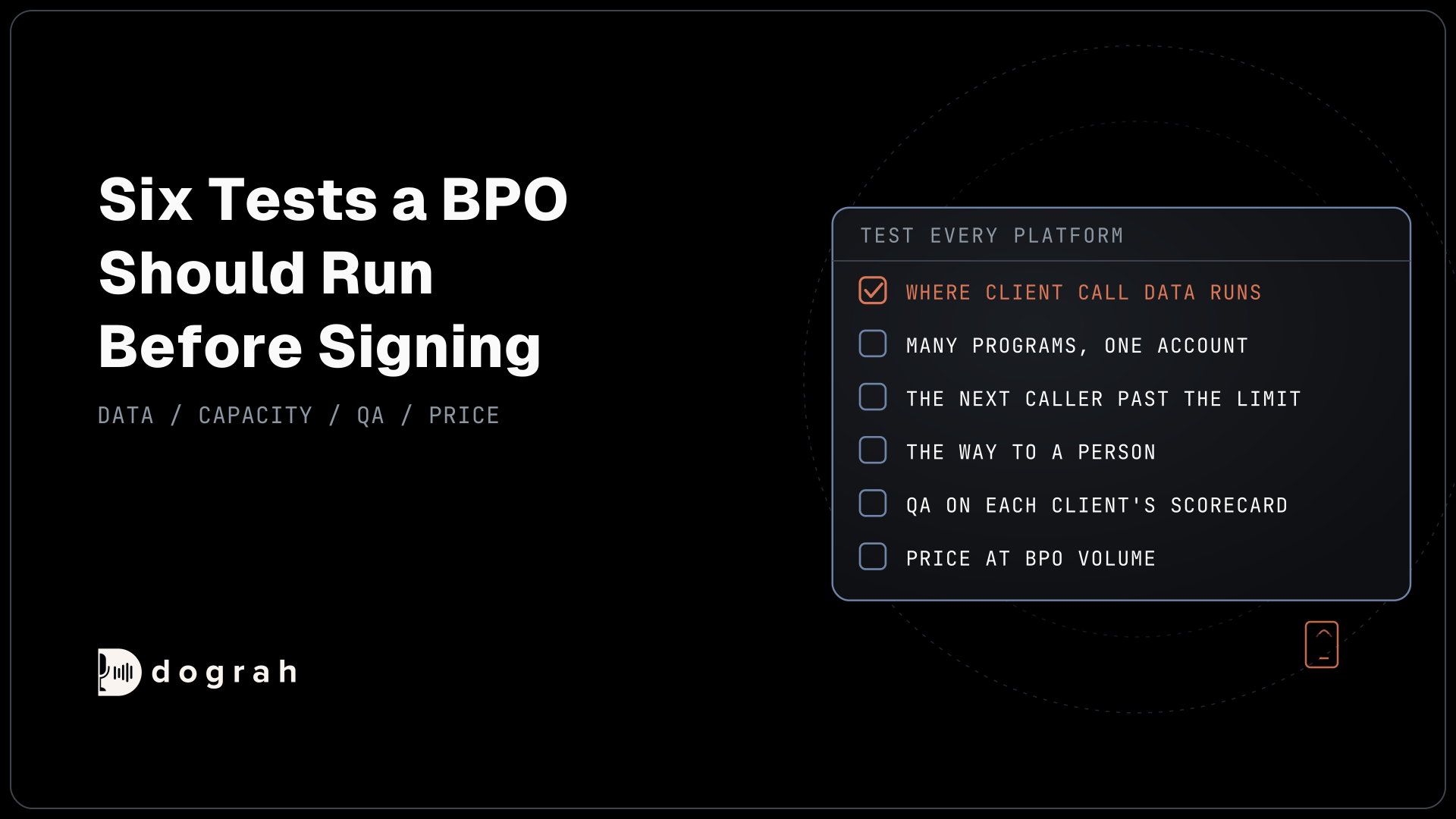
Six tests a BPO should run before signing
A BPO buys a voice platform for many clients at once, so the tests start with what each client's contract allows.
The first test is where each client's call data goes. A bank's contract may require recordings and transcripts on the BPO's own servers, while a retailer's may not. Check which plan lets calls run on your own servers, and which keeps them in the vendor's cloud.
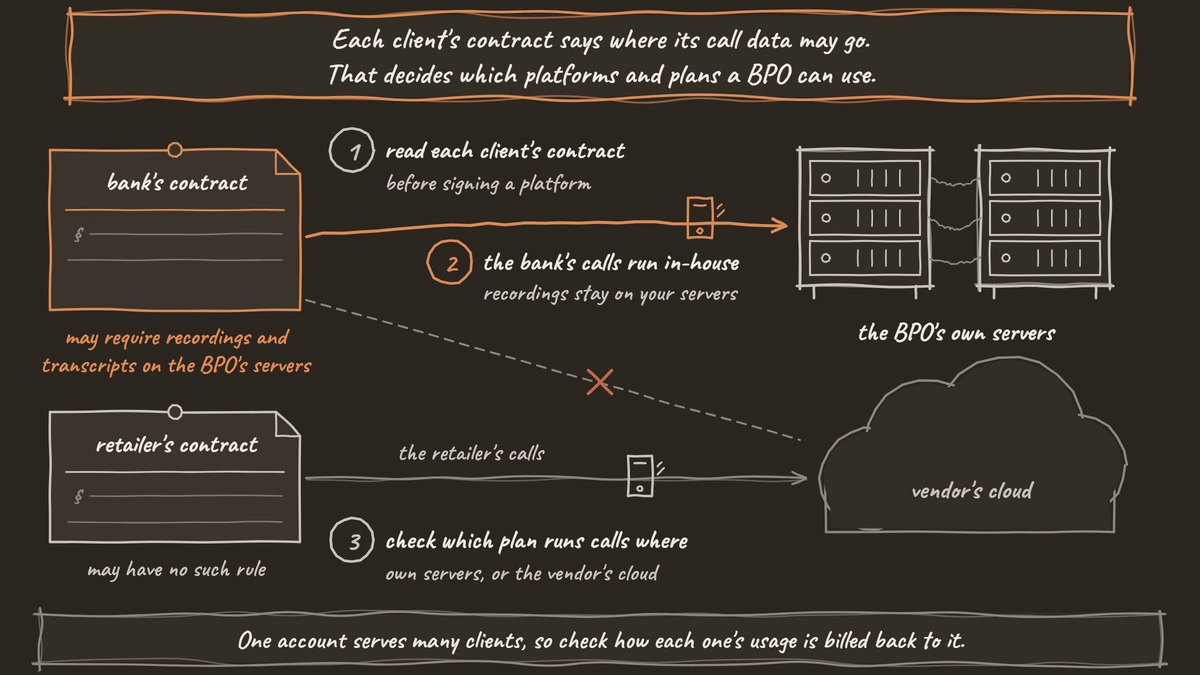
The second is many client programs on one account. Each program has its own script, verification step and systems. Check how one account keeps them apart, and how each client's usage is billed back to that client.
The third is capacity, meaning how many calls run at once and what the next caller hears when every line is busy. A BPO's busiest hour is the sum of every program sharing the account.
The fourth is the way to a person. Many callers still want one. In a OnePoll survey of 6,000 consumers for AnswerConnect, across the US, UK and Canada, 85% said they prefer a real person and 31% said they would hang up if connected to AI. Check how the transfer is routed and what the person who answers already knows.
The fifth is built-in QA, meaning whether the platform grades finished calls against each client's scorecard, and whether it can sample a share of them. The sixth is price at BPO volume, which covers the platform fee per minute or per contract and what sits on top, such as models, phone minutes and add-ons.
How the platforms compare for BPO work
The table starts with Dograh, then groups the rest by how they are bought: per minute, through sales, or as a framework your engineers build on.
| Platform | Type | Where calls can run | Concurrency | List price | What a BPO gets, and what's missing |
|---|---|---|---|---|---|
| Dograh | Open source (BSD 2-Clause), self-hostable | Your own servers; Dograh Cloud; Enterprise adds on-premise or private cloud | 10 by default, raised self-hosted or by contacting Dograh on Cloud; over the limit, a new inbound call is rejected | Self-hosted: no per-minute platform fee. Dograh Cloud: 1¢/min platform fee | Several client lines per agent, QA node with a sample rate, Paygent for client billing; each client's CRM or helpdesk connects through HTTP API tools |
| Vapi | Developer platform | Vapi's cloud | 4 with no package, 10 on Core, 30 on Pro; $10 per extra line a month | $0.05/min hosting before models and phone; Core $29/month | Wide model choice. HIPAA is a $2,000/month add-on |
| Retell AI | Developer platform | Retell's cloud; dedicated stable server as an Enterprise add-on | 20 free, then $8 per call a month | $0.07 to $0.31/min | AI Quality Assurance at $0.10/min after 100 free minutes |
| Bland AI | Developer platform | Bland's cloud; on-prem or VPC on Enterprise | 10 on Start, 50 on Build | Start $0.14/min; Build $0.12/min plus $299/month | On-prem needs an Enterprise contract |
| Smallest AI | Voice agent platform (Atoms) | Smallest AI's cloud; on-premise on Enterprise | 20 included on pay as you go | $0.09 to $0.21/min, by model | HIPAA zero data retention is a $1,000/month add-on on pay as you go |
| LiveKit | Open-source framework (Apache 2.0) plus LiveKit Cloud | Your own servers, or LiveKit Cloud | Cloud: 5 on Build, 20 on Ship | Cloud: Build free with 1,000 minutes; Ship from $50/month, then $0.01/min | Your engineers build the agent, flows and tools |
| Pipecat | Open-source Python framework (BSD 2-Clause) | Wherever you run it | Set by your servers | Free code | Your engineers build the agent, flows, campaigns and QA |
| Synthflow | Sales-led platform | Synthflow's cloud, with region-based hosting in the US and EU | Planned per contract | Enterprise contracts from $30,000 a year | Scoped to call volume, concurrency and telephony setup |
| Voiceflow | Agent platform for chat and phone | Hosted on Voiceflow; private cloud on Enterprise | Per plan | Usage-based for agencies; business pricing on request | Multi-client workspaces and white-labeling on the agency plan |
| Thoughtly | Sales-led platform | Thoughtly's cloud; dedicated infrastructure with data residency on Enterprise | 10 on Flex, 100+ on Scale | Through sales | Auto-QA and evals from the Scale plan |
| Leaping AI | Sales-led platform | Leaping AI's cloud, with hosted telephony or your own carrier | Agreed in the quote | Quote on request | 15+ languages |
| PolyAI | Managed voice vendor | PolyAI's cloud; your own carrier over SIP at no charge | 10 on its model API | Platform per minute through sales; API 2¢ per connected minute | The API plan excludes telephony and orchestration |
| Parloa | Managed voice vendor | Parloa's cloud | Through sales | Per minute for voice, in volume packages | Custom plans through sales |
Dograh: open source on the BPO's own servers
Against the six tests, Dograh's case is concrete. It runs from open code on the BPO's own servers, serves several client lines from one agent, states its concurrency limit and what happens past it, grades calls with a built-in QA node, and publishes its price. None of that needs a sales contract.
Self-hosted, recordings and transcripts stay on the BPO's servers. Dograh is the orchestration layer: it runs the call flow, tools and telephony, and the speech and language models are a separate layer you choose. The call audio stays in-house only when the speech and language models run on your own servers too. With your own key for a hosted model, the audio still reaches that provider. Our post on on-prem voice AI for BPOs covers the servers and models.
For many programs, several phone numbers can point at one agent, and the number the caller dialled reaches Pre-Call Data Fetch as to_number. So one agent can load the right client's details before it says hello. A program with a different script or verification step gets its own agent. For client billing, Dograh connects to Paygent, which tracks each call's usage and invoices your clients at your own rates.
Transfer Call works on Twilio, Telnyx and Asterisk ARI. It passes no summary by default; on Twilio it can play a short spoken introduction to both people. Write the details to your system with an HTTP API tool before the transfer. For a BPO that is the client's helpdesk, so the ticket is open when someone answers.
Every program can carry a QA node that grades each finished call against that client's scorecard, step by step, with a Sample Rate (%) setting. Our post on call QA and scoring in contact centers shows how to write one per client.
A campaign can cap its own outbound calls at once, while inbound calls share the organisation's single concurrency limit (10 by default). Past the limit, a new inbound call is rejected at once, so the overflow route sits in your phone system. Self-hosted Dograh has no per-minute platform fee (servers, model keys and phone minutes still cost); Dograh Cloud has a 1¢-a-minute platform fee.
Your team points HTTP API tools at each client's systems, and self-hosting puts uptime and upgrades in your team's hands. Dograh's Enterprise plan lists on-premise or private-cloud deployment with data residency, SSO and audit logs.

Open Source Alternative to Vapi / Retell
Self-hosted voice agent platform — no per-minute fees
dograh-hq/dograh
Star on GitHub
Developer platforms and open frameworks
These six suit a BPO with engineers on staff. The hosted four charge by the minute, and the two frameworks are free code your team builds on.
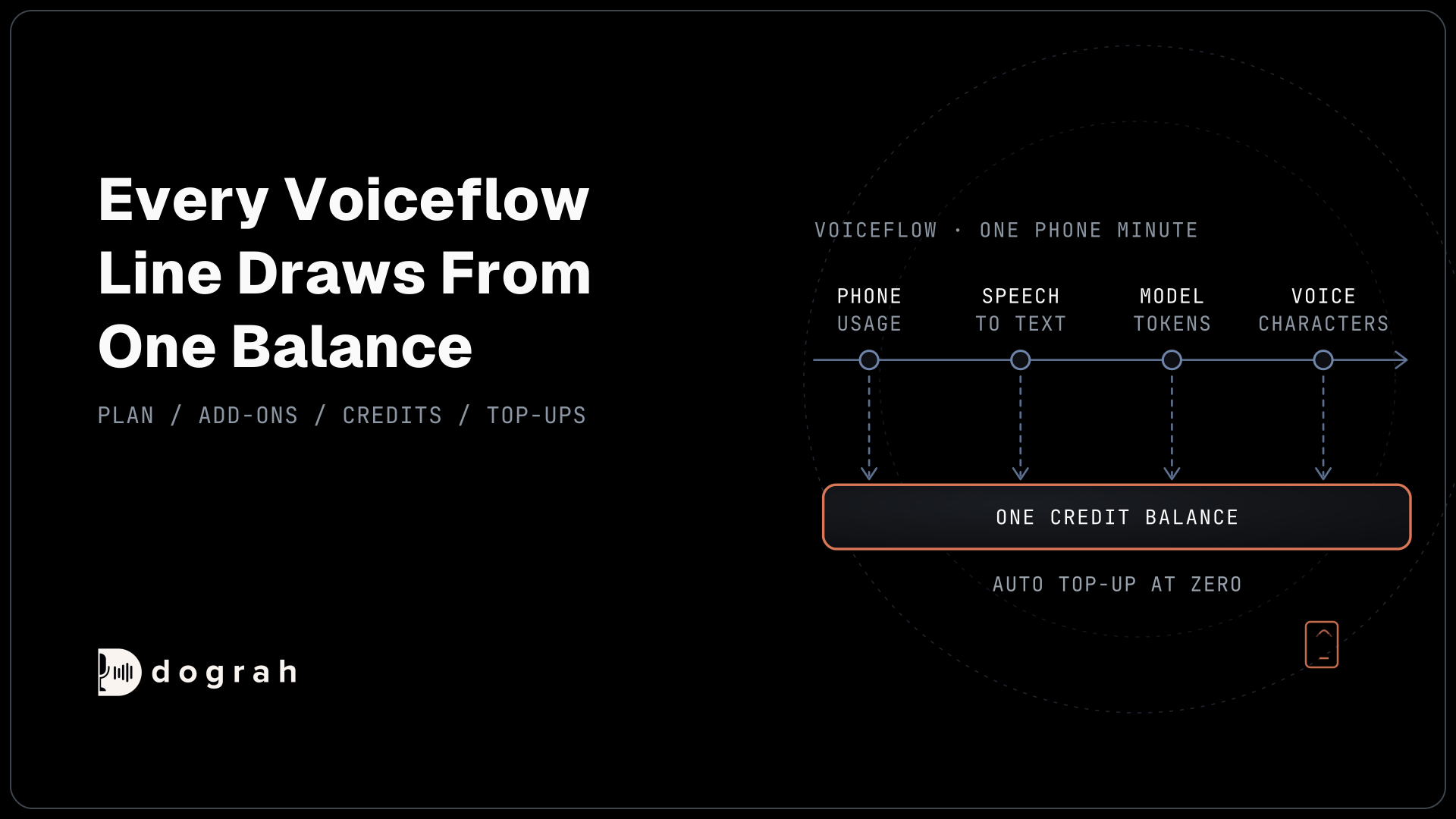
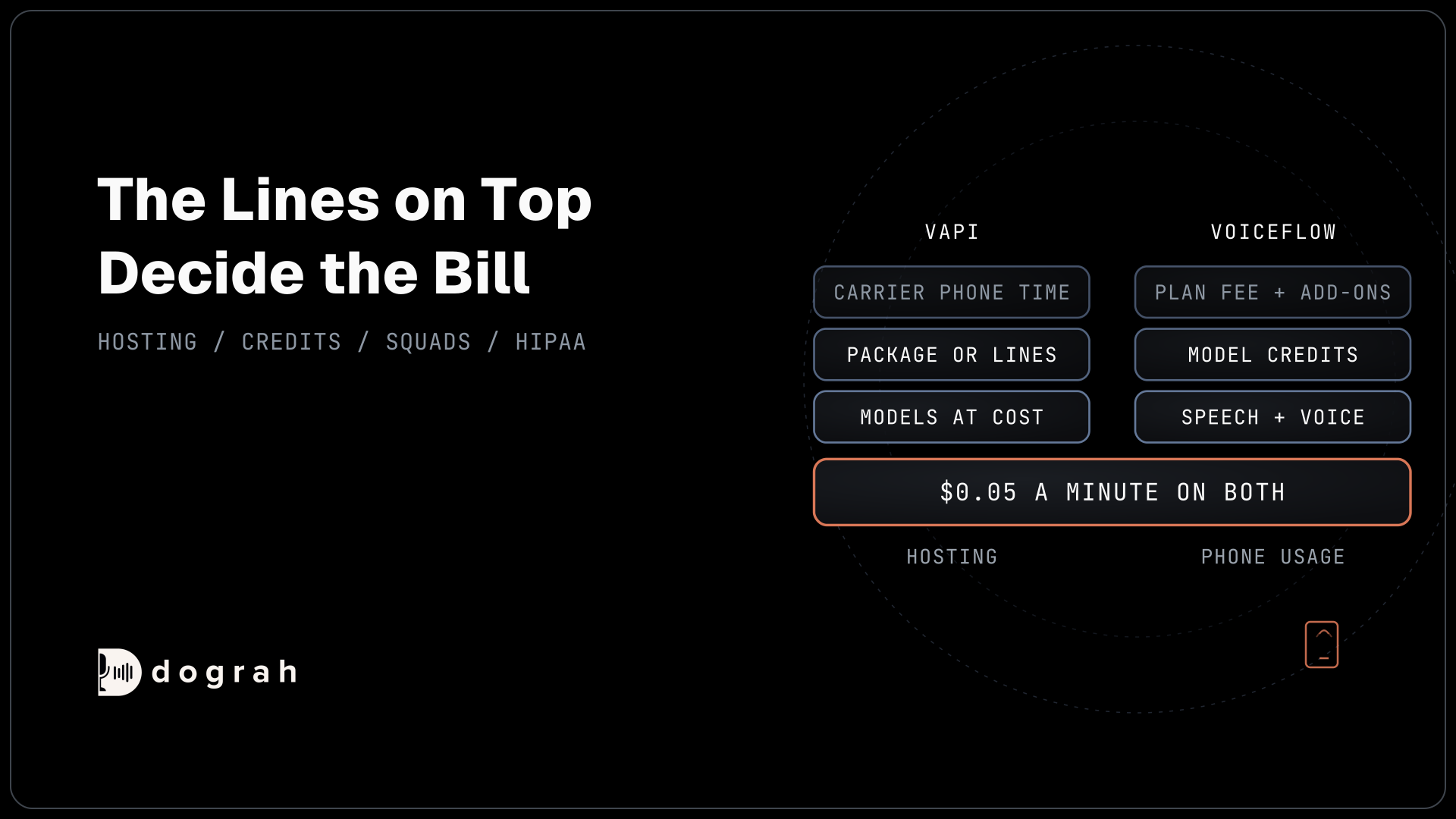
Vapi charges $0.05 a minute for hosting before models and phone minutes. Core costs $29 a month with 10 concurrent calls, Pro is 10% of the hosting fee with a $999 monthly minimum and 30 calls, and extra lines cost $10 a month each. HIPAA handling is a $2,000 a month add-on. Our breakdown of Vapi pricing adds up a full call.
Retell AI lists $0.07 to $0.31 a minute for voice agents, with 20 concurrent calls free and $8 per extra call a month. Its AI Quality Assurance add-on costs $0.10 a minute after the first 100 minutes, so grading every call on a busy program adds a per-minute line. Enterprise adds a dedicated stable server as an add-on, still in Retell's cloud.
Bland AI sells Start at $0.14 a minute with 10 concurrent calls, and Build at $0.12 a minute plus $299 a month with 50. On-prem or VPC deployment comes with its Enterprise plan. Smallest AI's Atoms platform charges $0.09 to $0.21 a minute depending on the models, with 20 concurrent calls, and offers on-premise deployment on Enterprise.
LiveKit and Pipecat are open-source frameworks. LiveKit's Agents framework is Apache 2.0, and it runs on your own servers or on LiveKit Cloud, where Ship starts at $50 a month for 5,000 agent minutes, then $0.01 a minute. Pipecat is a BSD 2-Clause Python framework with more than 16,000 GitHub stars and ready-made pieces for Twilio, Plivo, Telnyx and Vonage. With either one, your engineers write the call flows and build the rest of the platform around them.
Sales-led platforms and managed vendors
These vendors price through a sales conversation, and several design the agent for you. They suit a BPO that wants a partner to build each client program and accepts calls running in the vendor's cloud.
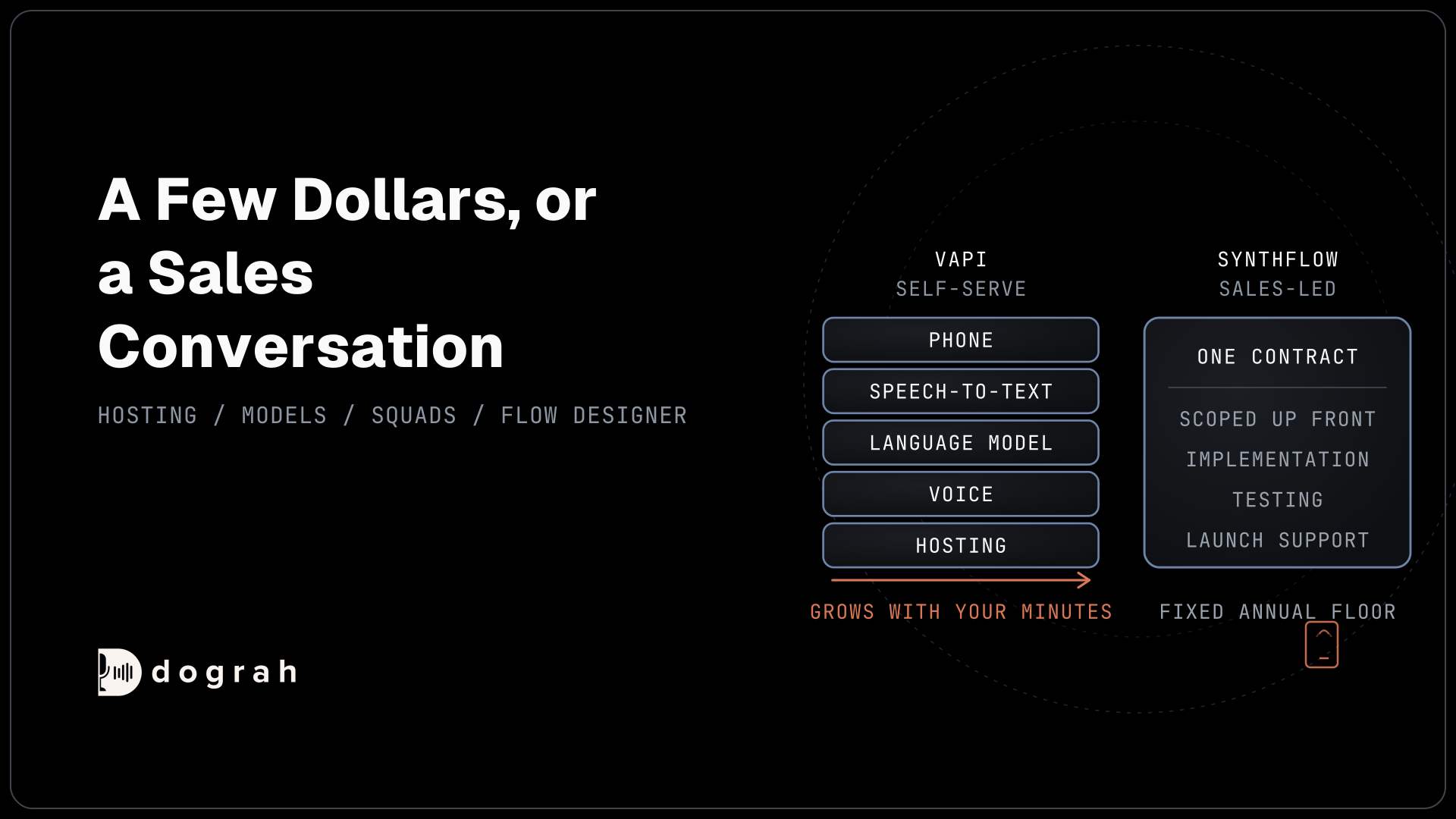
Synthflow sells one plan, Enterprise, with contracts from $30,000 a year, scoped to call volume, concurrency and telephony setup. It runs on Synthflow's own cloud, with region-based hosting in the US and EU. Voiceflow is built for chat and phone agents. Its agency plan offers usage-based billing, multi-client workspace management and white-labeling, which suits a BPO reselling agents. Agents are hosted on Voiceflow, with private cloud hosting on Enterprise.
Thoughtly lists 10 concurrent calls on Flex and 100 or more on Scale, which adds Auto-QA and evals. Its Enterprise plan, for a million minutes a month or regulated verticals, adds dedicated infrastructure with data residency and HIPAA with a BAA. Leaping AI quotes each deal, supports more than 15 languages, and runs on hosted telephony or your own carrier.
PolyAI prices its managed platform per minute through sales, and your own carrier connects over SIP at no charge. Its Dialog-RSN-1 model API costs 2¢ per connected minute, without telephony or orchestration. Parloa prices voice per minute, in volume packages agreed with its team.
Air AI still appears on older shortlists. The FTC sued Air AI in August 2025 over earnings and refund claims made to small businesses, and in March 2026 announced a settlement banning it from marketing business opportunities.
Join the Dograh Community
Dograh is an OSS alternative to Vapi. Join our Slack community for queries, releases, best practices & community interactions.
Which platform fits which BPO
The right choice depends on where client contracts let calls run and who will build each program. Four situations cover most BPOs.
A BPO whose clients limit where call data goes, or that runs enough minutes for per-minute fees to hurt, should start with Dograh self-hosted. It is the strongest fit for that need, because the code is open, the platform fee is zero when self-hosted, and one account serves many client lines with QA and client billing built in. A BPO with engineers and a few programs can start on Vapi, Retell AI or Bland AI and watch the fee as volume grows, or build on LiveKit or Pipecat.
A BPO that wants a vendor to design each agent will look at PolyAI, Parloa, Thoughtly or Synthflow, and accept the vendor's cloud and a sales contract. A BPO reselling chat and phone agents under its own brand can add Voiceflow's agency plan.
Whatever you shortlist, pilot one client program's busiest Tier-1 call on a real phone line, at that program's real peak. Most phone calls still reach the agent as 8 kHz audio, while a browser demo runs at 16 kHz, so a demo that sounds perfect can still mishear account numbers. Our comparison of the best AI voice agents for telecom applies the same own-or-rent test to phone operators.
Dograh's strengths line up with what BPO client contracts weigh most: open code, servers the BPO controls, one account for many client lines and a concurrency limit stated up front. To try it, self-host Dograh from GitHub with Docker Compose or start on Dograh Cloud, and point one client program's test number at it.
Glossary
- Client program
- One client's line of work inside a BPO, with its own script, verification step and systems. In Dograh, a program with its own script gets its own agent; programs that share one can share an agent across several numbers.
- Concurrency limit
- How many calls a platform runs at once. In a BPO every program sharing an account draws on it, so size it for the busiest hour across all of them.
- Self-hosting
- Running the voice platform on servers the BPO controls. Recordings and transcripts stay there; call audio stays in-house only when the speech and language models run there too.
- Sample rate (QA)
- The share of finished calls a QA review grades. Dograh's QA node starts at 100%, and below that it picks calls at random.