
Replicant prices by quote. Its pricing page describes pay-as-you-go pricing under month-to-month or multi-year terms, with an agreed-upon business outcome for performance evaluation, an ROI analysis and a dedicated team. For teams that want a rate they can multiply before a sales call, open-source Dograh lists its platform fee in public.
Key Takeaways
- Replicant gives rates with a quote, under month-to-month or multi-year terms.
- The agreed business outcome is for judging performance, so ask how it is measured.
- Ask for the billing unit, delivery costs and every module before comparing quotes.
Replicant sells its voice, chat and SMS automation through a quote, so the useful work is reading its pricing words closely. We go through each line of its pricing page, then talk about what drives a quote, a worksheet in letters, the questions to ask and where call data goes.
How Replicant prices its platform
Replicant prices every deal through its sales team, and its pricing page describes the shape of the deal in words. Replicant's pricing page calls its pricing "straightforward, pay-as-you-go" and lists what comes with it, and the call to action is "Request Pricing". The rates themselves arrive with the quote.
The page has been stable. PricingSaaS, which tracks public pricing pages, shows one plan, Enterprise, at "Contact", with no change recorded since 29 April 2026. So treat any tiered price ladder you find elsewhere for Replicant as unconfirmed until a quote matches it. Our Replicant review covers the products themselves, so this post stays on the money.
What Replicant's pricing page promises
Each line on the page tells you something about the contract, and each one leaves a question for the quote. The first is pay-as-you-go. Replicant pitches it at enterprises scaling conversational AI, so it describes usage billing inside an enterprise contract that starts with a request to sales. eesel's summary of reviewer reports, written by a company that sells a competing support tool, says buyers describe an implementation fee, a platform fee and usage billed by productive minutes, resolved calls or call volume. Treat that list as questions for the quote, and confirm each layer with Replicant.
The second line is the term, "Contract terms that are best for you, whether month-to-month or multi-year". Month-to-month keeps a way out open, and a multi-year term may be priced differently, so ask for both prices side by side.
The third line is the "Agreed-upon business outcome for performance evaluation". Replicant agrees a target with you and evaluates the program against it. Ask how the outcome is measured, who checks it, and whether missing or beating it changes anything in the bill or only in the review.
The last two lines are an "In-depth ROI analysis to calculate annual savings" and a "Dedicated team to ensure initial success and continuous improvement". The ROI analysis is Replicant's estimate of your savings, so check its inputs against your own call data. The dedicated team is the managed part of the product, and whether its work is priced in the usage rate or as a line of its own is a question for the quote.
What drives the size of a Replicant quote
Delivery work comes first. Replicant's Conversation Automation is built by "a team of experienced Delivery & Implementation experts", and the size of that build, from the number of call types to the scripts and testing, shapes the first year's cost. Your staff can then make point-and-click script edits, while bigger changes go back through Replicant's team.
Channels and products come next. One Replicant agent covers voice, chat and SMS in over 30 languages, and Conversation Intelligence is a second product that scores human and AI conversations for QA and coaching. Ask which channels and which products the quote covers, since each one adds scope.
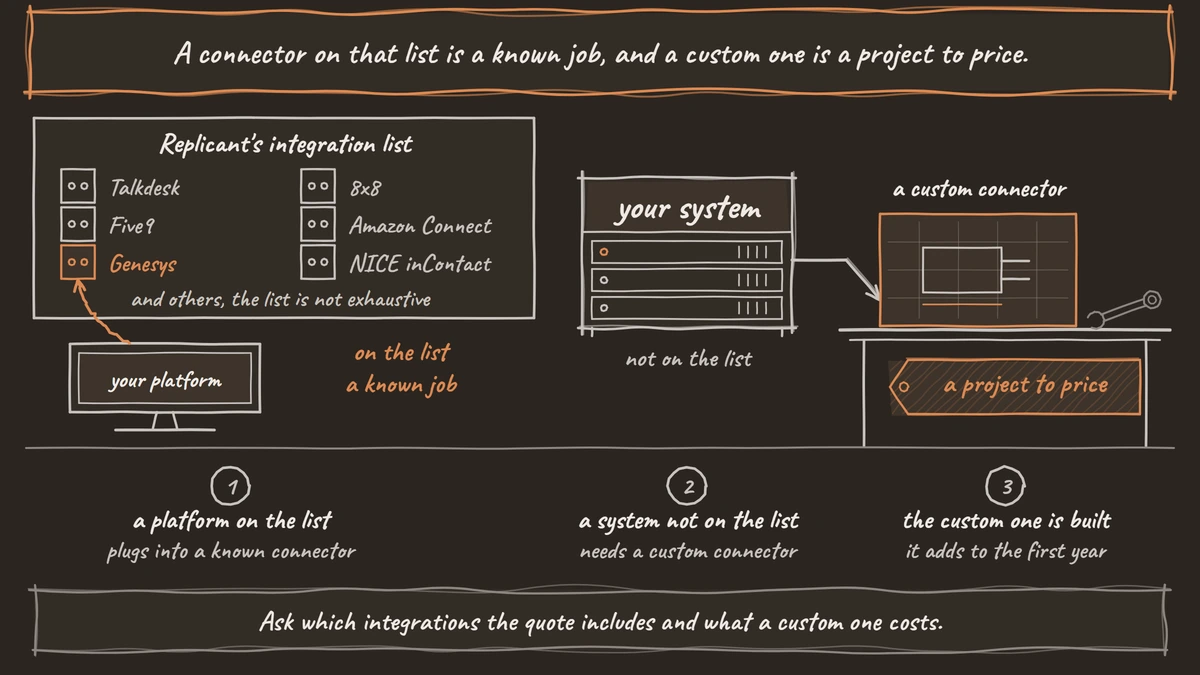
Integrations add work too. Replicant's integration list names Genesys, Talkdesk, Ujet, NICE inContact, Five9, Amazon Connect and 8x8 for contact centers, and Salesforce, Zendesk, ServiceNow, Kustomer and Gladly for CRM, and says the list is not exhaustive. A connector on that list is a known job, and a custom one is a project to price.
Volume and term close the list. Replicant's own claims count conversations automated, more than 100 million of them, so ask what one billing unit is in your contract and how much of your traffic it covers. Ask too how a larger volume commitment or a longer term moves the rate.

Open Source Alternative to Vapi / Retell
Self-hosted voice agent platform — no per-minute fees
dograh-hq/dograh
Star on GitHub
A worksheet for reading a Replicant quote
Replicant sets its rates in the quote, so this worksheet uses letters in place of prices. Fill each letter from the quote, and leave a line at zero only once sales confirms it does not apply.
| Line on the bill | How to work it out |
|---|---|
| Delivery and setup (S) | One-off fee for the build, if the quote lists one |
| Platform (P) | Any fixed monthly fee, whatever the volume |
| Usage | u units a month times the rate r, once you know what a unit is |
| Products and channels (C) | Conversation Intelligence, chat or SMS, if priced apart |
| Integrations (I) | Custom connectors outside the standard list |
| Phone | Carrier minutes and numbers, if your own carrier bills them |
In plain words, a month costs P + (u x r) + C + phone, and the first year adds S and I. The unit decides most of the bill, because u changes with every call while the other letters stay fixed. Bring last month's call counts and call lengths to the meeting so u is real, and compare the result with the published rates in our guide to Replicant alternatives.
Questions to ask in a Replicant quote
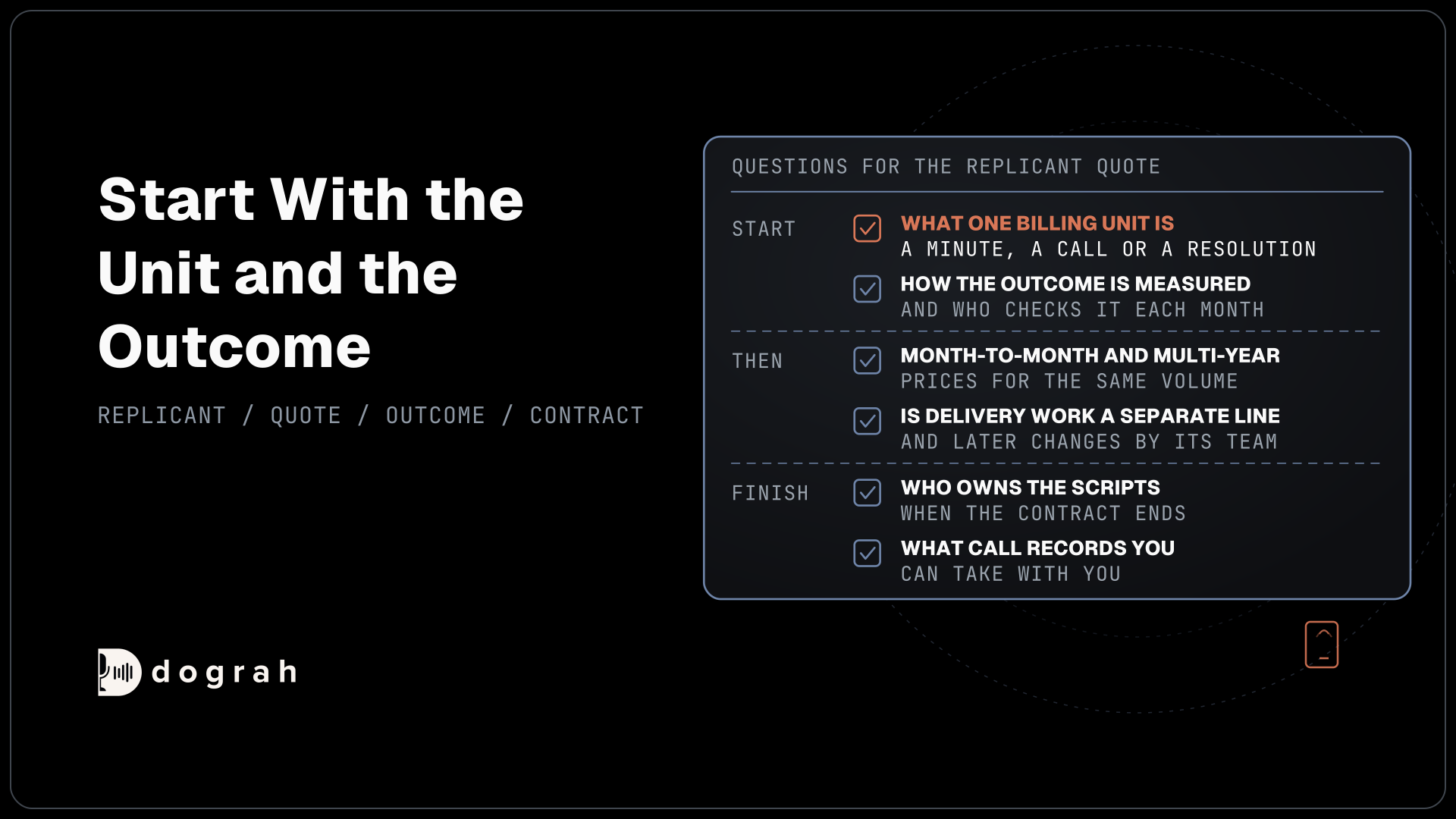
Start with the unit and the outcome. Ask what one billing unit is, a minute, a call or a resolution, and whether time after a transfer to a human agent counts. Ask how the agreed outcome is measured, who checks it each month, and what happens to the price if the program misses or beats it.
Then ask about the contract. Ask for the month-to-month and the multi-year price for the same volume, any minimum commitment, the overage rate and how the price changes at renewal. Ask whether delivery and implementation work is a separate line, whether later changes by Replicant's team cost extra, and whether Conversation Intelligence, chat or SMS are priced on their own.
Finish with integrations and exit. Ask which integrations the quote includes and what a custom one costs. Ask who owns the scripts and any tuned models when the contract ends, and what call records you can take with you.
Closed code and where call data goes
A Replicant quote buys a closed platform that Replicant runs for you. Its security page lists SOC 2 Type 2, PCI DSS and HIPAA certifications as independently validated, says "Customer data is never retained, reused, or used for training", and redacts personal and payment data from transcripts, analytics and QA by default.
Some details belong in the contract. Its agents run on "multiple, fine-tuned LLMs", so ask which model providers hear the audio. Ask too which region processes and stores your calls, and how long each record is kept. Your team configures scripts but cannot read the code that handles a call, so the security review rests on the contract and Replicant's certifications.
Join the Dograh Community
Dograh is an OSS alternative to Vapi. Join our Slack community for queries, releases, best practices & community interactions.
Where Dograh fits
Dograh is for teams that want to build the agents themselves and price the platform before any meeting. It is open source under BSD 2-Clause, and you can self-host it with Docker Compose on a server with 8 GB of RAM and 4 vCPUs, run it on Dograh Cloud, or take on-prem deployment on the Enterprise plan. Your team builds each agent in the Agent Builder or on the canvas, so a script change waits on nobody else.
The price is public, and the hosting choice sets it. Self-hosted Dograh has no per-minute platform fee, though servers, model keys and phone minutes still cost money, and the server, the database and the upgrades become your team's job. Support comes through the open-source community, with custom SLAs on Enterprise. Dograh Cloud handles the hosting for a 1¢-a-minute platform fee. As a worked example we calculated, 60,000 minutes in a month comes to a $600 platform fee before models and phone, with 10 concurrent calls included and more on request.
You also see every model in the call path, since you pick the speech-to-text, LLM and voice for each agent, including open-weight models that keep audio on your servers. Handoffs run through Transfer Call on Twilio, Telnyx, Plivo, Cloudonix and Asterisk ARI. Dograh calls the destination first and connects the caller only when someone answers, and if nobody picks up, the line is busy or the attempt fails, the call returns to the agent and carries on.
Replicant's case rests on a delivery team that builds the program and an outcome written into the contract, while this route puts the build in your team's hands. Our Dograh vs Replicant comparison weighs that trade in detail.
Glossary
- Agreed-upon business outcome
- The target Replicant agrees with a customer for evaluating the program's performance. How it relates to the bill is a question for the quote.
- Billing unit
- The quantity a usage-based contract counts, such as a minute, a call or a resolution. The same traffic gives very different bills depending on which unit applies.
- Delivery team
- Replicant's staff who design, build and tune a customer's agents. It is the managed part of the product, and its cost may sit in the rate or on its own line.
- Platform fee
- A charge for the software that runs the agent, separate from model, speech and phone costs. It can be fixed per month or counted per minute.