
Dograh and Kore.ai differ most in scope and in who owns the code. Kore.ai is a closed enterprise suite for customer service, employee support and process automation, sold by quote and metered per session. Teams that want to read the code and run the platform on their own servers get open-source Dograh, with the models they pick.
Key Takeaways
- Kore.ai covers service, employee support and back-office work in one closed suite.
- Both can run on your own servers, but only one lets you read the code.
- Kore.ai meters each module per session, so ask how one call becomes sessions.
Kore.ai sells an enterprise suite in which voice agents are one part, while Dograh is an open-source platform built for voice agents. This post sets the two side by side, starting with who builds the agent and ending with what a month costs on each. The last section covers when Dograh fits.
Dograh vs Kore.ai at a glance
Kore.ai calls itself an enterprise conversational and agentic AI platform, and its Agent Platform runs agents for customer service, employee support and process automation. Dograh is an open-source AI voice agent platform for phone and browser calls. Each row asks both products the same question.
| Row | Kore.ai | Dograh |
|---|---|---|
| Code | Closed. SDKs and tools under MIT | Open source under BSD 2-Clause |
| Who builds the agent | Your team, in ABL through Agent Studio, visually or in code, with Arch and coding tools | Your team, by describing it in the Agent Builder or editing on the canvas |
| Scope | Customer service, employee support and process automation | Voice agents for phone and browser calls, with a web chat widget |
| Voice path | Kore.ai Voice Gateway, pipeline or realtime | Speech-to-text, LLM and voice per agent, or a speech-to-speech model |
| Phone numbers | A number bought through Twilio inside Kore.ai, or your own SIP | Your own carrier, from Twilio and Telnyx to Asterisk ARI |
| Speech-to-speech | Five realtime providers | Seven options, from OpenAI Realtime to Gemini Live |
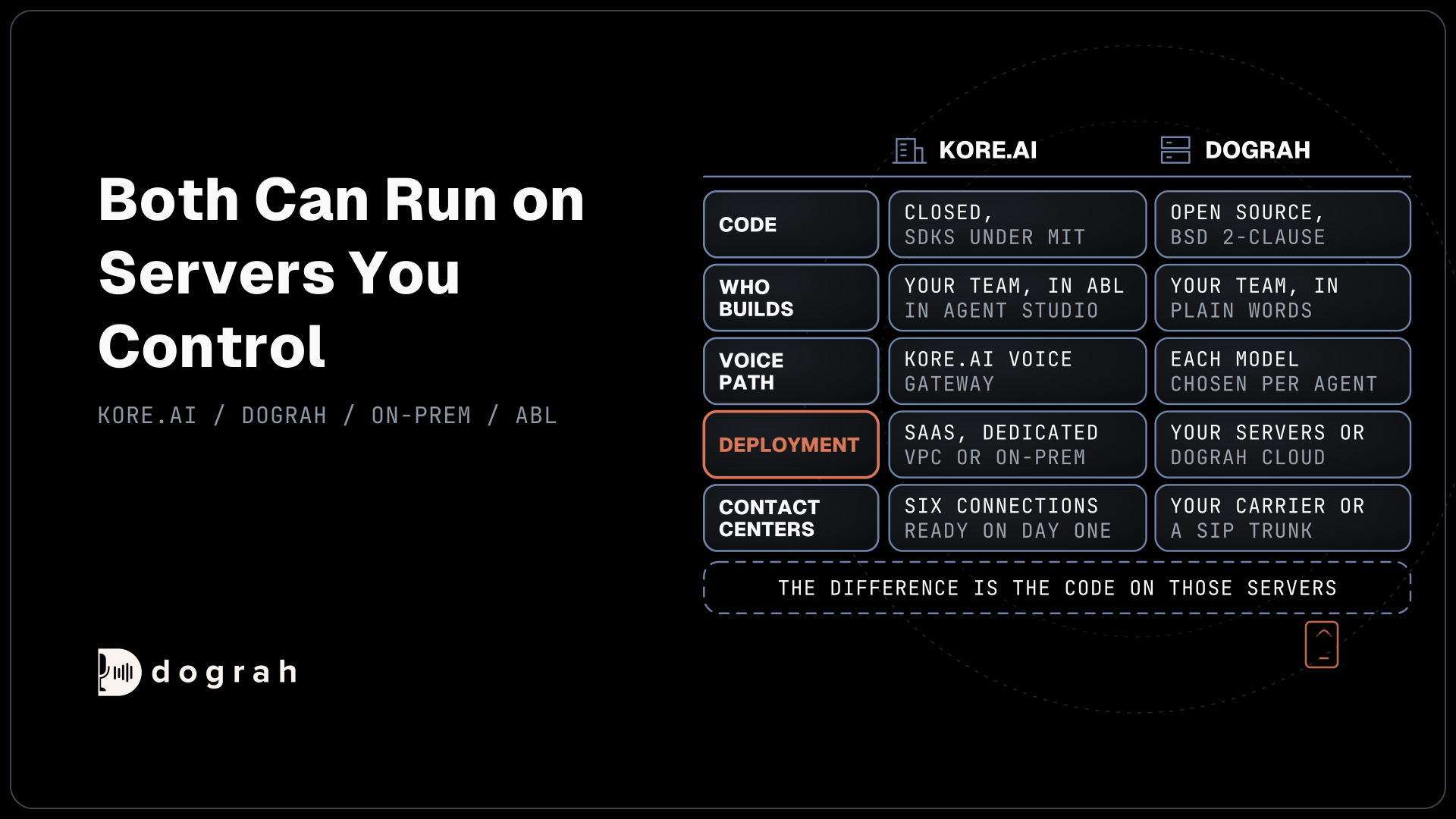
| Deployment | Multi-tenant SaaS, a dedicated VPC or on-prem | Your servers with Docker Compose or Helm, Dograh Cloud, or on-prem on Enterprise |
| Where call data sits | Kore.ai's cloud, your VPC or your data center, on closed code | Your own Postgres and storage when self-hosted |
| Pricing shape | By quote, modules metered per session on a 12-month contract | Self-hosted, no per-minute platform fee. Dograh Cloud, 1¢/min platform fee |
| Contact centers | NICE CXone, Five9, Microsoft Dynamics 365, Talkdesk, Genesys and Amazon Connect | Your carrier or SIP trunk, Asterisk ARI and Transfer Call to a queue number |
| Leaving | A project archive that imports into Kore.ai, messages and recordings by API | A CSV report of calls, agents as JSON and your own database |
Who builds the agent, ABL or plain words
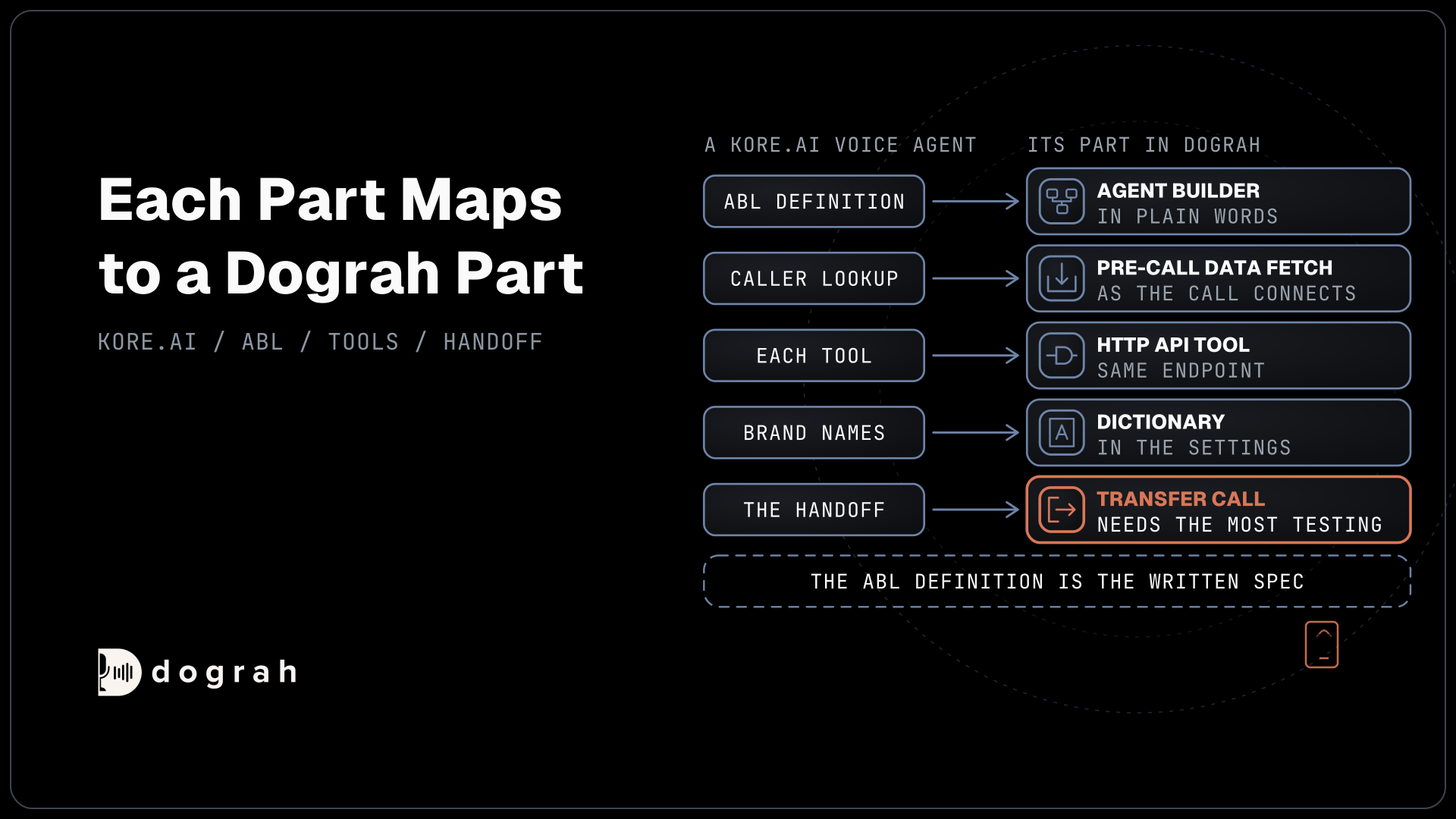
Your own team builds the agent on both products, and what differs is the tooling. Kore.ai agents are defined in ABL, its Agent Blueprint Language, which Kore.ai describes as a typed, schema-driven language for behavior, tools, guardrails and handoffs. Builders work in Agent Studio with visual and code authoring, Arch acts as a built-in AI solution architect, and the platform supports coding tools such as Claude Code, Cursor and Codex.
Dograh starts from a plain-words description. On the "Create an agent" page you describe the call, approve the "Your agent requirements" card and let the Agent Builder build it, and "Test agent" publishes version 1. Later edits in the Builder tab save as a draft while the published version keeps taking calls, and the canvas stays open for hand changes.
A self-hosted install runs the Agent Builder with a Dograh Service Key, and the canvas works without one. The Dograh MCP server lets an AI assistant create and edit agents too, so a team that likes building from a coding tool keeps that habit.
Voice, phone lines and contact centers
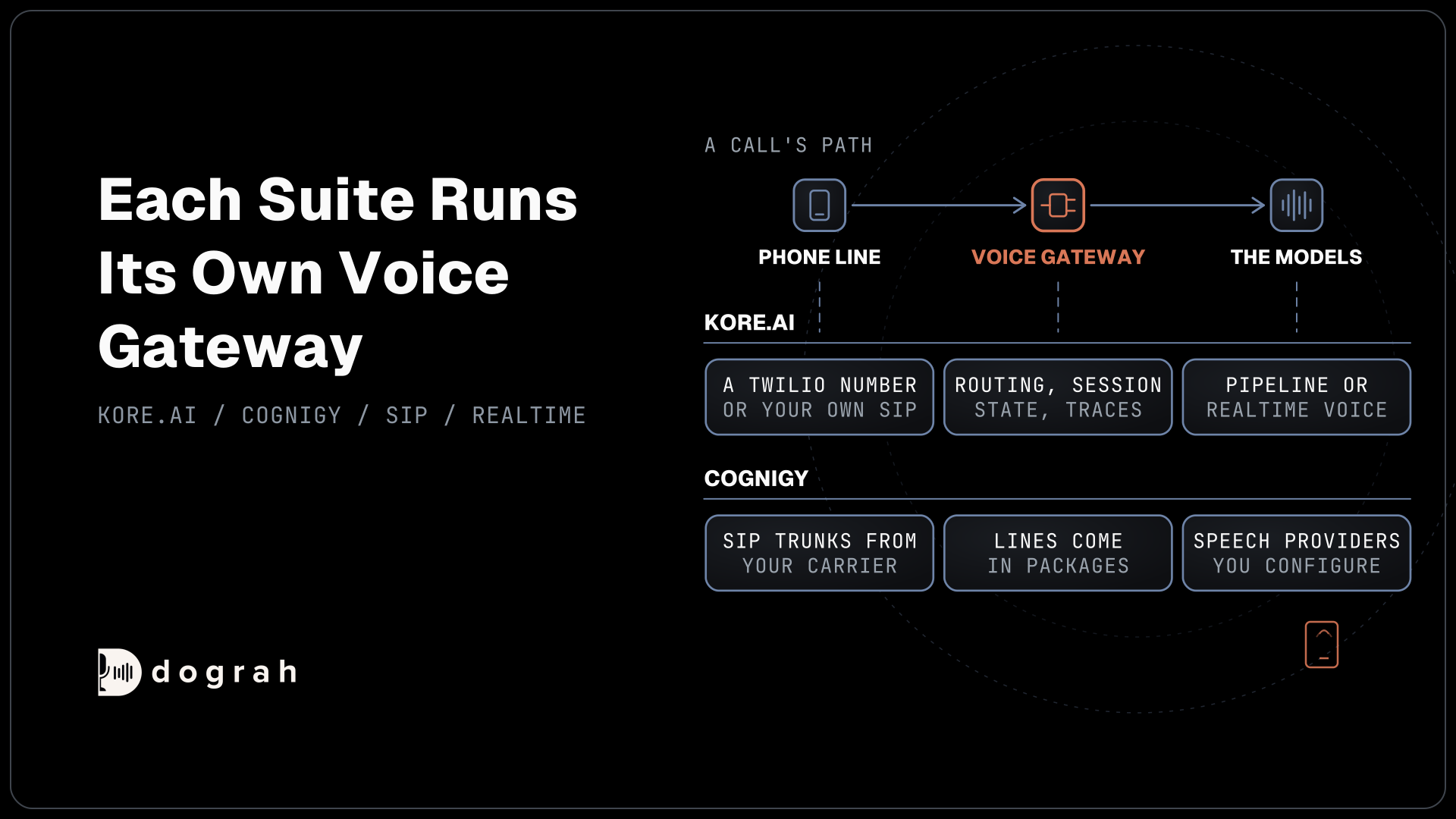
Voice on Kore.ai runs through its own gateway. The Kore.ai Voice Gateway handles telephony, routing, session state, traces and the call lifecycle, with a browser soft phone for tests, a number bought through Twilio, or your own SIP provider pointed at Kore.ai's SIP server. In pipeline mode an LLM works with speech providers such as Deepgram, Microsoft Speech and ElevenLabs, while realtime mode runs on Amazon Nova Sonic, Azure OpenAI Realtime, Grok, Gemini Live or OpenAI Realtime. With parallel transcription on, the caller's audio goes to both a speech-to-text and a speech-to-speech provider, and Kore.ai tells you to review usage and billing for both.
Dograh connects to your own carrier, whether that is Twilio, Telnyx, Plivo, Vonage, Exotel, Vobiz or Cloudonix, or an existing phone system through Asterisk ARI. On Twilio, Telnyx, Plivo, Cloudonix and Asterisk ARI, the Transfer Call tool hands a caller to a person, and Dograh calls the destination first and connects the caller only when someone answers. A busy, unanswered or failed attempt comes back to the agent, and the call continues.
Contact centers are where Kore.ai is ready on day one. It lists NICE CXone, Five9, Microsoft Dynamics 365, Talkdesk, Genesys and Amazon Connect, so the AI layer plugs into routing your team already uses. The open platform sits beside a contact center through your carrier, a SIP trunk or Asterisk ARI, hands callers to a queue number with Transfer Call, and reaches the CRM through HTTP API tools.

Open Source Alternative to Vapi / Retell
Self-hosted voice agent platform — no per-minute fees
dograh-hq/dograh
Star on GitHub
Deployment and where call data sits
Both products can run on servers you control, which keeps this row honest. Kore.ai offers multi-tenant SaaS, a dedicated VPC and on-premises deployment, and its trust center lists SOC 2 Type 2, PCI DSS and ISO/IEC 27001 among its certifications. Rasa's comparison with Kore.ai concedes that on-prem gives residency control, and adds that patches, scaling and high availability then fall to your operations team.
The difference is the code on those servers. A Kore.ai install inside your data center still runs Kore.ai's closed code under its license, so your security team reviews a contract. Dograh's code is public, and you can self-host it with Docker Compose on one server with 8 GB of RAM and 4 vCPUs, with runs and transcripts in Postgres and recordings in MinIO.
The audio follows the models. Your own provider keys move the contract to you while the audio still reaches each provider, and open-weight models on your own machines keep it inside your network for the whole call. Our post on the open-source alternative to Kore.ai maps where call data lives in each setup.
How each one prices a month
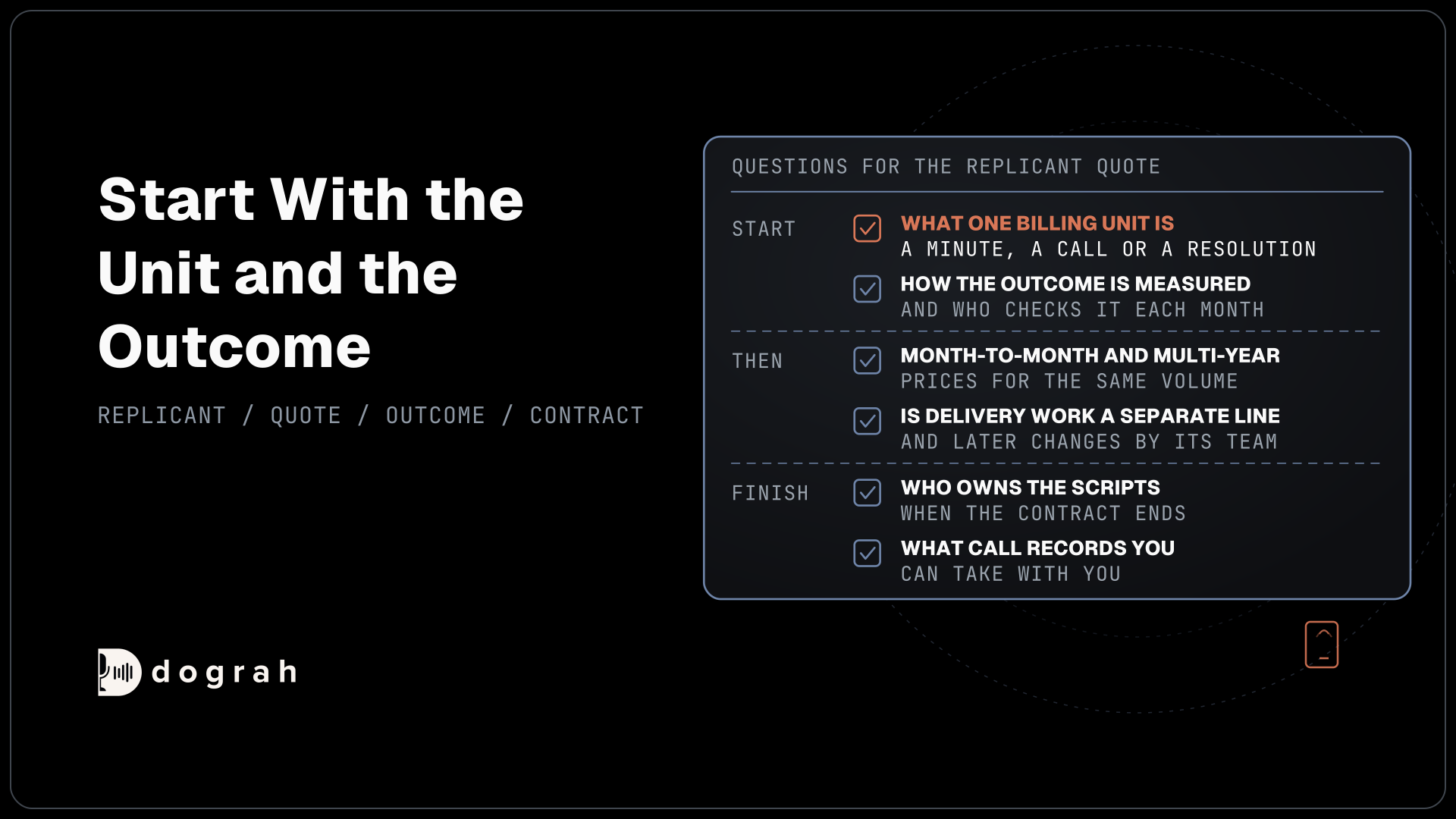
Kore.ai prices each deal by quote, and its AWS Marketplace listing for AI for Service shows the shape. It is a 12-month contract with no refunds, and every module is priced per session, from the base AI for Service line to Agent AI, Contact Center AI, Quality AI and the Interaction Gateway. Our post on Kore.ai pricing explains how a session turns into billing units.
The open side has fewer lines to read, and the hosting choice sets them. Self-hosted Dograh has no per-minute platform fee, though servers, model keys and phone minutes still cost money. A self-hosted install runs 10 calls at once by default, a limit you can raise, and the server, the database and the upgrades become your team's job, with support through the open-source community and custom SLAs on Enterprise. Dograh Cloud handles the hosting for a 1¢-a-minute platform fee and includes 10 concurrent calls, with more on request.
Where Kore.ai wins
Kore.ai is the stronger pick when the project is bigger than voice. One vendor covers customer service, employee support through AI for Work in HR, IT, sales and finance, and back-office jobs such as accounts payable. A company buying across departments gets one platform, one governance model and one contract.
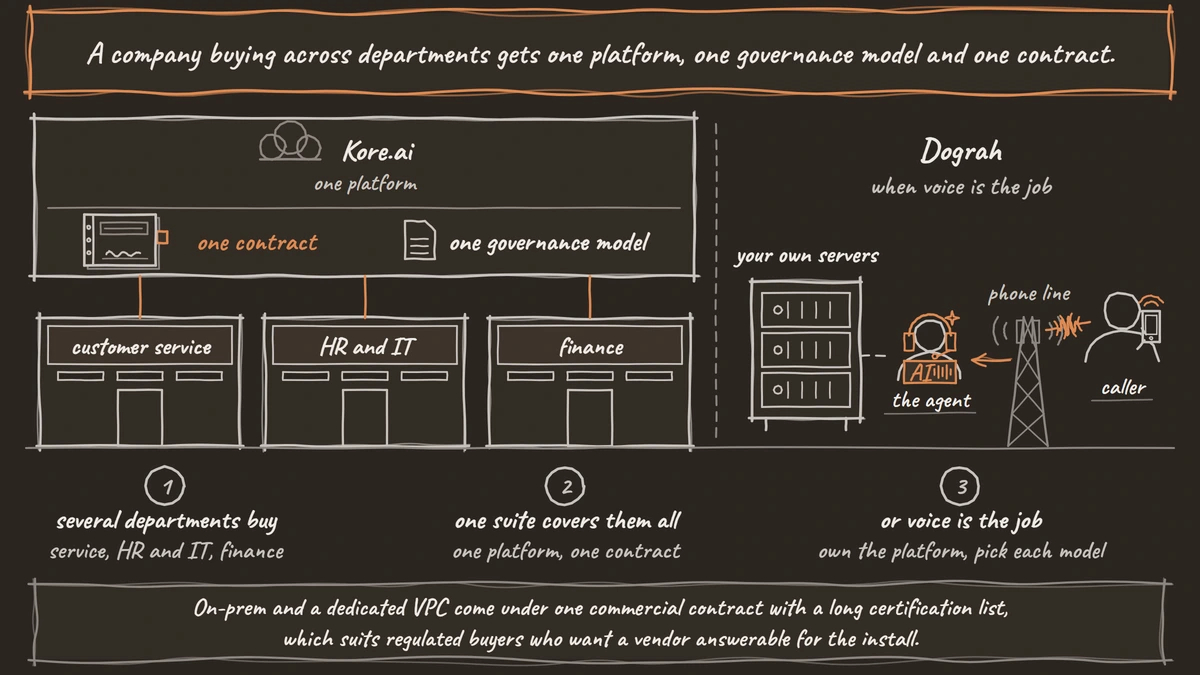
It is also ready for a large human floor. Agent AI assist, Contact Center AI, Quality AI and Outbound Campaigns work beside human agents, and the six contact center connections keep existing routing and reporting in place. On-prem and a dedicated VPC come under one commercial contract with a long certification list, which suits regulated buyers who want a vendor answerable for the install.
Buyers on PeerSpot give Kore.ai 7.8 out of 10 from 16 reviews, with 93% willing to recommend it, a small sample. They praise its low-code design, plugins and models, real-time testing and fast proofs of concept, and some ask for steadier support and clearer documentation. Our Kore.ai review covers who it fits.
Join the Dograh Community
Dograh is an OSS alternative to Vapi. Join our Slack community for queries, releases, best practices & community interactions.
When Dograh fits
Dograh fits when voice is the job and you want to own the platform. That means reading and changing the code, running it on your own servers without an enterprise contract, choosing each model per agent, and keeping call audio inside your network with local models when the data demands it.
To test the fit, start one agent on Dograh Cloud or a Docker Compose install and send one real call flow through your own carrier. Test the handoff over a real phone call, since browser test calls cannot transfer, and compare the call records with what Kore.ai gives you today. If you want more options first, our roundup of Kore.ai alternatives covers the field.
Glossary
- Agent Blueprint Language (ABL)
- Kore.ai's typed, schema-driven language for an agent's behavior, tools, guardrails and handoffs. Agents written in it run only on Kore.ai's platform.
- Session
- Kore.ai's unit for one conversation between a user and the agents in a project, kept even when the user moves between agents. Its AWS listing prices each module per session.
- Speech-to-speech model
- A model that hears the caller's audio and replies in audio in one step, without separate speech-to-text and text-to-speech stages.
- Open-weight model
- An AI model whose weights you can download and run on your own servers. Running one keeps call audio from reaching an outside model provider.