
Kore.ai vs Cognigy is a choice between two closed enterprise suites sold by quote. Kore.ai is independent, bills per session and still sells on-prem. NiCE Cognigy bills per billable conversation, sells only SaaS to new customers and fits NiCE CXone shops. Teams that want open code on their own servers can run Dograh, an open-source voice agent platform.
Key Takeaways
- Kore.ai still sells on-prem, while new Cognigy buyers get SaaS or CXone only.
- Kore.ai meters each module per session, and Cognigy counts billable conversations.
- On NiCE CXone, every 10 minutes of a voice call counts as a conversation.
Kore.ai and NiCE Cognigy both sell AI agents to large contact centers, and they part ways on how you deploy them, what they cover and how a call is billed. This post sets the two side by side so you can see which one fits your team. For teams that want to host the agent themselves, the last section covers open-source Dograh.
Kore.ai vs Cognigy in one table
Both suites build AI agents that answer customers and hand the hard cases to people, and both keep their code closed. The rows below come from each vendor's product pages, docs and listings, and the sections after them explain the rows that change a buying decision.
| Kore.ai | NiCE Cognigy | |
|---|---|---|
| Owner | Independent, led by founder and CEO Raj Koneru | NiCE, since 8 September 2025 |
| Scope | Customer service, employee support and process automation | Customer service across voice and digital channels, plus Agent Copilot for human agents |
| Voice path | Kore.ai Voice Gateway, pipeline or realtime | Voice Gateway on SIP trunks from your carrier |
| Phone lines | A number bought through Twilio inside Kore.ai, or your own SIP | Your carrier's SIP trunks |
| Speech-to-speech | Five realtime providers | One model in the docs, marked experimental. NiCE announced native models in November 2026 |
| Deployment for a new buyer | Multi-tenant SaaS, a dedicated VPC or on-prem | Cognigy SaaS or inside NiCE CXone |
| Contact center fit | NICE CXone, Five9, Microsoft Dynamics 365, Talkdesk, Genesys and Amazon Connect | Native in CXone, built for Amazon Connect, Avaya and Genesys |
| Billing unit | Session, each module metered per session | Billable conversation, plus Voice Gateway line packages |
| Rates | Set in a quote, 12-month contract on AWS Marketplace | Set in a quote |
| Leaving | A project archive that imports into Kore.ai, messages and recordings by API | Snapshots that open only in Cognigy, conversation data through OData |
Who owns each and what they sell
Kore.ai is an independent company, and it sells far beyond the contact center. Its AI for Service line covers AI agents, agent assist, contact center AI, voice agents, quality AI and outbound campaigns, AI for Work covers HR, IT, sales and finance requests, and its process products cover back-office jobs such as accounts payable. Kore.ai even names Cognigy among its own competitors, beside Glean, Moveworks, Decagon and Sierra. Our Kore.ai review covers the products in detail.
Cognigy belongs to NiCE, which closed its acquisition of Cognigy on 8 September 2025 and sells it inside the CXone platform and as a standalone product. Cognigy answers on voice, webchat, WhatsApp and SMS in more than 100 languages, with Agent Copilot and Live Chat for the people who take over. On 12 November 2026 NiCE launched a next generation of the product, and our Cognigy review covers what changed.
How calls reach each voice gateway
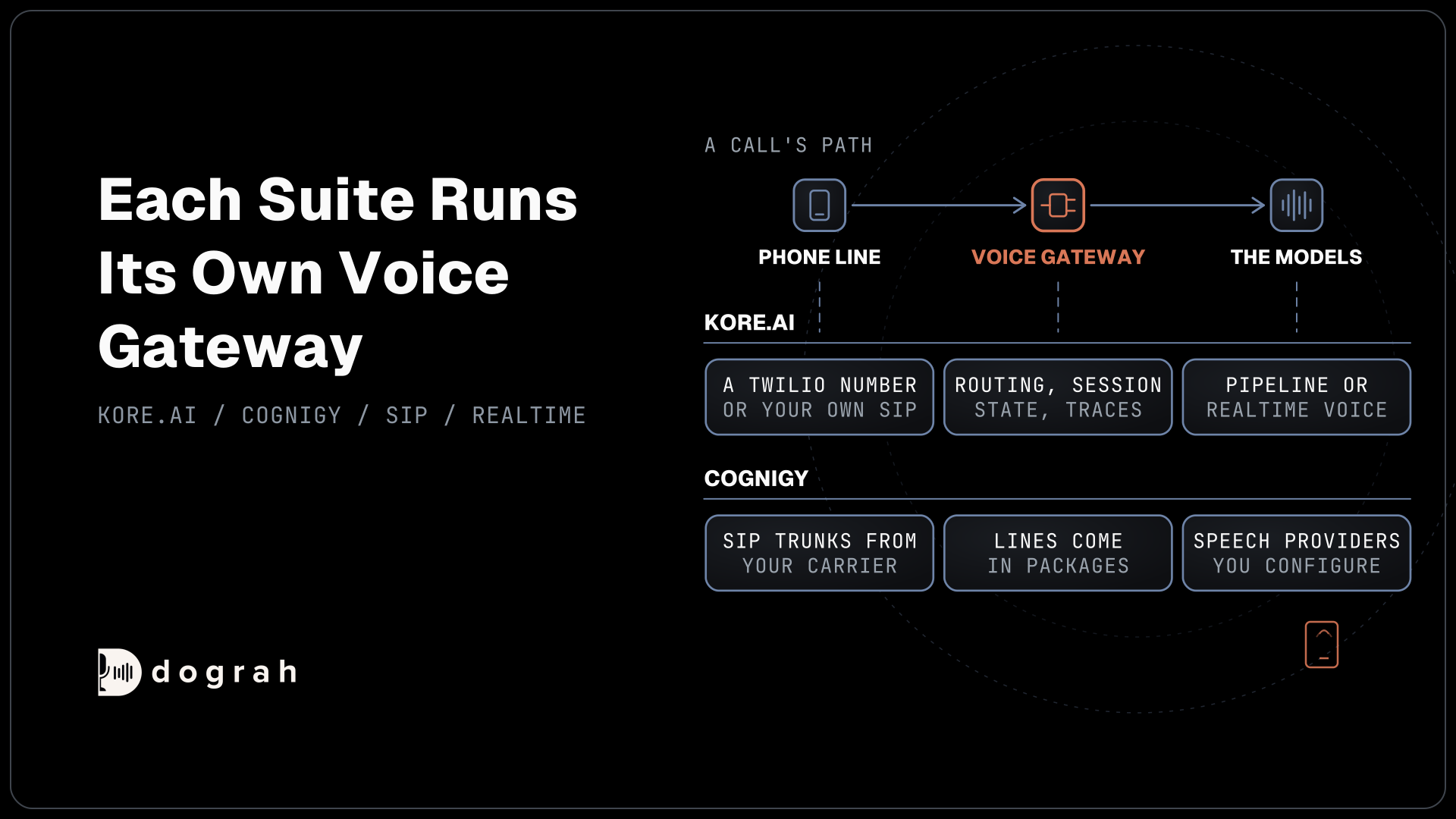
Each suite runs its own voice gateway, and they connect to phone lines differently. The Kore.ai Voice Gateway handles telephony, routing, session state, traces and the call lifecycle. You can test from a browser soft phone, buy a number through Twilio inside Kore.ai, or point your own SIP provider at Kore.ai's SIP server.
Kore.ai offers two voice modes. Pipeline voice pairs speech providers such as Deepgram, Microsoft Speech and ElevenLabs with an LLM, and realtime voice uses Amazon Nova Sonic, Azure OpenAI Realtime, Grok, Gemini Live or OpenAI Realtime. With parallel transcription switched on, the caller's audio goes to both a speech-to-text and a speech-to-speech provider, and both bill you.
Cognigy's Voice Gateway takes calls over SIP trunks from your own carrier, which must allow Cognigy's voice IP addresses, with G.711 as the preferred codec and transfers by SIP REFER or SIP INVITE. Capacity comes in packages of concurrent lines. NiCE's November launch announced native speech-to-speech models, while Cognigy's docs still list one speech-to-speech model, OpenAI GPT Live, and call the feature experimental and not recommended for production. Ask which applies to your contract.
Deployment and data for a new buyer
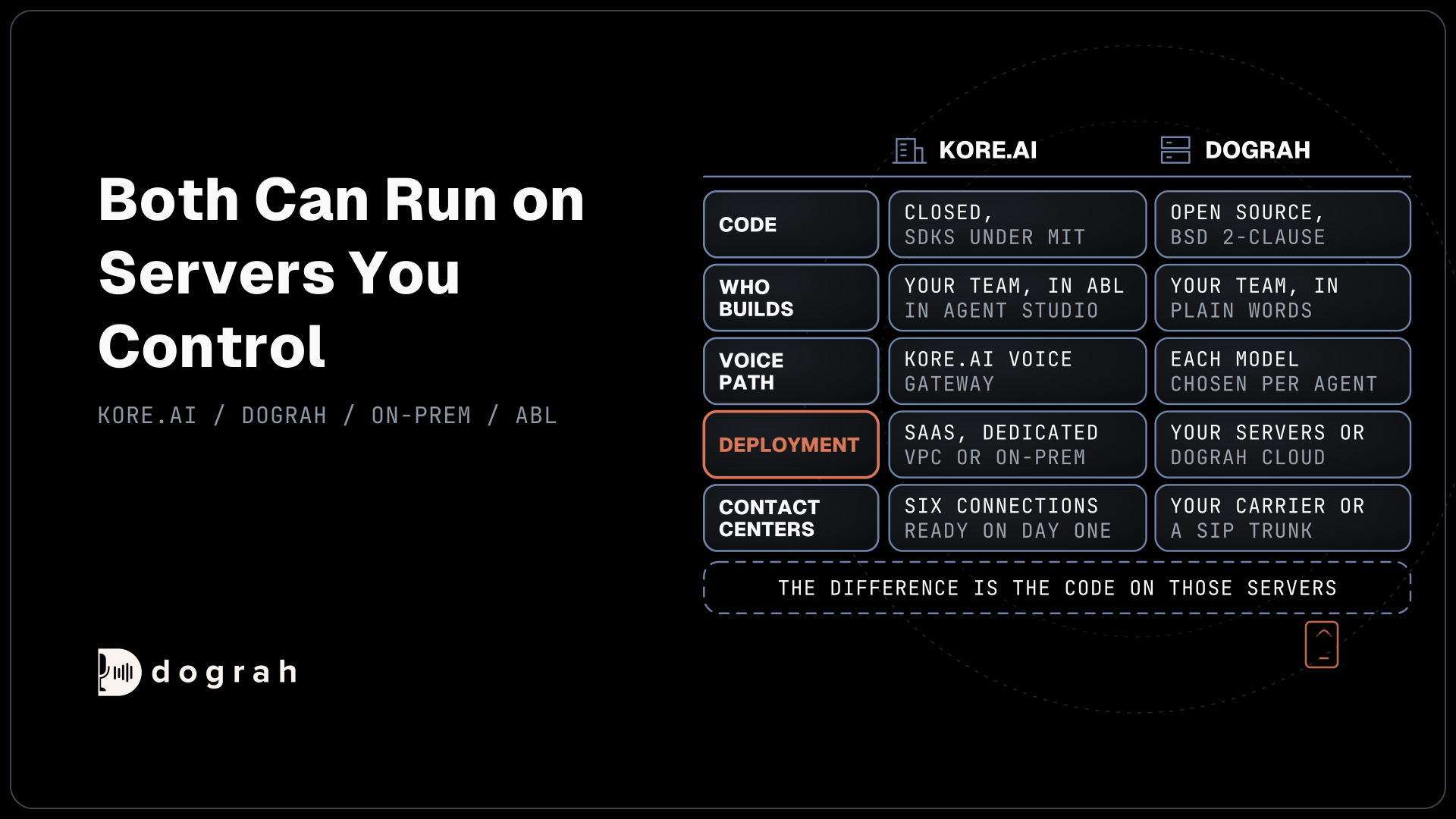
This is the row that most often decides the choice. Kore.ai offers multi-tenant SaaS, a dedicated single-tenant VPC and on-premises deployment, so a buyer who needs the runtime inside its own walls can still sign for it. Cognigy no longer offers on-premises installations to new customers, while existing installs keep running and receiving updates.
A new Cognigy buyer gets Cognigy SaaS, a managed cloud that usually runs in a shared environment, with clusters in Europe, the US, the UK and Australia, or Cognigy inside NiCE CXone and its own regions. On either suite the caller's audio also reaches the speech and language providers you configure, and on either suite the code stays closed, including on a Kore.ai on-prem install.

Open Source Alternative to Vapi / Retell
Self-hosted voice agent platform — no per-minute fees
dograh-hq/dograh
Star on GitHub
Sessions or billable conversations
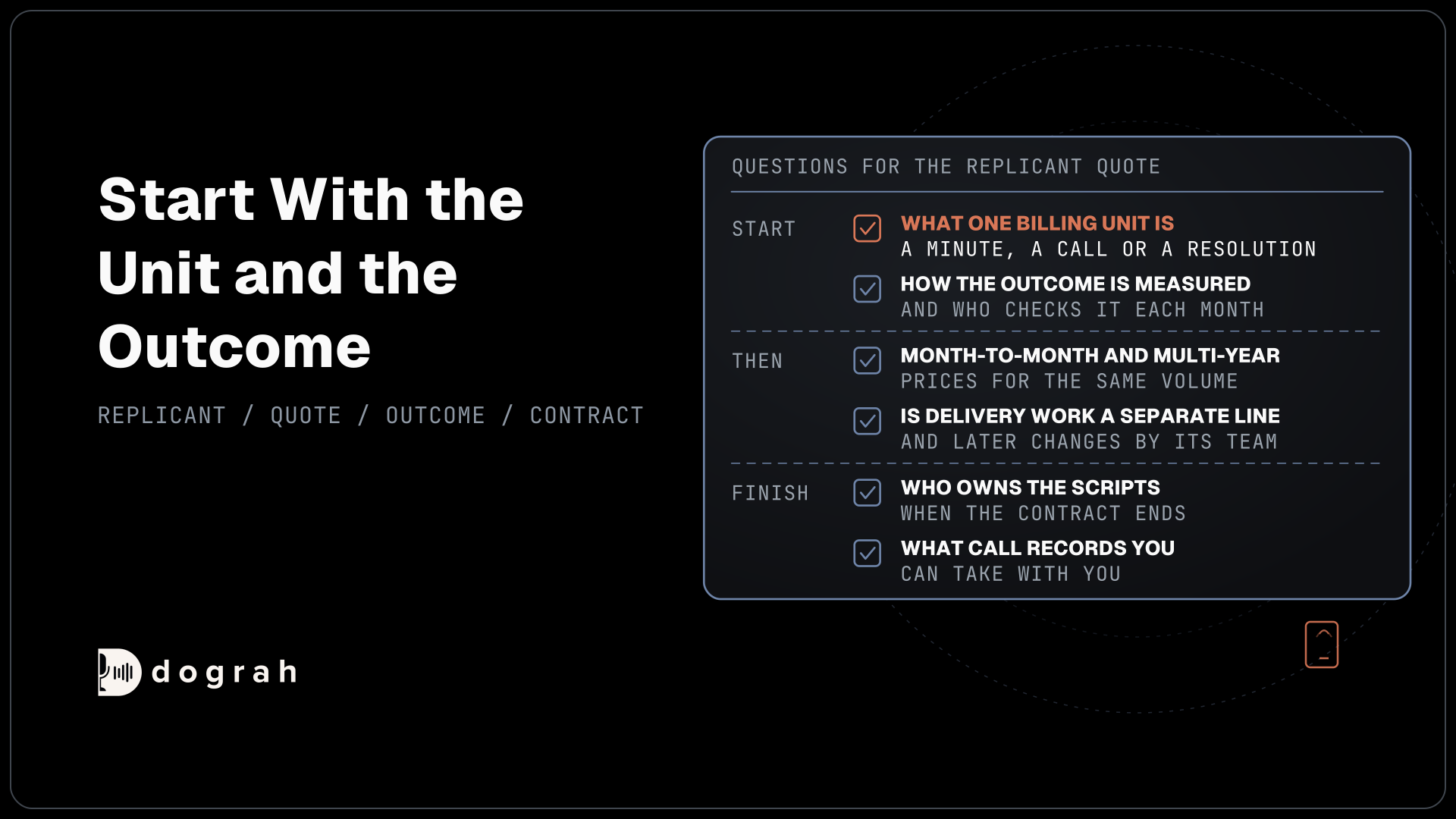
The two suites count usage in different units, and both set their rates in a quote. Kore.ai's AWS Marketplace listing for AI for Service is a 12-month contract with no refunds, and every module is priced per session, from the base line to Agent AI, Contact Center AI and the Interaction Gateway. A session is one conversation between a user and the agents in a project, and how a session becomes billing units depends on your plan, which our post on Kore.ai pricing walks through.
Cognigy counts a billable conversation, limited to up to 50 user inputs within 24 hours. Voice Gateway lines are a separate package, and a day above the package is billed as overage for that day. On NiCE CXone, voice counts by time, with up to 10 minutes of a call counted as one conversation and longer calls counted as more. NiCE also says default AI models are now included in the conversation price, and Cognigy limits those included models to installs connected to CXone with a new SKU.
As an example, take one support call that runs 23 minutes with fewer than 50 caller inputs. On standalone Cognigy it is one conversation. On NiCE CXone it counts as three, one for each started block of 10 minutes. On Kore.ai it is one session, and the units it earns depend on your plan's billing interval. Long calls move the two bills differently, so ask both vendors to price your real mix of call lengths.
What buyers say about each
Buyer reviews lean slightly toward Cognigy, on small samples. On PeerSpot, Cognigy averages 8.4 from 15 reviews with every reviewer willing to recommend it, and Kore.ai averages 7.8 from 16 reviews with 93% willing to recommend it.
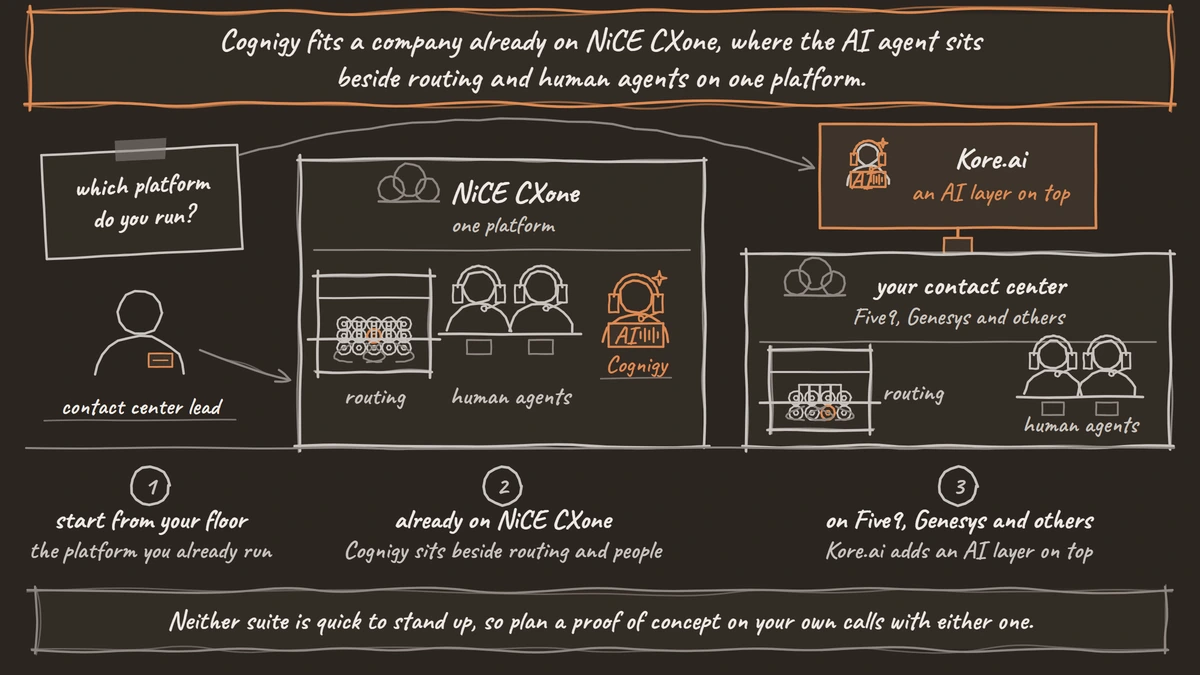
The themes differ more than the scores. Cognigy reviewers praise its visual builder and reusable assistants, and some find its pricing high or unclear and its version control weak for teams. Kore.ai reviewers praise low-code design, plugins and models, real-time testing and fast proofs of concept, and some report slow support after launch and disorganized documentation. Neither suite is quick to stand up, so plan a proof of concept on your own calls with either one.
Which one fits your team
Kore.ai fits a buyer who needs on-prem or a dedicated VPC today, or one vendor across customer service, employee support and back-office automation. It also suits a contact center on Five9, Talkdesk, Genesys, Amazon Connect or Microsoft Dynamics 365 that wants an AI layer on top, and a team that wants several realtime speech-to-speech providers in production.
Cognigy fits a company already on NiCE CXone, where the AI agent sits beside routing and human agents on one platform. It also suits a buyer happy on SaaS in a European, US, UK or Australian region who wants voice plus WhatsApp, SMS and webchat from one agent in 100+ languages. If you are also weighing Parloa, our Parloa vs Cognigy comparison covers that pair.
Join the Dograh Community
Dograh is an OSS alternative to Vapi. Join our Slack community for queries, releases, best practices & community interactions.
Where Dograh fits
Both suites keep their code closed, and only Kore.ai still sells on-prem to a new buyer. Dograh is an open-source AI voice agent platform under BSD 2-Clause, so a team that wants the platform on its own servers can run it there and read every line. The Docker Compose install needs a server with at least 8 GB of RAM and 4 vCPUs, a Helm chart covers Kubernetes, and the Enterprise plan adds on-prem and private-cloud deployment with data residency.
It is the orchestration layer for the call flow, tools and telephony, and you pick the speech-to-text, LLM and voice for each agent, including open-weight models that keep call audio inside your network. Callers reach it over Twilio, Telnyx, Plivo, Vonage, Exotel, Vobiz, Cloudonix or your own PBX through Asterisk ARI. With Transfer Call on Twilio, Telnyx, Plivo, Cloudonix or Asterisk ARI, Dograh calls the destination first and connects the caller only when someone answers, and a busy, unanswered or failed attempt returns to the agent so the call goes on.
Running it yourself changes the cost and the work. Self-hosted Dograh has no per-minute platform fee, though servers, model keys and phone minutes still cost money, and the server, the database and the upgrades become your team's job. Support comes through the open-source community, with custom SLAs on Enterprise. Dograh Cloud handles the hosting for a 1¢-a-minute platform fee and includes 10 concurrent calls, with more on request.
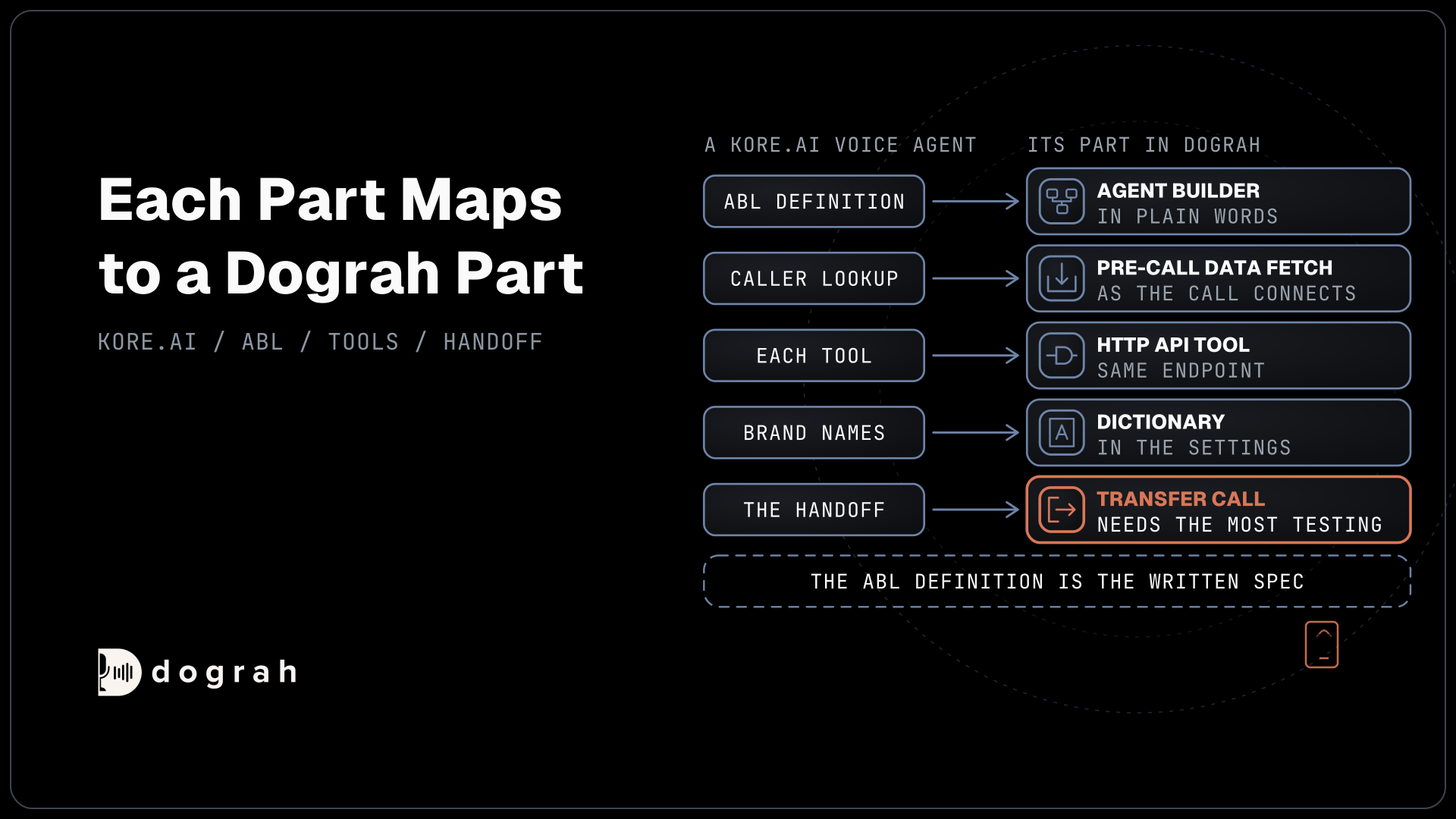
In the contact center, this route works through your phone line. The agent hands callers to a queue number with Transfer Call, and your CRM connects through HTTP API tools during the call. Our Dograh vs Kore.ai comparison weighs packaged connectors against this route in detail.
Glossary
- Session
- Kore.ai's usage unit, one conversation between a user and the agents in a project, kept even when the user moves between agents. Its AWS listing prices each module per session.
- Billable conversation
- Cognigy's usage unit, limited to up to 50 user inputs within 24 hours. On NiCE CXone, voice counts up to 10 minutes of a call as one conversation.
- Voice gateway
- The telephony layer that connects phone lines to an AI agent. Kore.ai and Cognigy each run their own, and Cognigy sells its capacity in packages of concurrent lines.
- Speech-to-speech model
- A model that hears the caller's audio and answers in audio in one step, without separate speech-to-text and text-to-speech stages.