
Replicant alternatives are divided into hosted voice platforms with published per-minute prices, open-source platforms you own and can self-host, and frameworks for teams that build the agent in code. Dograh is the open-source AI voice agent platform for teams that want ownership, run self-hosted or on Dograh Cloud. Vapi, Retell AI and Bland are the hosted platforms.
Key Takeaways
- Replicant prices each deal on request, with an agreed business outcome in the contract.
- Vapi, Retell AI and Bland publish per-minute rates you can price before a demo.
- Dograh's full platform is open source, so it can run on your own servers.
Replicant builds and runs voice, chat and SMS agents for large contact centers, priced on request. Below we compare the options in one table, start with open-source Dograh, then cover hosted platforms, frameworks, other managed vendors and a priced month, then when staying wins and what moving takes.
Replicant alternatives in one table
Replicant is the baseline row, and every other option answers the same five questions. Replicant's Conversation Automation covers voice, chat and SMS in over 30 languages on "multiple, fine-tuned LLMs", and its Delivery and Implementation team builds the agents. Replicant's pricing is pay-as-you-go under month-to-month or multi-year terms, with an agreed business outcome, and rates come on request.
| Option | Open source | Where it runs | How it bills | Who builds the agent | Models |
|---|---|---|---|---|---|
| Replicant (baseline) | No | Replicant runs it for you | Pay-as-you-go, rates on request, month-to-month or multi-year with an agreed business outcome | Replicant's Delivery and Implementation team, with point-and-click script edits | Multiple fine-tuned LLMs chosen by Replicant |
| Dograh | Yes, BSD 2-Clause | Your own servers with Docker Compose, Dograh Cloud, or on-prem on Enterprise | Self-hosted, no per-minute platform fee. Dograh Cloud, 1¢/min platform fee. Models and phone extra | Your team, with the Agent Builder or on the canvas | Dograh's own, your keys, or open-weight models on your servers, picked per agent |
| Vapi | No | Vapi's cloud | $0.05/min hosting plus models and phone. Core $29/mo for 10 calls at once | Your team, in code or the dashboard | Many providers, passed through at cost |
| Retell AI | No | Retell's cloud, with VPC or on-prem through an enterprise deal | $0.055/min voice infrastructure, $0.015/min telephony and the LLM. $0.07 to $0.31/min all-in | Your team | A choice of language models |
| Bland | No | Bland's cloud, with on-prem or VPC on Enterprise | Start $0.14/min. Build $0.12/min plus $299/mo | Your team | Bland's own models, inside the rate |
| LiveKit Agents and Pipecat | Yes, Apache-2.0 and BSD-2-Clause | Your own servers | Free to self-host | Your engineers, in code | Any model you wire in |
Every closed row runs code you cannot read, and only the hosted rows print a rate you can multiply by your own minutes. Dograh and the frameworks let you read and run the code, and Dograh is the one that arrives as a working platform with phone connections, transfers and QA in place. Our Replicant review covers the product itself, from its integrations to its security claims.
Dograh: open code you host and price yourself
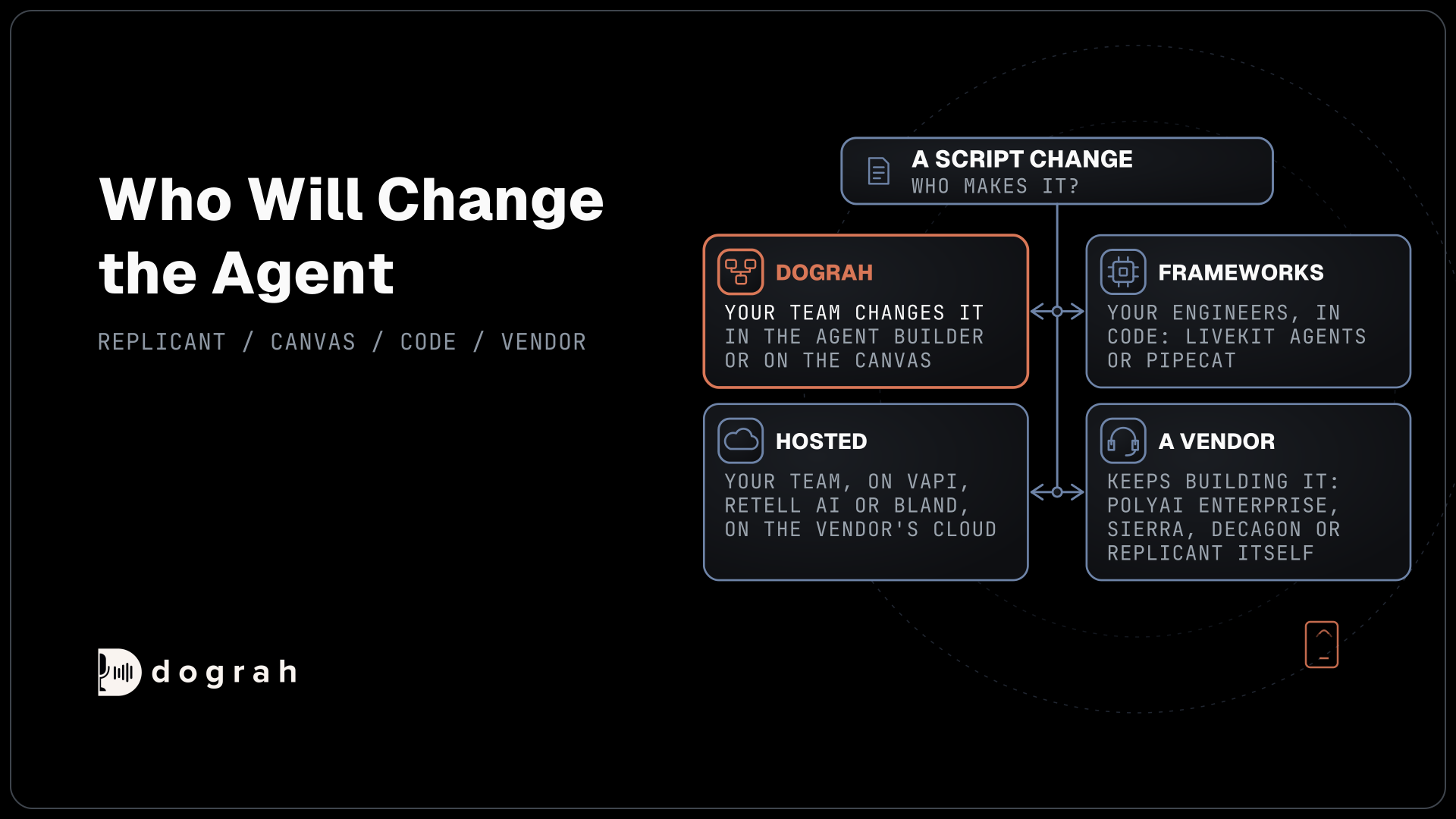
Dograh puts the whole platform in its GitHub repository under the BSD 2-Clause license, so your security team can read every line that touches a call. You can self-host it with Docker Compose on a server with at least 8 GB of RAM and 4 vCPUs, run it on Dograh Cloud, or take on-prem deployment inside your own data perimeter on the Enterprise plan. Your team builds the agent, by describing it to the Agent Builder and approving its plan or by drawing the flow on the canvas, so a script change never waits on a vendor's delivery queue.
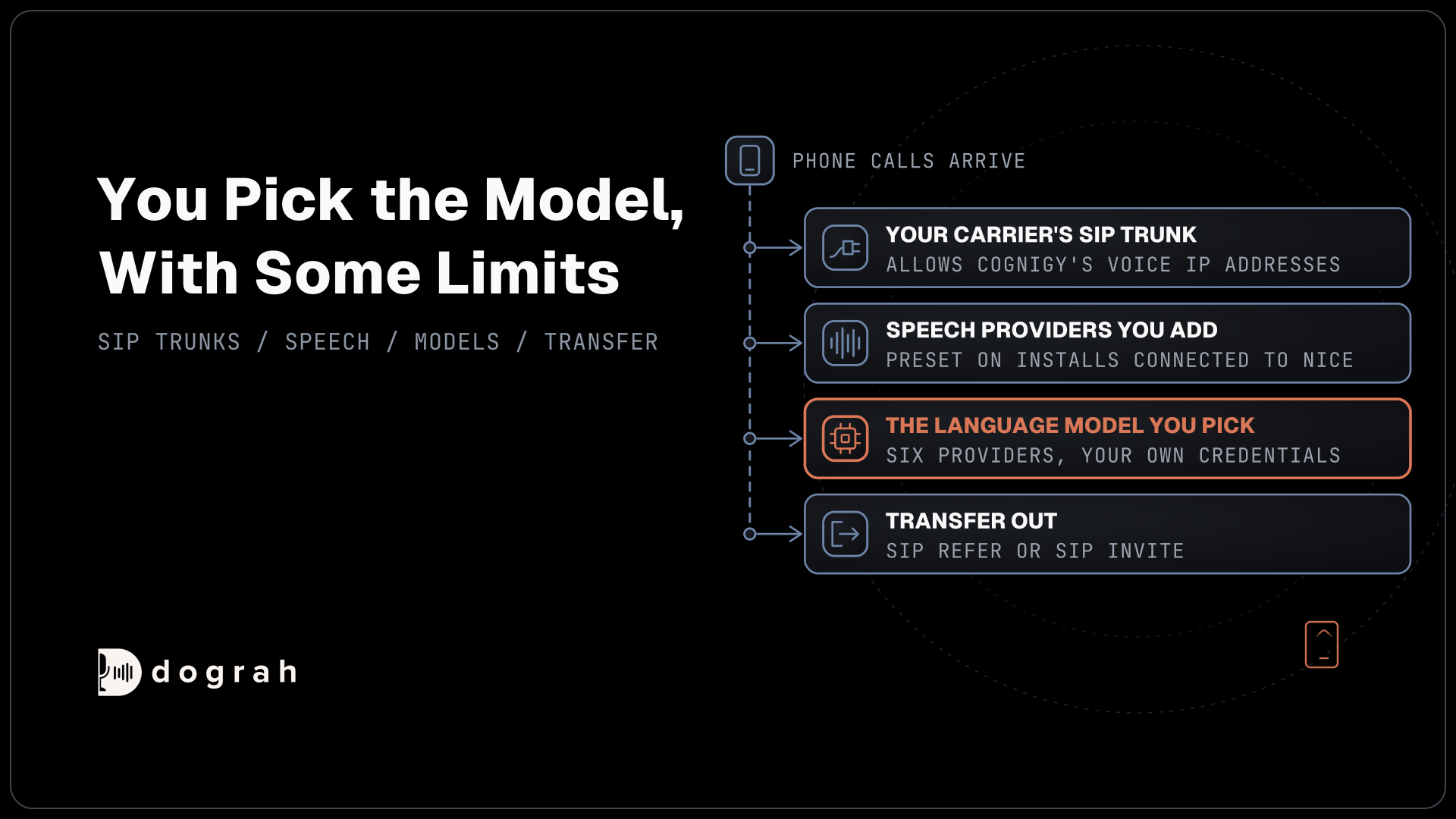
As the orchestration layer it runs the call flow, tools and telephony, and each agent gets the speech-to-text, LLM and voice provider you pick. Those can be Dograh's own models, a provider you already pay through your own keys, or open-weight models on machines you run. Bring your own key (BYOK) moves the contract to you while the audio still reaches that provider, and call audio stays inside your network only when the models run there too. Replicant chooses the fine-tuned models behind its agents, while here every model in the call path is one you picked.
The agent is voice-first. It answers phone calls, inbound WhatsApp voice calls and a website widget set to voice or chat, and a text goes out through your own SMS provider when an HTTP API tool asks for one during the call. It sits beside a contact center through your carrier or an existing PBX over Asterisk ARI. When a caller needs a person, Transfer Call works on Twilio, Telnyx, Plivo, Cloudonix and Asterisk ARI, ringing the destination first and connecting the caller only once someone answers. If nobody picks up or the line is busy, the agent hears that and carries on, and after each call the QA step scores every node, on test calls and live ones.
Cost follows where it runs. On your own servers, recordings and transcripts stay in your own storage, and self-hosted Dograh has no per-minute platform fee, though servers, model keys and phone minutes still cost money. Dograh Cloud charges a 1¢-a-minute platform fee. By default a self-hosted install handles 10 calls at once, which you can raise, and Cloud's pay-as-you-go plan includes 10, with more on request. The server, the database and every upgrade are your team's to run, the open-source edition is supported by the community in Slack, and custom SLAs come with the Enterprise plan.

Open Source Alternative to Vapi / Retell
Self-hosted voice agent platform — no per-minute fees
dograh-hq/dograh
Star on GitHub
Hosted platforms with a published per-minute rate
Each of these runs closed code on its vendor's cloud, but you can price it at your own volume before a sales call. Vapi's hosting fee is $0.05 a minute, and speech, the language model, the voice and the phone line are billed on top. Without a package you get 4 calls at once, Core gives 10 for $29 a month, and a HIPAA add-on costs $2,000 a month.
Retell AI charges $0.055 a minute for voice infrastructure and $0.015 a minute for telephony on its numbers, with the language model priced separately and no charge for your own SIP trunk. Its all-in range runs from $0.07 to $0.31 a minute, with 20 calls at once included and $8 a month for each extra.
Bland's Start plan is $0.14 a minute including its own models, with 10 calls at once and 100 calls a day. Build costs $0.12 a minute plus $299 a month, with 50 calls at once and 2,000 calls a day, and Enterprise adds on-prem or VPC deployment. PolyAI also sells self-serve plans, from $49 a month for 250 minutes, and our guide to PolyAI alternatives covers all four in more depth.
Open-source frameworks: LiveKit Agents and Pipecat
Teams whose engineers want to write the agent in code often start here. LiveKit Agents is Apache-2.0, with its turn-detection model under a separate LiveKit Model License, and Pipecat is a BSD-2-Clause Python framework that Dograh itself is built on. Both are strong foundations, and both leave the phone wiring, call history, transfers and QA for your team to build. Our comparison of open-source voice AI frameworks shows what each one leaves to you.
Other managed contact center vendors
Some teams leave Replicant for another vendor that builds and runs the program. PolyAI's Enterprise plan is built by PolyAI or a partner, with a BAA, SSO, an uptime SLA and data residency. Sierra charges per agreed outcome, and Decagon charges per conversation or per resolution. Kore.ai is the closed vendor that still sells on-prem, beside SaaS and a dedicated VPC, and our guide to Kore.ai alternatives covers it. Each of these prices by contract, so the comparison with Replicant happens in quotes and not on a rate card.
What 60,000 minutes a month costs
A worked example puts the published rates side by side. Take 60,000 call minutes in one month, the size of a busy support line, and price only the line each vendor bills for them.
| Option | Platform line for 60,000 minutes | Still to add |
|---|---|---|
| Replicant | Set in the contract | Set in the contract |
| Vapi | 60,000 x $0.05 = $3,000 | Models, phone, and a package if 4 calls at once is too few |
| Retell AI | 60,000 x $0.055 = $3,300, plus 60,000 x $0.015 = $900 telephony, so $4,200 | The language model. Retell's all-in range gives $4,200 to $18,600 |
| Bland Build | 60,000 x $0.12 + $299 = $7,499 | Phone time. 2,000 calls a day fits only if calls average a minute or more |
| Dograh Cloud | 60,000 x $0.01 = $600 | Your models and carrier |
| Dograh self-hosted | No platform fee | Servers, model keys and phone minutes |
The rows count different things. Bland's price already covers its models, whereas the Vapi, Retell AI and Dograh rows still need model costs added at each provider's rates. What the table does show is that every row except Replicant's can be worked out before a sales call, and checked again whenever your volume changes.
Join the Dograh Community
Dograh is an OSS alternative to Vapi. Join our Slack community for queries, releases, best practices & community interactions.
When staying on Replicant makes sense
Replicant is a sound choice for a large support team that wants a vendor to build and run the program. It lists integrations with Genesys, NiCE inContact, Five9, Amazon Connect, Talkdesk and other contact center platforms, plus CRMs such as Salesforce, Zendesk and ServiceNow. Its contract ties performance to an agreed business outcome, and Replicant says its SOC 2 Type 2, PCI DSS and HIPAA compliance is independently validated and that customer data is never used for training.
It also covers more than automated calls. Conversation Intelligence scores human and AI conversations in QA dashboards, which suits a team that wants one vendor watching its whole floor, and Replicant reports more than 200 deployments. If you are already live and meeting your targets, a move rarely pays back. The case for leaving starts when you want to see the price before you sign, change agents yourself or keep call data on your own servers.
What moving off Replicant takes
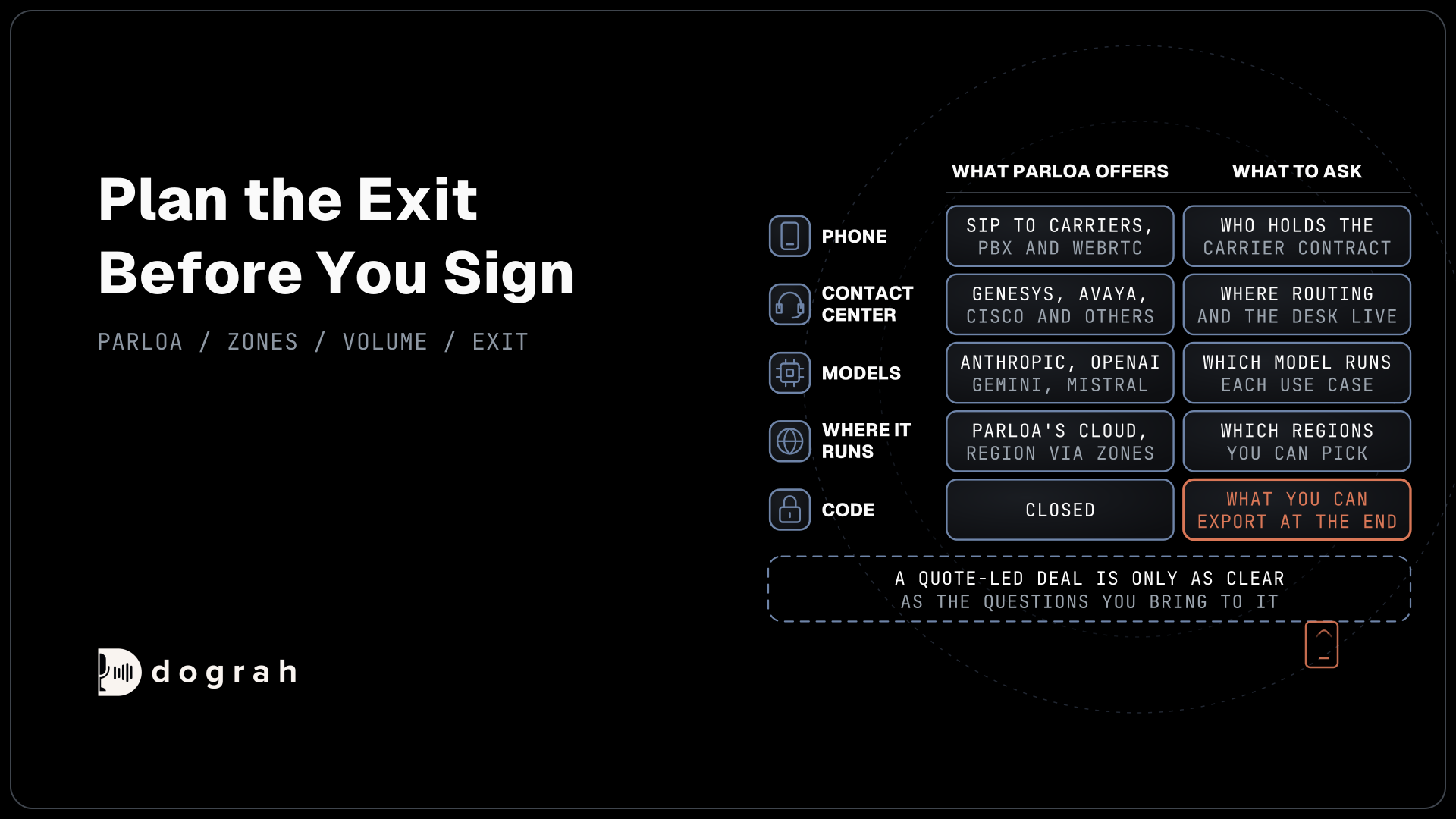
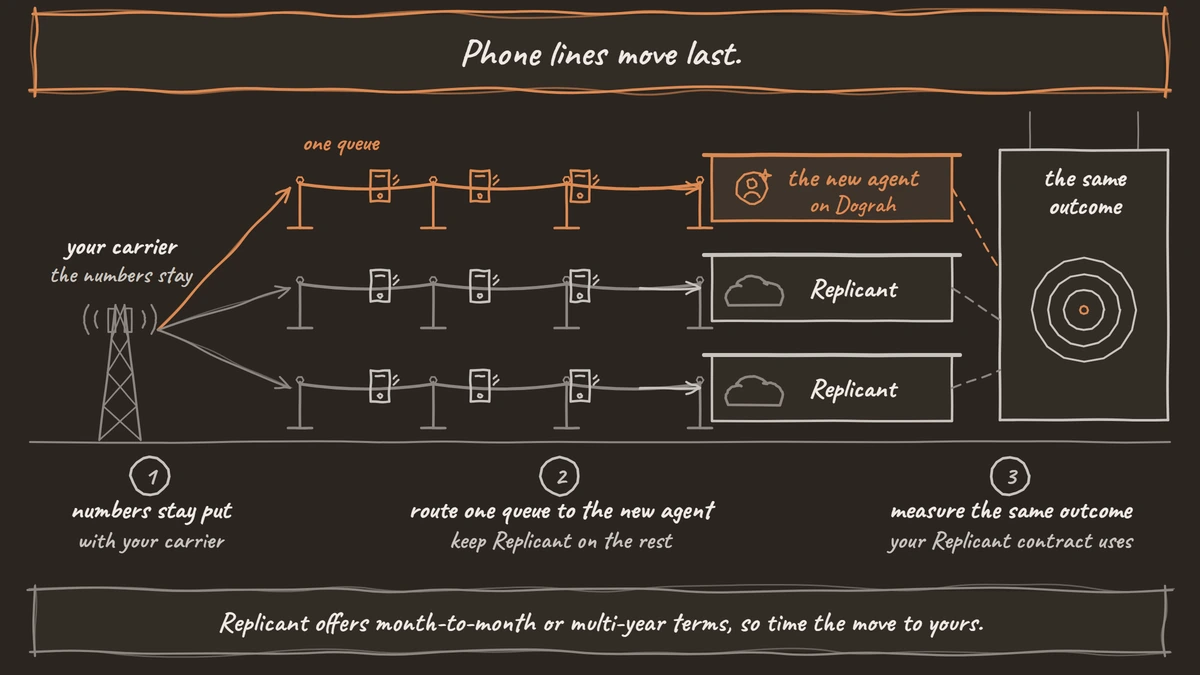
A move is mostly a rebuild, because Replicant's team built the agents. Ask what the contract says about owning the scripts, flows and any fine-tuned models, and what an export includes, then collect transcripts, recordings and QA scores before the term ends. Ask too where your calls are processed today, so the new setup can match or improve on it. Replicant offers month-to-month or multi-year terms, so time the move to yours.
Integrations come next, since each link to the contact center platform and the CRM needs a new route. Dograh reaches business systems through HTTP API tools and MCP tools during the call, a Webhook node after it, Pre-Call Data Fetch as the call connects and the API Trigger for outbound calls. On the Cloud plan you describe the agent in the Agent Builder, and a self-hosted install uses the builder with a Dograh Service Key or the canvas.
Phone lines move last. Numbers stay with your carrier or contact center platform, so change the routing for one queue once its new agent is ready, and keep Replicant on the rest. Measure the new agent against the same outcome your Replicant contract uses, and test every transfer over a real phone call, because a browser test call cannot run one.
Picking your Replicant alternative
Start from where your calls must run and who will change the agent. If you want open source, your own servers or on-prem inside your network, start with Dograh, with the Enterprise plan behind it when you need on-prem. If your engineers want to build the product in code, LiveKit Agents and Pipecat are good bases. If a hosted rate suits you, price Vapi, Retell AI and Bland at your own minutes with models and phone added. And if you want a vendor to keep building it for you, PolyAI Enterprise, Sierra, Decagon or Replicant itself fit that way of working. Whichever you pick, move one queue first and keep the old route until the new agent meets the same outcome.
Glossary
- Agreed business outcome
- A result written into a vendor contract to judge performance, such as a share of calls resolved. Replicant uses one, so measure any replacement against the same outcome.
- Platform fee
- The fee a voice agent platform takes for running the call, separate from what the models and phone line cost. Vapi, for example, charges $0.05 a minute for hosting.
- Orchestration layer
- The layer that runs a voice agent's call flow, turn-taking, tool calls and phone connection. The speech and language models can be swapped, since they sit in a separate layer.
- Bring your own key (BYOK)
- Your own account with a model provider, used inside the platform. Contract and bill are in your name, and the call audio still goes to that provider.