
Replicant suits large support teams on Genesys, NiCE, Five9 or Amazon Connect that want a vendor team to build and run voice, chat and SMS automation against an agreed business outcome. It is closed, hosted and priced on request. Teams that want to own the platform can use Dograh, the open-source AI voice agent platform, self-hosted or on Dograh Cloud.
Key Takeaways
- Replicant sells a managed program, with its delivery team building the agent for you.
- Replicant calls its pricing pay-as-you-go but gives rates only on request.
- Replicant holds strong certifications, but ask which regions and models handle your calls.
Replicant has automated contact center calls since 2017, and sells the work with the software. We cover what its two products do, where it is strong, how contracts are priced, where call data goes, demo questions, who it fits and how open-source Dograh serves teams that build their own.
What Replicant sells today
Replicant sells two products to large support teams. Replicant's Conversation Automation runs AI agents that handle customers across voice, chat and SMS, "fluent in over 30 languages and dialects" and "powered by multiple, fine-tuned LLMs". It reports more than 200 deployments and a delivery and implementation team whose job, in its words, is to help customers "Avoid pilot purgatory."
Conversation Intelligence is the second product. It analyzes voice, chat and email to show what drives contact volume and what to automate next, and it gives QA dashboards for both human and AI agents, with automated scoring and coaching plans. Replicant was founded in 2017 by Gadi Shamia and Benjamin Gleitzman, and it reports a Net Promoter Score of 65. Named customers include Hyatt, Orkin, Sunrun, Vivint and New Jersey Transit, across insurance, health, home services, finance, travel and retail.
Where Replicant is strong
Replicant's main strength is that it does the build for you. A delivery team takes the program from kick-off to launch, and Replicant says DoorDash went live six weeks after kick-off. For a support team without engineers to spare, that is the product as much as the software is.
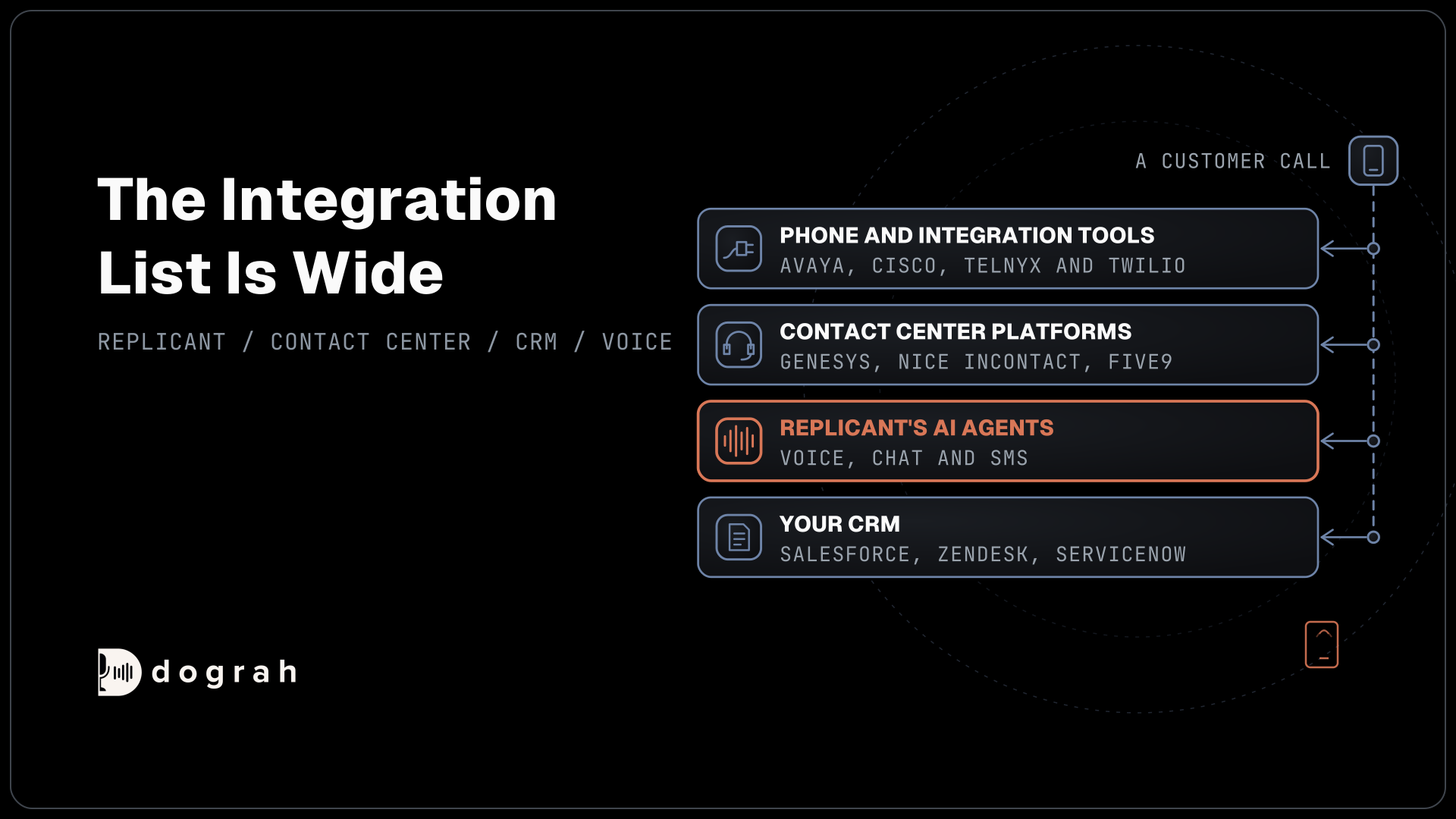
The integration list is wide. Replicant integrates with Genesys, NiCE inContact, Five9, Amazon Connect, 8x8, Talkdesk and Ujet for contact center (CCaaS) platforms, Salesforce, Zendesk, Kustomer, Gladly and ServiceNow for CRM, and Avaya, Cisco, Telnyx and Twilio among phone and integration tools. It also lists SAP, PeopleSoft, Stripe and Shopify.
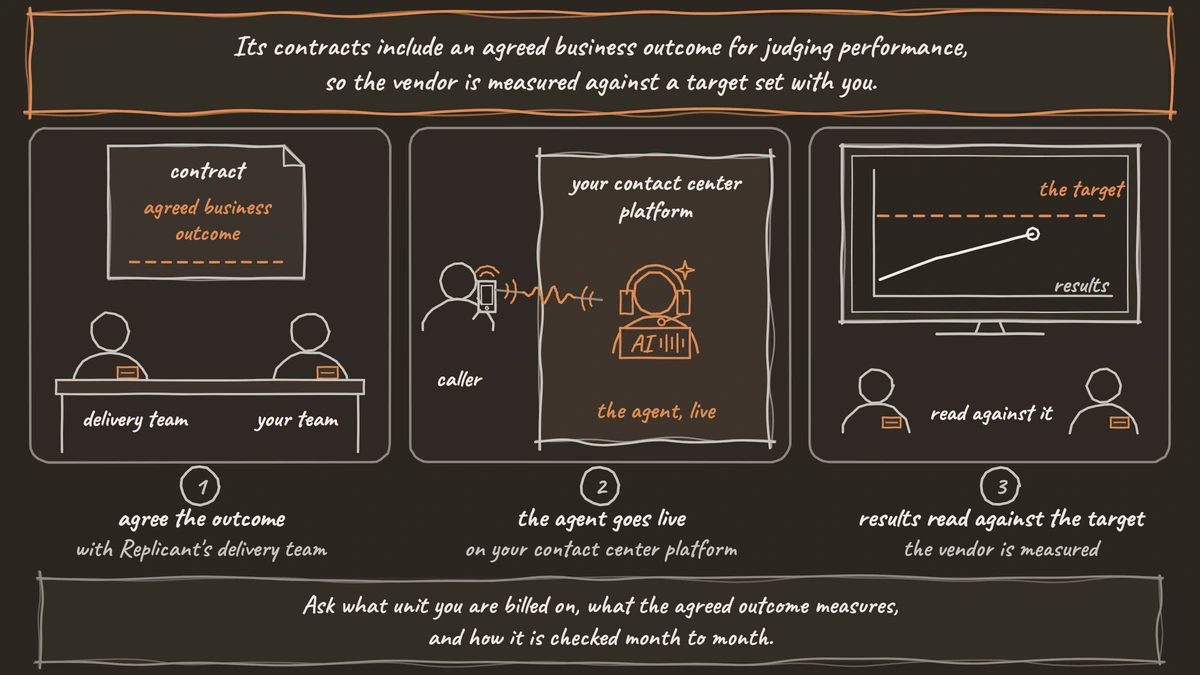
Its contracts include an agreed business outcome for judging performance, so the vendor is measured against a target set with you. Replicant's own case studies report results such as a 68% drop in cost per call at Rollins and more than 12,000 calls a week automated for New Jersey Transit. Those are vendor figures, so ask for references in your own industry.
How Replicant prices its contracts
Replicant describes its pricing in words, with rates given on request. It calls the pricing "straightforward, pay-as-you-go" and offers contract terms "whether month-to-month or multi-year", an "Agreed-upon business outcome for performance evaluation", an ROI analysis and a dedicated team.
Pay-as-you-go here describes how usage is billed inside an enterprise contract, since Replicant pitches the pricing at enterprises scaling conversational AI. Ask what unit you pay for, a minute, a call or a resolution, what the setup and delivery work costs, and what happens to the bill if the agreed outcome is missed.
Where call data goes and who controls it
Replicant's security record is strong on paper. It lists SOC 2 Type 2, PCI DSS and HIPAA, independently validated, plus alignment with GDPR, the NIST Cybersecurity Framework and the NIST AI Risk Management Framework. It says "Customer data is never retained, reused, or used for training", redacts personal and payment data from transcripts, analytics and QA, and fails over across its phone, voice and model providers.
Other details are worth settling in the contract. Ask which region hosts your calls, how long recordings and transcripts are kept, and which model and speech providers hear them. The platform is closed and hosted, so you cannot read the code that handles a call or move it onto your own servers. Changes to the agent also run through Replicant's team, which suits a managed program and slows a team that wants to test changes itself.

Open Source Alternative to Vapi / Retell
Self-hosted voice agent platform — no per-minute fees
dograh-hq/dograh
Star on GitHub
Automation plus a suite for human agents
Replicant is one of several vendors that pair an AI agent with software that grades human agents. Its Conversation Intelligence product scores both and builds coaching plans, so one contract can cover the automated calls and the QA program for your staff. That bundle is useful if you want both from one vendor. If you only need the automated calls, you are paying for a layer you will not use, and our post on Observe.AI alternatives walks through the same split for another suite.
Questions to ask in a Replicant demo
Start with money and measurement. Ask what unit you are billed on, what the agreed outcome measures, and how it is checked month to month. Ask how long a typical rollout takes for a team your size, and who changes the agent after launch, your staff or Replicant's.
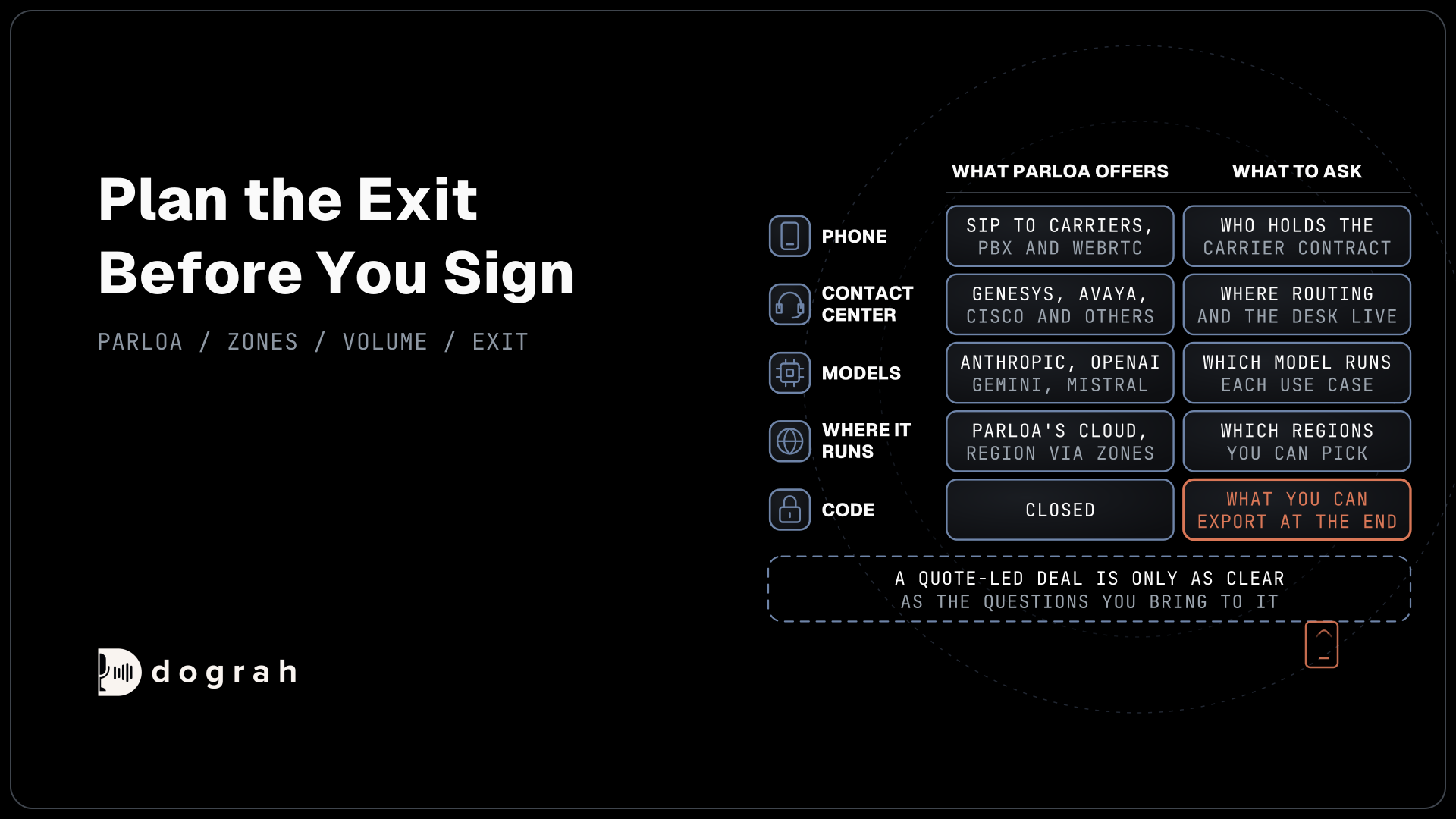
Then ask about data. Ask which model and speech providers handle your calls and in which region, how long each record is kept, and what you can export if you leave. Finally, ask how the agent connects to your contact center platform, and test a transfer to a live agent on your own lines.
Who Replicant fits
Replicant fits a large support team on Genesys, NiCE, Five9 or Amazon Connect that wants a vendor to design, build and tune the automation, with a contract tied to an agreed result. Teams in home services, insurance, travel and other high-volume support work match its customer list. It also fits buyers who want human-agent QA and automation under one vendor.
It fits less well a team that wants to build and change agents itself, read the code, choose its own models, run on its own servers, or start without a sales cycle. Our guide to AI call center software compares the wider field for that kind of team.
Join the Dograh Community
Dograh is an OSS alternative to Vapi. Join our Slack community for queries, releases, best practices & community interactions.
Where Dograh fits
Dograh, the open-source AI voice agent platform, is built for teams that want to run the automation themselves. Its code is public under the BSD 2-Clause license, and it runs self-hosted with Docker Compose, on Dograh Cloud, or on-prem on the Enterprise plan. A new agent starts in the Agent Builder, where you describe the call and approve the requirements it lists before it builds, and your own team edits it from there.
On the phone side, Dograh connects through its own carriers or a SIP trunk rather than a contact center connector. Twilio and Telnyx, both on Replicant's list, are Dograh providers too, along with Plivo, Cloudonix and Asterisk ARI. When a caller needs a person, Transfer Call on Twilio, Telnyx, Plivo, Cloudonix or Asterisk ARI rings that person first and puts the caller through only once the call is answered. A missed, busy or failed transfer leaves the caller with the agent, and the call continues.
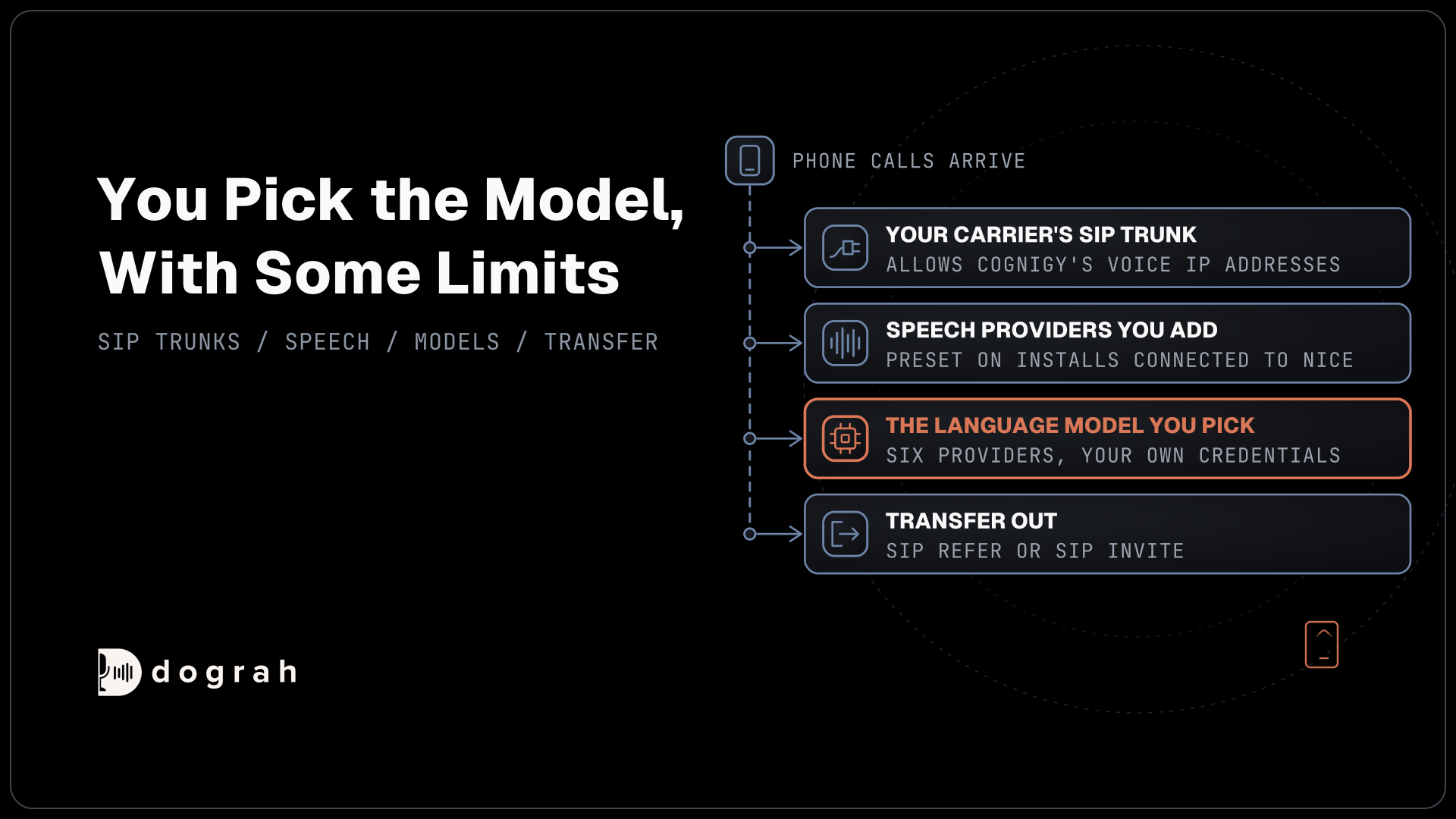
You choose the models for each agent, from Dograh's own to any provider on your key or open-weight models you host, so you always know which models hear your calls. The agent works in your CRM or help desk through HTTP API tools, MCP tools and the Webhook node, and a text message goes out through your own provider from an HTTP API tool. The QA step scores every step of the agent's own test and live calls.
Self-hosted, there is no per-minute platform fee, but servers, model keys and phone minutes still cost money. Dograh Cloud charges a 1¢-a-minute platform fee. Server upkeep, the database and every upgrade sit with your team, and support is community-based on the open-source version, with custom SLAs on Enterprise. Our roundup of Replicant alternatives compares the other options.
Glossary
- Agreed business outcome
- A contract that names a business result, such as calls resolved without a person, and judges the vendor against it. Replicant's contracts include one.
- CCaaS
- Contact center as a service, a hosted contact center platform such as Genesys, Five9, NiCE or Amazon Connect that routes calls to agents.
- Pilot purgatory
- When a voice AI pilot works in a test but never reaches full production. Replicant sells its delivery team as the way out.
- SIP trunk
- A phone line delivered over the internet that connects a voice platform to a carrier or phone system without a contact center connector.