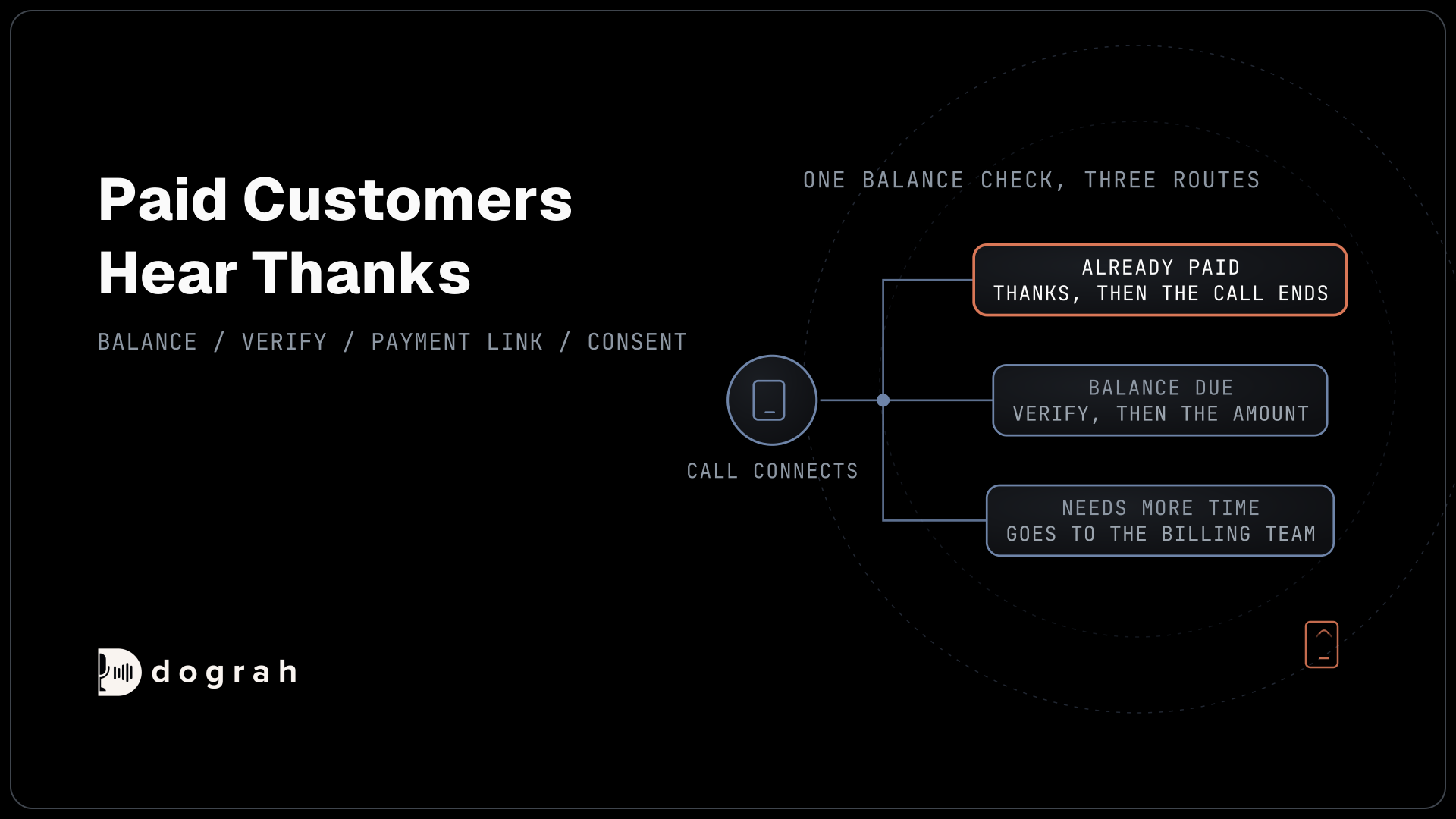

AI voice agents for telecom bill reminders are outbound phone agents that tell customers what they owe and when it is due, shortly before and just after the due date. The agent checks the balance as the call connects, verifies the customer before stating the amount, offers the provider's own payment link or a person, and makes no sales offer.
Key Takeaways
- Check the balance as the call connects; paid customers hear thanks.
- Verify the customer before stating any amount or due date.
- Keep offers out of the reminder; an offer changes the consent needed.
This post is part of our guide to AI voice agents for telecom, cable and broadband. The guide's section on billing calls puts it in one line: "The bill reminder is a service call that tells a verified customer what is due and when, and it carries no offer." Here is that call in full, built on Dograh, an open-source, self-hostable voice agent platform, with the provider's billing system kept as the only record of the balance.
Who a reminder call reaches
A bill reminder often reaches someone who is already worried about the bill, so the call has to be calm and short, with a clear next step. In a BroadbandNow survey of 954 US adults in March 2026, 19% said they worry each month about paying their internet bill, and that rose to 41% among former Affordable Connectivity Program recipients. The average home internet plan cost $81.16 a month. BroadbandNow is a comparison site, so treat this as survey data from a commercial source.
That is why the reminder never sounds like a demand. It states the amount and the date and offers a way to pay. Anyone who needs more time goes to a person who can agree a payment arrangement.
A reminder is also different from collections. A provider reminding its own customers about its own bill is generally outside the federal debt collection rules, which cover debts owed to another. Collections after default, often through a third party, follow the stricter path set out in AI Voice Agents for Debt Collection: Verify First, Then Talk. This is general information, not legal advice; confirm your position with counsel.
How the reminder call runs
The call reads the balance as it connects, verifies the customer, then states what is due. Your billing system starts it, either as a list uploaded to Campaigns or one call at a time through the API Trigger, a few days before the due date and again just after it.
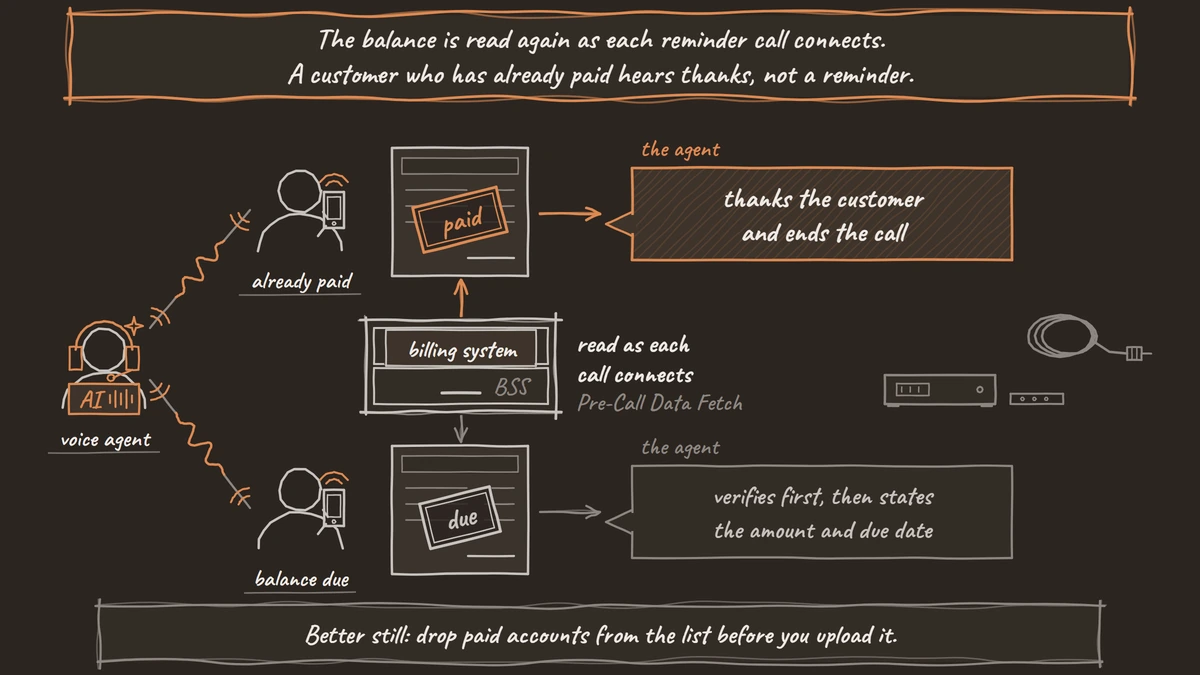
Pre-Call Data Fetch, at the bottom of the Start Call node, set to "Outbound calls only", asks your billing system for the account's current balance once the call connects. Customers pay at all hours, and a list built last night can be out of date by morning. If the system shows the bill paid, the agent thanks the customer and ends the call. Better still, drop paid accounts from the list before you upload it, so they get no call at all.
The call opens with Greeting Text, fixed words played as written, naming the provider. If you want to tell customers they're speaking with an automated assistant, or your location requires it by law, say so there as well. Variables need a fallback, such as {{customer_name | there}}, or a missing value is read aloud as the raw placeholder.
Then the agent verifies the customer with an approved check your security team sets, such as the last digits of the account number. Asking for the customer by name only finds the right person. Write the prompt so the agent names no amount or date until the check passes.
After verification, the agent states the amount and the due date exactly as the billing system returned them. If the system also returns why the bill changed, such as a promotion ending or a new fee, the agent says that too, because it is the first question most customers ask.
The reminder never reads call detail. Under 47 CFR 64.2010, a carrier may disclose call detail information on a customer-initiated call only after a password, or by "calling the customer at the telephone number of record". A question about a specific call on the bill goes to a person or to that callback, never to the reminder.

Open Source Alternative to Vapi / Retell
Self-hosted voice agent platform — no per-minute fees
dograh-hq/dograh
Star on GitHub
Payment without a card number on the call
The agent never takes card details; payment happens in the provider's own systems. When the customer wants to pay now, an HTTP API tool asks the provider's own system to send its secure payment link by text or email. Dograh has no feature for taking customer payments on a call and no keypad (DTMF) tool, and it sends no texts itself.
If the customer offers a card number anyway, the agent stops them politely and points them to the link. A spoken card number would stay in the recording and transcript, which keep everything said.
When the customer wants more time or disputes a charge, the agent does not decide it. Transfer Call passes the customer to the billing team. It works on Twilio only and passes no summary, so the agent first writes the account and the reason to your system through an HTTP API tool. If nobody answers within the 30-second default, the customer stays with the agent; tell it in the prompt to offer a callback and write the request through an HTTP API tool.
Prepaid mobile follows the same shape. Before a prepaid plan's validity ends, the agent reminds the customer and the provider's system sends its recharge link.
Keep the reminder free of offers
A reminder with no offer is a service call; add an offer and it becomes a sales call with stricter consent. This is general information, not legal advice.
In the US, the Telephone Consumer Protection Act (TCPA) covers calls made with an artificial or prerecorded voice, and the FCC's February 2024 ruling, FCC 24-17, confirmed that AI-generated voices count. A service call to a mobile number generally needs the customer's prior express consent. The rule text at 47 CFR 64.1200 treats "any telephone call that includes or introduces an advertisement or constitutes telemarketing" differently, allowing it with "the prior express written consent of the called party".
An offer turns the reminder into telemarketing, and that generally needs the customer's prior express written consent. So the reminder never mentions a faster plan or a bundle, even to a customer who sounds unhappy with the price. Upgrades belong on their own consented call, covered in AI voice agents for plan upgrades and cross-sell in telecom.
Sales calls to residential lines are barred before 8 a.m. or after 9 p.m., "local time at the called party's location", and keeping reminders inside those hours is good practice. Campaigns in Dograh use one time zone per campaign, so split your list by time zone. Dograh keeps no do-not-call list, so opt-outs live in your own system, written there by an HTTP API tool or from the webhook, and removed before each upload. Confirm your own position with counsel before the first campaign.
Join the Dograh Community
Dograh is an OSS alternative to Vapi. Join our Slack community for queries, releases, best practices & community interactions.
Campaign settings and the write-back
Every call ends with a disposition, the recorded outcome, in the billing system. The agent records what the customer said, such as a promised payment date, as the customer stated it, and a Webhook node sends the outcome, the promised date, the recording link and the transcript link to your system. A temporary failure there is retried automatically.
Campaign retries run from 0 to 10, with 2 as the default, and fire on busy, no answer or voicemail as you choose. Retries never re-call someone who answered. Under voicemail settings, the agent either disconnects (the default) or leaves a message; a message should name only the provider and a number to call back, never the amount. A contact cannot be removed from a running campaign; the campaign itself can only be paused and resumed, so a customer who pays mid-campaign is caught by the balance check as the call connects.
The education version of this call, AI Voice Agents for Fee and Payment Reminders in Education, uses the same before-the-due-date pattern. Test on a real phone line before the first campaign. Self-hosted Dograh has no per-minute platform fee (servers, model keys and phone minutes still cost); Dograh Cloud has a 1¢-a-minute platform fee.
Glossary
- Call detail information
- Information about specific calls, such as the number called and the time or length of a call. A carrier may disclose it on a customer-initiated call only after a password, or by calling back the telephone number of record, so a reminder call never reads it.
- Pre-Call Data Fetch
- A Dograh setting at the bottom of the Start Call node that asks your system for data once the call connects. On a bill reminder, set to Outbound calls only, it returns the current balance so a customer who already paid is thanked instead of reminded.
- Prior express consent
- Under the TCPA, the customer's permission to receive informational calls made with an artificial or prerecorded voice. A bill reminder with no offer generally needs it; a call that adds an offer generally needs prior express written consent.
- Disposition
- The recorded outcome of a call, such as paid, promise to pay, dispute or no answer. The agent records it as the customer stated it, and the webhook writes it to the billing system.