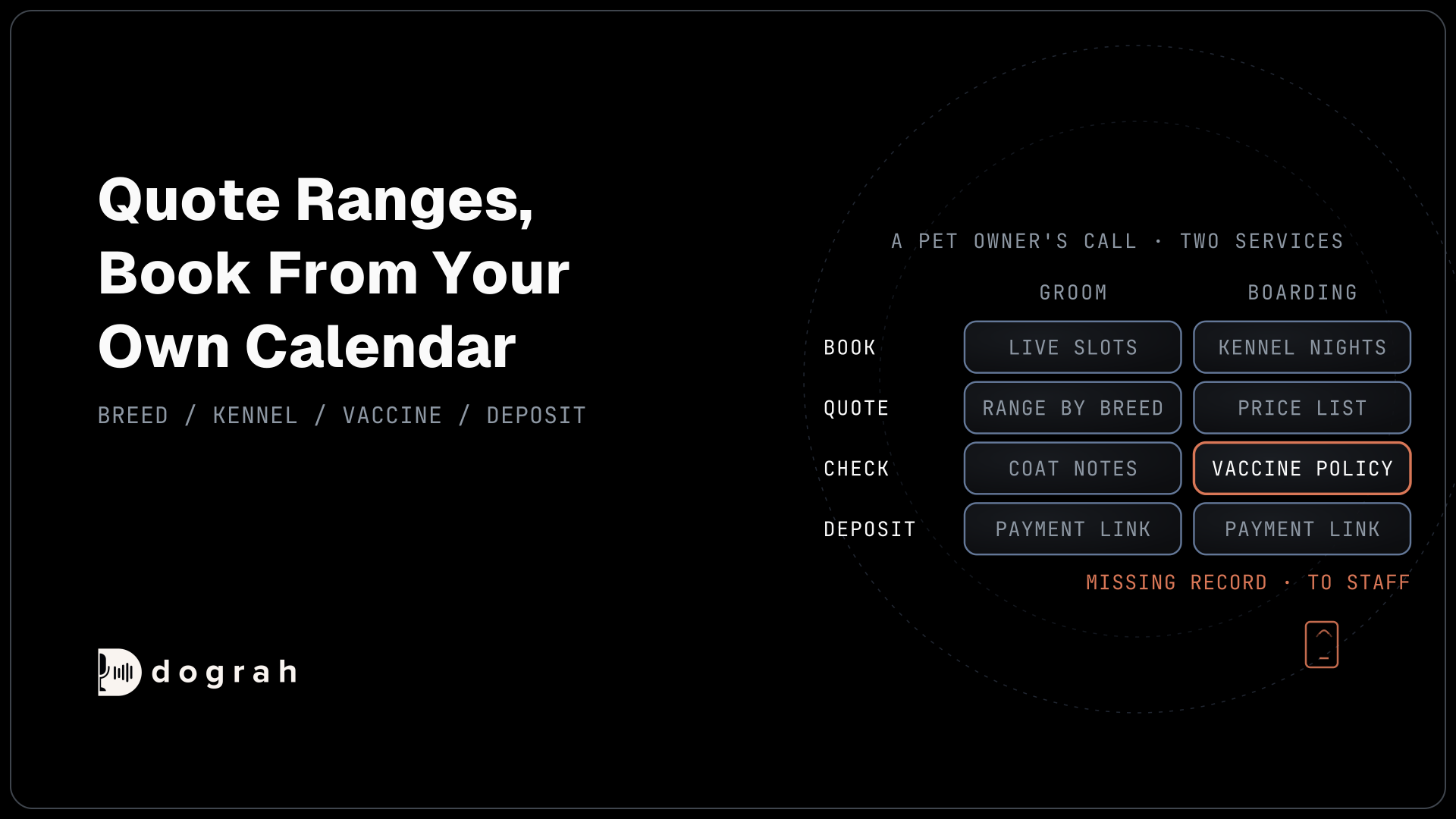

AI voice agents for pet grooming and boarding bookings book grooms and kennel stays from the business's own calendar during the call. They quote price ranges from its price list, check the boarding vaccine policy against the record on file, and leave deposits to a payment link from its own system. Matted coats and bite histories go to staff.
Key Takeaways
- Book only slots and kennel dates your own calendar returns during the call.
- Quote grooming prices as ranges, and let the groomer set the final price at check-in.
- A missing vaccine record goes to staff, because the agent never grants an exception.
This post is part of our guide to AI voice agents for veterinary clinics. The guide's section "Grooming and boarding bookings" sums up this call in one line: it books non-medical services from the grooming or kennel calendar, quoting prices and vaccine rules from the business's own documents. Here is that call in full, run in Dograh, an open-source, self-hostable voice agent platform.
What makes grooming and boarding calls different
Grooming and boarding sit outside medical care, so the agent works from the business's own calendar and written rules instead of a vet's judgement. The American Pet Products Association puts US spending on other pet services, a group that includes boarding and grooming, at $14.3 billion in 2025. Many vet clinics run these services next door to the exam rooms, and many owners still book them by phone.
The calls have their own shape. A groom's length and price depend on the breed, the size and the state of the coat. A boarding stay needs dates, a kennel that fits and proof the pet meets the vaccine policy. Medical visits, such as the vaccine itself, are booked from the vet's schedule instead, which AI voice agents for vet appointment booking and vaccination reminders covers.
Booking a groom from live slots
The agent collects what the groomer needs first: the pet's name, breed, rough weight, the service and the coat's condition. For an existing client, it confirms who is calling before it reads anything from the record, with an approved check such as the postcode on file or the last digits of the account number. A phone number finds the record, but it does not prove who is speaking.
Then it reads open slots. An HTTP API tool asks your grooming calendar for times that fit the service length and the groomer, and the agent offers only those. Tell it in the prompt to read the booking back (pet, service, day and time) before a second tool writes it, and to call it booked only when your system returns a booking ID. Add a Preset Parameter named workflow_run_id with the value {{initial_context.workflow_run_id}}, so your system can ignore a repeated request. The same live-slots pattern runs in AI voice agents for home-services appointment booking.
Prices come from your own price list. Upload it to the Knowledge Base as a PDF, DOCX or TXT file, up to 5 MB, and select it on the node. The agent quotes the range for that breed and size, and the groomer confirms the price at check-in. A badly matted coat or a dog that has bitten before is written down as a note for staff, and the agent promises nothing about either.

Open Source Alternative to Vapi / Retell
Self-hosted voice agent platform — no per-minute fees
dograh-hq/dograh
Star on GitHub
Boarding: dates, kennels and the vaccine policy
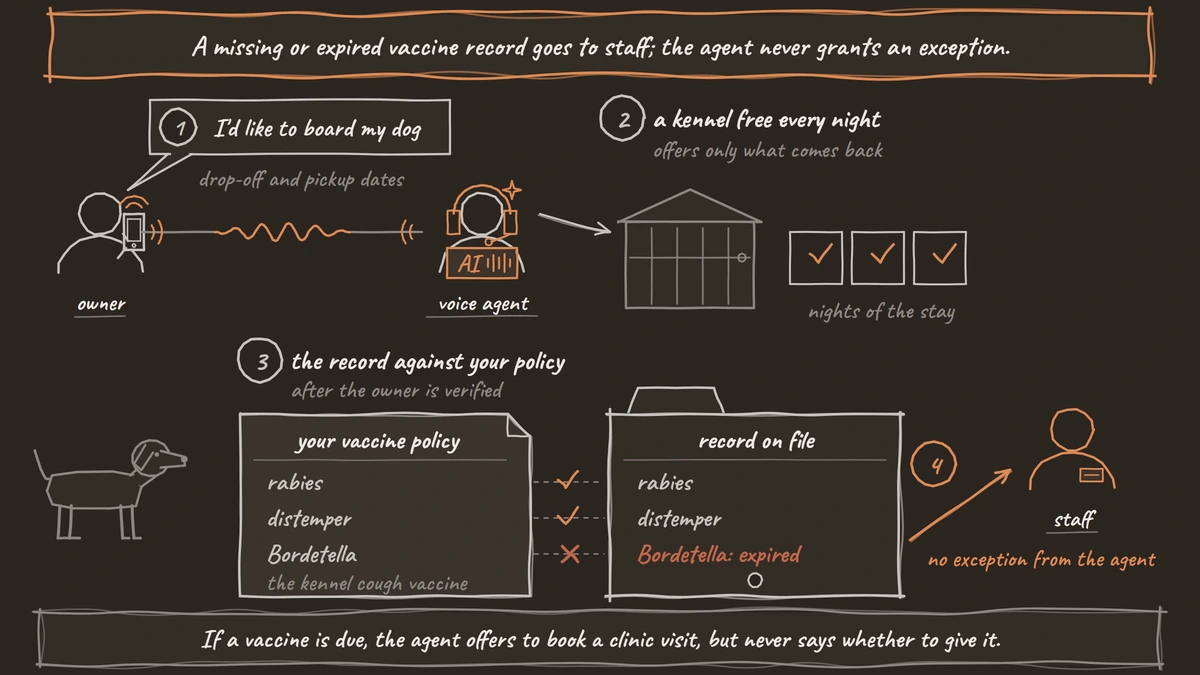
A boarding call books dates, not a time slot. The agent asks for drop-off and pickup dates and times, how many pets are coming and their sizes, then asks your boarding system through an HTTP API tool whether a kennel that fits is free for every night of the stay. It offers only what comes back.
The vaccine policy is the business's own. One boarding business might require rabies, distemper and Bordetella, the vaccine for a common cause of kennel cough. Another adds a daycare evaluation for new dogs, so the agent reads your written policy from the Knowledge Base rather than assuming one. After the owner is verified, a tool reads the pet's vaccine record on file and the agent compares it with the policy. A missing or expired record goes to staff, and the agent never grants an exception. It also never says whether a pet should have a vaccine. If one is due, it offers to book the visit with the clinic.
Feeding times, medication and behaviour notes are written to the booking as the owner states them, for staff to read. For a pet on medication during a stay, the instructions come from the vet's notes, never from the agent. Tell it in the prompt to record the medicine and dose as said, and to flag the booking for staff to check against the record.
Deposits, changes and handing over
Some steps need the business's own systems, and some calls belong to a person. A deposit is paid through a secure link that your own system or payment provider sends by text or email, and an HTTP API tool asks it to send that link during the call. Dograh has no feature for taking payments on a call and no keypad (DTMF) tool. Recordings and transcripts keep whatever is said, so the call never asks for a full account, card or Social Security number; use a short check such as the last four digits, and send payment links by text or email from your own system.
Changes and cancellations follow your written policy. The agent reads the notice period or fee from the Knowledge Base, says it before making the change, then writes the change back through an HTTP API tool.
Hand over the calls that need judgement: a complaint, a bite history, a pet with special handling needs or a refund request. Transfer Call works on Twilio, Telnyx and Asterisk ARI. It passes no summary by default; on Twilio it can play a short spoken introduction to both people. Write the details to your system with an HTTP API tool before the transfer. If nobody answers, the caller stays with the agent; tell it in the prompt to offer a callback. The callback request goes to your system the same way.
An owner who mentions a sick or injured pet hears the clinic's fixed emergency line, set as Transition Speech on a pathway: "If your pet is having an emergency, please call your nearest emergency vet now."
Join the Dograh Community
Dograh is an OSS alternative to Vapi. Join our Slack community for queries, releases, best practices & community interactions.
Several locations, breed names and cost
A business with several sites can run one agent. Several phone numbers can point at the same agent, and Pre-Call Data Fetch, at the bottom of the Start Call node, receives the dialled number as to_number. Your endpoint returns that location's name and opening hours, and the agent's tools then read that location's calendar and price list.
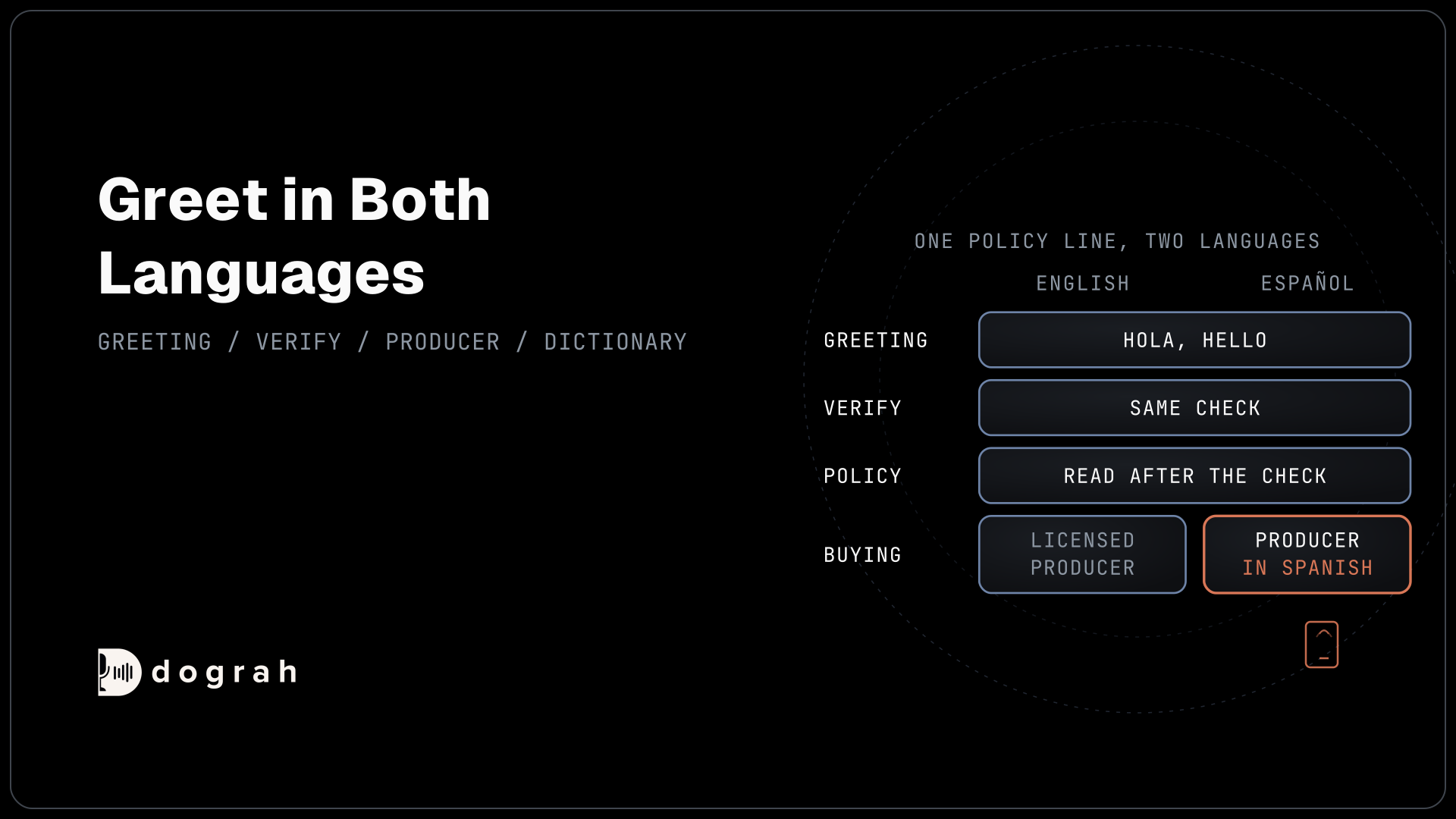
Breed names trip up speech-to-text, so add the hard ones, such as Bichon Frise or Lagotto Romagnolo, and words like Bordetella to the agent's Dictionary under Settings. This post covers owners calling in. Reminder calls going out need the owner's consent first, which the booking post covers.
Self-hosting keeps owner details and recordings on servers the business runs. Dograh is the orchestration layer: it runs the call flow, tools and telephony, and the speech and language models are a separate layer you choose. The call audio stays in-house only when the speech and language models run on your own servers too. Self-hosted Dograh has no per-minute platform fee (servers, model keys and phone minutes still cost); Dograh Cloud has a 1¢-a-minute platform fee.
Glossary
- Price range quote
- The span a groomer charges for a breed and size, read from the business's own price list. The agent quotes the range on the call, and the groomer sets the final price after seeing the coat at check-in.
- Vaccine policy
- The boarding or grooming business's own written rule on which vaccines a pet must have, such as rabies, distemper and Bordetella at one business. The agent reads it from the Knowledge Base and compares it with the record on file; exceptions go to staff.
- workflow_run_id
- The ID of one Dograh call. Sent as a Preset Parameter on the booking tool, it lets your calendar ignore a repeated request, so one call never books the same slot twice.
- Dictionary
- A list of words in the agent's Settings that speech-to-text should listen for, such as unusual breed names. It lowers the chance that a breed or vaccine name is misheard.