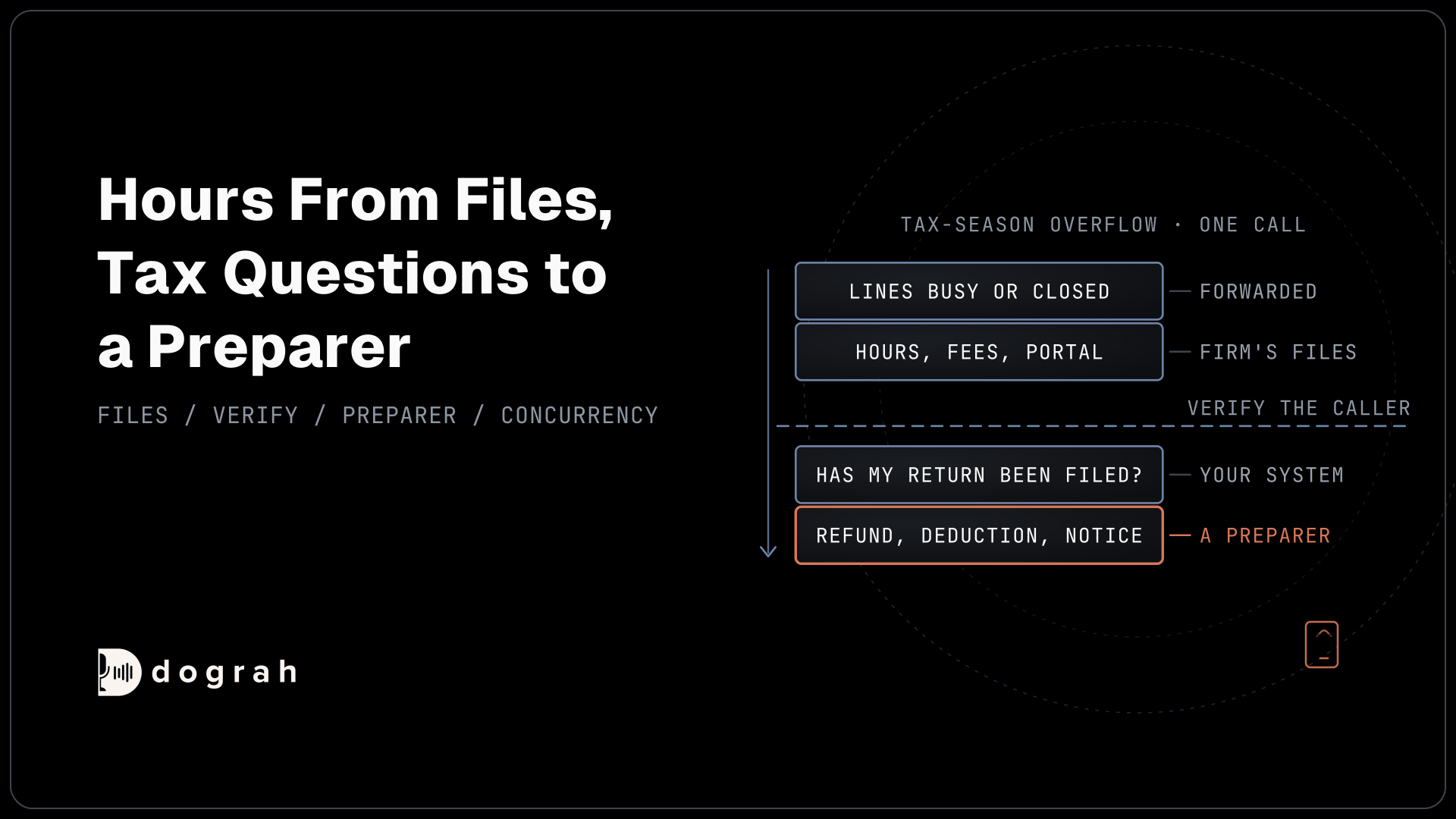

AI voice agents for tax-season call overflow pick up the calls a firm's staff cannot reach when every line is busy or the office is closed. They answer general questions only from the firm's own files, check status after verifying the caller, and send every question about the caller's own return to a preparer.
Key Takeaways
- General answers come only from the firm's own Knowledge Base files.
- The agent never gives tax advice; own-return questions go to a preparer.
- Size the concurrency limit for the final two weeks; extra calls are rejected.
This post is part of our guide to AI voice agents for tax and accounting firms. The guide's section "During the season: documents and call overflow" sums up this call in one line: the overflow agent picks up when every line is busy or the office is closed, and it answers only general questions from the firm's own files. Here is that call in full, run in Dograh, an open-source, self-hostable voice agent platform.
Why tax-season calls overflow
Tax-season calls overflow because most of a firm's season lands in its last few weeks. The IRS filing season statistics show tax professionals had e-filed 72.8 million returns by mid-April, up from 52.8 million in early April. About 20 million returns went in during those two weeks, and the phones peak with them.
Most calls in those weeks are short and repeat. Callers ask about hours, what to bring, how the portal works and whether a return has been filed. A smaller share, such as a question about a refund or a letter from the IRS, needs a preparer. The overflow agent answers the first kind and sends the second kind to a person, so preparers spend the peak weeks on returns.
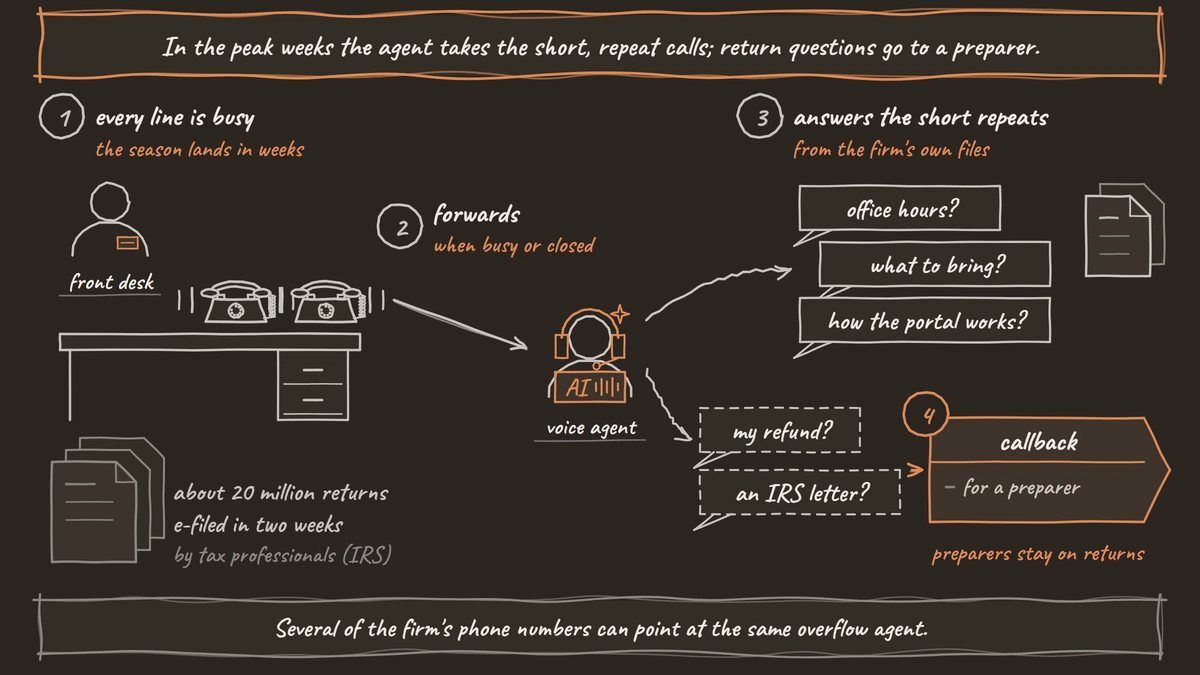
The calls reach the agent through your own phone setup. Your phone system forwards calls to the agent's number when every line is busy or the office is closed, and several of the firm's numbers can point at the same agent.
Answer only from the firm's own files
The agent answers general questions from documents the firm writes and approves, and from nothing else. Upload them to the Knowledge Base under Files, as PDF, DOCX, DOC, TXT, JSON or MD files of up to 5 MB each, then select them on the agent's node under Knowledge Base Documents. Full Document mode needs no embedding key, while Chunked Search, for longer files, needs one.
Good overflow files are short and plain. They hold office hours and holiday closures, the fee list, a what-to-bring checklist, portal upload steps and how long a return usually takes once everything is in. Some firms add general IRS lines they have approved. The IRS page on when to file says: "An extension of time to file is not an extension of time to pay." A firm can approve that as a general answer.
Tell the agent in the prompt to answer only from those files and to pass anything else to the team. When the files are silent, a model tends to fill the gap with a guess, so a short "I don't have that here, a preparer will call you back" path matters more than a long FAQ. The same pattern, answering from your own documents and handing the rest over, is set out in our post on AI voice agents for patient support lines.

Open Source Alternative to Vapi / Retell
Self-hosted voice agent platform — no per-minute fees
dograh-hq/dograh
Star on GitHub
Every return question goes to a preparer
One rule holds on every overflow call. The agent never gives tax advice, and any question about the caller's own return goes to a preparer. That covers "Can I deduct my home office?", "How big will my refund be?", "Should I file an extension?" and any letter from the IRS or the state.
A prompt instruction alone cannot hold that line. Models avoid a banned phrase and still deliver its meaning, as in "you'll probably be fine this year". Exact wording holds only where Dograh plays fixed text. So give return questions their own pathway, and put the hand-off line in that pathway's Transition Speech, as fixed text or a recorded clip: "I can't advise on your return, but a preparer will call you back." The model still picks the pathway by reading its condition, so read the transcripts of calls that took it, and of calls that should have.
On that pathway, the agent collects what the preparer needs. For a notice, that is the notice number and date as the caller reads them. Tell the agent in the prompt never to interpret the letter. Then an HTTP API tool writes a callback request to the firm's practice management system with the caller's number and question.
Transfer Call can connect the caller to a person instead. Transfer Call works on Twilio, Telnyx and Asterisk ARI. It passes no summary by default; on Twilio it can play a short spoken introduction to both people. Write the details to your system with an HTTP API tool before the transfer. If nobody answers, the caller stays with the agent; tell it in the prompt to offer a callback. In the final two weeks preparers rarely pick up, so the callback request is usually the better default.
A caller who wants an appointment is not asking for advice. The booking flow is covered in AI voice agents for tax-season appointment scheduling.
Status questions come after verification
"Has my return been filed?" is the status question the agent hears most, and its answer is tax return information. So the call runs greet, verify, then disclose. A phone number finds the client record but does not prove who is holding the phone, and in season a spouse or a bookkeeper often calls for someone else.
Before the agent says anything about a return, it confirms identity with a check the firm approves, such as date of birth. Recordings and transcripts keep whatever is said, so the call never asks for a full account, card or Social Security number; use a short check such as the last four digits, and send payment links by text or email from your own system.
After the check, an HTTP API tool reads the status live from the firm's system, such as "waiting on documents" or "filed", and the agent reads out only what the system returns. If the check fails, the agent offers a callback and names nothing about the return. A refund amount stays with the preparer.
Sizing the agent for the final two weeks
Overflow is a capacity job, so size the concurrency limit for the peak. Self-hosted Dograh runs 10 concurrent calls by default, adjustable with DEFAULT_ORG_CONCURRENCY_LIMIT, though the servers and the phone provider set the real ceiling. Dograh Cloud Pay as you go includes 10 concurrent calls, and for more you contact Dograh. A new inbound call over the limit is rejected, not queued, so set the limit for the busiest afternoon of the final two weeks.
Calls after the office closes follow the same rules. Our post on AI voice agents for after-hours coverage covers what happens when the person on call does not answer.
Test before the peak, on a real phone number, because a phone line sounds different from a browser test and a browser call cannot transfer. Once live, run QA on a random 5 to 10% sample of calls, and read every call that took the preparer pathway.
Every overflow call can carry tax return information, so where it runs matters under IRC 7216, the federal rule on disclosing it. On-Prem Voice AI for Accounting Firms counts each place a call goes and what that means for the firm.
Self-hosted Dograh has no per-minute platform fee (servers, model keys and phone minutes still cost); Dograh Cloud has a 1¢-a-minute platform fee.
Join the Dograh Community
Dograh is an OSS alternative to Vapi. Join our Slack community for queries, releases, best practices & community interactions.
Glossary
- Transition Speech
- Fixed text or a recorded clip that Dograh plays when a call moves along a pathway. A tax firm puts its no-advice hand-off line there, because a node prompt cannot guarantee wording.
- Callback request
- A note written to the firm's system during the call through an HTTP API tool, with the caller's number and question, so a preparer calls back. It is the usual ending for a return question in the peak weeks.
- Tax return information
- Under the IRC 7216 rules, information a client gives a preparer for a return, down to name, address and identifying number. A status answer is tax return information, so the agent verifies before giving one.
- Concurrency limit
- The number of calls Dograh runs at once, 10 by default. A new inbound call over the limit is rejected, not queued, so a tax firm sizes it for the final two weeks.