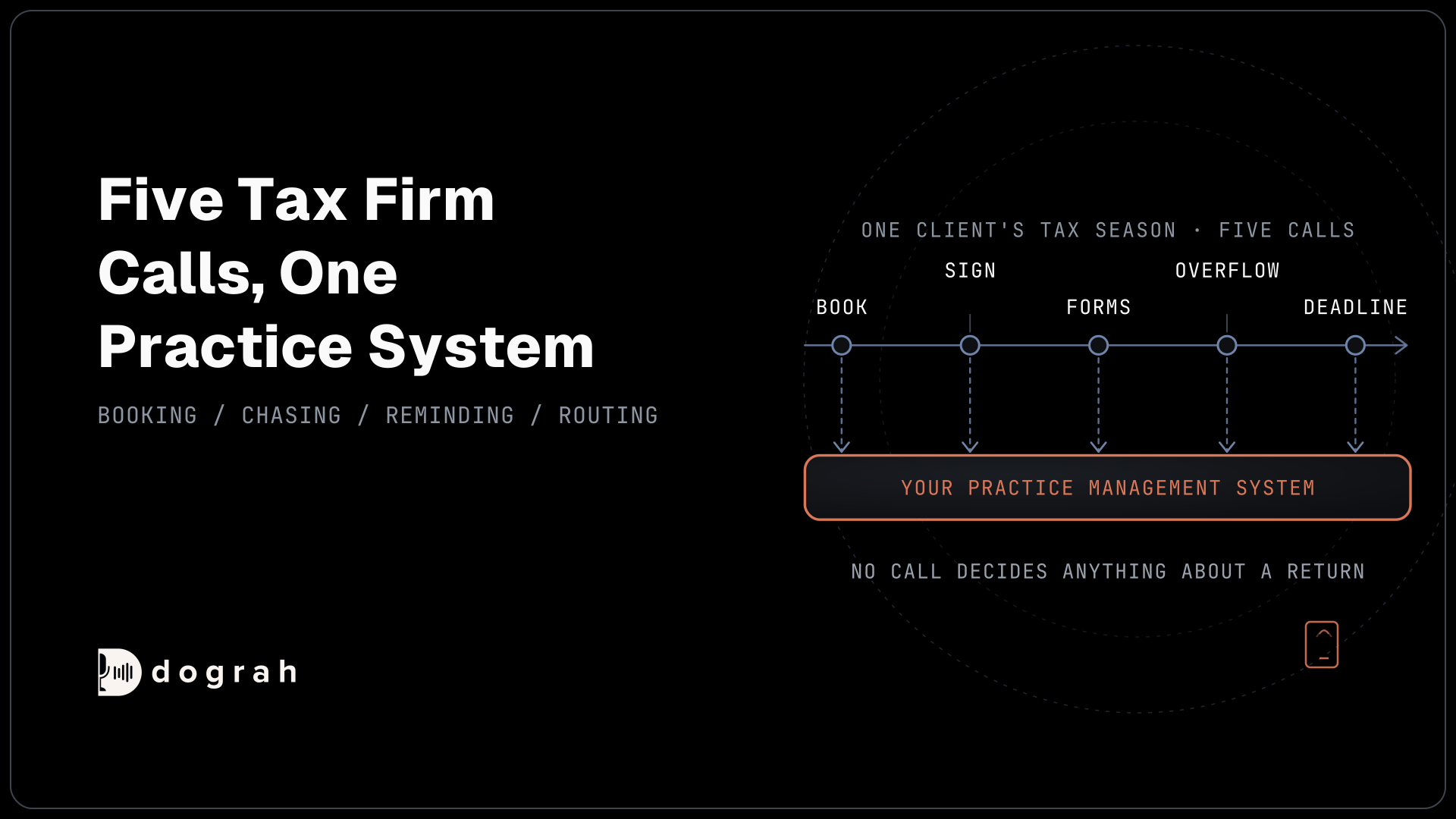

AI voice agents for tax and accounting firms answer and place a firm's routine calls: tax-season booking, engagement letter follow-ups, missing-document reminders, overflow questions and deadline reminders. They read and write the practice management system during the call. They never give tax advice, and any question about the caller's own return goes to a preparer.
Key Takeaways
- The agent never gives tax advice; own-return questions go to a preparer.
- Documents and payments never pass through the call; your system sends the links.
- Each hosted provider that hears a call is generally a Safeguards Rule service provider.
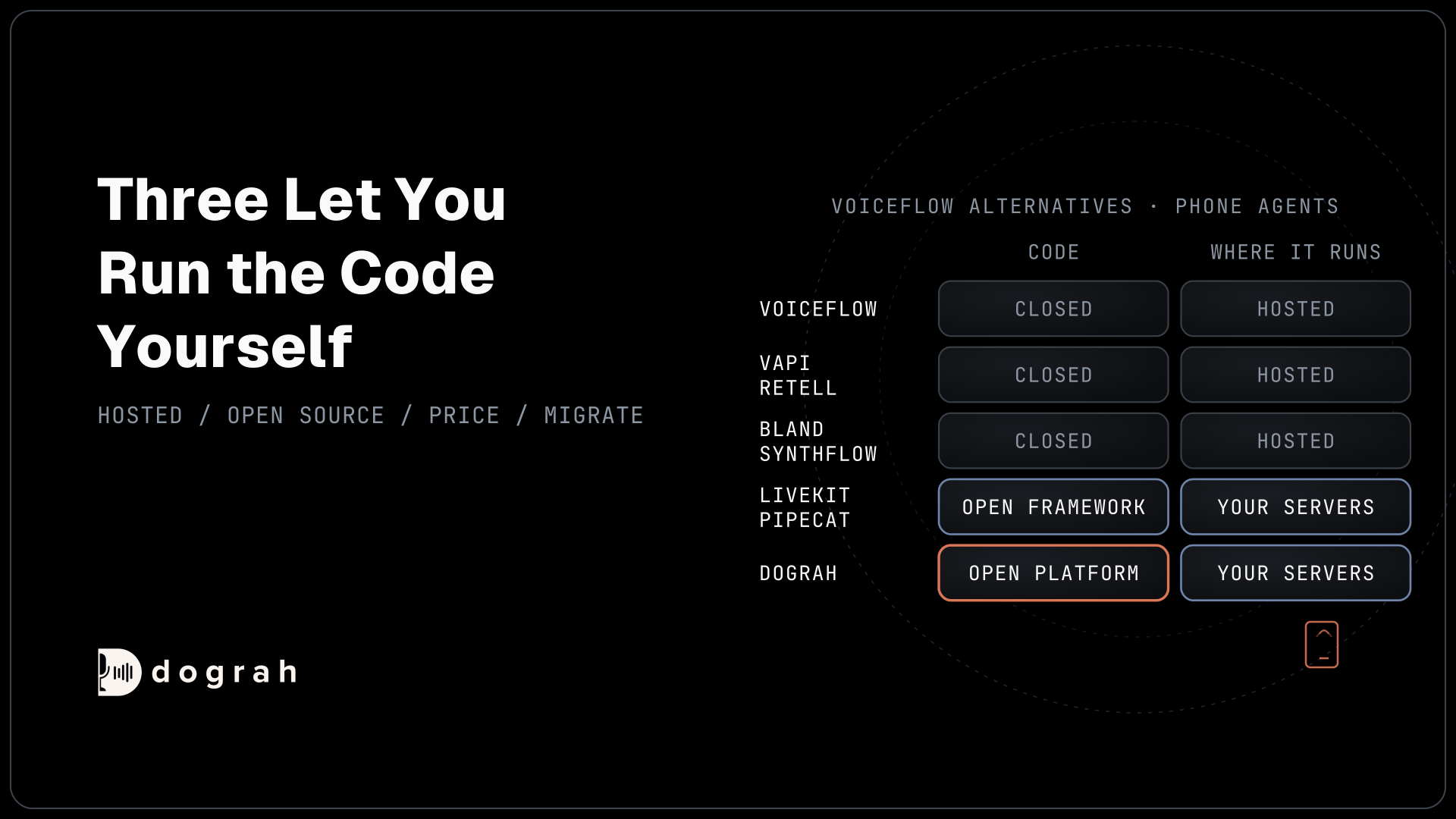
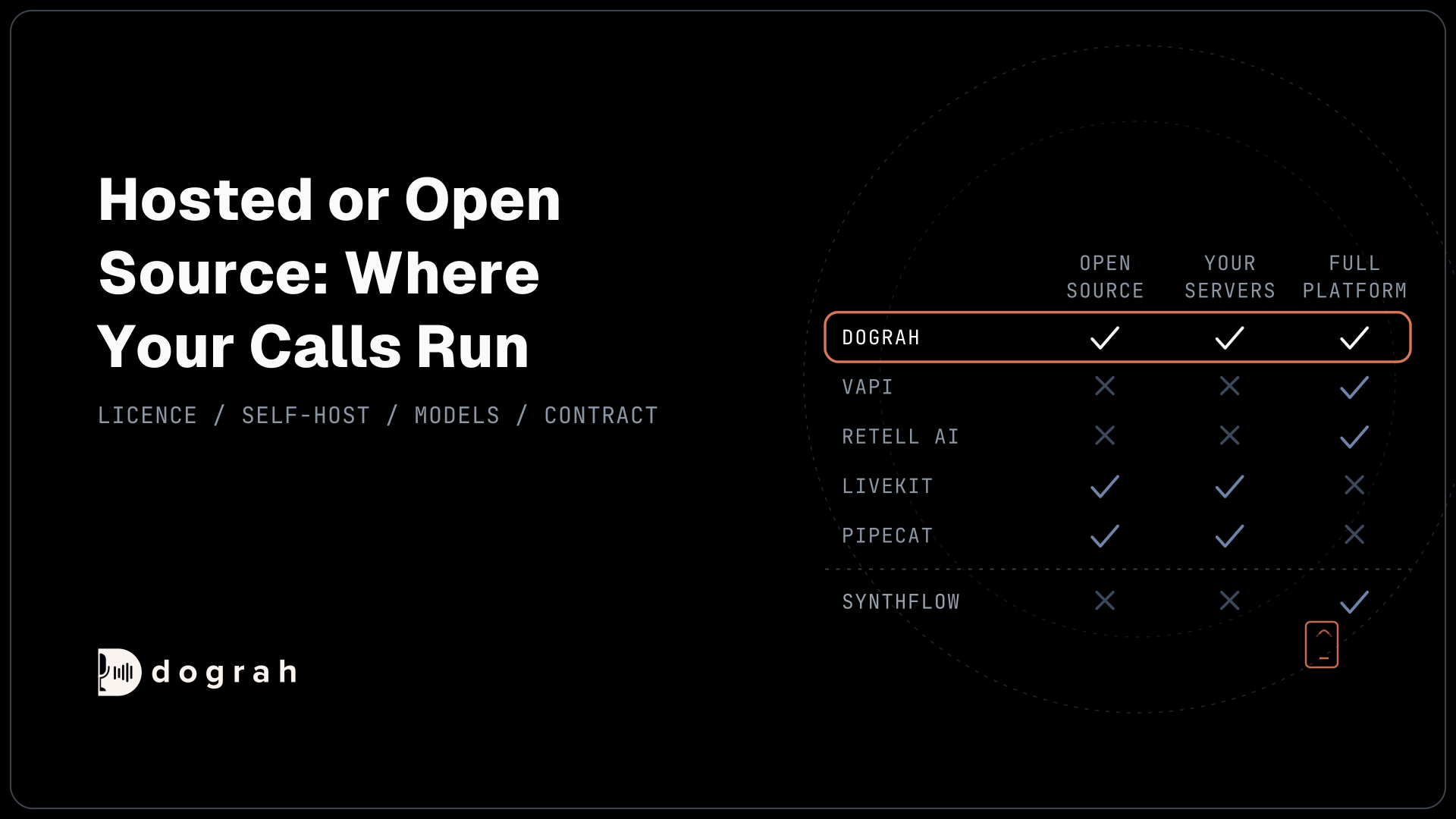
This guide follows a client's year from the first booking to the deadline, then covers where the calls run and the rules for each. The examples use Dograh, an open-source voice agent platform. You can self-host it or run it on Dograh Cloud.
Tax and accounting firm calls, and when they peak
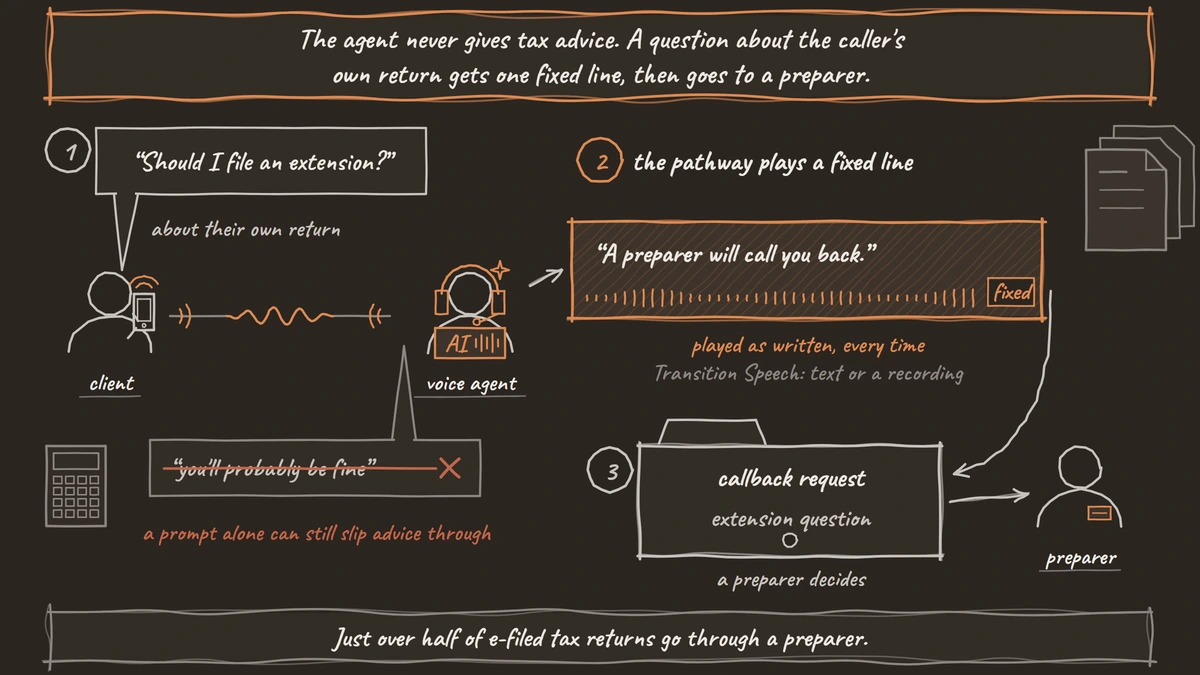
Most of a tax firm's phone work is booking, chasing, reminding and routing, and most of it lands in a few weeks. The IRS filing season statistics show 75.3 million individual returns e-filed by tax professionals in the latest season, out of 141 million e-filed returns in total. Just over half of e-filed returns go through a preparer, so a firm's phone carries a large share of the season.
The work also arrives late. The IRS's weekly figures show tax professionals had e-filed about 7.9 million returns by early February and 52.8 million by early April. About 20 million more came in the last two weeks before the April deadline.
One rule holds on all of them. The agent never gives tax advice, and any question about the caller's own return goes to a preparer. "Can I deduct my home office?" and "Should I file an extension?" both get the same answer, that a preparer will call back. Tell the agent that in the prompt, but a prompt alone cannot guarantee it. Models avoid a banned phrase and still deliver its meaning ("you'll probably be fine this year"). Exact wording holds only where Dograh plays fixed text, such as the Greeting Text or a pathway's Transition Speech (text or a recorded clip). So the hand-off line lives there, and the pathway leads to a callback request.
The agent works through your practice management system
During the call, an HTTP API tool asks the firm's system for open slots, a client's missing items or the signing status of a letter. A second tool writes the booking or the request back. Pre-Call Data Fetch can load the client's record as the call connects. After the call, a Webhook node sends the outcome and the transcript link to the same system, and retries automatically on a temporary failure.
Dograh has no built-in connector for practice management software, tax software or calendars, so each connection is an HTTP API tool pointed at your system's own API. Our guide to Integrating Voice Agents With Your Stack covers the other routes, such as the API Trigger.
Every call runs greet, verify, then disclose. A phone number finds a record but does not prove who is holding the phone, and in a tax firm a spouse or bookkeeper often answers. Before the agent names an appointment, a missing form or a due date, it confirms identity with a check the firm approves, such as date of birth or the last four digits of a number the firm already holds.
Some callers need a person. Transfer Call works on Twilio, Telnyx and Asterisk ARI. It passes no summary by default; on Twilio it can play a short spoken introduction to both people. Write the details to your system with an HTTP API tool before the transfer. If nobody answers, the caller stays with the agent; tell it in the prompt to offer a callback.
Before the work: booking and engagement letters
Tax-season appointment scheduling
An HTTP API tool reads the open slots for the appointment type the caller needs, such as a new-client meeting or a document drop-off. The agent reads the booking back before writing it once.
Because HTTP API tools do not retry on their own and a caller may repeat themselves, the booking tool carries a Preset Parameter named workflow_run_id with the value {{initial_context.workflow_run_id}}, so the firm's system ignores a duplicate. An existing appointment is read back or moved only after verification, and "Should I file an extension instead?" goes to a preparer. AI voice agents for tax-season appointment scheduling covers appointment types, reschedules and reminder calls.
Engagement letter and e-sign follow-up
After verifying the client, the agent says which document is waiting, such as the engagement letter or a taxpayer consent form the firm uses under the IRC 7216 rules. Then an HTTP API tool asks the firm's e-sign or practice management system to resend the signing link by text or email.
Signing status is read live as the call connects, so a client who signed this morning is thanked and the reminder ends there. Questions about scope, fees or the letter's terms are written to the file for the partner, and the agent reads no clause aloud. AI voice agents for engagement letter and e-sign follow-up covers the call and how often to make it.

Open Source Alternative to Vapi / Retell
Self-hosted voice agent platform — no per-minute fees
dograh-hq/dograh
Star on GitHub
During the season: documents and call overflow
Document-collection reminders
The reminder call names the missing item and why the return needs it. Clients usually miss a W-2 or a K-1 because nobody told them which form is needed and by when. The list of missing forms is itself tax return information, so the agent reads it only after verification and never into a voicemail. Voicemail handling is off by default. Turn it on in Settings, and if you choose Leave a message, the message gives the firm's name and a callback number only.
The agent never takes a document, or a photo of one, on the call. An HTTP API tool asks the firm's portal to send its secure upload link by text or email. Keep the cadence gentle, for example one call per missing item per week, stopping when the item arrives. Campaigns have no per-contact call cap, so the firm's own list enforces it. A running campaign's contact list cannot be edited, so build each list from the portal's missing-items report right before launch. AI voice agents for document-collection reminders in accounting covers the full call.
Tax-season call overflow
The overflow agent picks up when every line is busy or the office is closed, and it answers only general questions from the firm's own files. Upload the firm's hours, fee list, what-to-bring checklist and portal instructions to the Knowledge Base, as PDF, DOCX, DOC, TXT, JSON or MD files of up to 5 MB each. Tell the agent in the prompt to stick to them.
A refund amount, a deduction or an IRS or state notice goes to a preparer. For a notice, the agent takes the notice number and date as the caller reads them, never interprets the letter, and writes a callback request for a preparer. "Has my return been filed?" is answered only after verification, read live from the firm's system through an HTTP API tool.
Self-hosted Dograh runs 10 concurrent calls by default, adjustable with DEFAULT_ORG_CONCURRENCY_LIMIT, and Dograh Cloud Pay as you go includes 10. A new inbound call over the limit is rejected, not queued, so size the limit for the last two weeks. AI voice agents for tax-season call overflow covers the overflow call, and our guide to AI receptionists covers reception more broadly.
Deadline and extension reminders
Due dates differ by client. Fiscal-year filers have their own dates, and IRS disaster relief can postpone deadlines for clients in affected areas. So the date comes from the firm's system for each client, never from a date written into the prompt.
The IRS page on when to file says: "An extension of time to file is not an extension of time to pay." If the firm approves that line, it can sit in the Knowledge Base as a general answer. Whether to extend, or what the client owes, goes to a preparer, and an HTTP API tool records the extension request.
These calls run as a campaign. Calling hours are set by weekday in one time zone per campaign (UTC by default), so split the client list by time zone. Pre-Call Data Fetch re-reads the client's status when the call connects (on outbound calls, after the person answers), so the agent can thank a client who filed this morning instead of reminding them. It changes what the agent says, but it does not skip the call. Estimated-tax reminders carry the date and the firm's payment instructions only. AI voice agents for tax deadline and extension reminders covers dates, consent and the time-zone split.
Where the calls run: IRC 7216 and the Safeguards Rule
Nearly every call above carries tax return information, so where the audio and transcripts go is a legal question too. This section is general information, not legal advice.
Section 7216 of the Internal Revenue Code makes it a misdemeanor for a preparer who "knowingly or recklessly" discloses "any information furnished to him for, or in connection with, the preparation of any such return". The regulations under it treat even a client's name, address or identifying number given for a return as tax return information. A booking call already carries some.
The FTC Safeguards Rule adds a second layer. Its definitions say "An accountant or other tax preparation service that is in the business of completing income tax returns is a financial institution". A service provider is "any person or entity that receives, maintains, processes, or otherwise is permitted access to customer information through its provision of services directly to a financial institution". IRS Publication 4557 puts it plainly: "According to the FTC Safeguards Rule, tax return preparers must create and enact security plans to protect client data."
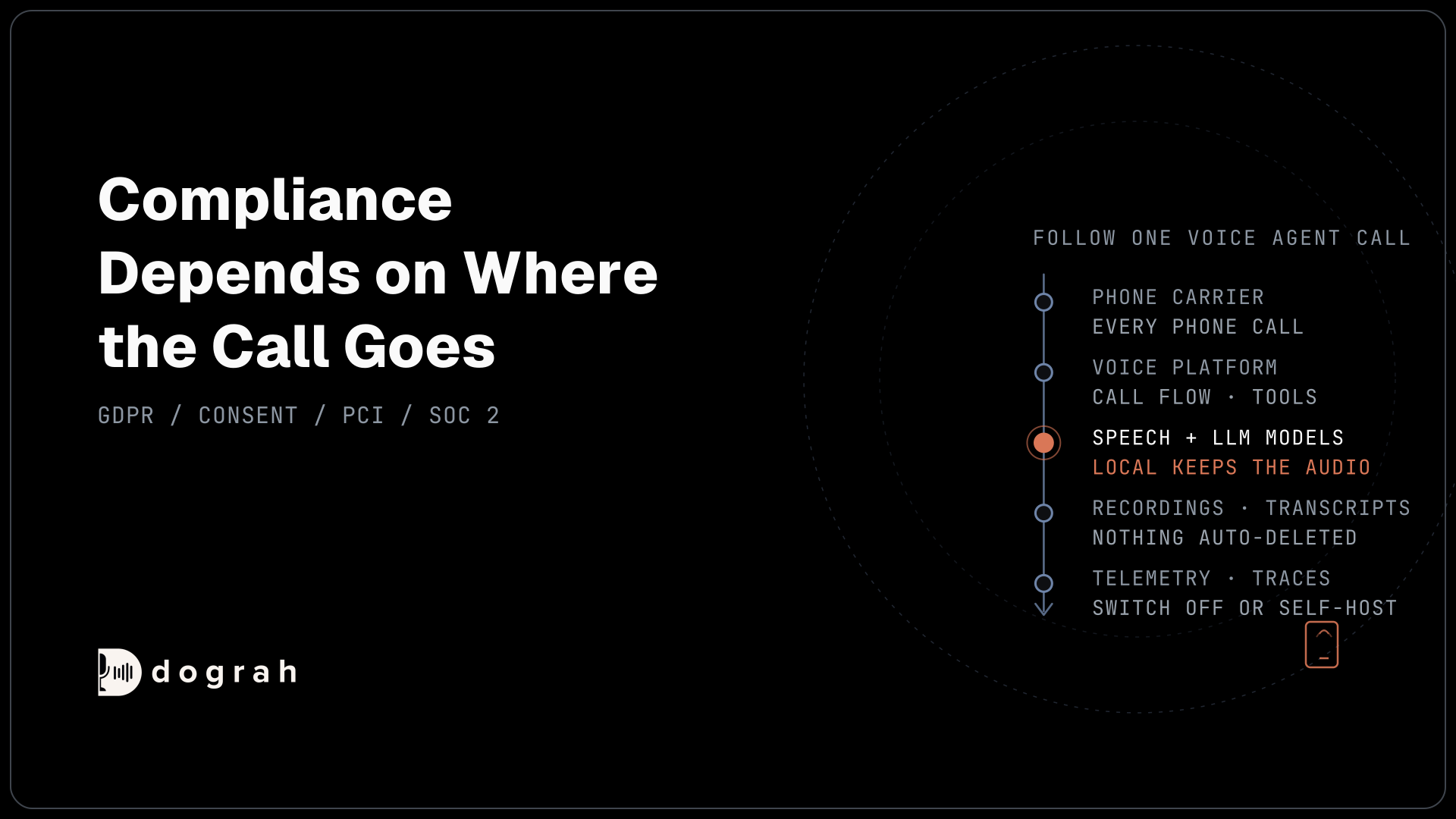
So each outside company that hears the call or stores its transcript is generally a service provider the firm has to oversee. That can include the voice platform and each model provider behind it. A phone carrier that stores recordings can be one too. Unlike legal privilege, covered in our guide to AI voice agents for law firms, these duties can generally be met with hosted providers under contract, as long as the firm picks capable ones and keeps checking them. The 7216 regulations also let a preparer share return information with another preparer "located in the United States" for auxiliary services; a recipient outside the US generally needs the client's signed consent first. So on-prem shortens the list of providers the firm has to oversee.
Dograh is the orchestration layer: it runs the call flow, tools and telephony, and the speech and language models are a separate layer you choose. Using a model provider through your own key (BYOK) changes who holds the contract, but the audio still reaches the provider. Self-hosting Dograh keeps recordings and transcripts on your servers. The call audio stays in-house only when the speech and language models run on your own servers too.
Because you self-host Dograh inside your existing compliance perimeter, you don't need a separate vendor review for Dograh. The speech and language model providers you choose may still need their own review, unless those models run on your servers too. Dograh starts every account on its own managed models. To keep call audio away from Dograh, open Models, switch the Organization default to BYOK with your own speech and language providers (or local models), and check that no agent has its own model override. For calls that carry little beyond a name and a time, Dograh Cloud handles the security work for you.
Our post on why voice data needs to stay local explains what a voice recording exposes, and On-Prem Voice AI for Accounting Firms counts every place a call goes and what each one means under the rule. Confirm your position with counsel.
Join the Dograh Community
Dograh is an OSS alternative to Vapi. Join our Slack community for queries, releases, best practices & community interactions.
Rules that apply to every call
This is general information, not legal advice.
Nothing sensitive passes through the call. Recordings and transcripts keep whatever is said, so the call never asks for a full account, card or Social Security number; use a short check such as the last four digits, and send payment links by text or email from your own system. Documents go through the portal's upload link. Dograh has no retention setting and deletes nothing automatically, so the firm deletes recordings and transcripts from its own storage under its own policy. On a self-hosted install, recording can be switched off only for the whole server, and transcripts are still saved.
Outbound calls need consent. In its February 2024 ruling, FCC 24-17, the Federal Communications Commission confirmed that the Telephone Consumer Protection Act (TCPA) limits on calls using an "artificial or prerecorded voice" cover "current AI technologies that generate human voices". Such calls generally need the called party's prior express consent. The engagement letter is a natural place to ask for it, recorded in the firm's system.
Dograh keeps no do-not-call list. When a caller opts out, an HTTP API tool writes it to your own list, and you remove those numbers before the next campaign upload. The do_not_call call tag records the request but never blocks a later call.
If you want to tell callers they're speaking with an automated assistant, or your location requires it by law, write it in the Greeting Text along with the firm's name. Recording consent depends on the state, and some states require every party's consent. Recording starts as the call connects, so the recording notice must be the first thing the caller hears, in the Greeting Text. Confirm your position on consent and recording with counsel in each state where you call.
Which call to hand over first
Start with appointment booking and overflow questions answered from the Knowledge Base, which read only a calendar or the firm's own files. Engagement letter and document reminders come next, since they name a client's documents after verification. Deadline reminders follow once the firm's system returns each client's own date. Decide where the calls run before any agent reads return details aloud.
Put every agent on a real phone number before a client hears it, because a phone line sounds different from a browser test. Once live, run QA on a random 5 to 10% sample of calls and read every call that ended in a hand-off to a preparer.
Self-hosted Dograh has no per-minute platform fee (servers, model keys and phone minutes still cost); Dograh Cloud has a 1¢-a-minute platform fee.
Each call above has its own deep dive:
- AI Voice Agents for Tax-Season Appointment Scheduling
- AI Voice Agents for Engagement Letter and E-Sign Follow-up
- AI Voice Agents for Document-Collection Reminders in Accounting
- AI Voice Agents for Tax-Season Call Overflow
- AI Voice Agents for Tax Deadline and Extension Reminders
- On-Prem Voice AI for Accounting Firms
Glossary
- Tax return information
- Under the IRC 7216 regulations, information a client or a third party gives a preparer for a return, down to the client's name, address and identifying number. Almost every call a tax firm's agent takes carries some, so it verifies before disclosing.
- Service provider (Safeguards Rule)
- Under 16 CFR 314.2, any person or entity that receives, maintains, processes or is permitted access to customer information by serving a financial institution. A hosted voice platform or model provider that hears a tax firm's calls is generally one.
- Transition Speech
- Fixed text or a recorded clip that Dograh plays when a call moves along a pathway. It is where a tax firm puts the no-advice hand-off line, because a node prompt cannot guarantee wording.
- Extension request
- A client's request, recorded during a call through an HTTP API tool, for the preparer to consider filing an extension. The agent records it as stated; it never files an extension or promises one.