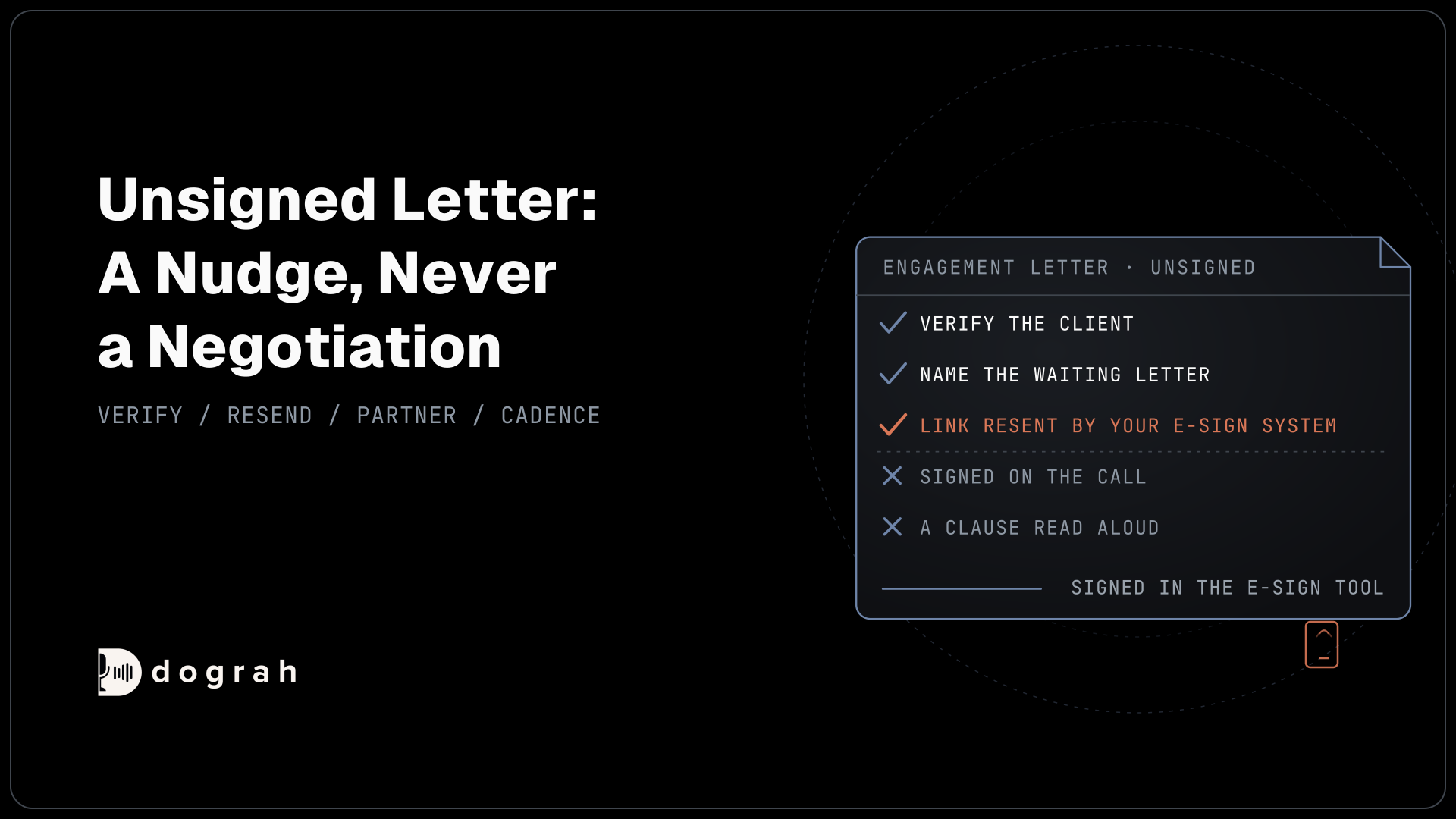

AI voice agents for engagement letter and e-sign follow-up call clients whose engagement letter or consent form is still unsigned. After verifying the client, the agent names the waiting document and has the firm's e-sign system resend the signing link by text or email. Terms and fee questions go to the partner; return questions go to a preparer.
Key Takeaways
- Call only after the e-sign tool's own reminders, and only while the letter is unsigned.
- Nobody signs on the call. The firm's e-sign system resends the link.
- The agent reads no clause aloud, and terms and fees go to the partner.
This post is part of our guide to AI voice agents for tax and accounting firms. The guide's section "Before the work: booking and engagement letters" calls this "a short, polite nudge": the agent says which document is waiting, and the firm's own system resends the signing link. Here is that call in full, run in Dograh, an open-source, self-hostable voice agent platform.
Why an unsigned engagement letter is worth a call
An engagement letter sets the scope and the fee before the work starts, so an unsigned one leaves both open. Writing in the Journal of Accountancy, a risk control director at the insurer CNA advises signed engagement letters for all tax compliance work, issued every year. The column also recommends automated e-sign reminders and a dashboard of clients who have not signed.
Most of that chase needs no call. The firm's e-sign tool or practice management system already sends its own emails. The call is the next step, for the clients still unsigned after those reminders. It often follows a booking made by AI voice agents for tax-season appointment scheduling, since a new client books first and signs second. So the call has a small job. It reminds the client and gets the link resent.
Verify, then name the document that is waiting
The greeting plays before the agent knows who answered, so it carries the firm's name and the client's name only. The agent verifies the person before it discloses anything. A phone number finds the record, but it does not prove who is speaking, so the agent asks for a check the firm approves, such as date of birth or the last four digits of a number the firm already holds. If the check fails, it leaves the firm's number and says nothing about the letter.
After the check, the agent names the document exactly: this year's engagement letter, or a taxpayer consent form the firm uses under the IRC 7216 rules. Naming the exact item works better than "some paperwork", as our post on application follow-up argues for a missing document.
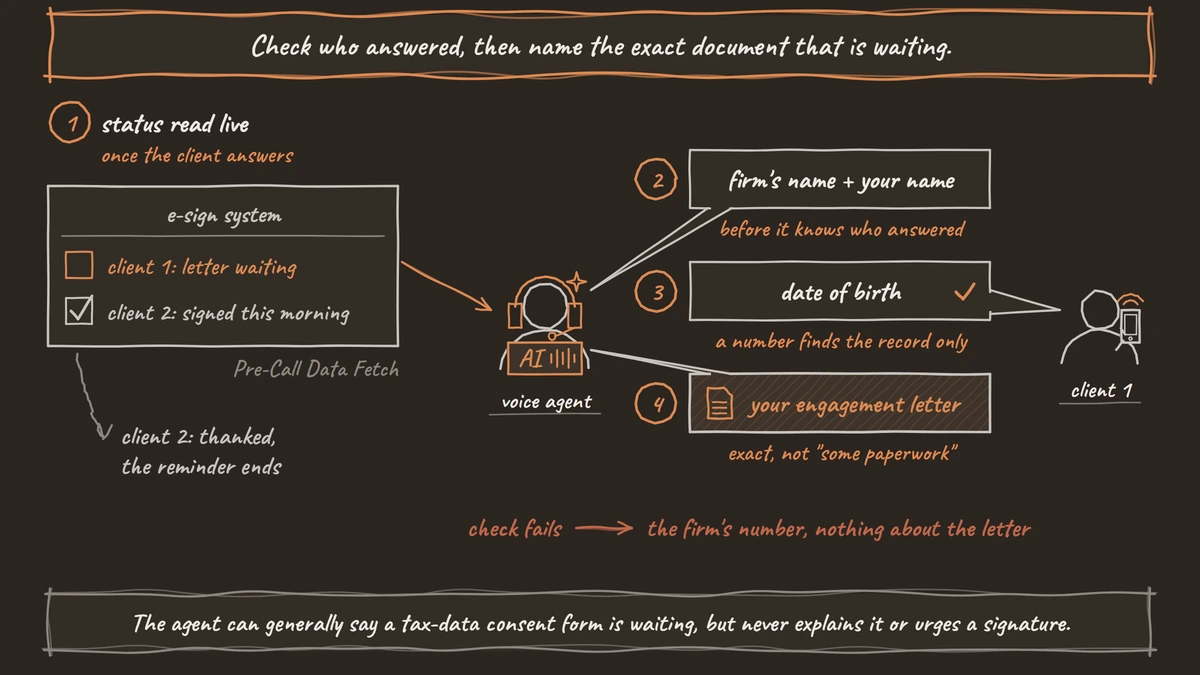
The consent form needs extra care. 26 CFR 301.7216-3 says "A consent to disclose or use tax return information must be signed and dated by the taxpayer." It also says that when the preparer receiving the information "is located outside of the United States, the taxpayer's consent under § 301.7216-3 prior to any disclosure is required." So the agent can generally say the form is waiting, but it never explains what the client is consenting to and never urges them to sign it. Those questions go to the partner. Confirm your own position with counsel.
Signing status is read live. Pre-Call Data Fetch loads it from the e-sign or practice management system once the call connects (on outbound calls, after the person answers). Tell the agent in the prompt that a client who signed this morning is thanked and the reminder ends there. It changes what the agent says, and the call still goes ahead.

Open Source Alternative to Vapi / Retell
Self-hosted voice agent platform — no per-minute fees
dograh-hq/dograh
Star on GitHub
The signing link comes from your e-sign system
The agent never sends a document and never takes a signature. An HTTP API tool asks the firm's e-sign or practice management system to resend the signing link by text or email. Dograh has no SMS tool and sends no texts itself, so the link always comes from the firm's own system.
A spoken "yes, I agree" on the call is not a signature. The regulation asks for a consent "signed and dated by the taxpayer", and the engagement letter needs the client's signature in the e-sign tool too. So the agent records what the client said, such as "I'll sign it tonight", and the link does the rest.
Joint returns often need both spouses to sign. The agent speaks only with the verified client, and the e-sign system sends the second spouse their own link. The agent never discusses the letter with someone who has not passed the check.
The tool waits 5 seconds by default and does not retry. If it returns an error, tell the agent in the prompt to say the office will resend the link and write a callback request instead. The same link mechanic sends upload links in document-collection reminders in accounting.
Questions about scope or fees go to the partner
The engagement letter is the partner's agreement, so the agent leaves its terms alone. It reads no clause aloud and never explains or changes the terms. "Why is the fee higher this year?" and "Does this cover my rental property?" are written to the client's file for the partner through an HTTP API tool, with a callback request.
Questions about the return follow the rule for every tax firm call: the agent never gives tax advice; any question about the caller's own return goes to a preparer. Tell the agent both rules in the prompt. A prompt alone cannot hold the wording, because a model avoids the banned phrase and still says its meaning. So the hand-off line plays as Transition Speech, fixed text or a recorded clip that Dograh plays when the call moves along a pathway, and that pathway leads to the callback request.
To hand the call over instead, Transfer Call works on Twilio, Telnyx and Asterisk ARI. It passes no summary by default; on Twilio it can play a short spoken introduction to both people. Write the details to your system with an HTTP API tool before the transfer. If nobody answers, the caller stays with the agent; tell it in the prompt to offer a callback.
How often to call, and when to stop
A follow-up works when it is short and stops on time. Upload the unsigned list from the e-sign dashboard as a CSV to Campaigns, or start each call from the firm's system with the API Trigger.
Consent generally comes before the first call. In its February 2024 declaratory ruling, the FCC said calls using AI-generated voices "require the prior express consent of the called party to initiate such calls absent an emergency purpose or exemption." A client who has not signed the engagement letter has not given consent in it either, so take consent at intake and record it in the firm's system. Confirm your position with counsel.
Keep the cadence gentle, for example one call a week until the letter is signed, and stop when the e-sign tool marks it signed. Campaigns have no per-contact call cap, so the firm's own list enforces it. To stop calling someone mid-campaign, pause the campaign and start a new one from a corrected list. For lists that change daily, start calls from your own system with the API Trigger, so your system decides who is called.
Voicemail handling is off by default. Turn it on in Settings, and if you choose Leave a message, the message gives the firm's name and a callback number, never the document or the fee. Dograh keeps no do-not-call list. When a caller opts out, an HTTP API tool writes it to your own list, and you remove those numbers before the next campaign upload. The do_not_call call tag records the request but never blocks a later call.
Self-hosted Dograh has no per-minute platform fee (servers, model keys and phone minutes still cost); Dograh Cloud has a 1¢-a-minute platform fee.
Join the Dograh Community
Dograh is an OSS alternative to Vapi. Join our Slack community for queries, releases, best practices & community interactions.
Glossary
- Engagement letter
- The agreement that sets the scope of a firm's work and its fee before the work starts. The agent reminds the client it is waiting and has the e-sign system resend it; the partner owns its terms.
- Section 7216 consent
- A client's written consent, under the IRC 7216 regulations, for a preparer to disclose or use tax return information in a way the rules otherwise bar. It must be signed and dated by the taxpayer, so it is never given by voice on a call.
- Signing link
- A one-client link from the firm's own e-sign or practice management system that opens the letter for signature. During the call, an HTTP API tool asks that system to resend it by text or email.
- Pre-Call Data Fetch
- A Dograh setting at the bottom of the Start Call node that loads data from the firm's system once the call connects. Here it reads whether the letter is signed, so the agent thanks a client who already signed.