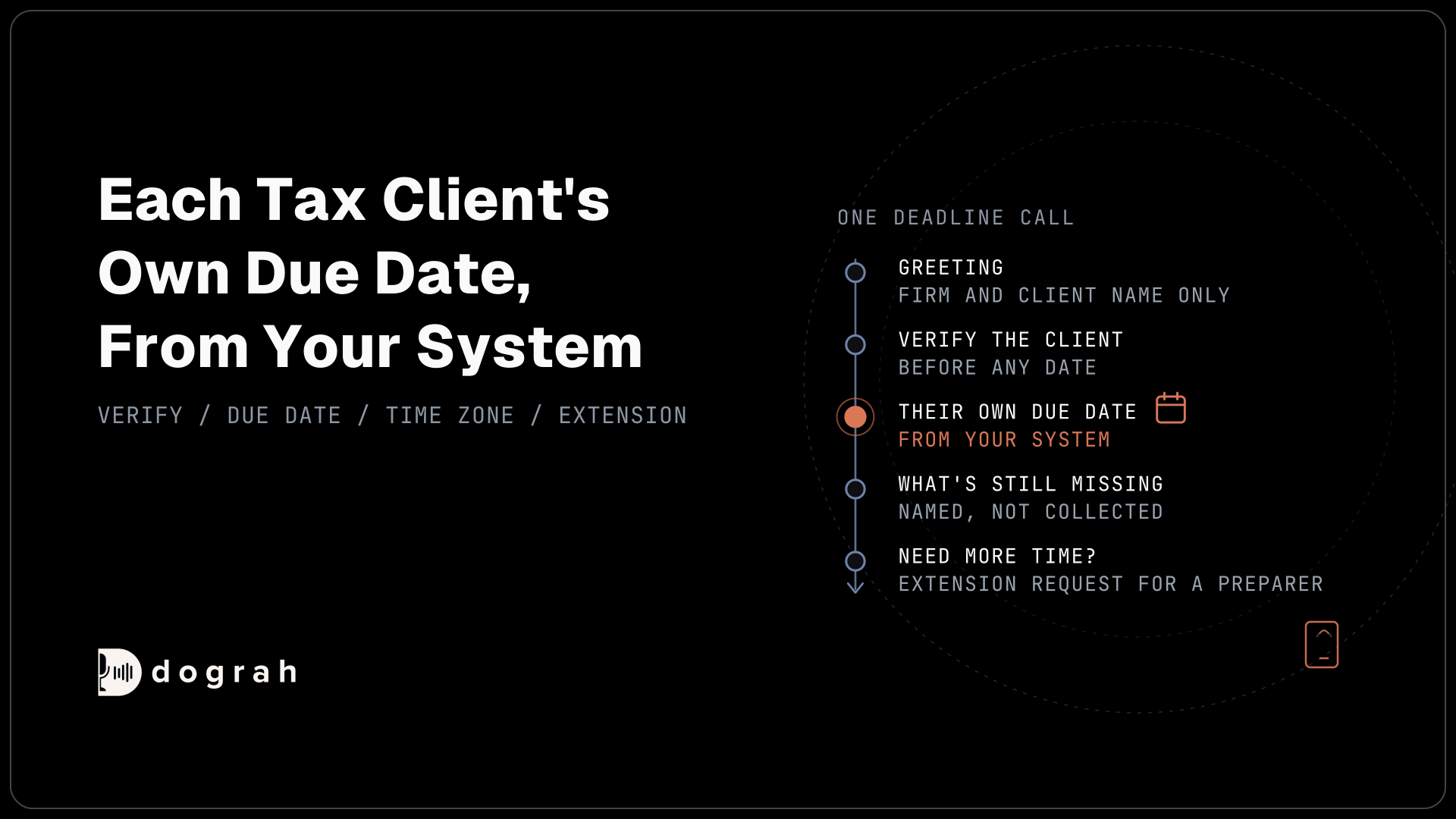

AI voice agents for tax deadline and extension reminders call the clients who have not acted on a firm's earlier notices. After verifying the client, they state that client's own due date from the firm's system and what is still missing. They never give tax advice, and they record an extension request for a preparer instead of promising one.
Key Takeaways
- Read each client's due date from your system, never from the prompt.
- Calling hours use one time zone per campaign, so split lists by time zone.
- The agent records extension requests for a preparer and never files one.
This post is part of our guide to AI voice agents for tax and accounting firms. The guide's section "Deadline and extension reminders" sets the rule for this call: "A deadline call states the client's own due date and what the firm still needs, and it never decides whether the client should extend." Here is that call in full, run in Dograh, an open-source, self-hostable voice agent platform.
Why a deadline call still earns its place
Most deadline reminders need no call. The firm's portal or practice management system sends the first notice, and Dograh has no SMS tool, so texts stay there. The call goes to the clients who have not acted, with no documents sent and no reply.
Timing is what makes it worth a call. The IRS filing season statistics show tax professionals had e-filed 72.8 million returns by mid-April, about 20 million of them in the two weeks before. A client who is still silent two weeks out is the one a preparer most needs to reach.
Extension season repeats the pattern. The IRS says: "If you can't file by the due date of your return, you can request an automatic 6-month extension of time to file." Extended clients then face a second deadline and need a second round of calls. Chasing missing forms is covered in AI voice agents for document-collection reminders in accounting. This call is about the date.
Each client's own date, read from your system
The due date comes from the firm's system for each client, never from a date written into the prompt. The IRS page on when to file gives fiscal-year filers "The fourth month after your fiscal year ends, day 15". It also says: "If day 15 falls on a Saturday, Sunday or legal holiday, the due date is delayed until the next business day."
Disasters move dates by area. The IRS lists each postponement on its disaster relief page, such as relief for taxpayers hit by Hurricane Isaias in Alabama and Florida, with deadlines pushed into February 2027. Two clients of the same firm can have different dates for the same return.
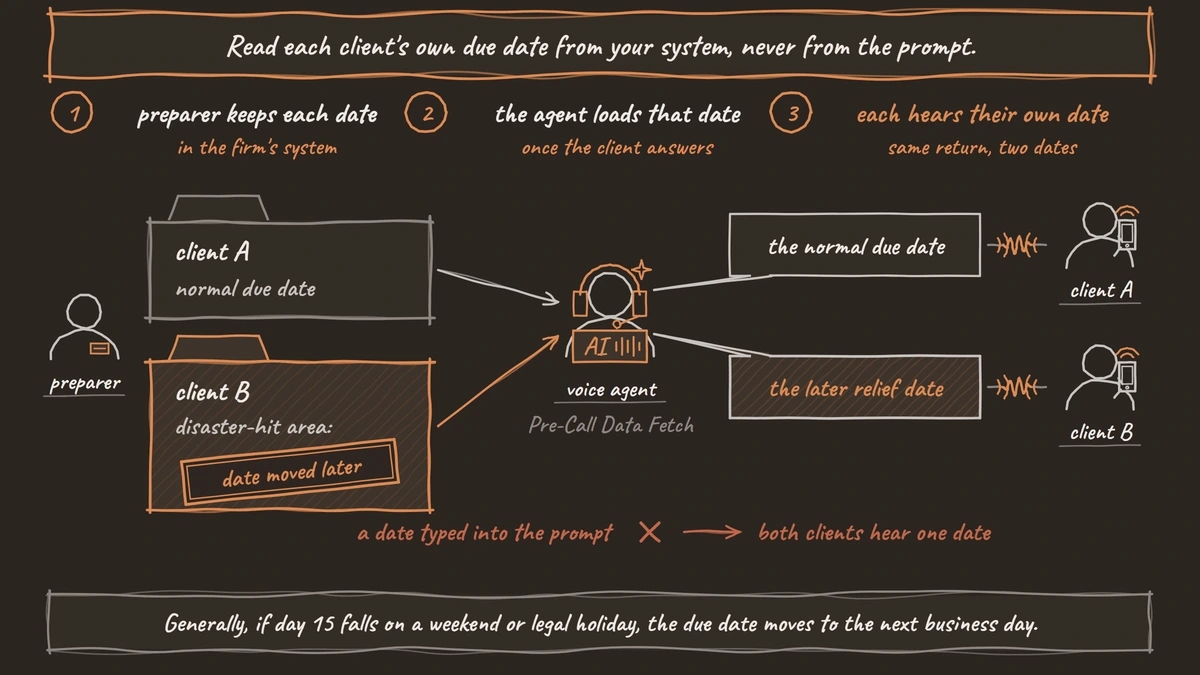
So the date lives where the preparer keeps it. Pre-Call Data Fetch, at the bottom of the Start Call node, can load the client's due date and filing status when the call connects. On outbound calls it runs after the person answers. Because it re-reads the status, a client who filed this morning is thanked and the call ends there. It changes what the agent says, but it does not skip the call.

Open Source Alternative to Vapi / Retell
Self-hosted voice agent platform — no per-minute fees
dograh-hq/dograh
Star on GitHub
Calling hours, time zones and consent
Deadline calls run as a campaign. Calling hours are set by weekday in one time zone per campaign (UTC by default), not in each client's local time. A firm with clients in New York and California needs two campaigns, or the California list could hear its first calls at 6 a.m.
Local time matters for a legal reason too. The FCC's calling rules in 47 CFR 64.1200(c)(1) bar telephone solicitations to "Any residential telephone subscriber before the hour of 8 a.m. or after 9 p.m. (local time at the called party's location)". A reminder to an existing client is generally not a solicitation, but keeping the same window in each client's own time zone is the safe default.
Consent generally comes before the first call. In its February 2024 declaratory ruling, the FCC said calls using AI-generated voices "require the prior express consent of the called party to initiate such calls absent an emergency purpose or exemption." The engagement letter is a natural place to ask, recorded in the firm's system. This is general information, not legal advice; confirm your position with counsel.
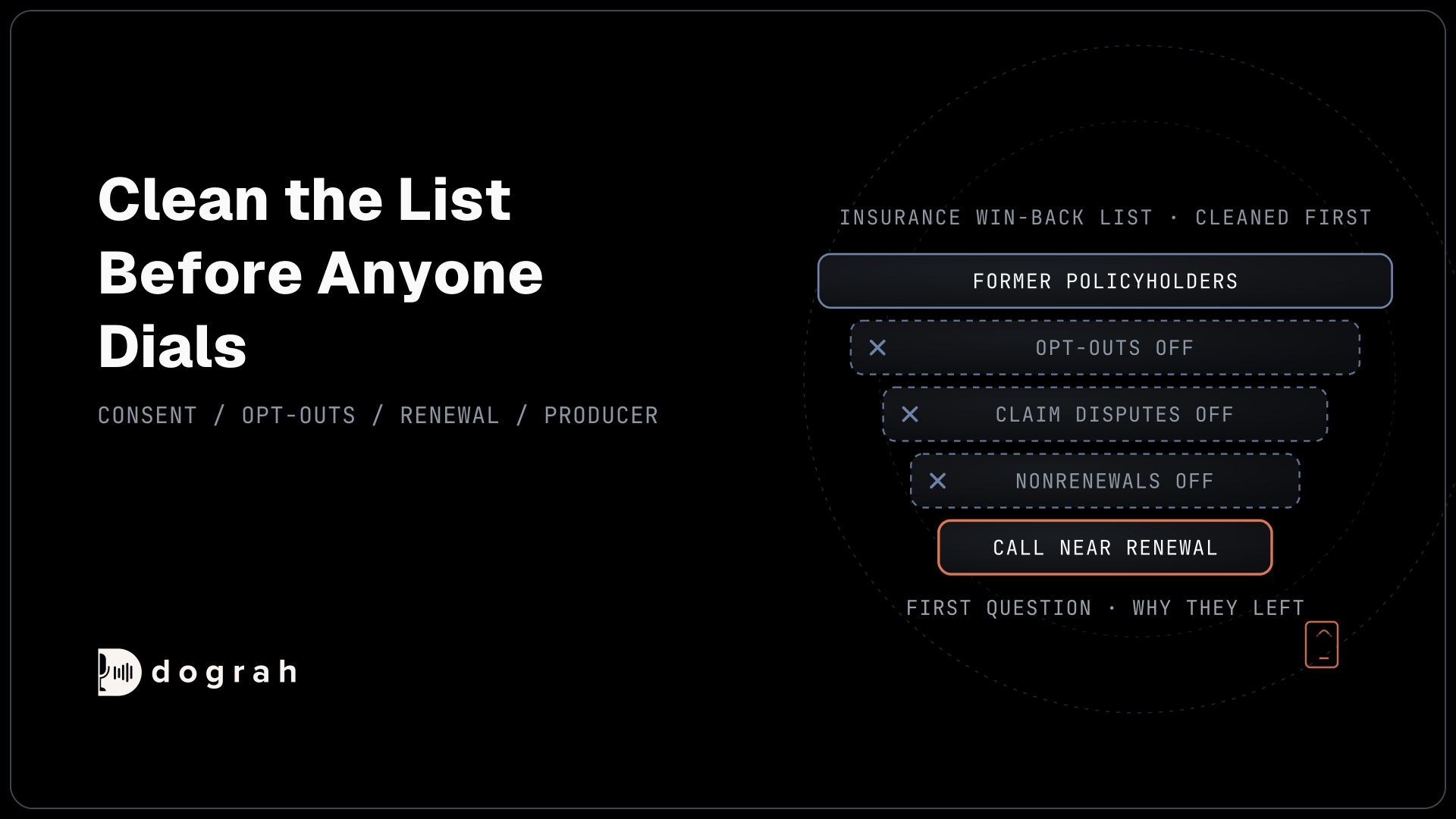
Retries run from 0 to 10, 2 by default, with a delay between 30 seconds and an hour. Campaigns have no per-contact call cap, so the firm's own list sets how often anyone is called. A running campaign's contact list cannot be edited. To stop calling someone mid-campaign, pause the campaign and start a new one from a corrected list. For lists that change daily, start calls from your own system with the API Trigger, so your system decides who is called.
Dograh keeps no do-not-call list. When a caller opts out, an HTTP API tool writes it to your own list, and you remove those numbers before the next campaign upload. The do_not_call call tag records the request but never blocks a later call. The same before-the-due-date pattern runs in our post on AI voice agents for rent reminders.
How the call runs: verify, then the date
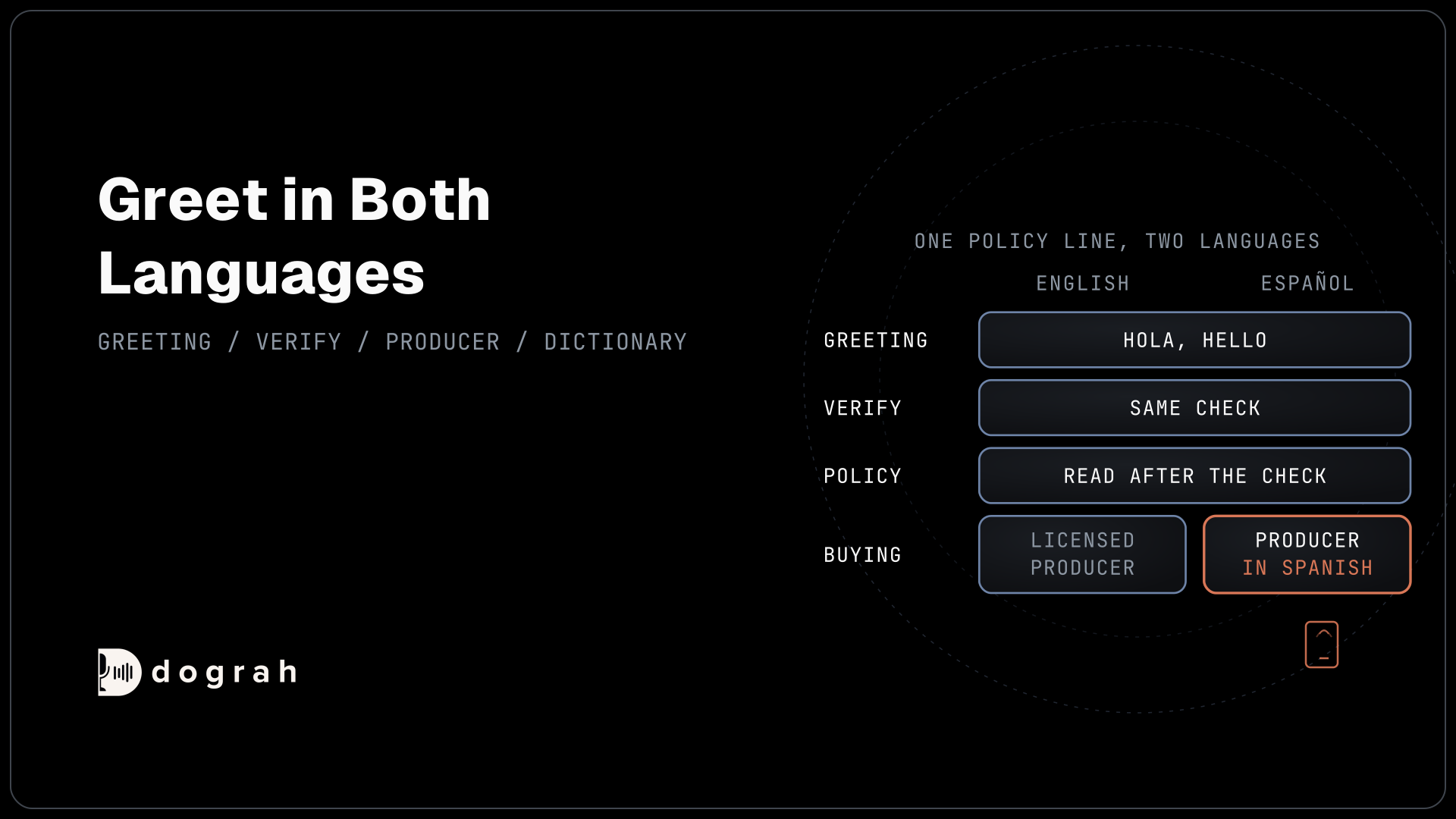
The call opens with Greeting Text, fixed words Dograh plays as the call connects, and it names the firm. If you want to tell clients they're speaking with an automated assistant, or your location requires it by law, write it in the Greeting Text along with the firm's name.
A fixed greeting per contact, as text or a recorded clip, can come from the campaign file, and contacts without one hear the agent's normal greeting. It plays before the client is verified, so it carries the firm's name and the client's name only.
Asking for the client by name only finds the right person. Before the agent names a date or a missing form, it confirms identity with a check the firm approves, such as date of birth. Recordings and transcripts keep whatever is said, so the call never asks for a full account, card or Social Security number; use a short check such as the last four digits, and send payment links by text or email from your own system.
After the check, the agent states the due date and what the firm still needs, then asks whether the client will make the date. Voicemail handling is off by default. Turn it on under Settings, Voicemail & Screening. "When voicemail is detected" then starts on "Disconnect the call". Choose "Leave a message" for a short one with the firm's name and a callback number only, never the due date or the missing forms, because anyone in the household can play it.
Extension requests go to a preparer
One rule holds here. The agent never gives tax advice, and any question about the caller's own return goes to a preparer. "Should I extend?" and "Will I owe?" both get a preparer callback.
Tell the agent that in the prompt, and give those questions a pathway whose Transition Speech plays the hand-off line as fixed text or a recorded clip. If the firm approves the IRS line "An extension of time to file is not an extension of time to pay." as a general answer, play it the same way, as fixed text.
A client who says "I need more time" gets an extension request recorded for the preparer. An HTTP API tool writes it to the firm's system as the client stated it, with the reason they gave. The agent never files an extension and never promises one.
Estimated-tax reminders carry the date and the firm's payment instructions only. No payment is taken on the call. Instead, an HTTP API tool asks the firm's own system to send its payment link by text or email.
Transfer Call works on Twilio, Telnyx and Asterisk ARI. It passes no summary by default; on Twilio it can play a short spoken introduction to both people. Write the details to your system with an HTTP API tool before the transfer. If nobody answers, the caller stays with the agent; tell it in the prompt to offer a callback. Clients calling back reach the inbound agent in AI voice agents for tax-season call overflow.
Self-hosted Dograh has no per-minute platform fee (servers, model keys and phone minutes still cost); Dograh Cloud has a 1¢-a-minute platform fee.
Join the Dograh Community
Dograh is an OSS alternative to Vapi. Join our Slack community for queries, releases, best practices & community interactions.
Glossary
- Extension request
- A client's request, recorded during the call through an HTTP API tool, for the preparer to consider an extension. The agent records it as the client stated it; it never files an extension or promises one.
- Disaster postponement
- IRS relief that pushes filing and payment deadlines later for taxpayers in a declared disaster area. It is why a firm's clients can have different due dates for the same return, and why the agent reads each date from the firm's system.
- Calling hours
- The weekday time windows a Dograh campaign may dial in. They use one time zone per campaign (UTC by default), so a client list across time zones needs separate campaigns.
- Pre-Call Data Fetch
- A setting at the bottom of Dograh's Start Call node that loads data from your system when the call connects. A deadline agent uses it to read the client's current due date and filing status.