
AI voice agents for Tier-1 call deflection answer routine support calls, such as order status and policy questions, and solve them from start to finish. They verify the caller, read and write the client's system during the call, and transfer anything that needs judgement to a person. A call counts as deflected only when the problem was solved.
Key Takeaways
- Pick a call type only if the agent can finish it from the client's system.
- Count a call as deflected only when the caller's problem was solved.
- Write notes to the client's helpdesk before every transfer to a person.
This post is part of our guide to AI voice agents for BPO and contact centers. The guide's section "Tier-1 call deflection: calls the agent finishes" sets the rule in one line: "Tier-1 deflection means the agent solves a routine call from start to finish." Here is how to pick those calls for each client program and run them in Dograh, an open-source, self-hostable voice agent platform.
What counts as a deflected call
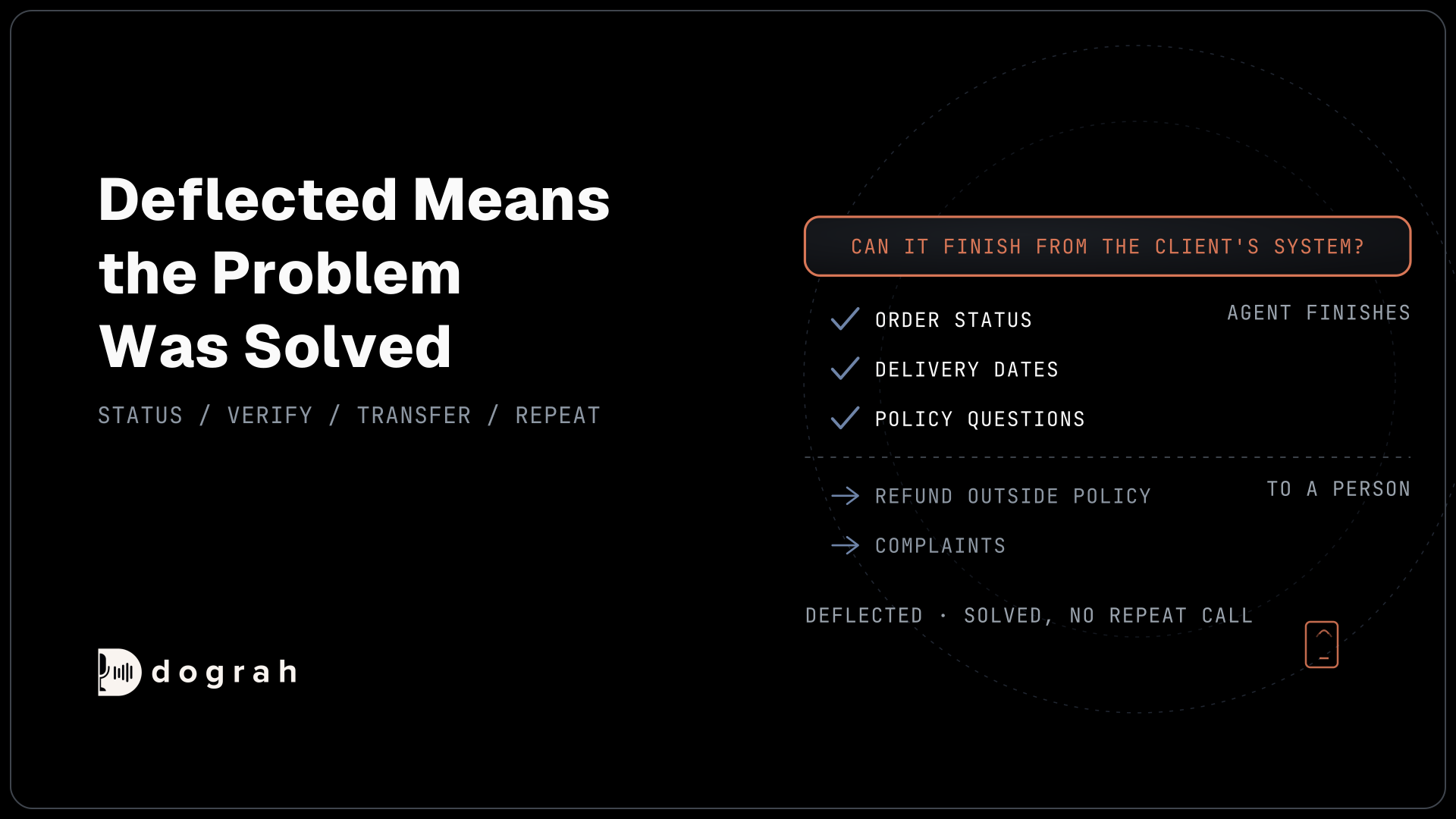
A tier-1 call is deflected when the caller's problem is solved and no person was needed. A call that only stayed away from a person does not count.
The difference matters because the easy number misleads. The containment rate, the share of calls finished without a person, also rises when an agent loops callers until they give up. Our post on AI voice agent vs IVR explains why containment fails on its own. A BPO that reports containment to a client is reporting how few callers reached a person, and that says little about how many got help.
The work itself is moving. The Bureau of Labor Statistics outlook for customer service representatives counts about 2.7 million jobs in 2025 and projects a 5% decline by 2035, as self-service systems let customers handle simple tasks. Those simple tasks are tier-1 calls. They are the ones to automate first, and the easiest ones to check.
Pick call types the agent can finish
Pick each call type by one test: can the agent finish it from the client's own system or documents? If the answer depends on someone's judgement, the call stays with people.
Calls that usually pass are order and account status, delivery dates, opening hours, password reset links sent by the client's own system, and policy questions with a written answer. Calls that usually fail are refunds outside policy and complaints, along with anything the client's own staff would take to a manager.
The Knowledge Base holds the client's documents for the written answers, such as a returns policy or a fee table. It takes PDF, DOCX, DOC, TXT and JSON files of up to 5 MB each.
For a status or a change, an HTTP API tool reads the client's system or writes to it during the call, for example to look up an order or update a delivery address. Dograh has no built-in CRM or helpdesk integration, so each client's system connects this way, or through Pre-Call Data Fetch, which loads the caller's record once the call connects. An HTTP API tool waits 5 seconds by default and does not retry, so a slow client API shows up on the first test call.
Which calls the agent keeps is one decision. When it picks them up, set by the contact center's own phone system, is another, covered in AI Voice Agents for Overflow Call Handling.

Open Source Alternative to Vapi / Retell
Self-hosted voice agent platform — no per-minute fees
dograh-hq/dograh
Star on GitHub
Verify before any account detail
Every tier-1 call runs in the same order: greet, verify, then answer. A phone number finds a record, but it does not prove who is calling.
Tell the agent in the prompt to ask for the client's approved check, such as date of birth or the last digits of an account number, before it names any order, balance or account detail. Pre-Call Data Fetch can load the record early, but write the prompt so nothing from it is spoken until the caller passes. Tell the agent to use an HTTP API tool for a change only after the check, too.
Recordings and transcripts keep whatever is said, so the call never asks for a full account, card or Social Security number; use a short check such as the last four digits, and send payment links by text or email from your own system.
Each client sets its own check. When two programs verify callers differently, give each one its own agent, so neither prompt has to carry the other's rules.
When a tier-1 call goes to a person
Some calls should leave the agent early, and the prompt has to say which. In a OnePoll survey of 6,000 consumers for AnswerConnect, across the US, UK and Canada, 85% said they prefer a real person.
So tell the agent in the prompt to transfer as soon as a caller asks for a person, or when the call type is not on the program's list. A caller who fails the check twice goes to a person too, never to a third attempt.
Transfer Call works on Twilio, Telnyx and Asterisk ARI. It passes no summary by default; on Twilio it can play a short spoken introduction to both people. Write the details to your system with an HTTP API tool before the transfer. Browser test calls can't transfer, so test every transfer on a real phone line.
For a BPO, that system is the client's helpdesk. Tell the agent in the prompt to write who called and what it already tried, so the person who picks up opens that ticket instead of starting over. If nobody answers, the caller stays with the agent; tell it in the prompt to offer a callback. AI Voice Agents for Human Handoff Routing covers how to route each transfer.
Join the Dograh Community
Dograh is an OSS alternative to Vapi. Join our Slack community for queries, releases, best practices & community interactions.
Measure tier-1 call deflection per client program
Report deflection per client program, and prove it with the client's own records. The test is whether the same caller rang back about the same problem within a few days.
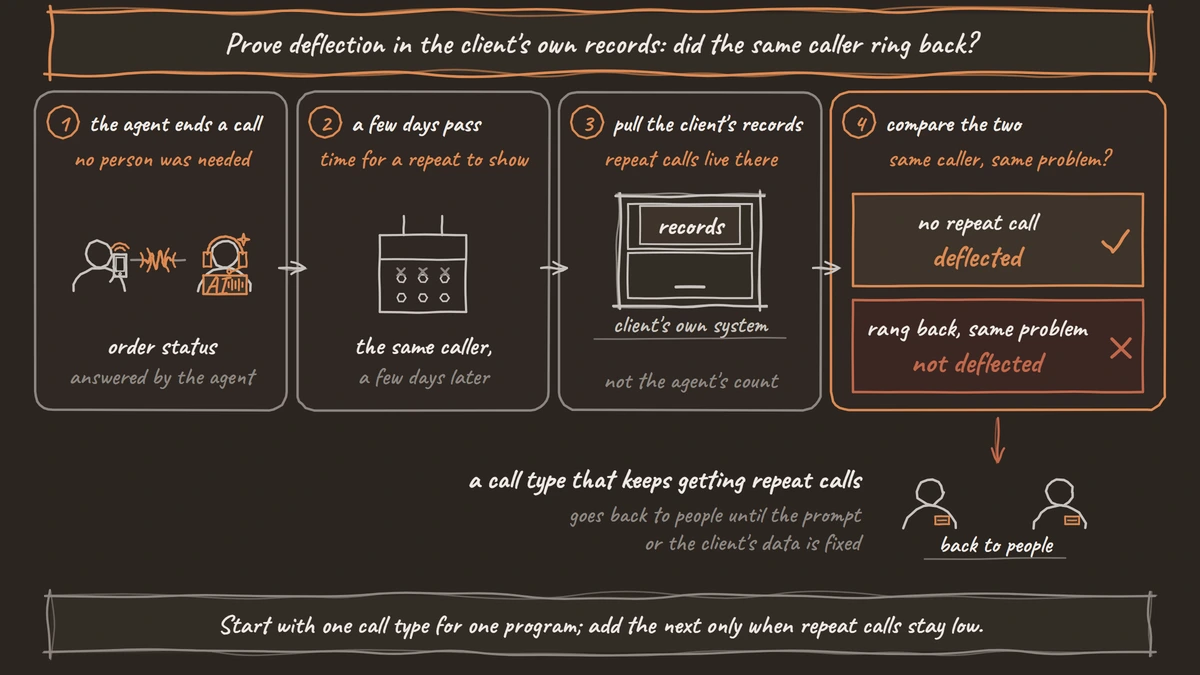
Pull repeat calls from the client's system and compare them with the agent's calls. The QA node adds a second check after each call. It scores each step of the flow separately, with its own tags, a 1-10 score, sentiment and a summary, and there is no single call score. Write the client's rules into the QA prompt, such as whether the agent verified before naming an account detail.
Run QA on every call while a call type is new, then on a random 5-10% of live calls through the Sample Rate (%) setting. A call type that keeps producing repeat calls goes back to people until the prompt or the client's data is fixed.
Self-hosted Dograh has no per-minute platform fee (servers, model keys and phone minutes still cost); Dograh Cloud has a 1¢-a-minute platform fee. Start with one call type for one program, the busiest one that passes the test. Add the next only when repeat calls stay low. The same pattern outside a BPO, for a single business's support line, is set out in AI voice agents for inbound customer support.
Glossary
- Deflected call
- A tier-1 call the voice agent solved from start to finish, with no person needed. A call that only stayed away from a person, without solving the problem, does not count.
- Containment rate
- The share of calls an automated system finishes without handing the caller to a person. It also rises when an agent loops callers until they hang up, so it is checked against repeat calls.
- Approved check
- The verification step a client sets for its callers, such as date of birth or the last digits of an account number. The agent asks for it before naming any account detail.
- Pre-Call Data Fetch
- A Dograh setting at the bottom of the Start Call node that calls the client's endpoint once the call connects and loads what it returns, such as the caller's record, for the agent to use after verification.