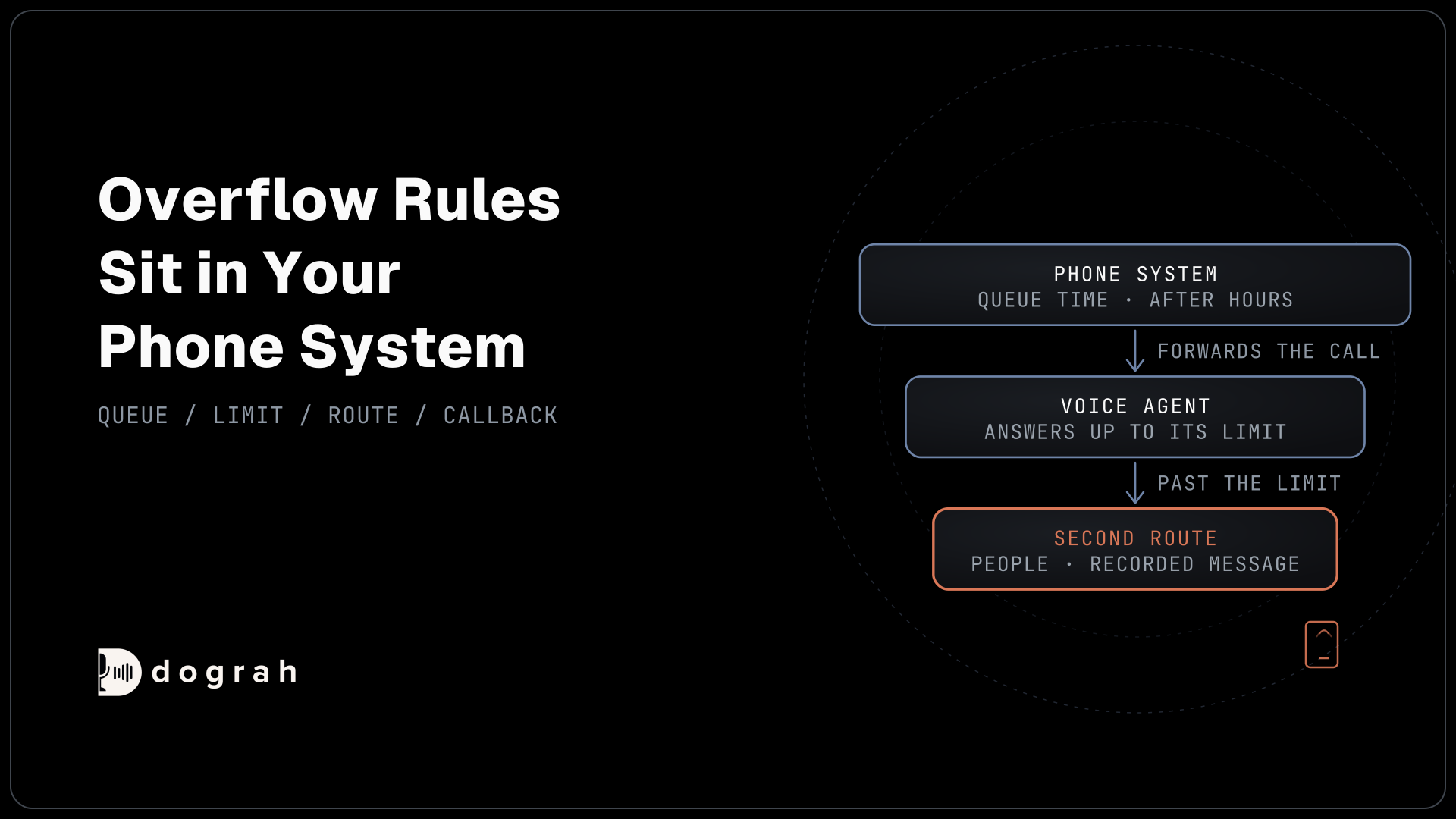

AI voice agents for overflow call handling answer the calls your contact center's phone system sends them, such as callers who have waited past a set time and calls after hours. The agent answers up to its concurrency limit. Past that limit a new call is turned away, so a second overflow route sits in the phone system.
Key Takeaways
- Your phone system decides when a call overflows; the agent only answers it.
- Over the concurrency limit, a new inbound call is rejected at once, not queued.
- Keep a second overflow route to people or a recorded message at your carrier.
This post is part of our guide to AI voice agents for BPO and contact centers. The guide's section "Overflow call handling: when the agent picks up" puts it in two lines: "The contact center's own phone system decides when a call goes to the agent. Dograh then answers it, up to its concurrency limit." Here is how to set those rules and size that limit, with the agent running in Dograh, an open-source, self-hostable voice agent platform.
Who decides when a call overflows
The contact center's own phone system decides, and the agent's number answers whatever it sends. Dograh never holds callers in line or picks who goes next.
Most floors already run an automatic call distributor, or routing software that does the same job, to share calls between people. Overflow is one more rule in it, which forwards the call to a dedicated number when a condition is met. In Dograh that number has its Inbound workflow set to the overflow agent, so the call reaches the agent the moment it is forwarded.
A BPO usually has several client lines overflowing at once. Several numbers can point at the same agent, and the number the caller dialled reaches Pre-Call Data Fetch as to_number, so the agent loads the right client's details as the call connects. The greeting waits for that lookup, and the caller hears ringing meanwhile.
What the agent does once it answers is a separate choice, covering which calls it solves and which it passes on. AI Voice Agents for Tier-1 Call Deflection covers how to pick them.
Overflow call handling rules in your phone system
Send calls to the agent on queue time, and not only when every person is busy. Callers give up sooner than most teams expect.
In a Nextiva survey of 400 people, 54% of callers said they hang up after waiting up to eight minutes for an agent. In the same survey, 75% said they would rather schedule a callback than wait. So set the queue-time rule well inside that window, for example after two or three minutes, and let the agent either solve the call or take a callback request.
The busy rule still matters for spikes, such as a client's billing day or a service outage. Set it to send calls when no person is free, but keep the queue-time rule too, so callers already waiting are not left behind the new ones.
After hours is the simplest rule. Outside the program's staffed hours, every call goes to the agent. Tell the agent in the prompt which calls cannot wait for the morning team. Our post on AI voice agents for after-hours coverage covers that list and the on-call transfer.
Size the concurrency limit for the busiest hour
The concurrency limit is the number to plan around, because it caps how many overflow calls the agent can take at once. A campaign can cap its own outbound calls at once, while inbound calls share the organisation's single concurrency limit (10 by default). Self-hosted, you raise it with DEFAULT_ORG_CONCURRENCY_LIMIT, and your servers and phone provider set the practical ceiling. Dograh Cloud Pay as you go includes 10, with more by contacting Dograh.
Campaign calls take slots from the same limit. A busy outbound campaign on Monday morning leaves fewer lines for Monday's inbound overflow, so cap the campaign or schedule it away from the inbound peak.
Size the limit for the busiest hour across every client program that shares it, not the average day. A rough count is enough to start. If the busiest hour sends 120 overflow calls that last 4 minutes each, that is 480 call-minutes in 60 minutes, or about 8 calls at once on average. Calls bunch up, so peaks run above the average, and a limit of 10 would already be tight.
Seasonal peaks count too, and tax firms see the same pattern every spring, set out in AI voice agents for tax-season call overflow.

Open Source Alternative to Vapi / Retell
Self-hosted voice agent platform — no per-minute fees
dograh-hq/dograh
Star on GitHub
What happens past the limit
Past the limit, a new inbound call is rejected at once, not queued. It creates no call record in Dograh and fires no webhook, and on Twilio the caller hears a fixed message that cannot be changed.
That means the agent cannot be the last stop. The second overflow route has to sit in the phone system or at the carrier, so that when the agent's number does not take the call, it goes somewhere else. The older answers still work here. A human team, an answering service, voicemail or a recorded message with a callback number can each be the second route, and any of them beats a caller who hears nothing useful.
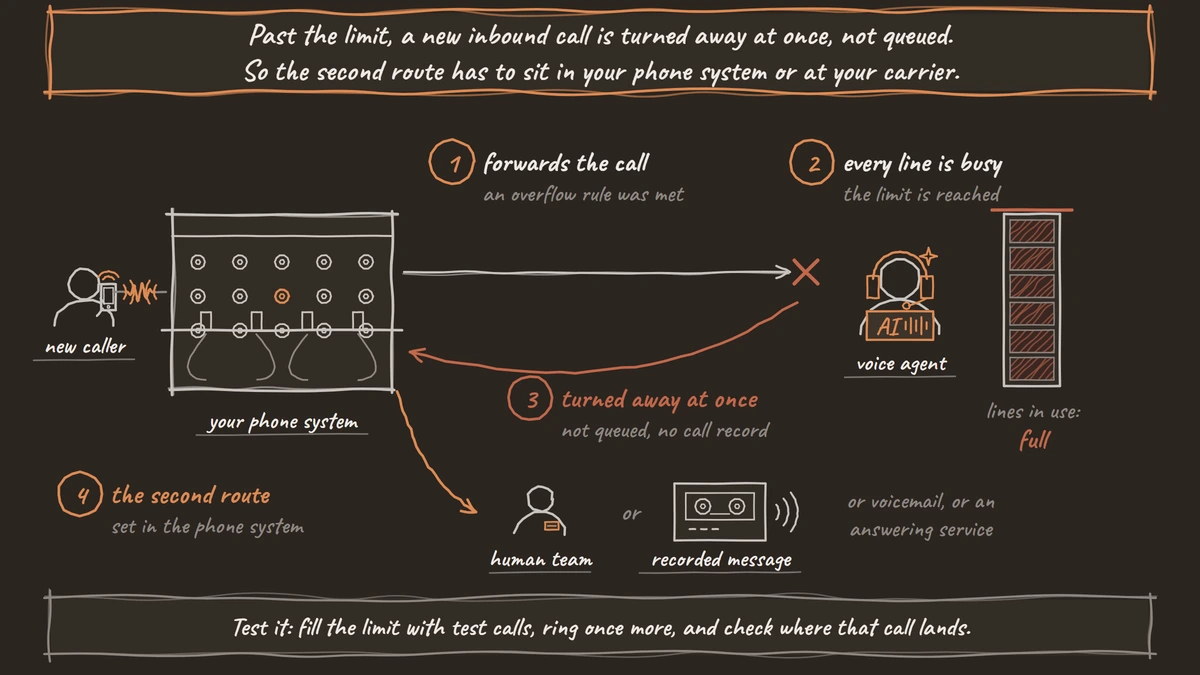
Test this path on purpose. Fill the limit with test calls, ring once more, and check that the extra call lands on the second route.
Hand back to a person, then load test
An overflow call still needs a way to a person. Transfer Call works on Twilio, Telnyx and Asterisk ARI. It passes no summary by default; on Twilio it can play a short spoken introduction to both people. Write the details to your system with an HTTP API tool before the transfer.
For a BPO, that system is the client's helpdesk, and an HTTP API tool writes the ticket so the person who answers sees it first. If nobody answers, the caller stays with the agent; tell it in the prompt to offer a callback. During an overflow spike the human team is busy by definition, so plan for that case first. AI Voice Agents for Human Handoff Routing covers how each transfer is routed.
Before a client goes live, load test over real phone calls. Browser test calls can't transfer, and a browser call runs at 16 kHz while most phone calls still reach the agent as 8 kHz audio, so a browser test hides both problems. Start with a small load, then raise it in steps toward the busiest hour, and listen to calls at each step. Self-hosted Dograh has no per-minute platform fee (servers, model keys and phone minutes still cost); Dograh Cloud has a 1¢-a-minute platform fee.
Join the Dograh Community
Dograh is an OSS alternative to Vapi. Join our Slack community for queries, releases, best practices & community interactions.
Glossary
- Automatic call distributor (ACD)
- The part of a contact center's phone system that shares incoming calls between people by rules. Overflow to a voice agent is one more ACD rule that forwards a call to the agent's number.
- Queue-time rule
- An overflow rule that sends a call to the voice agent once the caller has waited past a set time, instead of only when every person is busy.
- Concurrency limit
- The number of calls Dograh runs at once for an organisation, 10 by default. Inbound calls share it, campaign calls take slots from it, and a new inbound call over the limit is rejected at once.
- Second overflow route
- Where a call goes when the voice agent cannot take it, such as a human team or a recorded message. It is set in the phone system or at the carrier, not in Dograh.