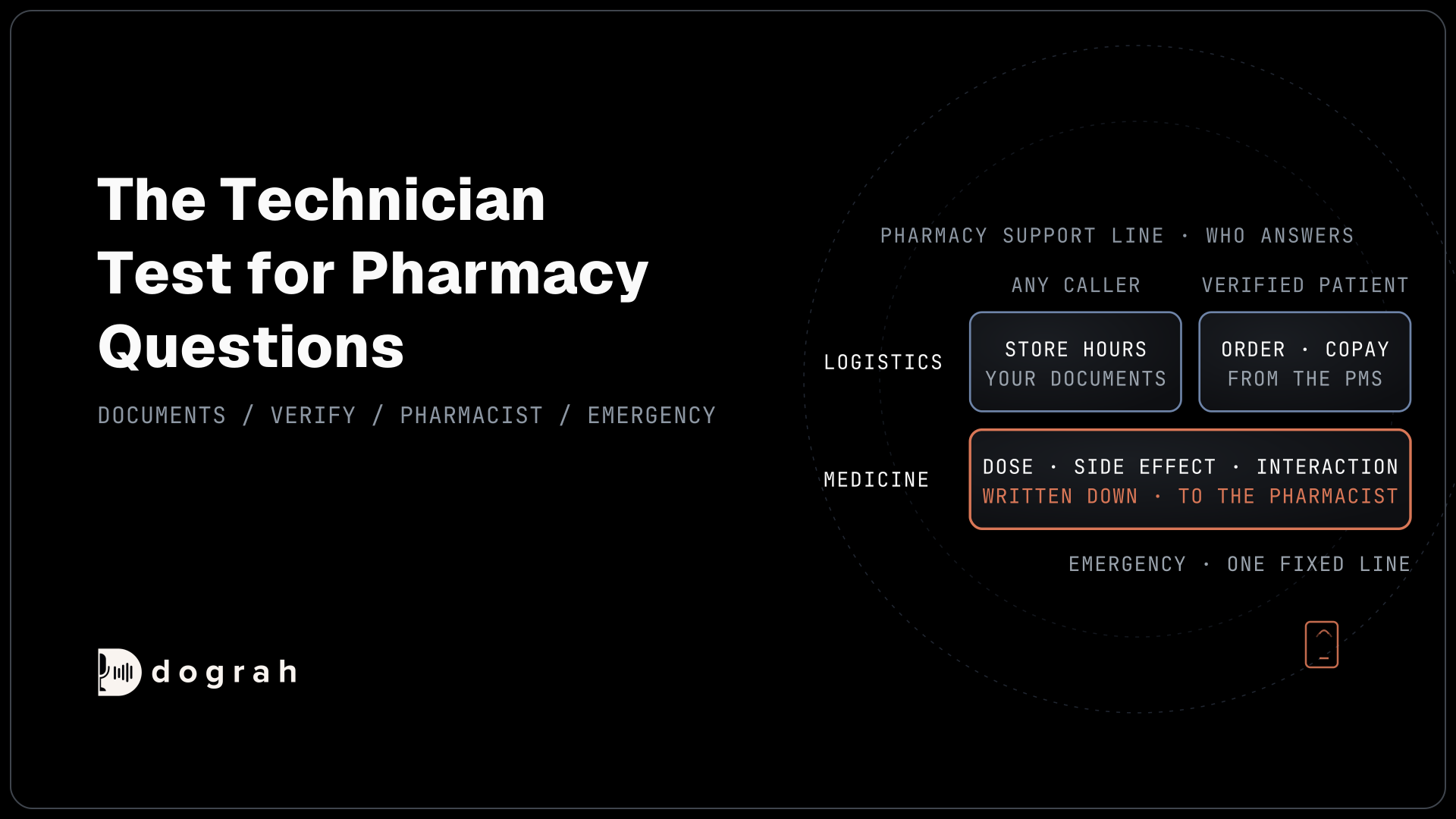

AI voice agents for pharmacy patient support answer the questions a technician at the counter could answer. Store questions are answered from the pharmacy's own documents. Anything about the caller's own prescriptions waits for verification. Every question about the medicine itself is written down and handed to the pharmacist, and a medical emergency gets one fixed line.
Key Takeaways
- The agent answers only what a technician at the counter could answer.
- Every question about the medicine goes to the pharmacist, written down first.
- A medical emergency gets one fixed line: "hang up and call 911".
This post is part of our guide to AI voice agents for pharmacy and pharma. Its section "Questions at the counter: patient support" sets the rule for this line: the agent answers what a technician at the counter could answer, and hands everything about the medicine itself to the pharmacist. Here is that line in full, run in Dograh, an open-source, self-hostable voice agent platform.
What a pharmacy patient support line answers
A pharmacy's support line hears two kinds of question, and the agent should only ever answer one of them. The first kind is about the store and the service. Are you open on Sunday, do you deliver to my area, do you give flu shots without an appointment, is there parking? These have one right answer, and it is written down somewhere the pharmacy controls. The second kind is about a medicine: what it does, how to take it, what to do after a missed dose or a strange rash. Those need a pharmacist's judgement every time.
We use a simple test. If a technician at the counter could answer it from the store's own documents, or from the PMS after checking who is calling, the agent can. If the technician would turn round and call the pharmacist over, the agent hands over too. Your state board of pharmacy generally sets which steps a pharmacist must handle, and the agent should stay inside the same line a technician does.
Hospitals run the same split on their own lines, as our post on AI voice agents for patient support lines shows. This post keeps to what changes at a pharmacy.
Questions that need no verification
General questions need no check, because the answer is the same for every caller. The agent answers them from the Knowledge Base: upload your own documents under Knowledge Base Files, then select them on the agent's node under Knowledge Base Documents. It accepts PDF, DOCX, DOC, TXT and JSON files up to 5 MB each.
Put the store's hours, holiday closures, delivery area, walk-in vaccine policy, accepted insurance plans and parking in one short document per store, and keep it current. Tell the agent in the prompt to answer only from those documents, and to say it will pass the question on when the answer is not there. A guessed holiday opening time sends a patient to a locked door.
Anything about the caller's own prescriptions is different. HIPAA's verification rule, 45 CFR 164.514(h), generally says a covered entity must "verify the identity of a person requesting protected health information" when that person "is not known to the covered entity". So the agent asks for date of birth plus one more detail on file before it names any medicine, order or price. After that, the call follows the status flow in AI voice agents for pharmacy order status. This is general information, not legal advice; confirm your position with counsel.

Open Source Alternative to Vapi / Retell
Self-hosted voice agent platform — no per-minute fees
dograh-hq/dograh
Star on GitHub
Every medicine question goes to the pharmacist
Every question about the medicine itself goes to the pharmacist: what it does, the dose, a missed dose, a side effect, an interaction, or a switch to another brand. The agent gives no medical advice, including the advice that sounds harmless, such as "take it with food".
Side effects are the easiest place to slip. Under 21 CFR 314.80, an adverse drug experience is "Any adverse event associated with the use of a drug in humans, whether or not considered drug related". That last clause is the point: whether a headache comes from the medicine is a judgement, and the agent never makes it. Tell the agent in the prompt to record what the caller said, in the caller's words, and pass it on. The pharmacist decides what happens next.
So write the question down before the handover. Transfer Call works on Twilio, Telnyx and Asterisk ARI. It passes no summary by default; on Twilio it can play a short spoken introduction to both people. Write the details to your system with an HTTP API tool before the transfer. The note in your system is what the pharmacist sees when they pick up.
If nobody answers, the caller stays with the agent; tell it in the prompt to offer a callback. The callback request, written through an HTTP API tool, puts the question on the pharmacist's list. A patient who keeps missing doses needs a different, outbound call from the care team, covered in our post on AI voice agents for medication adherence.
One fixed line for a medical emergency
A caller who describes a medical emergency should hear the same words every time, so those words cannot be left to the model.
Build an emergency pathway with a short written condition, such as "the caller describes trouble breathing, chest pain, a severe allergic reaction or an overdose". Once that pathway is chosen, its Transition Speech plays "hang up and call 911" exactly as written, as fixed text or a recorded clip. On a speech-to-speech model only recordings play, so use a recorded clip there. Inside a normal node the AI writes its own words, which is why a prompt alone cannot promise the exact line.
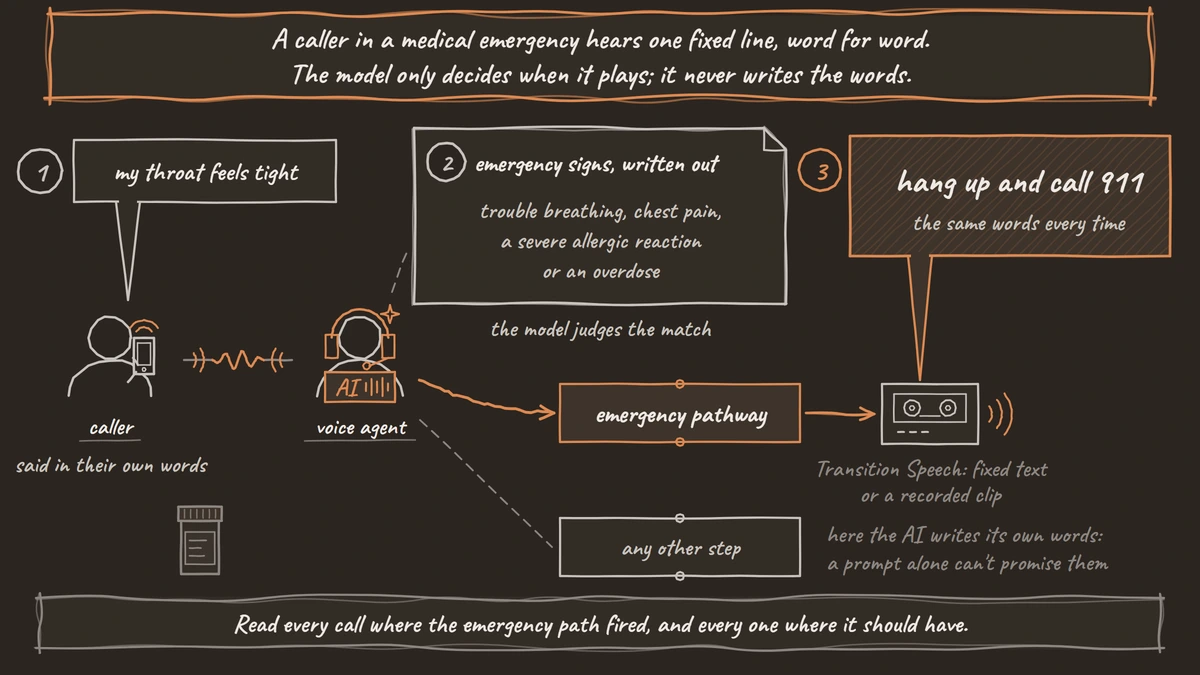
Choosing the pathway is still the language model reading that condition, so detection is never a hard rule. Keep the condition short and specific, and test it with real phrasing before go-live: "my throat feels tight", "I took two by mistake", "I feel like I'm going to pass out". Read every call where the pathway fired, and every call where it should have.
Join the Dograh Community
Dograh is an OSS alternative to Vapi. Join our Slack community for queries, releases, best practices & community interactions.
Checking the line stays on logistics
A rule in the prompt only matters if you can see it holding on real calls. The QA node runs after calls and scores each step separately, with its own tags, a 1 to 10 score, sentiment and a summary, so a turn that drifted into advice shows up on the step where it happened. Once live, run QA on a random 5 to 10% sample of calls, and read every call that reached the pharmacist route.
Test on a real phone number before patients call. Most phone calls reach the agent as 8 kHz audio, while a browser test runs at 16 kHz, and web calls cannot transfer. Drug names are hard for speech-to-text, so add the ones your store dispenses most to the Dictionary in the agent's Settings.
The recordings matter too. Once a caller names a medicine, the recording and transcript hold protected health information. The HIPAA Journal's analysis of the federal breach portal found business associates involved in 43% of large healthcare breaches in the first six months of 2026. Every vendor that keeps a copy of the call is one more place a breach can start, so count them before the first patient call.
For patient calls, self-host Dograh. No BAA with Dograh is needed, because Dograh never sees the data. Your speech and language providers may need their own BAA, and your phone carrier may too. HIPAA-compliant voice AI for pharmacy covers each layer.
Dograh starts every account on its own managed models. To keep call audio away from Dograh, open Models, switch the Organization default to BYOK with your own speech and language providers (or local models), and check that no agent has its own model override. Dograh is the orchestration layer: it runs the call flow, tools and telephony, and the speech and language models are a separate layer you choose. The call audio stays in-house only when the speech and language models run on your own servers too.
Self-hosted Dograh has no per-minute platform fee (servers, model keys and phone minutes still cost); Dograh Cloud has a 1¢-a-minute platform fee.
Glossary
- Knowledge Base
- The documents a Dograh agent answers general questions from, uploaded under Knowledge Base Files and selected on a node under Knowledge Base Documents. For a pharmacy, that means hours, delivery area and services, kept current per store.
- Pharmacist route
- The path every medicine question takes: the agent writes the caller's question to the pharmacy's system, then transfers the call, or writes a callback request if the pharmacist does not answer.
- Transition Speech
- Fixed text or a recorded clip that plays word for word when a pathway is taken. It carries the emergency line, because inside a normal node the AI writes its own words.
- Adverse drug experience
- Under 21 CFR 314.80, any adverse event associated with the use of a drug, whether or not considered drug related. Because that is a judgement, the support agent records what the caller said and leaves the decision to the pharmacist.