
AI voice agents for pharmacy and pharma handle the logistics calls: order status, delivery windows, refill reminders, recall notices, store questions and manufacturer program calls. They verify the caller first, read every answer from the pharmacy management system during the call and write changes back. Questions about the medicine itself go to a pharmacist or the program's safety team.
Key Takeaways
- Verify the caller before naming any medicine, order, price or delivery address.
- Every answer is read from the pharmacy management system during the call.
- Doses, missed doses, side effects and interactions go to a pharmacist, never the model.
This guide walks through each call a pharmacy or a drug manufacturer's program can hand to a voice agent, and how each one runs in Dograh, an open-source voice agent platform that reads and writes your pharmacy management system during the call.
What a pharmacy phone line hears
Most calls to a pharmacy are about logistics: is the prescription ready, what will it cost, when will it arrive, is the store open on Sunday.
In Drug Channels, Bryce Platt notes that the US has "almost 8,000 fewer retail pharmacies than it did in 2018, and more than 2,000 closed in 2025 alone." Drug Channels Institute estimates that US prescription dispensing revenues "reached $751 billion in 2025, up 10% from the 2024 figure." More work lands on fewer counters, so an agent that takes the status and delivery calls gives the pharmacist's time back to checking and counselling.
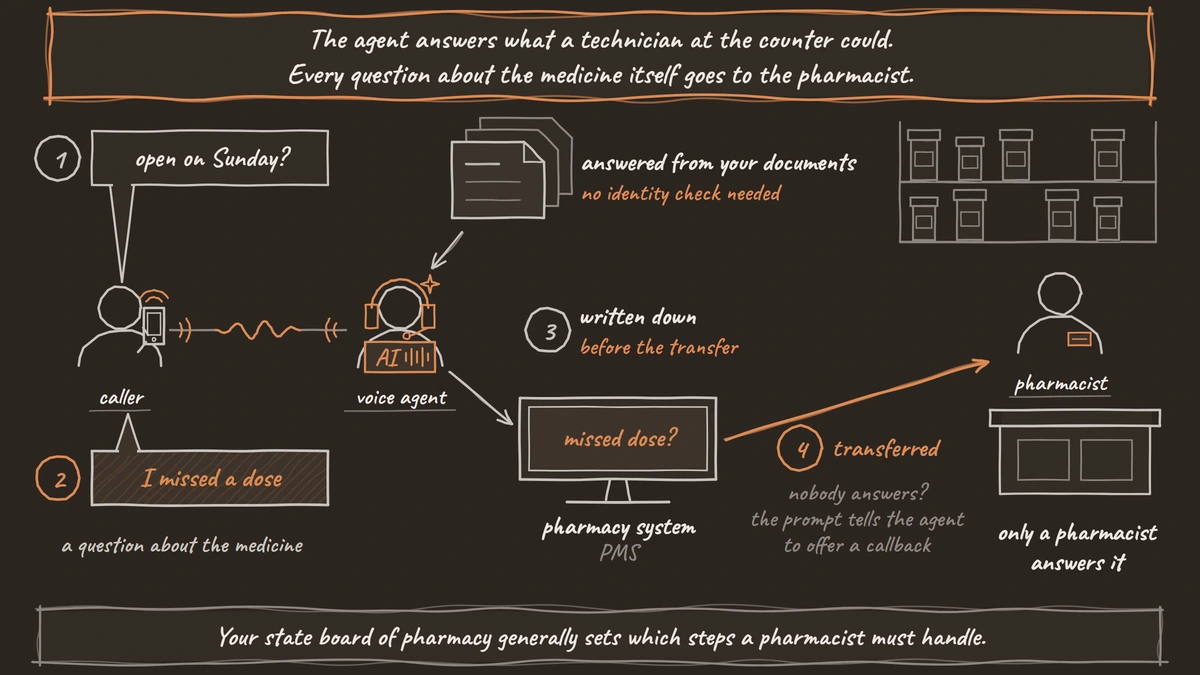
An agent earns its place on a call when the answer already sits in a system the pharmacy runs. It stops where the answer needs a pharmacist's judgement. Your state board of pharmacy generally sets which steps a pharmacist must handle, and the agent should stay inside the same line a technician does.
Every answer comes from the pharmacy management system
Every call in this guide reads from the pharmacy management system (PMS) and writes back to it, and the agent keeps no copy of its own.
During the call, an HTTP API tool asks the PMS for what the call needs: an order's status, refills left, the copay on file or a delivery slot. The agent offers only what comes back, and a second HTTP API tool writes what the caller agreed to. The tool's Custom Message plays once just before the tool runs, so a slow lookup does not leave silence. The tool waits 5 seconds by default and does not retry, so tell the agent in the prompt what to say when a lookup fails.
Dograh has no built-in PMS integration. Each connection points an HTTP API tool, the Webhook node or Pre-Call Data Fetch at your PMS's own API or an integration layer, and your system can start calls through the API Trigger. Integrating Voice Agents With Your Stack covers each route.
One agent can answer for several stores. Pre-Call Data Fetch, at the bottom of the Start Call node, sends the dialled number as to_number once the call connects, and your endpoint returns that store's name, hours and pharmacist line.
Every call about a patient runs greet, verify, then disclose. A phone number finds a record, but it does not prove who is calling. Before the agent names a medicine, an order, a price or a delivery address, it asks for an approved check, such as date of birth plus one more detail on file. A caller acting for the patient goes to staff unless the PMS lists them as authorised.
Recordings and transcripts keep whatever is said, so the call never asks for a full account, card or Social Security number; use a short check such as the last four digits, and send payment links by text or email from your own system. Drug names are hard for speech-to-text, so add the ones your store dispenses most to the Dictionary in the agent's Settings.
Order status: is the prescription ready
The status call is inbound and read-only. After verification, the agent reads the status exactly as the PMS returns it: ready for pickup, in progress, waiting on the prescriber, waiting on insurance, or too soon to fill. Tell the agent in the prompt never to guess a time the PMS did not return. A caller who asks what they will pay hears the copay the PMS has on file; any other cost goes to staff.
Name only the prescription the patient asked about, never everything on the profile. AI voice agents for pharmacy order status covers the statuses and the caregiver who calls for a parent.

Open Source Alternative to Vapi / Retell
Self-hosted voice agent platform — no per-minute fees
dograh-hq/dograh
Star on GitHub
Getting it to the patient: delivery and refills
Delivery coordination
After verification, the delivery call confirms the window, reads the address back and asks who can accept the parcel. Who may accept it is your pharmacy's rule: the agent records the name as stated, and your delivery system applies the rule. Tell the agent in the prompt never to offer "leave it at the door" for a refrigerated or controlled-substance parcel unless your pharmacy allows it for that item.
Calls go out from a CSV uploaded to Campaigns, where each column becomes a variable, or one at a time through the API Trigger. A per-contact greeting from the campaign file plays before verification, so it names the pharmacy and the patient only, never the medicine. If voicemail is set to leave a message, keep it to the pharmacy's name, a callback number and a toll-free opt-out number. AI voice agents for pharmacy delivery coordination goes deeper.
Refill reminders
The refill reminder call tells a verified patient that a refill is due and takes the request, after checking refills left, the last fill and whether it is too soon to fill. No refills left goes to the prescriber route, and a controlled substance goes to the pharmacist, who still approves every fill. AI voice agents for prescription refill reminders covers both directions.
Specialty first fills
A specialty drug's first fill needs a welcome call, and the agent handles the paperwork part of it. After verification, the agent reads the benefits status and the patient's cost exactly as your pharmacy system returns them. It never estimates a cost, predicts a prior authorization or promises copay help. Anything the system does not return goes to staff. It then books the first shipment. Because it states a cost, this call generally falls outside the healthcare call exemption covered below, so it rests on the patient's prior express consent; get the patient's consent when the referral is taken.
Teaching a patient how to take a specialty drug is generally the pharmacist's counseling (42 CFR 456.705 sets this for Medicaid, and states set their own rules). The agent offers the pharmacist and transfers; it never gives the teaching. Confirm your state's rule with counsel. AI voice agents for specialty pharmacy onboarding goes deeper.
Questions at the counter: patient support
General questions need no verification: opening hours, the delivery area, walk-in vaccines or parking. The agent answers them from your own documents in the Knowledge Base.
Every question about the medicine itself goes to the pharmacist: what it does, the dose, a missed dose, a side effect, an interaction or a switch to another product. Transfer Call works on Twilio, Telnyx and Asterisk ARI. It passes no summary by default; on Twilio it can play a short spoken introduction to both people. Write the details to your system with an HTTP API tool before the transfer. If nobody answers, the caller stays with the agent; tell it in the prompt to offer a callback.
A medical emergency gets one fixed line: the emergency pathway's Transition Speech plays "hang up and call 911" exactly as written. On a speech-to-speech model only recordings play, so record this line. Choosing the pathway is still the language model reading a written condition, so keep the condition short and test it on real calls. AI voice agents for pharmacy patient support goes deeper.
Safety calls: drug recall notifications
The pharmacy decides who is affected, and the agent only delivers the instruction.
FDA's enforcement data on openFDA lists 765 drug recall entries reported in 2025: 49 Class I, 655 Class II and 61 Class III, each entry a product rather than a separate recall. Only Class I carries a reasonable probability of serious harm, so the agent's main job is to read the instruction clearly.
The list comes from your dispensing records, matched to the recalled lot. Run one campaign per recall, so every patient on it gets the same instruction. That instruction can then play as fixed Transition Speech after verification, word for word, because it carries no per-patient detail. When a patient asks "should I stop taking it?", tell the agent in the prompt to answer only if the instruction says so, and otherwise to offer the pharmacist.
Every attempt and answer goes back to the pharmacy's record through an HTTP API tool or the Webhook node. A running campaign's contact list cannot be edited, so to stop calling someone, pause it and start a new campaign from a corrected list. AI voice agents for pharmacy recall notifications goes deeper.
Join the Dograh Community
Dograh is an OSS alternative to Vapi. Join our Slack community for queries, releases, best practices & community interactions.
The pharma side: manufacturer program calls
Drug manufacturers run patient-support and hub programs whose calls look like a pharmacy's: enrolment, benefits status, delivery through a specialty pharmacy and refill reminders.
If a caller mentions a side effect on a manufacturer's program call, it is generally an adverse event the manufacturer has to review. Confirm the process with your pharmacovigilance team.
21 CFR 314.80 defines an adverse drug experience as "Any adverse event associated with the use of a drug in humans, whether or not considered drug related". It requires each applicant, the company holding the approved application, to "promptly review all adverse drug experience information obtained or otherwise received by the applicant from any source". A program call is one of those sources. So tell the agent in the prompt never to judge whether something is a side effect, and to write the caller's words to the safety team's system before the call moves on.
This section is general information, not legal advice; confirm your position with counsel.
Rules for every pharmacy call
Two rules apply to every call above. This is general information, not legal advice.
The first is why refill calls are allowed at all. Under 45 CFR 164.501, HIPAA's definition of marketing excludes communications made "To provide refill reminders or otherwise communicate about a drug or biologic that is currently being prescribed for the individual, only if any financial remuneration received by the covered entity in exchange for making the communication is reasonably related to the covered entity's cost of making the communication." Under this refill reminder exclusion, a reminder generally stays outside marketing unless a third party pays more than is reasonably related to the cost of the call.
The second is the phone rule. Under the Telephone Consumer Protection Act (TCPA), the FCC's healthcare call exemption covers calls "strictly limited" to purposes that include "prescription notifications". Those calls "must state the name and contact information of the healthcare provider" at the beginning, "must not include any telemarketing, solicitation, or advertising" and must be "generally one minute or less in length for voice calls". A provider "may initiate only one message ... per day to each patient, up to a maximum of three voice calls or text messages combined per week to each patient", and "must honor opt-out requests immediately."
Our reading is that a refill, delivery or recall call to a patient's mobile generally fits "prescription notifications", within those limits. Campaigns have no per-patient call cap, so enforce those limits in your own list, or set retries to 0.
Dograh keeps no do-not-call list. When a caller opts out, an HTTP API tool writes it to your own list, and you remove those numbers before the next campaign upload. The do_not_call call tag records the request but never blocks a later call. If you want to tell callers they're speaking with an automated assistant, or your location requires it by law, write it in the Greeting Text along with the pharmacy's name. Confirm your position with counsel before the first campaign.
Where pharmacy call data lives: HIPAA
Once a caller names a medicine, the recording and transcript hold protected health information.
The HIPAA Journal's analysis of the federal breach portal found business associates involved in 43% of large (500 or more people) healthcare breaches in the first six months of 2026.
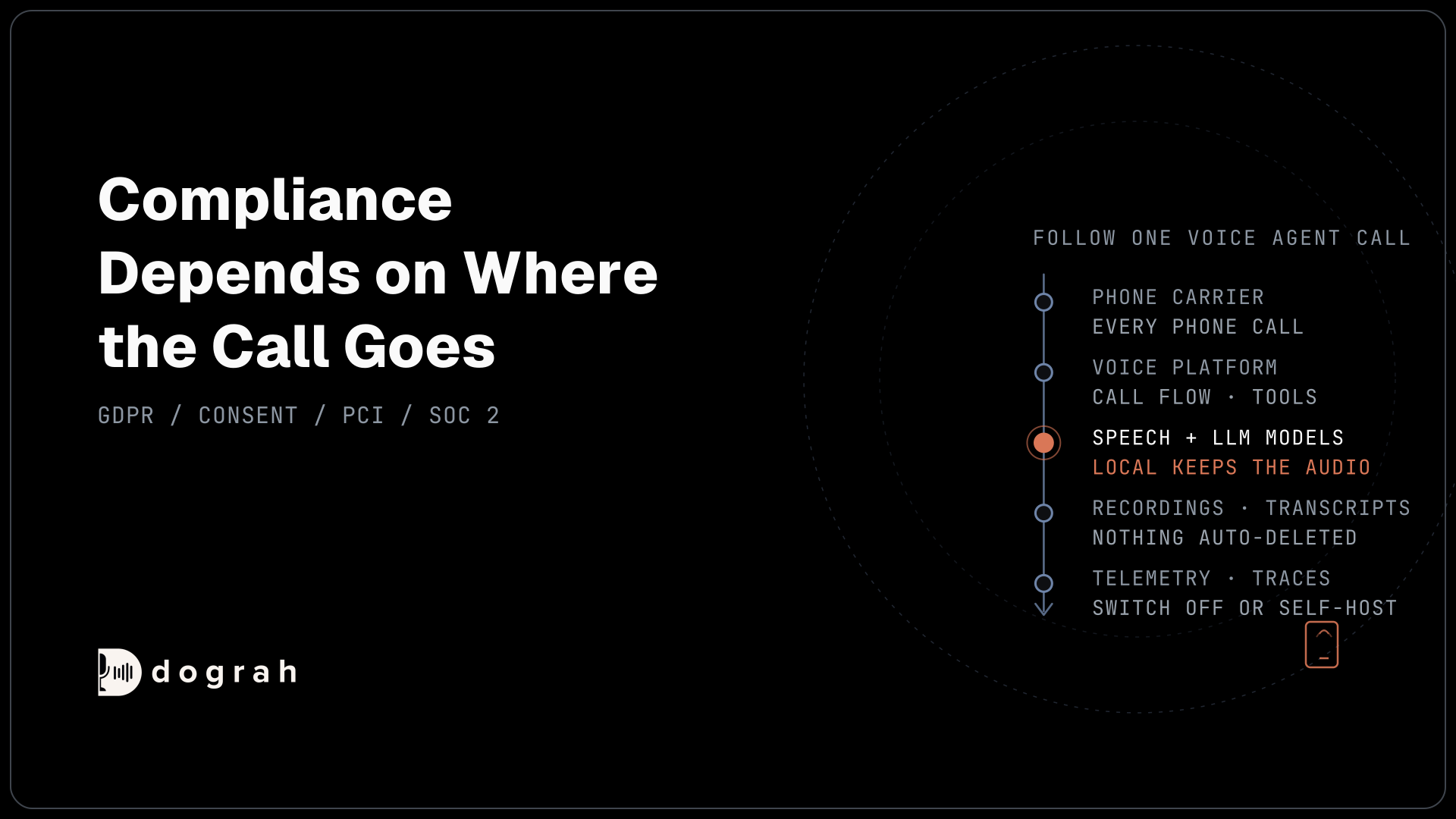
For patient calls, self-host Dograh. No BAA with Dograh is needed, because Dograh never sees the data. Your speech and language providers may need their own BAA, and your phone carrier may too. If your servers run in a cloud account such as AWS, Google Cloud or Azure, that cloud provider needs a BAA too. A BAA delegates obligations and never transfers your liability.
Dograh starts every account on its own managed models. To keep call audio away from Dograh, open Models, switch the Organization default to BYOK with your own speech and language providers (or local models), and check that no agent has its own model override. Dograh is the orchestration layer: it runs the call flow, tools and telephony, and the speech and language models are a separate layer you choose. The call audio stays in-house only when the speech and language models run on your own servers too.
Dograh has no retention setting and no automatic deletion, so recordings and transcripts follow your own storage rules. HIPAA-compliant voice AI for pharmacy counts every vendor on a pharmacy call.
Choosing a pharmacy voice agent, and where to start
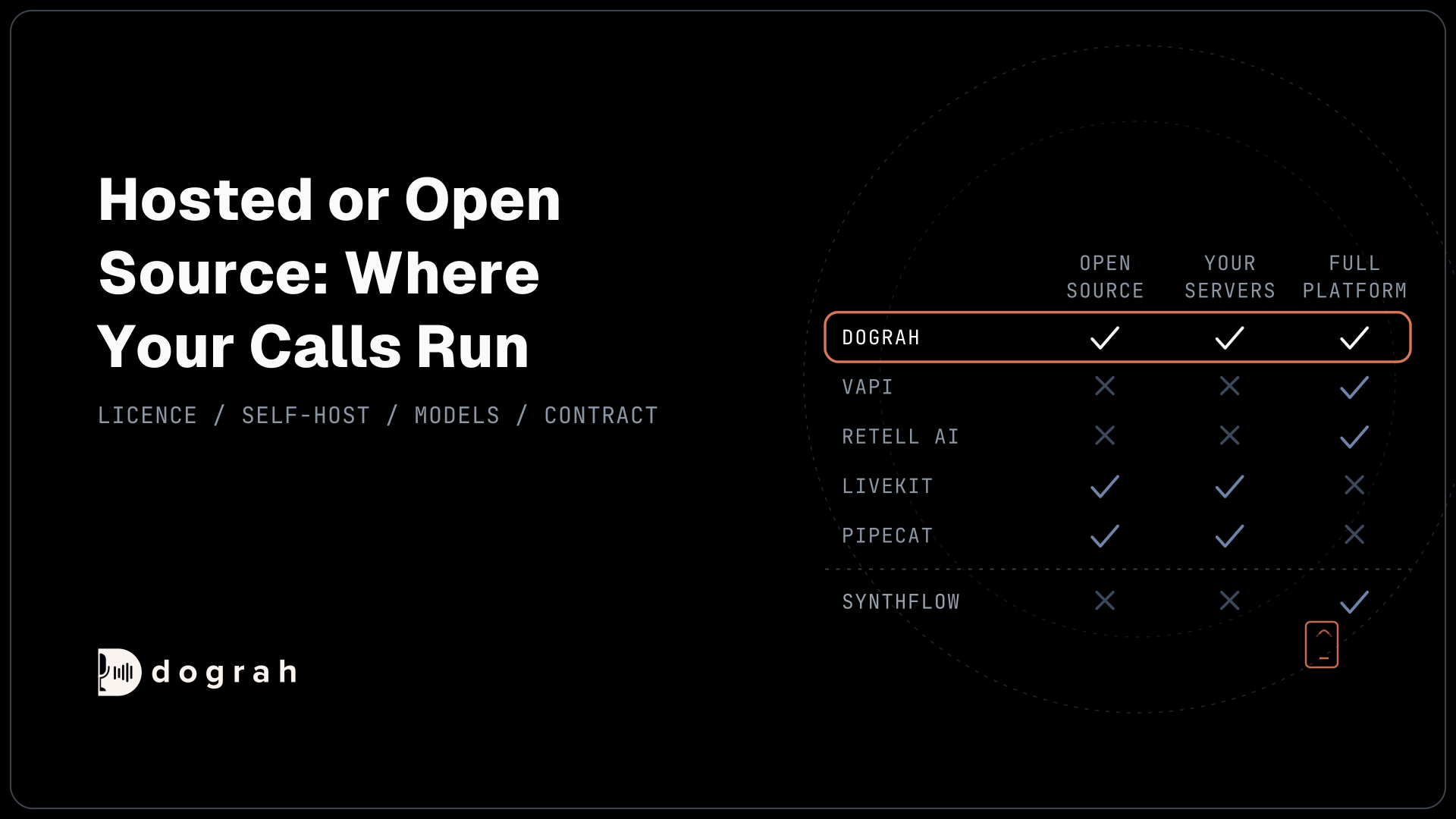
Pharmacy specialists come with PMS connections and pharmacy rules already built. General voice platforms, and Dograh, connect through the PMS's own API, and differ on where the call data lives. Self-hosted Dograh has no per-minute platform fee (servers, model keys and phone minutes still cost); Dograh Cloud has a 1¢-a-minute platform fee. Best AI voice agents for pharmacies compares the options.
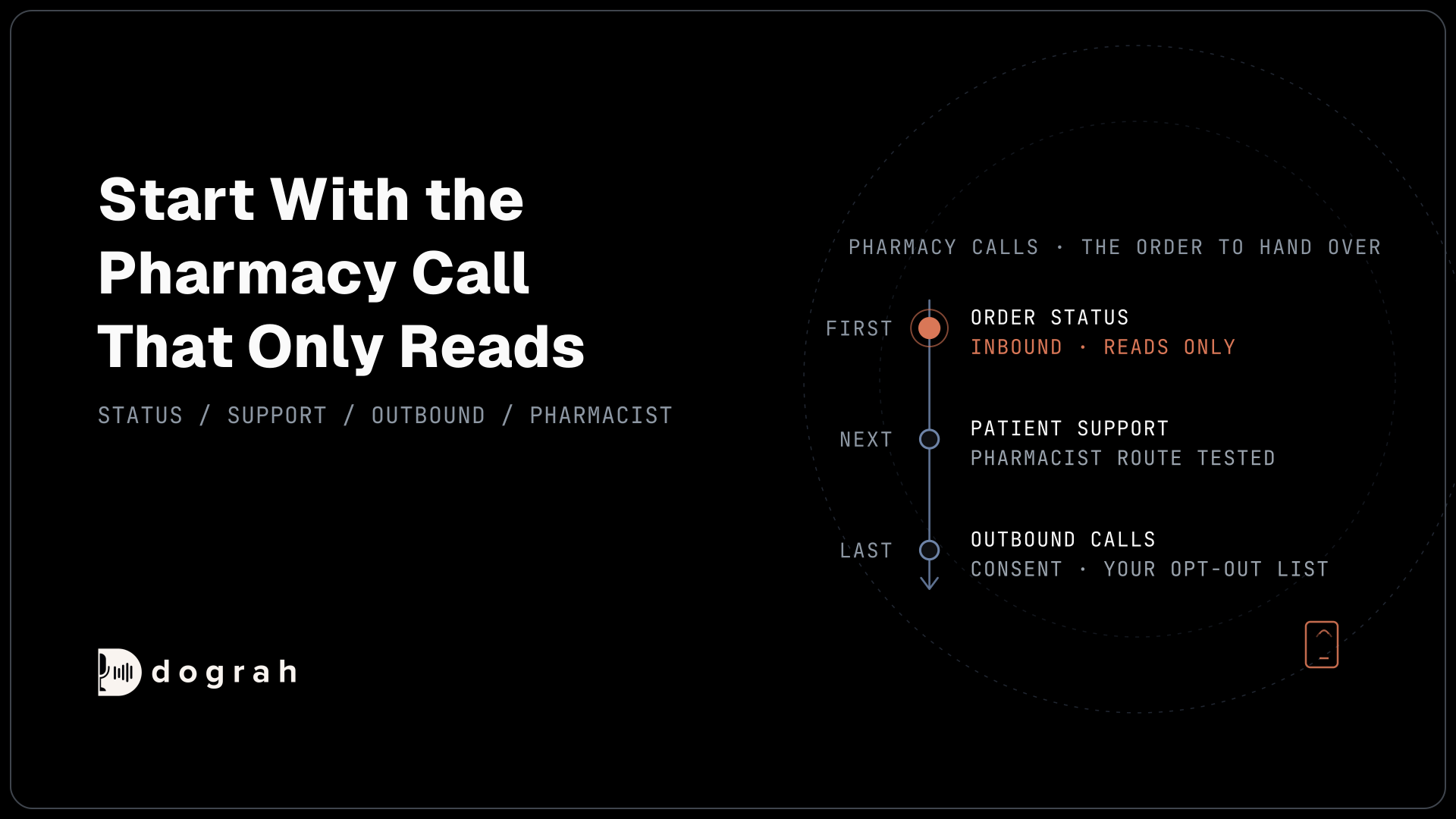
Start with inbound order status, because it reads and never writes. Patient support comes next, once the pharmacist route and the emergency line are tested. Outbound campaigns come last, once consent and your opt-out list live in your own system.
Test on a real phone number before any patient hears the agent: phone calls usually arrive as 8 kHz audio, a browser test runs at 16 kHz, and browser calls cannot transfer. Testing Voice Agents Before You Go Live sets the order. Once live, run QA on a random 5 to 10% sample of calls, and read every call that reached the pharmacist route.
Each pharmacy call above has its own deep dive:
- AI Voice Agents for Pharmacy Order Status
- AI Voice Agents for Pharmacy Delivery Coordination
- AI Voice Agents for Prescription Refill Reminders in Pharmacy
- AI Voice Agents for Specialty Pharmacy Onboarding
- AI Voice Agents for Pharmacy Patient Support
- AI Voice Agents for Pharmacy Recall Notifications
- HIPAA-Compliant Voice AI for Pharmacy
- Best AI Voice Agents for Pharmacies
Glossary
- Pharmacy management system (PMS)
- The software a pharmacy uses to record prescriptions, fills, prices and patients. A voice agent reads status, copays and refills from it during the call and writes requests back, so it never keeps its own copy.
- Refill reminder exclusion
- The part of HIPAA's marketing definition, in 45 CFR 164.501, that lets a pharmacy remind patients about a drug they are already prescribed. It holds only while any third-party payment stays reasonably related to the cost of making the call.
- Prescription notification
- One of the purposes the FCC's healthcare call exemption allows without telemarketing consent, within its limits: the provider named first, about a minute long, one call a day and three a week, and no offers.
- Adverse drug experience
- Under 21 CFR 314.80, any adverse event associated with the use of a drug, whether or not considered drug related. A manufacturer must review the ones it receives, so a side effect mentioned on a program call is recorded as stated and routed to its safety team.