
AI debt collection software for agencies should talk to consumers by phone, confirm the right person before naming any debt, play the collector notice as fixed words, and keep each call within your frequency limits. Disputes, hardship, bankruptcy and attorney cases go to a person. The agency should hold every recording for the three years Regulation F requires.
Key Takeaways
- Judge each control by what a recorded call shows.
- Disputes and hardship requests always leave the AI and go to a person.
- Your own list counts calls per debt. Campaign settings set retries and hours.
Below is a buyer's checklist for AI collection calls, the cases that stay with a person, the rules and the cost against human collectors. We show how each part works in Dograh, the open-source AI voice agent platform we build. You can self-host it or run it on Dograh Cloud.
What AI collection software does on a call
AI collection software talks to the consumer, which a dialer never did. A dialer places calls and passes the ones that connect to a collector. A voice agent holds the conversation itself. It confirms who answered, gives the collector notice, explains the balance, offers the payment options your agency set and records what the person agreed to.
That changes what you are buying. With a dialer, your collectors carried the rules on every call. With an AI agent, the software carries them, so each rule has to live somewhere you can see and test, such as a fixed line in the agent or a count in your own system.
Two kinds of buyer use it. Collection agencies work accounts for creditors and debt buyers. Creditors' in-house teams call their own customers before an account is ever placed. The federal rules treat these two groups differently, which a section below covers.
The complaint record shows where the risk sits. In the first ten months of 2026, the CFPB's complaint database logged 263,420 debt collection complaints. The largest group, 121,969, were about attempts to collect a debt the person said they did not owe, and 80,848 of those said the debt was not theirs at all. Complaints are what people report, and no finding stands behind each one. Still, they put identity checks and dispute handling at the top of any checklist.
The buyer's checklist for AI collection calls
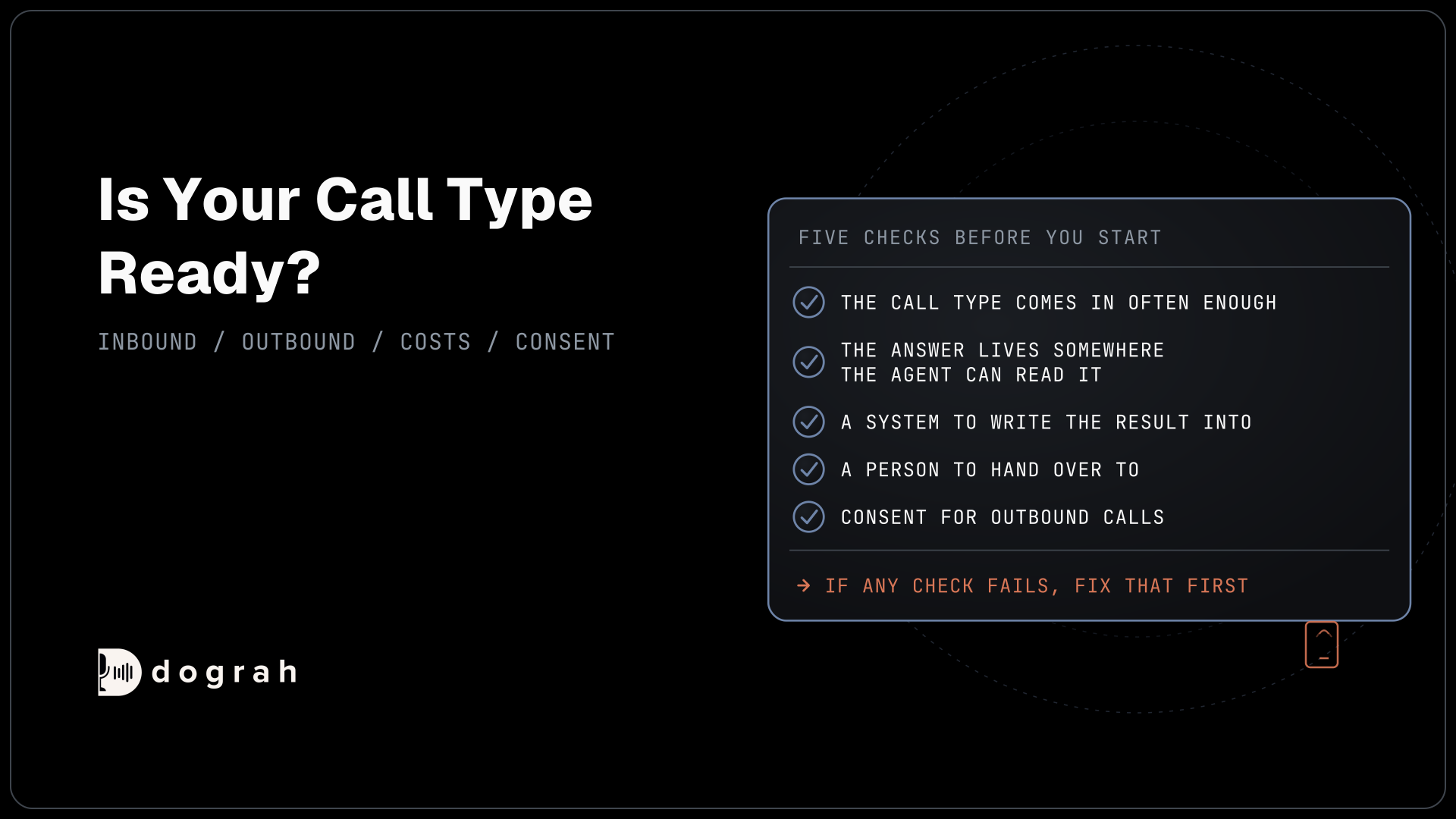
Each row below is a control you can check by listening to a recorded call or reading its log. A vendor's demo shows the call going well. The recording shows what the software does when it does not.
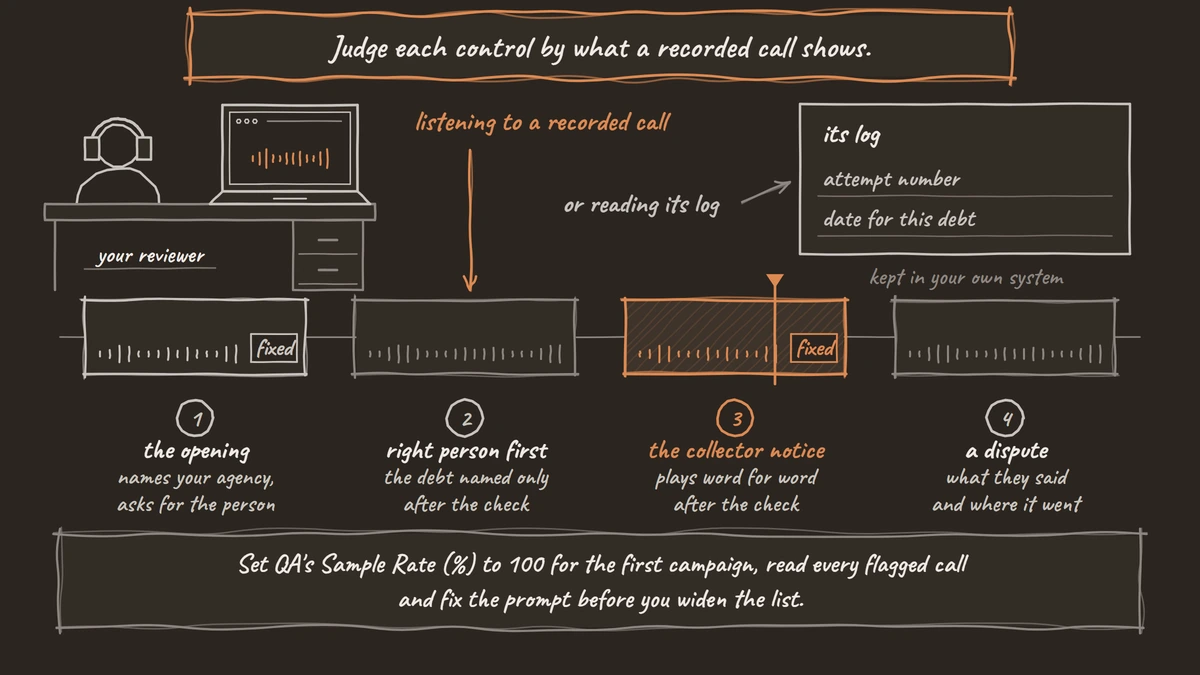
| Control | What to check on a recorded call | Where it sits in Dograh |
|---|---|---|
| Right person first | The debt is named only after an approved check, such as date of birth or the last digits of the account number | The prompt asks for the check, and QA flags any call that named the debt before it passed |
| Fixed opening | The opening names your agency and asks for the person, nothing more | Greeting Text on the Start Call node, with Allow Greeting Interruption switched off |
| Fixed collector notice | The notice plays word for word after the check | Transition Speech on the "identity confirmed" pathway, as fixed text or a recording |
| Call limits per debt | The attempt number and date for this debt | Your own system keeps the count, and campaign retries and calling hours run inside it |
| Stop requests and disputes | What the person said and where it went | Written to your system through an HTTP API tool, or handed over with Transfer Call |
| Payment with no card numbers | No card digits spoken on the call | An HTTP API tool asks your payment provider to send its secure link |
| Every call reviewed at launch | A score and tags for each step of the call | Built-in QA with Sample Rate (%) set to 100 for the first campaign |
| Where recordings live | Who can pull a call from three years ago | Your own storage when self-hosted, with full call traces through View Trace |
Two rows decide most outcomes. The right-person row exists because a collector may not discuss a debt with anyone except the consumer and a short list such as their attorney. Asking for someone by name only finds them. It does not prove who answered. Our post on AI voice agents for debt collection walks through verification and the polite exit for a wrong person.
The notice row exists because a model told to "deliver the disclosure naturally" says a new sentence each time. Fixed text says the same one on every call. Compliance-safe collection disclosures shows where each notice plays and how later calls get the shorter version.
The opening row matters more than it looks. The Start Call node's Greeting Text is spoken word for word. Allow Greeting Interruption is on by default, so switch it off and the agency's name always plays in full, even if the consumer starts talking.
What must stay with a person
Some answers end the AI's part of the call, because the next step needs judgment or a legal stop. Write each one into the prompt as a trigger the agent cannot talk past.
A dispute comes first. When someone says the debt is not theirs or the amount is wrong, the agent stops discussing payment, records what they said and passes it on. Hardship is the second. The agent can offer the plans your agency set, but a job loss or a medical bill that needs something outside those plans is a decision for a collector.
Other answers are legal stops. A consumer who says an attorney represents them on the debt is contacted through that attorney from then on. A bankruptcy filing halts collection of debts from before the case. A request to stop calling ends phone contact. In each case the agent says it will pass the message on, records the answer as the caller stated it and closes the collection part of the call.
In Dograh, Transfer Call hands a live call to your team on Twilio, Telnyx, Plivo, Cloudonix or Asterisk ARI. Dograh calls the destination first and connects the consumer only when someone answers. On Twilio, the transfer can also open with a short spoken introduction that the consumer and your collector both hear before they are connected. Context Mapping can send disputes and hardship cases to different numbers.
The transfer carries no summary by default, so the agent writes the details to your system through an HTTP API tool before it transfers. If nobody answers within the timeout, 30 seconds unless you change it, the consumer stays with the agent, which takes a callback request and writes that to your system too.

Open Source Alternative to Vapi / Retell
Self-hosted voice agent platform — no per-minute fees
dograh-hq/dograh
Star on GitHub
The federal rules in plain words
Two federal laws and one FCC ruling shape every AI collection call in the US. The Fair Debt Collection Practices Act (FDCPA) covers anyone who regularly collects debts owed to someone else. A collection agency is covered. A creditor collecting its own debt in its own name generally is not, unless it uses a name that suggests a third party is collecting. Regulation F, the CFPB's rule under the Act, sets the details. In the first conversation the collector says it is trying to collect a debt and that any information will be used for that purpose, a line widely called the mini-Miranda. Every later conversation says the call is from a debt collector.
Regulation F's call-frequency rule presumes a collector is within limits if it calls about a debt no more than seven times in seven days, and waits seven days after a phone conversation about it. Calls before 8 a.m. or after 9 p.m. at the consumer's location are presumed inconvenient. A person who asks not to be called by phone must not be called that way again. Records that show compliance are kept for three years after the last collection activity, and each recorded call for three years after the call.
The AI voice brings in the Telephone Consumer Protection Act (TCPA). The FCC has ruled that an AI voice is an artificial voice under that Act. Calls to mobile numbers then need the person's prior express consent, and the call names the business at the start and gives a callback number. A person can withdraw consent in any reasonable way. State laws add their own limits on top of these, so confirm your own position with counsel before the first campaign goes out.
Cost against human collectors
A collector's hour has a known price, and an AI call's minute has parts you can add up. The Bureau of Labor Statistics puts median pay for bill and account collectors at $22.61 an hour, or $47,030 a year, across about 160,200 jobs. It projects those jobs to fall 10% over the decade to 2035 and ties the drop to better software and automated calling systems.
On the AI side you pay for phone minutes and model usage, plus any platform fee. Self-hosted Dograh has no per-minute platform fee, but servers, model keys and phone minutes still cost money. Dograh Cloud charges a 1¢-a-minute platform fee.
Cost per minute is the wrong unit to compare on, because one account can take several calls. Our post on calculating ROI on automated collections calls works it out per 100 accounts reached, using the same BLS wage.
In our view, an agency keeps its best collectors and hands the AI the routine reminder and promise-to-pay calls. Those collectors then spend their hours on the disputes and hardship cases from the section above, where a person changes the outcome.
Join the Dograh Community
Dograh is an OSS alternative to Vapi. Join our Slack community for queries, releases, best practices & community interactions.
Third-party agencies and first-party creditors
Collecting for someone else or for yourself changes which rules apply and what the opening line must say. An agency collecting for clients is a debt collector under the FDCPA. It calls under its own true business name. It keeps the client's name out of the call until the right person is confirmed, and it logs every attempt so a client audit can replay any call. AI voice agents for third-party collections covers those duties, including calls to find a consumer and disputes handed to staff.
A creditor collecting its own debt in its own name generally sits outside the FDCPA. A name that suggests a third party is collecting pulls it back in, so the opening line is a legal control and belongs in fixed Greeting Text. State laws such as California's Rosenthal Fair Debt Collection Practices Act can reach creditors anyway. AI voice agents for first-party collections covers early calls and when to place an account with an agency.
One collection call, start to finish
A good AI collection call follows one order: greet, verify, disclose, then talk about money. The opening names the agency and asks for the consumer, and it says nothing about a debt. Next comes the identity check. Only after it passes does the collector notice play, followed by the balance and the payment options. The call ends with an agreed date and amount read back, or with a hand-over to a person.
The agent works from your numbers. Pre-Call Data Fetch asks your system for the balance, the approved check value and the allowed plans once the call connects, and the greeting waits for the answer. The agent never guesses an amount.
AI collection calls prints a full sample call line by line. It marks which words are fixed text and which the model writes, and it shows the moment a person takes over.
Payment plans and reminder calls
Much of the daily work sits in two calls: setting up a payment plan and reminding someone about it. On a plan call, the agent offers only the plans your system returns for that account and reads back each date and amount. Then an HTTP API tool asks your payment provider to send its secure link. The person accepts the plan on the provider's own page, so no card numbers are spoken on the call. AI debt payment plan calls walks through that call.
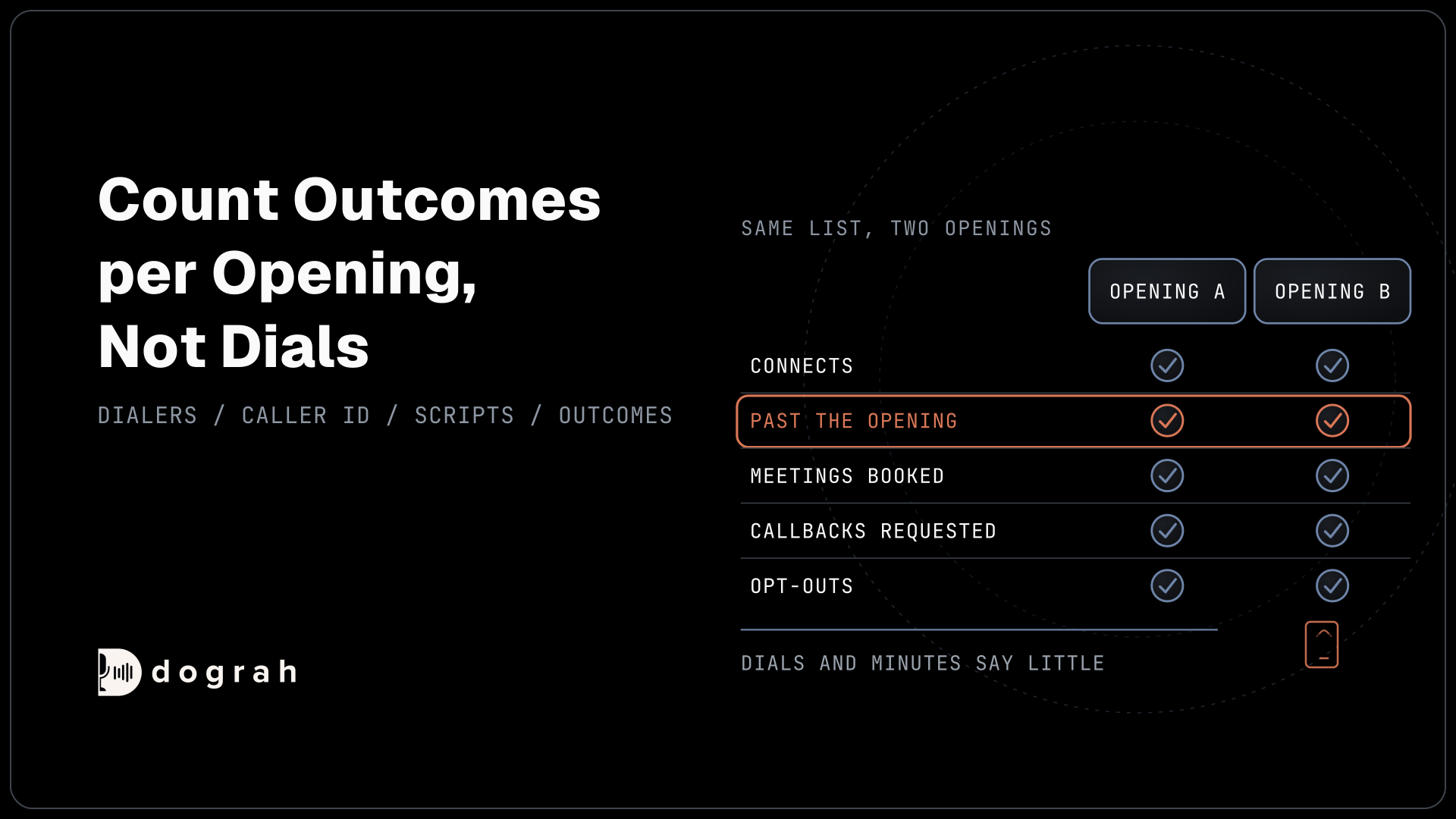
Reminders are where frequency limits bite. Dograh campaigns do not cap calls per contact. You set the retries (0 to 10) and the calling hours, which run in one time zone per campaign, so split a national list by time zone.
The seven-in-seven count lives in your own list, because it runs per debt across every campaign. AI payment reminder calls for collection agencies shows how retries, redials and new campaigns add up against it.
Hosted or self-hosted: who holds the recording
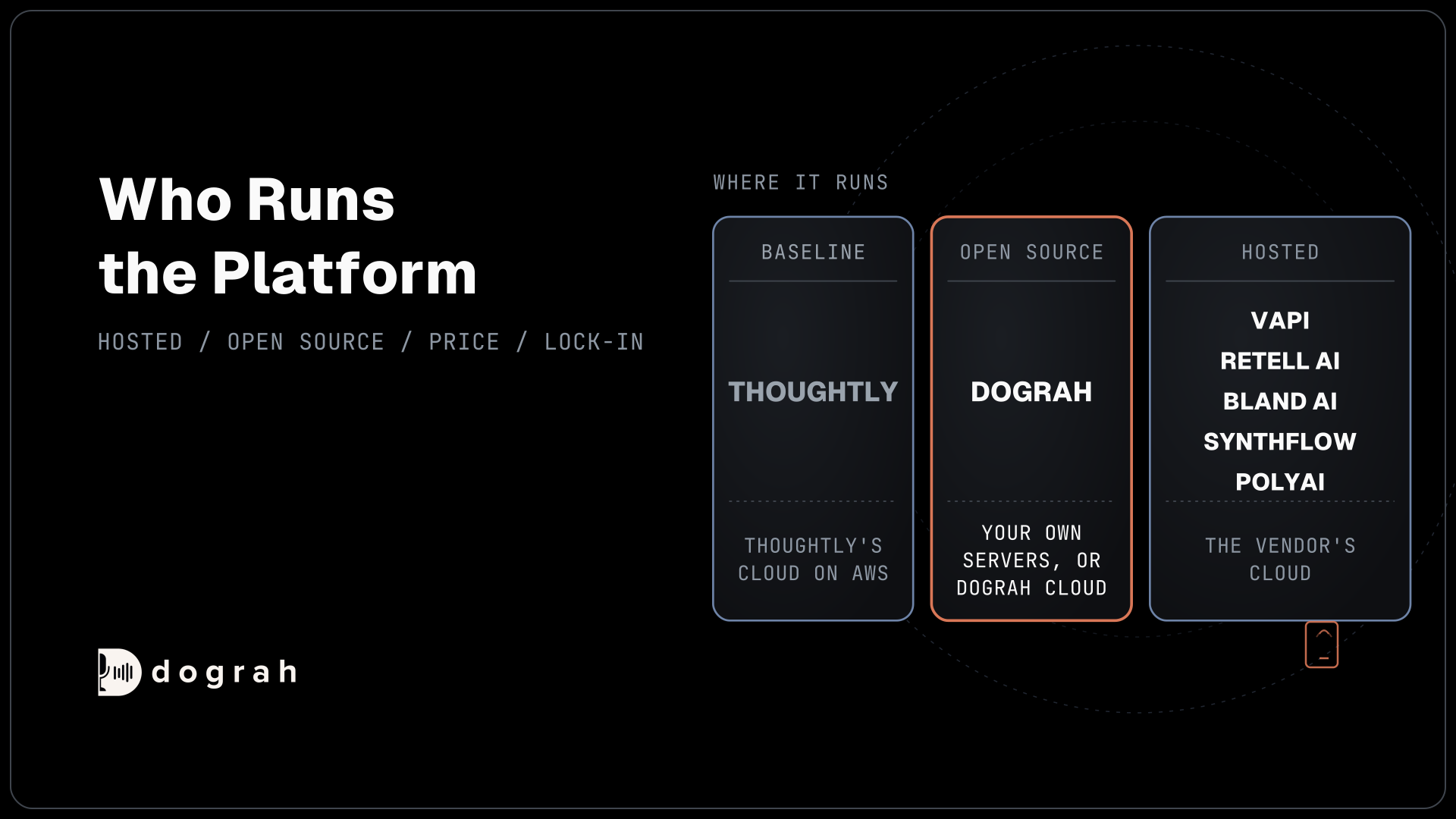
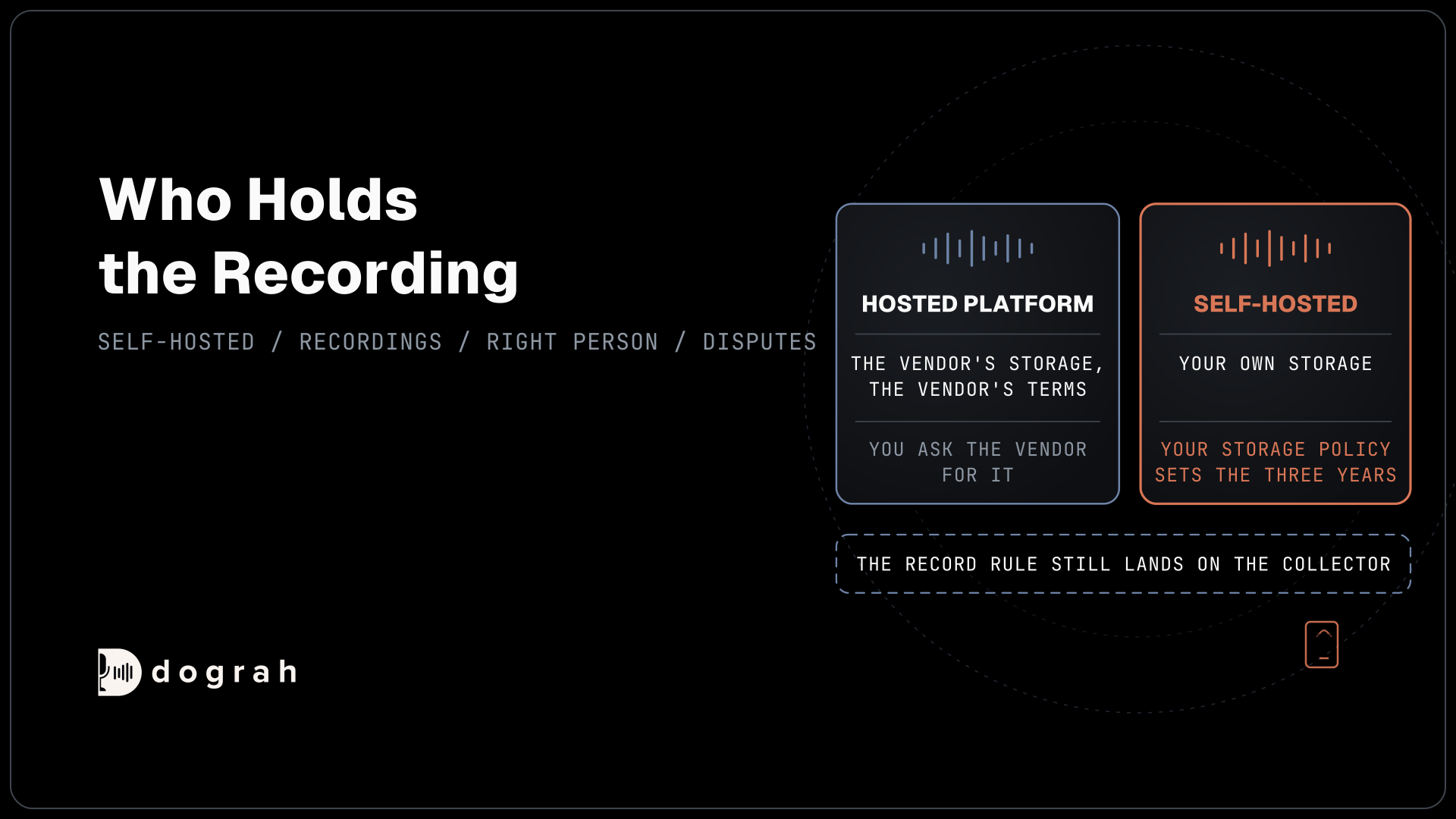
The biggest difference between collection voice platforms is where the recordings and transcripts end up. With a hosted platform, every recording sits in the vendor's storage under the vendor's terms. When a consumer disputes a call two years later, you ask the vendor for it. Regulation F's three-year record rule still lands on the collector, whoever stores the file.
Self-host Dograh and every recording and transcript lands in your own storage, along with the call traces. There is no retention timer and no automatic deletion, so your own storage policy sets the three years.
You also choose the models. Bring your own keys for any LLM, speech-to-text or text-to-speech provider, or run open models on your own servers so no outside model provider hears account details. Pre-recorded clips in a real collector's voice can carry the fixed lines, with text-to-speech filling in the rest.
On Dograh Cloud the same agents run without your own servers, and each client can sit in its own team that you switch between from the sidebar. Self-hosted, give each client its own agent with its own phone setup and caller IDs. Our page on self-hosted voice agents for collection agencies covers the self-hosted route in more detail.
Rules change across borders and languages. Our guide to compliance disclosure calls links the UK, Canada, Spanish and Hindi collection posts.
Start with one list and every call reviewed
Start small and listen. Set QA's Sample Rate (%) to 100 for the first campaign, read every flagged call and fix the prompt before you widen the list. Once flagged calls are rare, lower the rate.
Each part of the checklist above has its own deep dive:
- AI collection calls: a sample call, line by line
- AI voice agents for third-party collections
- AI voice agents for first-party collections
- AI debt payment plan calls
- AI payment reminder calls for collection agencies
Glossary
- Mini-Miranda
- The collector's notice under Regulation F: in the first conversation, that it is trying to collect a debt and will use any information for that purpose, and in later calls, that the call is from a debt collector.
- Seven-in-seven count
- The per-debt call count behind Regulation F's frequency test. A collector that calls about a debt no more than seven times in seven days, and waits seven days after a conversation, is presumed within limits.
- Transition Speech
- Fixed text or a recorded clip played while the call moves to its next step, with the caller muted. The collector notice plays here, after the identity check passes.
- Context Mapping
- A Transfer Call setting that picks the destination number from a value gathered on the call, such as the issue type, so disputes and hardship cases reach different teams.